2002 JEEP LIBERTY gas
[x] Cancel search: gasPage 1717 of 1803
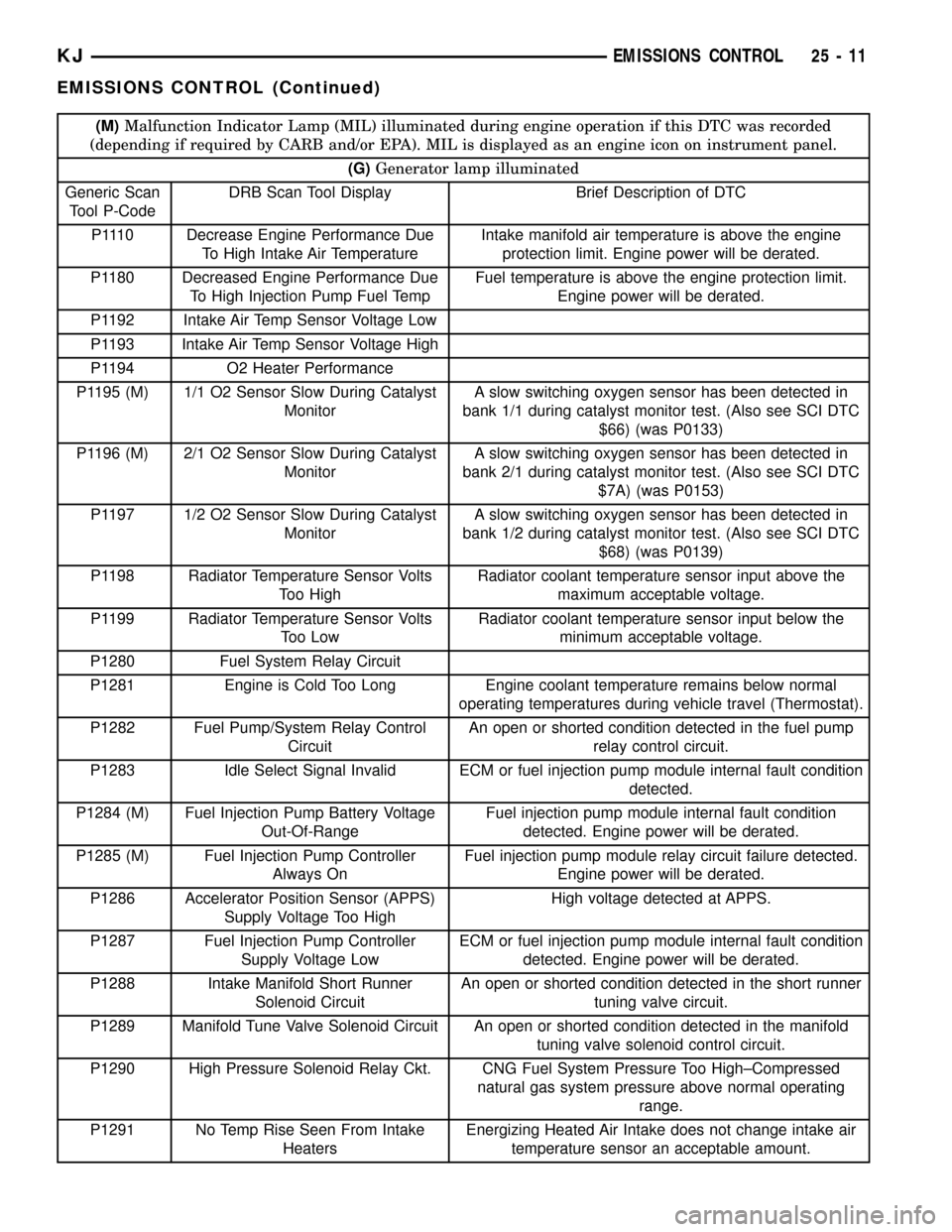
(M)Malfunction Indicator Lamp (MIL) illuminated during engine operation if this DTC was recorded
(depending if required by CARB and/or EPA). MIL is displayed as an engine icon on instrument panel.
(G)Generator lamp illuminated
Generic Scan
Tool P-CodeDRB Scan Tool Display Brief Description of DTC
P1110 Decrease Engine Performance Due
To High Intake Air TemperatureIntake manifold air temperature is above the engine
protection limit. Engine power will be derated.
P1180 Decreased Engine Performance Due
To High Injection Pump Fuel TempFuel temperature is above the engine protection limit.
Engine power will be derated.
P1192 Intake Air Temp Sensor Voltage Low
P1193 Intake Air Temp Sensor Voltage High
P1194 O2 Heater Performance
P1195 (M) 1/1 O2 Sensor Slow During Catalyst
MonitorA slow switching oxygen sensor has been detected in
bank 1/1 during catalyst monitor test. (Also see SCI DTC
$66) (was P0133)
P1196 (M) 2/1 O2 Sensor Slow During Catalyst
MonitorA slow switching oxygen sensor has been detected in
bank 2/1 during catalyst monitor test. (Also see SCI DTC
$7A) (was P0153)
P1197 1/2 O2 Sensor Slow During Catalyst
MonitorA slow switching oxygen sensor has been detected in
bank 1/2 during catalyst monitor test. (Also see SCI DTC
$68) (was P0139)
P1198 Radiator Temperature Sensor Volts
Too HighRadiator coolant temperature sensor input above the
maximum acceptable voltage.
P1199 Radiator Temperature Sensor Volts
Too LowRadiator coolant temperature sensor input below the
minimum acceptable voltage.
P1280 Fuel System Relay Circuit
P1281 Engine is Cold Too Long Engine coolant temperature remains below normal
operating temperatures during vehicle travel (Thermostat).
P1282 Fuel Pump/System Relay Control
CircuitAn open or shorted condition detected in the fuel pump
relay control circuit.
P1283 Idle Select Signal Invalid ECM or fuel injection pump module internal fault condition
detected.
P1284 (M) Fuel Injection Pump Battery Voltage
Out-Of-RangeFuel injection pump module internal fault condition
detected. Engine power will be derated.
P1285 (M) Fuel Injection Pump Controller
Always OnFuel injection pump module relay circuit failure detected.
Engine power will be derated.
P1286 Accelerator Position Sensor (APPS)
Supply Voltage Too HighHigh voltage detected at APPS.
P1287 Fuel Injection Pump Controller
Supply Voltage LowECM or fuel injection pump module internal fault condition
detected. Engine power will be derated.
P1288 Intake Manifold Short Runner
Solenoid CircuitAn open or shorted condition detected in the short runner
tuning valve circuit.
P1289 Manifold Tune Valve Solenoid Circuit An open or shorted condition detected in the manifold
tuning valve solenoid control circuit.
P1290 High Pressure Solenoid Relay Ckt. CNG Fuel System Pressure Too High±Compressed
natural gas system pressure above normal operating
range.
P1291 No Temp Rise Seen From Intake
HeatersEnergizing Heated Air Intake does not change intake air
temperature sensor an acceptable amount.
KJEMISSIONS CONTROL 25 - 11
EMISSIONS CONTROL (Continued)
Page 1718 of 1803
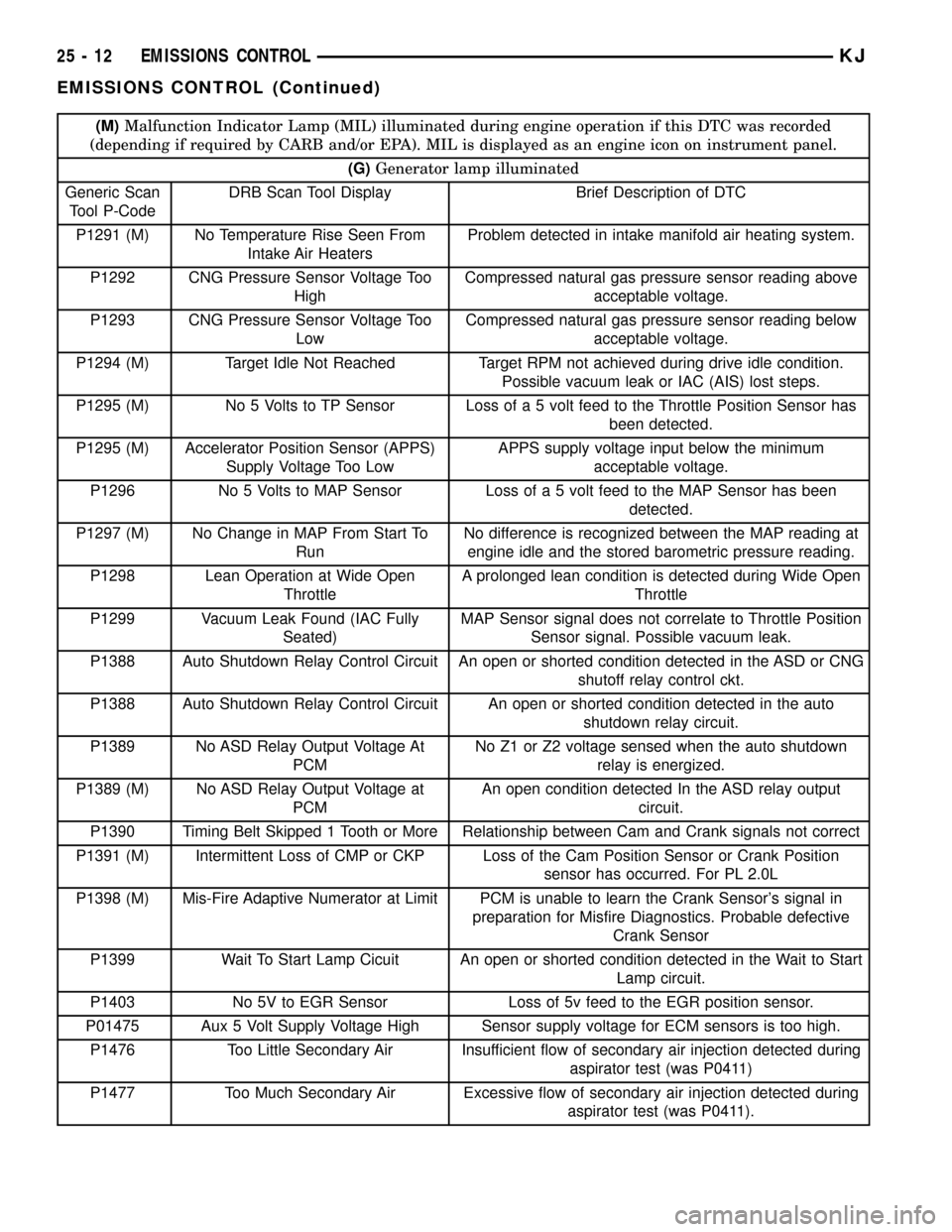
(M)Malfunction Indicator Lamp (MIL) illuminated during engine operation if this DTC was recorded
(depending if required by CARB and/or EPA). MIL is displayed as an engine icon on instrument panel.
(G)Generator lamp illuminated
Generic Scan
Tool P-CodeDRB Scan Tool Display Brief Description of DTC
P1291 (M) No Temperature Rise Seen From
Intake Air HeatersProblem detected in intake manifold air heating system.
P1292 CNG Pressure Sensor Voltage Too
HighCompressed natural gas pressure sensor reading above
acceptable voltage.
P1293 CNG Pressure Sensor Voltage Too
LowCompressed natural gas pressure sensor reading below
acceptable voltage.
P1294 (M) Target Idle Not Reached Target RPM not achieved during drive idle condition.
Possible vacuum leak or IAC (AIS) lost steps.
P1295 (M) No 5 Volts to TP Sensor Loss of a 5 volt feed to the Throttle Position Sensor has
been detected.
P1295 (M) Accelerator Position Sensor (APPS)
Supply Voltage Too LowAPPS supply voltage input below the minimum
acceptable voltage.
P1296 No 5 Volts to MAP Sensor Loss of a 5 volt feed to the MAP Sensor has been
detected.
P1297 (M) No Change in MAP From Start To
RunNo difference is recognized between the MAP reading at
engine idle and the stored barometric pressure reading.
P1298 Lean Operation at Wide Open
ThrottleA prolonged lean condition is detected during Wide Open
Throttle
P1299 Vacuum Leak Found (IAC Fully
Seated)MAP Sensor signal does not correlate to Throttle Position
Sensor signal. Possible vacuum leak.
P1388 Auto Shutdown Relay Control Circuit An open or shorted condition detected in the ASD or CNG
shutoff relay control ckt.
P1388 Auto Shutdown Relay Control Circuit An open or shorted condition detected in the auto
shutdown relay circuit.
P1389 No ASD Relay Output Voltage At
PCMNo Z1 or Z2 voltage sensed when the auto shutdown
relay is energized.
P1389 (M) No ASD Relay Output Voltage at
PCMAn open condition detected In the ASD relay output
circuit.
P1390 Timing Belt Skipped 1 Tooth or More Relationship between Cam and Crank signals not correct
P1391 (M) Intermittent Loss of CMP or CKP Loss of the Cam Position Sensor or Crank Position
sensor has occurred. For PL 2.0L
P1398 (M) Mis-Fire Adaptive Numerator at Limit PCM is unable to learn the Crank Sensor's signal in
preparation for Misfire Diagnostics. Probable defective
Crank Sensor
P1399 Wait To Start Lamp Cicuit An open or shorted condition detected in the Wait to Start
Lamp circuit.
P1403 No 5V to EGR Sensor Loss of 5v feed to the EGR position sensor.
P01475 Aux 5 Volt Supply Voltage High Sensor supply voltage for ECM sensors is too high.
P1476 Too Little Secondary Air Insufficient flow of secondary air injection detected during
aspirator test (was P0411)
P1477 Too Much Secondary Air Excessive flow of secondary air injection detected during
aspirator test (was P0411).
25 - 12 EMISSIONS CONTROLKJ
EMISSIONS CONTROL (Continued)
Page 1723 of 1803

DESCRIPTION - TASK MANAGER
The PCM is responsible for efficiently coordinating
the operation of all the emissions-related compo-
nents. The PCM is also responsible for determining if
the diagnostic systems are operating properly. The
software designed to carry out these responsibilities
is referred to as the 'Task Manager'.
DESCRIPTION - MONITORED SYSTEMS
There are new electronic circuit monitors that
check fuel, emission, engine and ignition perfor-
mance. These monitors use information from various
sensor circuits to indicate the overall operation of the
fuel, engine, ignition and emission systems and thus
the emissions performance of the vehicle.
The fuel, engine, ignition and emission systems
monitors do not indicate a specific component prob-
lem. They do indicate that there is an implied prob-
lem within one of the systems and that a specific
problem must be diagnosed.
If any of these monitors detect a problem affecting
vehicle emissions, the Malfunction Indicator Lamp
(MIL) will be illuminated. These monitors generate
Diagnostic Trouble Codes that can be displayed with
the MIL or a scan tool.
The following is a list of the system monitors:
²Misfire Monitor
²Fuel System Monitor
²Oxygen Sensor Monitor
²Oxygen Sensor Heater Monitor
²Catalyst Monitor
²Leak Detection Pump Monitor (if equipped)
All these system monitors require two consecutive
trips with the malfunction present to set a fault.
Refer to the appropriate Powertrain Diagnos-
tics Procedures manual for diagnostic proce-
dures.
The following is an operation and description of
each system monitor:
OXYGEN SENSOR (O2S) MONITOR
Effective control of exhaust emissions is achieved
by an oxygen feedback system. The most important
element of the feedback system is the O2S. The O2S
is located in the exhaust path. Once it reaches oper-
ating temperature 300É to 350ÉC (572É to 662ÉF), the
sensor generates a voltage that is inversely propor-
tional to the amount of oxygen in the exhaust. The
information obtained by the sensor is used to calcu-
late the fuel injector pulse width. This maintains a
14.7 to 1 Air Fuel (A/F) ratio. At this mixture ratio,
the catalyst works best to remove hydrocarbons (HC),
carbon monoxide (CO) and nitrogen oxide (NOx) from
the exhaust.The O2S is also the main sensing element for the
Catalyst and Fuel Monitors.
The O2S can fail in any or all of the following
manners:
²slow response rate
²reduced output voltage
²dynamic shift
²shorted or open circuits
Response rate is the time required for the sensor to
switch from lean to rich once it is exposed to a richer
than optimum A/F mixture or vice versa. As the sen-
sor starts malfunctioning, it could take longer to
detect the changes in the oxygen content of the
exhaust gas.
The output voltage of the O2S ranges from 0 to 1
volt. A good sensor can easily generate any output
voltage in this range as it is exposed to different con-
centrations of oxygen. To detect a shift in the A/F
mixture (lean or rich), the output voltage has to
change beyond a threshold value. A malfunctioning
sensor could have difficulty changing beyond the
threshold value.
OXYGEN SENSOR HEATER MONITOR
If there is an oxygen sensor (O2S) shorted to volt-
age DTC, as well as a O2S heater DTC, the O2S
fault MUST be repaired first. Before checking the
O2S fault, verify that the heater circuit is operating
correctly.
Effective control of exhaust emissions is achieved
by an oxygen feedback system. The most important
element of the feedback system is the O2S. The O2S
is located in the exhaust path. Once it reaches oper-
ating temperature 300É to 350ÉC (572 É to 662ÉF), the
sensor generates a voltage that is inversely propor-
tional to the amount of oxygen in the exhaust. The
information obtained by the sensor is used to calcu-
late the fuel injector pulse width. This maintains a
14.7 to 1 Air Fuel (A/F) ratio. At this mixture ratio,
the catalyst works best to remove hydrocarbons (HC),
carbon monoxide (CO) and nitrogen oxide (NOx) from
the exhaust.
The voltage readings taken from the O2S sensor
are very temperature sensitive. The readings are not
accurate below 300ÉC. Heating of the O2S sensor is
done to allow the engine controller to shift to closed
loop control as soon as possible. The heating element
used to heat the O2S sensor must be tested to ensure
that it is heating the sensor properly.
The O2S sensor circuit is monitored for a drop in
voltage. The sensor output is used to test the heater
by isolating the effect of the heater element on the
O2S sensor output voltage from the other effects.
KJEMISSIONS CONTROL 25 - 17
EMISSIONS CONTROL (Continued)
Page 1725 of 1803

Normal vehicle miles or engine misfire can cause a
catalyst to decay. This can increase vehicle emissions
and deteriorate engine performance, driveability and
fuel economy.
The catalyst monitor uses dual oxygen sensors
(O2S's) to monitor the efficiency of the converter. The
dual O2S's sensor strategy is based on the fact that
as a catalyst deteriorates, its oxygen storage capacity
and its efficiency are both reduced. By monitoring
the oxygen storage capacity of a catalyst, its effi-
ciency can be indirectly calculated. The upstream
O2S is used to detect the amount of oxygen in the
exhaust gas before the gas enters the catalytic con-
verter. The PCM calculates the A/F mixture from the
output of the O2S. A low voltage indicates high oxy-
gen content (lean mixture). A high voltage indicates a
low content of oxygen (rich mixture).
When the upstream O2S detects a lean condition,
there is an abundance of oxygen in the exhaust gas.
A functioning converter would store this oxygen so it
can use it for the oxidation of HC and CO. As the
converter absorbs the oxygen, there will be a lack of
oxygen downstream of the converter. The output of
the downstream O2S will indicate limited activity in
this condition.
As the converter loses the ability to store oxygen,
the condition can be detected from the behavior of
the downstream O2S. When the efficiency drops, no
chemical reaction takes place. This means the con-
centration of oxygen will be the same downstream as
upstream. The output voltage of the downstream
O2S copies the voltage of the upstream sensor. The
only difference is a time lag (seen by the PCM)
between the switching of the O2S's.
To monitor the system, the number of lean-to-rich
switches of upstream and downstream O2S's is
counted. The ratio of downstream switches to
upstream switches is used to determine whether the
catalyst is operating properly. An effective catalyst
will have fewer downstream switches than it has
upstream switches i.e., a ratio closer to zero. For a
totally ineffective catalyst, this ratio will be one-to-
one, indicating that no oxidation occurs in the device.
The system must be monitored so that when cata-
lyst efficiency deteriorates and exhaust emissions
increase to over the legal limit, the MIL will be illu-
minated.
DESCRIPTION - TRIP DEFINITION
The term ªTripº has different meanings depending
on what the circumstances are. If the MIL (Malfunc-
tion Indicator Lamp) is OFF, a Trip is defined as
when the Oxygen Sensor Monitor and the Catalyst
Monitor have been completed in the same drive cycle.
When any Emission DTC is set, the MIL on the
dash is turned ON. When the MIL is ON, it takes 3good trips to turn the MIL OFF. In this case, it
depends on what type of DTC is set to know what a
ªTripº is.
For the Fuel Monitor or Mis-Fire Monitor (contin-
uous monitor), the vehicle must be operated in the
ªSimilar Condition Windowº for a specified amount of
time to be considered a Good Trip.
If a Non-Contiuous OBDII Monitor fails twice in a
row and turns ON the MIL, re-running that monitor
which previously failed, on the next start-up and
passing the monitor, is considered to be a Good Trip.
These will include the following:
²Oxygen Sensor
²Catalyst Monitor
²Purge Flow Monitor
²Leak Detection Pump Monitor (if equipped)
²EGR Monitor (if equipped)
²Oxygen Sensor Heater Monitor
If any other Emission DTC is set (not an OBDII
Monitor), a Good Trip is considered to be when the
Oxygen Sensor Monitor and Catalyst Monitor have
been completed; or 2 Minutes of engine run time if
the Oxygen Sensor Monitor or Catalyst Monitor have
been stopped from running.
It can take up to 2 Failures in a row to turn on the
MIL. After the MIL is ON, it takes 3 Good Trips to
turn the MIL OFF. After the MIL is OFF, the PCM
will self-erase the DTC after 40 Warm-up cycles. A
Warm-up cycle is counted when the ECT (Engine
Coolant Temperature Sensor) has crossed 160ÉF and
has risen by at least 40ÉF since the engine has been
started.
DESCRIPTION - COMPONENT MONITORS
There are several components that will affect vehi-
cle emissions if they malfunction. If one of these com-
ponents malfunctions the Malfunction Indicator
Lamp (MIL) will illuminate.
Some of the component monitors are checking for
proper operation of the part. Electrically operated
components now have input (rationality) and output
(functionality) checks. Previously, a component like
the Throttle Position sensor (TPS) was checked by
the PCM for an open or shorted circuit. If one of
these conditions occurred, a DTC was set. Now there
is a check to ensure that the component is working.
This is done by watching for a TPS indication of a
greater or lesser throttle opening than MAP and
engine rpm indicate. In the case of the TPS, if engine
vacuum is high and engine rpm is 1600 or greater
and the TPS indicates a large throttle opening, a
DTC will be set. The same applies to low vacuum if
the TPS indicates a small throttle opening.
All open/short circuit checks or any component that
has an associated limp in will set a fault after 1 trip
with the malfunction present. Components without
KJEMISSIONS CONTROL 25 - 19
EMISSIONS CONTROL (Continued)
Page 1730 of 1803

EVAPORATIVE EMISSIONS
TABLE OF CONTENTS
page page
EVAPORATIVE EMISSIONS
DESCRIPTION - EVAPORATION CONTROL
SYSTEM............................24
SPECIFICATIONS
TORQUE............................26
EVAP/PURGE SOLENOID
DESCRIPTION.........................27
OPERATION...........................27
REMOVAL.............................27
INSTALLATION.........................27
FUEL FILLER CAP
DESCRIPTION.........................27
OPERATION...........................27
LEAK DETECTION PUMP
DESCRIPTION.........................27
OPERATION...........................28
REMOVAL.............................28INSTALLATION.........................28
ORVR
DESCRIPTION.........................29
OPERATION...........................29
P C V VA LV E
DESCRIPTION.........................29
OPERATION...........................31
DIAGNOSIS AND TESTING - PCV VALVE.....31
REMOVAL.............................32
INSTALLATION.........................32
VACUUM LINES
DESCRIPTION.........................33
VAPOR CANISTER
DESCRIPTION.........................33
OPERATION...........................33
REMOVAL.............................33
INSTALLATION.........................33
EVAPORATIVE EMISSIONS
DESCRIPTION - EVAPORATION CONTROL
SYSTEM
The evaporation control system prevents the emis-
sion of fuel tank vapors into the atmosphere. When
fuel evaporates in the fuel tank, the vapors pass
through the control valve located in the top section of
the fuel pump module, through the fuel management
valve, and through vent hoses and tubes to a char-
coal filled evaporative canister. The canister tempo-
rarily holds the vapors. The Powertrain Control
Module (PCM) allows intake manifold vacuum to
draw vapors into the combustion chambers during
certain operating conditions.
Gas powered engines use a duty cycle purge sys-
tem. The PCM controls vapor flow by operating theduty cycle EVAP purge solenoid. Refer to Duty Cycle
EVAP Canister Purge Solenoid.
When equipped with certain emissions packages, a
Leak Detection Pump (LDP) will be used as part of
the evaporative system for OBD II requirements.
Also refer to Leak Detection Pump.
Vehicles powered with gasoline engines are also
equipped with ORVR (On-Board Refueling Vapor
Recovery). Refer to ORVR for additional information.
NOTE: The evaporative system uses specially man-
ufactured lines/hoses. If replacement becomes nec-
essary, only use fuel resistant, low permeation
hose.
Certain components can be found in (Fig. 1).
25 - 24 EVAPORATIVE EMISSIONSKJ
Page 1737 of 1803

OPERATION
The PCV system operates by engine intake mani-
fold vacuum. Filtered air is routed into the crankcase
through the air cleaner hose and crankcase breath-
er(s) (if used). The metered air, along with crankcase
vapors, are drawn through the PCV valve and into a
passage in the intake manifold. The PCV system
manages crankcase pressure and meters blow-by
gases to the intake system, reducing engine sludge
formation.
The PCV valve contains a spring loaded plunger.
This plunger meters the amount of crankcase vapors
routed into the combustion chamber based on intake
manifold vacuum.
TYPICALPCV valves are shown in (Fig. 9), (Fig.
10) and (Fig. 11).
When the engine is not operating, or during an
engine pop-back, the spring forces the plunger back
against the seat (Fig. 9). This will prevent vapors
from flowing through the valve.
During periods of high manifold vacuum, such as
idle or cruising speeds, vacuum is sufficient to com-
pletely compress spring. It will then pull the plunger
to the top of the valve (Fig. 10). In this position there
is minimal vapor flow through the valve.
During periods of moderate manifold vacuum, the
plunger is only pulled part way back from inlet. This
results in maximum vapor flow through the valve
(Fig. 11).
DIAGNOSIS AND TESTING - PCV VALVE
3.7L
(1) Disconnect PCV line/hose (Fig. 7) by discon-
necting rubber connecting hose at PCV valve fitting.
(2) Remove PCV valve at oil filler tube by rotating
PCV valve downward until locating tabs have been
freed at cam lock (Fig. 7). After tabs have cleared,
pull valve straight out from filler tube.To prevent
damage to PCV valve locating tabs, valve must
be pointed downward for removal. Do not force
valve from oil filler tube.
(3) After valve is removed, check condition of valve
o-ring (Fig. 7). Also, PCV valve should rattle when
shaken.
(4) Reconnect PCV valve to its connecting line/
hose.
(5) Start engine and bring to idle speed.
(6) If valve is not plugged, a hissing noise will be
heard as air passes through valve. Also, a strong vac-
uum should be felt with a finger placed at valve
inlet.
(7) If vacuum is not felt at valve inlet, check line/
hose for kinks or for obstruction. If necessary, clean
out intake manifold fitting at rear of manifold. Do
this by turning a 1/4 inch drill (by hand) through the
fitting to dislodge any solid particles. Blow out the
fitting with shop air. If necessary, use a smaller drill
to avoid removing any metal from the fitting.
(8)Do not attempt to clean the old PCV valve.
(9) Return PCV valve back to oil filler tube by
placing valve locating tabs (Fig. 7) into cam lock.
Press PCV valve in and rotate valve upward. A slight
click will be felt when tabs have engaged cam lock.
Valve should be pointed towards rear of vehicle.
(10) Connect PCV line/hose and connecting rubber
hose to PCV valve.
(11) Disconnect rubber hose from fresh air fitting
at air cleaner resonator box. Start engine and bring
to idle speed. Hold a piece of stiff paper (such as a
parts tag) loosely over the opening of the discon-
nected rubber hose.
(12) The paper should be drawn against the hose
opening with noticeable force. This will be after
allowing approximately one minute for crankcase
pressure to reduce.
Fig. 9 Engine Off or Engine Pop-BackÐNo Vapor
Flow
Fig. 10 High Intake Manifold VacuumÐMinimal
Vapor Flow
Fig. 11 Moderate Intake Manifold VacuumÐ
Maximum Vapor Flow
KJEVAPORATIVE EMISSIONS 25 - 31
PCV VALVE (Continued)
Page 1739 of 1803

VACUUM LINES
DESCRIPTION
A vacuum schematic for emission related items can
be found on the VECI label. Refer to Vehicle Emis-
sion Control Information (VECI) Label for label loca-
tion.
VAPOR CANISTER
DESCRIPTION
A maintenance free, EVAP canister is used on all
gasoline powered models. The EVAP canister is
located near the left/front corner of the fuel tank.
OPERATION
The EVAP canister is filled with granules of an
activated carbon mixture. Fuel vapors entering the
EVAP canister are absorbed by the charcoal granules.
The canister serves two functions: as a temporary
fuel vapor storage point while refueling the vehicle
for the ORVR system, as a temporary vapor storage
point while the engine is running.
Fuel tank pressure vents into the EVAP canister.
Fuel vapors are temporarily held in the canister until
they can be drawn into the intake manifold. The duty
cycle EVAP canister purge solenoid allows the EVAP
canister to be purged at predetermined times and at
certain engine operating conditions.
Refer to ORVR for additional information.
REMOVAL
The EVAP canister is located near front of fuel
tank and next to left/rear spring. (Fig. 13).
(1) Raise vehicle.
(2) Disconnect vacuum hoses/lines at EVAP canis-
ter. Note location of lines before removal.
(3) Remove EVAP canister and mounting bracket
assembly from body (2 bolts).
(4) Remove canister-to-mounting bracket bolt.
(5) Slide 2 canister mounting pins from mounting
bracket (Fig. 14).
INSTALLATION
(1) Slide 2 canister mounting pins into mounting
bracket (Fig. 14).
(2) Install canister-to-mounting bracket bolt.
(3) Position canister and bracket assembly to body.
(4) Install 2 mounting bracket bolts. Tighten to 47
N´m (35 ft. lbs.) torque.
(5) Connect vacuum hoses/lines at EVAP canister.
(6) Lower vehicle.
Fig. 13 EVAP CANISTER LOCATION
1 - LEFT/REAR SPRING
2 - EVAP CANISTER
3 - MOUNTING BRACKET
4 - BRACKET BOLTS
5 - VACUUM LINES
Fig. 14 EVAP CANISTER MOUNTING PINS
1 - MOUNTING PINS
2 - MOUNTING BRACKET
3 - EVAP CANISTER
KJEVAPORATIVE EMISSIONS 25 - 33
Page 1746 of 1803

COVER - REMOVAL, COWL TRIM.......23-157
COVER - REMOVAL, INSTRUMENT
PANEL TOP........................23-152
COVER - REMOVAL, STRUCTURAL........9-55
COVER(S) - DESCRIPTION, CYLINDER
HEAD...............................9-25
COVER(S) - INSTALLATION, CYLINDER
HEAD...........................9-26,9-34
COVER(S) - INSTALLATION, TIMING
BELT / CHAIN........................9-76
COVER(S) - REMOVAL, CYLINDER HEAD . . 9-25,
9-34
COVER(S) - REMOVAL, TIMING BELT /
CHAIN..............................9-74
COWL GRILLE - INSTALLATION........23-140
COWL GRILLE - REMOVAL............23-140
COWL TRIM COVER - INSTALLATION....23-157
COWL TRIM COVER - REMOVAL.......23-157
COWL WEATHERSTRIP - INSTALLATION . 23-185
COWL WEATHERSTRIP - REMOVAL.....23-185
COWL/PLENUM SEAL - INSTALLATION . . . 23-187
COWL/PLENUM SEAL - REMOVAL......23-187
COWL/PLENUM WINDOW BAFFLE SEAL -
INSTALLATION......................23-187
COWL/PLENUM WINDOW BAFFLE SEAL -
REMOVAL.........................23-187
CRADLE CROSSMEMBER -
INSTALLATION, ENGINE................13-6
CRADLE CROSSMEMBER - REMOVAL,
ENGINE.............................13-6
CRANKSHAFT - DESCRIPTION...........9-42
CRANKSHAFT - INSPECTION.............9-43
CRANKSHAFT - INSTALLATION...........9-43
CRANKSHAFT - REMOVAL..............9-43
CRANKSHAFT OIL SEAL - FRONT -
INSTALLATION........................9-47
CRANKSHAFT OIL SEAL - FRONT -
REMOVAL...........................9-46
CRANKSHAFT OIL SEAL - REAR -
INSTALLATION........................9-48
CRANKSHAFT OIL SEAL - REAR -
REMOVAL...........................9-48
CRANKSHAFT POSITION SENSOR -
DESCRIPTION.......................14-30
CRANKSHAFT POSITION SENSOR -
INSTALLATION.......................14-32
CRANKSHAFT POSITION SENSOR -
OPERATION.........................14-31
CRANKSHAFT POSITION SENSOR -
REMOVAL..........................14-31
CROSSMEMBER - INSTALLATION,
ENGINE CRADLE......................13-6
CROSSMEMBER - INSTALLATION,
RADIATOR.........................23-146
CROSSMEMBER - INSTALLATION, REAR . . . 13-7
CROSSMEMBER - REMOVAL, ENGINE
CRADLE.............................13-6
CROSSMEMBER - REMOVAL, RADIATOR . 23-146
CROSSMEMBER - REMOVAL, REAR.......13-7
CROSS-OVER PIPE - INSTALLATION.......11-3
CROSS-OVER PIPE - REMOVAL..........11-3
CRUISE INDICATOR - DESCRIPTION......8J-16
CRUISE INDICATOR - OPERATION.......8J-17
CURTAIN AIRBAG - DESCRIPTION, SIDE . . 8O-38
CURTAIN AIRBAG - INSTALLATION, SIDE . . 8O-41
CURTAIN AIRBAG - OPERATION, SIDE....8O-39
CURTAIN AIRBAG - REMOVAL, SIDE.....8O-40
CUSHION - FRONT - INSTALLATION,
SEAT .............................23-167
CUSHION - FRONT - INSTALLATION,
SEAT BACK........................23-167
CUSHION - FRONT - REMOVAL, SEAT . . . 23-167
CUSHION - FRONT - REMOVAL, SEAT
BACK.............................23-167
CUSHION - REAR - INSTALLATION, SEAT . 23-171
CUSHION - REAR - INSTALLATION, SEAT
BACK.............................23-170
CUSHION - REAR - REMOVAL, SEAT....23-171
CUSHION - REAR - REMOVAL, SEAT
BACK
.............................23-170
CUSHION COVER - FRONT -
INSTALLATION, SEAT
.................23-167
CUSHION COVER - FRONT - REMOVAL,
SEAT
.............................23-167
CUSHION SIDE SHIELDS -
INSTALLATION, SEAT
.................23-167
CUSHION SIDE SHIELDS - REMOVAL,
SEAT
.............................23-167CUSTOMER PREFERENCES - STANDARD
PROCEDURE, RKE TRANSMITTER........8N-8
CV JOINT/BOOT-INNER - INSTALLATION . . . 3-17
CV JOINT/BOOT-INNER - REMOVAL.......3-15
CV JOINT/BOOT-OUTER - INSTALLATION . . . 3-13
CV JOINT/BOOT-OUTER - REMOVAL.......3-12
CYLINDER - DESCRIPTION, MASTER......5-24
CYLINDER - INSPECTION, MASTER........6-9
CYLINDER - INSTALLATION, FLIP-UP
GLASS SUPPORT...................23-139
CYLINDER - INSTALLATION, LOCK......23-125,
23-138
CYLINDER - INSTALLATION, LOCK.......19-11
CYLINDER - INSTALLATION, MASTER.....5-25
CYLINDER - INSTALLATION, SUPPORT . . . 23-120
CYLINDER - OPERATION, MASTER........5-24
CYLINDER - REMOVAL, FLIP-UP GLASS
SUPPORT.........................23-139
CYLINDER - REMOVAL, LOCK....23-125,23-137
CYLINDER - REMOVAL, LOCK...........19-10
CYLINDER - REMOVAL, MASTER.........5-25
CYLINDER - REMOVAL, SUPPORT......23-120
CYLINDER BLEEDING - STANDARD
PROCEDURE, MASTER.................5-24
CYLINDER BORE HONING - STANDARD
PROCEDURE.........................9-39
CYLINDER COMBUSTION PRESSURE
LEAKAGE - DIAGNOSIS AND TESTING......9-8
CYLINDER COMPRESSION PRESSURE -
DIAGNOSIS AND TESTING...............9-8
CYLINDER FLUID LEVEL - STANDARD
PROCEDURES, MASTER................5-26
CYLINDER HEAD - DESCRIPTION.........9-30
CYLINDER HEAD COVER(S) -
DESCRIPTION........................9-25
CYLINDER HEAD COVER(S) -
INSTALLATION....................9-26,9-34
CYLINDER HEAD COVER(S) - REMOVAL . . . 9-25,
9-34
CYLINDER HEAD GASKET - DIAGNOSIS
AND TESTING....................9-19,9-30
CYLINDER LOCK SWITCH -
DESCRIPTION, DOOR..................8Q-9
CYLINDER LOCK SWITCH -
DESCRIPTION, TAILGATE...............8N-9
CYLINDER LOCK SWITCH - DIAGNOSIS
AND TESTING, DOOR.................8Q-10
CYLINDER LOCK SWITCH - DIAGNOSIS
AND TESTING, TAILGATE...............8N-9
CYLINDER LOCK SWITCH -
INSTALLATION, DOOR.................8Q-10
CYLINDER LOCK SWITCH -
INSTALLATION, TAILGATE..............8N-10
CYLINDER LOCK SWITCH - OPERATION,
DOOR.............................8Q-10
CYLINDER LOCK SWITCH - OPERATION,
TAILGATE...........................8N-9
CYLINDER LOCK SWITCH - REMOVAL,
DOOR.............................8Q-10
CYLINDER LOCK SWITCH - REMOVAL,
TAILGATE..........................8N-10
CYLINDER/POWER BOOSTER -
DIAGNOSIS AND TESTING, MASTER . . 5-21,5-24
CYLINDERS - ASSEMBLY, WHEEL.........5-29
CYLINDERS - CLEANING, WHEEL.........5-28
CYLINDERS - DISASSEMBLY, WHEEL......5-28
CYLINDERS - INSPECTION, WHEEL.......5-29
CYLINDERS - INSTALLATION, WHEEL
.....5-29
CYLINDERS - REMOVAL, WHEEL
.........5-28
DAMAGED OR WORN THREADS -
STANDARD PROCEDURE, REPAIR
.........9-9
DAMPER - INSTALLATION, VIBRATION
.....9-55
DAMPER - REMOVAL, VIBRATION
........9-54
DATA LINK CONNECTOR - DESCRIPTION
. . 8E-10
DATA LINK CONNECTOR - OPERATION
....8E-10
DAYTIME RUNNING LAMP RELAY -
DESCRIPTION
.......................8L-20
DAYTIME RUNNING LAMP RELAY -
INSTALLATION
.......................8L-21
DAYTIME RUNNING LAMP RELAY -
OPERATION
.........................8L-20
DAYTIME RUNNING LAMP RELAY -
REMOVAL
..........................8L-21
DECOUPLER - DIAGNOSIS AND
TESTING, GENERATOR
................8F-27
DECOUPLER PULLEY - DESCRIPTION,
GENERATOR
........................8F-26DECOUPLER PULLEY - INSTALLATION,
GENERATOR........................8F-30
DECOUPLER PULLEY - OPERATION,
GENERATOR........................8F-27
DECOUPLER PULLEY - REMOVAL,
GENERATOR........................8F-27
DEFINITION - DESCRIPTION, TRIP.......25-19
DEFLECTOR - INSTALLATION, WIND.....23-180
DEFLECTOR - REMOVAL, WIND........23-180
DEFOGGER - DESCRIPTION, REAR
WINDOW............................8G-3
DEFOGGER - OPERATION, REAR
WINDOW............................8G-3
DEFOGGER FUNCTION - DIAGNOSIS AND
TESTING, REAR HVAC CONTROL
ASSEMBLY WINDOW..................8G-9
DEFOGGER GRID - DESCRIPTION, REAR
WINDOW............................8G-5
DEFOGGER GRID - DIAGNOSIS AND
TESTING, REAR WINDOW..............8G-5
DEFOGGER GRID - OPERATION, REAR
WINDOW............................8G-5
DEFOGGER RELAY - DESCRIPTION,
REAR WINDOW.......................8G-6
DEFOGGER RELAY - DIAGNOSIS AND
TESTING, REAR WINDOW..............8G-6
DEFOGGER RELAY - INSTALLATION,
REAR WINDOW.......................8G-7
DEFOGGER RELAY - OPERATION, REAR
WINDOW............................8G-6
DEFOGGER RELAY - REMOVAL, REAR
WINDOW............................8G-7
DEFOGGER SWITCH - DESCRIPTION,
REAR WINDOW.......................8G-8
DEFOGGER SWITCH - DIAGNOSIS AND
TESTING, REAR WINDOW..............8G-8
DEFOGGER SWITCH - OPERATION, REAR
WINDOW............................8G-8
DEFOGGER SYSTEM - DIAGNOSIS AND
TESTING, REAR WINDOW..............8G-4
DEFROST DOO - INSTALLATION, FLOOR . . 24-37
DEFROST DOOR - REMOVAL...........24-35
DEFROST DOOR - REMOVAL, FLOOR.....24-36
DEFROST DOOR ACTUATOR -
INSTALLATION, FLOOR................24-25
DEFROST DOOR ACTUATOR - REMOVAL,
FLOOR.............................24-24
DEFROST DUCT/DEMISTER ADAPTOR -
REMOVAL..........................24-32
DEFROST/DEMISTER DUCT -
INSTALLATION.......................24-32
DELIVERY - DESCRIPTION, FUEL.........14-2
DELIVERY - OPERATION, FUEL...........14-3
DEMAGNETIZING - STANDARD
PROCEDURE, COMPASS...............8M-2
DEMISTER OUTLETS - DESCRIPTION.....24-29
DEPLOYMENT - STANDARD
PROCEDURE, SERVICE AFTER A
SUPPLEMENTAL RESTRAINT............8O-6
DETECTION PUMP - DESCRIPTION, LEAK . 25-27
DETECTION PUMP - INSTALLATION,
LEAK..............................25-28
DETECTION PUMP - OPERATION, LEAK . . . 25-28
DETECTION PUMP - REMOVAL, LEAK....25-28
DEVICES - STANDARD PROCEDURE,
ELECTROSTATIC DISCHARGE (ESD)
SENSITIVE........................8W-01-8
DIAGNOSIS CHART - DIAGNOSIS AND
TESTING, COOLING SYSTEM.............7-6
DIAGNOSIS, DIAGNOSIS AND TESTING -
WATER DRAINAGE AND WIND NOISE . . . 23-176
DIAGNOSTIC PROCEDURES, DIAGNOSIS
AND TESTING......................23-176
DIAGNOSTIC TROUBLE CODES -
DESCRIPTION........................25-2
DIAGNOSTICS (OBD) - DIAGNOSIS AND
TESTING, ON-BOARD...................7-3
DIAGRAMS - DESCRIPTION, HOW TO
USE WIRING......................8W-01-1
DIAGRAMS - HYDRAULIC SCHEMATICS,
SCHEMATICS.......................21-100
DIESEL - TORQUE, EXCEPT.............8F-23
DIFFERENTIAL - ASSEMBLY
........3-105,3-41
DIFFERENTIAL - DISASSEMBLY
.....3-105,3-41
DIFFERENTIAL - INSTALLATION
. 3-105,3-42,3-73
DIFFERENTIAL - REMOVAL
.....3-104,3-40,3-71
DIFFERENTIAL - TRAC-LOK - ASSEMBLY
. . 3-109,
3-77
KJINDEX 7
Description Group-Page Description Group-Page Description Group-Page