2002 JEEP LIBERTY roof rack
[x] Cancel search: roof rackPage 669 of 1803

WARNING: USE EXTREME CARE TO PREVENT ANY
FOREIGN MATERIAL FROM ENTERING THE SIDE
CURTAIN AIRBAG, OR BECOMING ENTRAPPED
BETWEEN THE SIDE CURTAIN AIRBAG CUSHION
AND THE HEADLINER. FAILURE TO OBSERVE THIS
WARNING COULD RESULT IN OCCUPANT INJURIES
UPON AIRBAG DEPLOYMENT.
(1) Position the side curtain airbag into the vehicle
as a unit.
(2) Align all four plastic push-in fasteners that
secure the extruded plastic side curtain airbag chan-
nel with their holes in the roof side rail and push
them straight into the roof rail until they are fully
seated (Fig. 40) and (Fig. 41).
(3) Install and tighten the upper screw that
secures the side curtain airbag inflator bracket to the
U-nut in the roof rail, followed by the lower screw
(Fig. 42). Tighten the screws to 12 N´m (105 in. lbs.).
(4) Working from the rear of the vehicle to the
front, install and tighten each of the three screws
that secure the side curtain airbag manifold tube
brackets to the U-nuts in the roof rail. Tighten the
screws to 12 N´m (105 in. lbs.).(5) Route the side curtain airbag pigtail wire
through the trough along the top of the extruded
plastic airbag channel on the roof side rail, then
between the channel and the body down the B-pillar.
NOTE: Be certain that the side curtain airbag pigtail
wire is routed behind the airbag channel, between
the channel and the body above the B-pillar.
(6) Engage the three side curtain airbag pigtail
wire retainer clips into the B-pillar (Fig. 39).
(7) Reconnect the side curtain airbag pigtail wire
connector to the body wire harness connector near
the base of the B-pillar.
(8) Engage the two side curtain airbag tether plas-
tic retainer clips into the A-pillar (Fig. 38).
(9) Install and tighten the screw that secures the
side curtain airbag tether retainer to the base of the
A-pillar near the belt line. Tighten the screw to 14
N´m (120 in. lbs.).
Fig. 41 Side Curtain Airbag (Rear) Remove/Install
1 - ROOF PANEL
2 - SCREW (3)
3 - U-NUT (5)
4 - PIGTAIL WIRE
5 - MANIFOLD
6 - C-PILLAR
7 - PUSH-IN FASTENER (4)
8 - CHANNEL
Fig. 42 Side Curtain Airbag Inflator Remove/Install
1 - U-NUT (5)
2 - ROOF PANEL
3 - INFLATOR
4 - C-PILLAR
5 - SCREW (2)
6 - MANIFOLD
7 - PIGTAIL WIRE
8 - BRACKET
8O - 42 RESTRAINTSKJ
SIDE CURTAIN AIRBAG (Continued)
Page 695 of 1803

INSTALLATION
The hood ajar switch striker is not intended for
reuse. If the striker is removed from the hood inner
reinforcement for any reason, it must be replaced
with a new unit.
(1) Position the new hood ajar switch striker to the
inner hood panel reinforcement (Fig. 8).
(2) Insert the integral mounting tab on the front of
the hood ajar switch striker into the forward mount-
ing hole in the inner hood panel reinforcement.
(3) Align the integral retainer on the rear of the
hood ajar switch striker with the rearward mounting
hole in the inner hood panel reinforcement.
(4) Using hand pressure, firmly press the hood
ajar switch striker rearward and upward against the
inner hood panel reinforcement until the hood ajar
switch striker retainer is fully engaged in the rear-
ward mounting hole in the inner hood panel rein-
forcement.
(5) Close and latch the hood.
INTRUSION TRANSCEIVER
MODULE
DESCRIPTION
An Intrusion Transceiver Module (ITM) is part of
the Rest-Of-World (ROW) premium version of the
Vehicle Theft Alarm (VTA) in the Vehicle Theft Secu-
rity System (VTSS) (Fig. 9). The ROW premium ver-
sion of the VTA is only available in vehicles built for
certain markets, where the additional features
offered by this system are required. The ITM is
located in the passenger compartment, on the lower
surface of the headliner near the center of the vehi-cle. This unit is designed to provide interior motion
detection, and serve as an interface between the
Body Control Module (BCM) and the alarm siren
module.
The ITM is concealed beneath a dedicated molded
plastic trim cover that approximates the size and
shape of a typical dome lamp housing. However,
rather than a lens, the ITM features three sets of
louvered openings in a molded lateral center rib for-
mation. One set of louvered openings is located at
each outboard end of the center rib, while the third
set is centered. Each of the louvered openings is cov-
ered on the inside by a single molded black plastic
sight shield that extends the length of the center rib
for appearance. The module is secured to a molded
plastic mounting bracket above the headliner by four
latch features that are integral to the underside of
the module housing. Besides the ITM, the trim cover
also conceals two plastic pins integral to the mount-
ing bracket that are used to secure the bracket to the
headliner with two stamped nuts that are installed
from below. An adhesive-backed foam pad is installed
above the ITM bracket between the headliner and
the roof panel to provide additional headliner stabili-
zation and support for the ITM mounting. Two small
notch-like service holes on the rear edge of the trim
cover afford access to the two integral rear latches of
the ITM for service removal (Fig. 10).
The ITM circuitry is contained within a black
molded plastic housing with four integral mounting
tabs that are secured to the back of the trim cover
with four screws. Concealed within the housing is the
Fig. 9 Intrusion Transceiver Module
1 - ITM
2 - HEADLINERFig. 10 Intrusion Transceiver Module
1 - TRIM COVER
2 - CONNECTOR RECEPTACLE
3 - HOUSING
4 - SCREW (4)
5 - SERVICE HOLE (2)
6 - LATCH FEATURE (4)
8Q - 14 VEHICLE THEFT SECURITYKJ
HOOD AJAR SWITCH STRIKER (Continued)
Page 1469 of 1803

SPECIFICATIONS
TORQUE SPECIFICATIONS
DESCRIPTION N´m Ft. Lbs. In. Lbs.
FENDER BOLTS 12 9 Ð
FLIP-UP GLASS HINGE BOLTS 7 Ð 60
FRONT DOOR CHECK STRAP NUTS 12 9 Ð
FRONT DOOR CHECK STRAP TO A-PILLAR BOLTS 12 9 Ð
FRONT DOOR GLASS RUN CHANNEL BOLTS 9 Ð 80
FRONT DOOR HINGE TO A-PILLAR BOLTS 28 21 Ð
FRONT DOOR HINGE TO DOOR NUTS 23 17 Ð
FRONT DOOR LATCH SCREW 11 8 Ð
FRONT DOOR LATCH STRIKER SCREWS 28 21 Ð
FRONT DOOR OUTSIDE HANDLE NUTS 6 Ð 55
FRONT DOOR REGULATOR BOLTS 9 Ð 80
FRONT SEAT BACK RECLINER BOLTS 28 21 Ð
FRONT SEAT BOLTS/NUT 43 32 Ð
FRONT SEAT RISER BOLTS 28 21 Ð
FRONT SEAT TRACK BOLTS 28 21 Ð
HOOD HINGE TO BODY BOLTS 28 21 Ð
HOOD HINGE TO HOOD BOLTS 12 9 Ð
HOOD LATCH NUTS 12 9 Ð
HOOD LATCH SUPPORT BOLTS 10 Ð 85
INSTRUMENT PANEL CENTER SUPPORT BRACKET
BOLTS23 17 Ð
INSTRUMENT PANEL HVAC NUTS/BOLTS 6 Ð 55
INSTRUMENT PANEL ROLL DOWN BOLTS 54 40 Ð
INSTRUMENT PANEL TOP BOLTS 28 21 Ð
OUTSIDE MIRROR NUTS 7 Ð 65
RADIATOR CROSSMEMBER BOLTS 12 9 Ð
REAR DOOR CHECK STRAP NUTS 12 9 Ð
REAR DOOR CHECK STRAP TO A-PILLAR BOLTS 12 9 Ð
REAR DOOR GLASS RUN CHANNEL BOLTS 9 Ð 80
REAR DOOR HINGE TO B-PILLAR BOLTS 28 21 Ð
REAR DOOR HINGE TO DOOR NUTS 23 17 Ð
REAR DOOR LATCH SCREW 11 8 Ð
REAR DOOR LATCH STRIKER SCREWS 28 21 Ð
REAR DOOR OUTSIDE HANDLE NUTS 6 Ð 55
REAR SEAT BACK HINGE BOLTS 28 21 Ð
REAR SEAT LATCH/LOCK ASSEMBLY BOLTS 28 21 Ð
REAR SEAT OUTBOARD NUTS 43 32 Ð
REAR SEAT OUTER SEAT CUSHION LEG BOLTS 35 26 Ð
ROOF RACK BOLTS 8 Ð 75
23 - 4 BODYKJ
BODY (Continued)
Page 1609 of 1803

LUGGAGE RACK
REMOVAL
(1) Using a trim stick C-4755 or equivalent,
remove the roof rack covers. (Fig. 8)
(2) Remove the bolts and remove the roof rack.
(Fig. 7)
INSTALLATION
(1) Install the roof rack and install the bolts.
(2) Tighten the bolts to 8 N´m (75 in. lbs.).
(3) Snap on the roof rack covers.
REAR WHEELHOUSE SPLASH
SHIELD
REMOVAL
(1) Remove the wheel flare moldings. (Refer to 23 -
BODY/EXTERIOR/REAR WHEEL OPENING
FLARE MOLDING - REMOVAL)
(2) Remove the three push pin fasteners and
remove the splash shield. (Fig. 9)
INSTALLATION
(1) Install the splash shield and install the three
push pin fasteners.
(2) Install the wheel flare moldings. (Refer to 23 -
BODY/EXTERIOR/REAR WHEEL OPENING
FLARE MOLDING - INSTALLATION)
Fig. 7 LUGGAGE RACK
1 - BOLTS (4)
2 - RACK RAIL
Fig. 8 RACK COVERS
1 - COVER
2 - BOLTS
3 - ROOF PANEL
4 - KNURLED NUT
5 - ROOF RACK
Fig. 9 WHEELHOUSE SPLASH SHIELD
1 - SPLASH SHIELD
2 - PUSH PIN FASTENERS (3)
23 - 144 EXTERIORKJ
Page 1627 of 1803
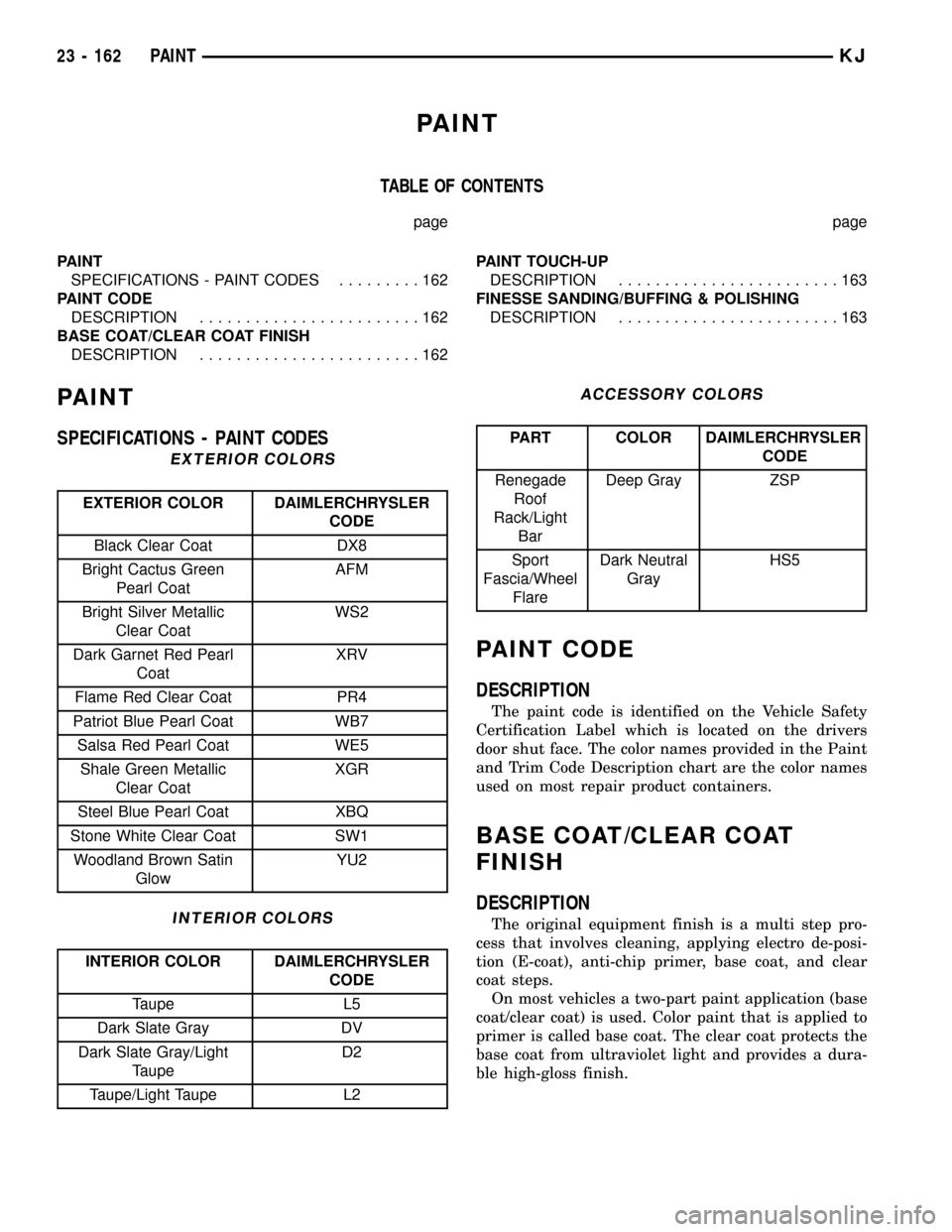
PAINT
TABLE OF CONTENTS
page page
PAINT
SPECIFICATIONS - PAINT CODES.........162
PAINT CODE
DESCRIPTION........................162
BASE COAT/CLEAR COAT FINISH
DESCRIPTION........................162PAINT TOUCH-UP
DESCRIPTION........................163
FINESSE SANDING/BUFFING & POLISHING
DESCRIPTION........................163
PAINT
SPECIFICATIONS - PAINT CODES
EXTERIOR COLORS
EXTERIOR COLOR DAIMLERCHRYSLER
CODE
Black Clear Coat DX8
Bright Cactus Green
Pearl CoatAFM
Bright Silver Metallic
Clear CoatWS2
Dark Garnet Red Pearl
CoatXRV
Flame Red Clear Coat PR4
Patriot Blue Pearl Coat WB7
Salsa Red Pearl Coat WE5
Shale Green Metallic
Clear CoatXGR
Steel Blue Pearl Coat XBQ
Stone White Clear Coat SW1
Woodland Brown Satin
GlowYU2
INTERIOR COLORS
INTERIOR COLOR DAIMLERCHRYSLER
CODE
Taupe L5
Dark Slate Gray DV
Dark Slate Gray/Light
TaupeD2
Taupe/Light Taupe L2
ACCESSORY COLORS
PART COLOR DAIMLERCHRYSLER
CODE
Renegade
Roof
Rack/Light
BarDeep Gray ZSP
Sport
Fascia/Wheel
FlareDark Neutral
GrayHS5
PAINT CODE
DESCRIPTION
The paint code is identified on the Vehicle Safety
Certification Label which is located on the drivers
door shut face. The color names provided in the Paint
and Trim Code Description chart are the color names
used on most repair product containers.
BASE COAT/CLEAR COAT
FINISH
DESCRIPTION
The original equipment finish is a multi step pro-
cess that involves cleaning, applying electro de-posi-
tion (E-coat), anti-chip primer, base coat, and clear
coat steps.
On most vehicles a two-part paint application (base
coat/clear coat) is used. Color paint that is applied to
primer is called base coat. The clear coat protects the
base coat from ultraviolet light and provides a dura-
ble high-gloss finish.
23 - 162 PAINTKJ
Page 1644 of 1803

SUNSHADE
REMOVAL
(1) Remove glass assembly from the sunroof
assembly. (Refer to 23 - BODY/SUNROOF/GLASS
PANEL - REMOVAL)
(2) Remove two screws from trough assembly (Fig.
3).
(3) Remove trough assembly.
(4) Slide the sunshade forward to disengage the
guide feet from the tracks through the cutouts at the
front of the tracks.
CAUTION: Use care not to crease the sunshade
when removing or installing.
INSTALLATION
(1) Place sunshade into position, through the cut-
outs at the front of the tracks and slide the sunshade
back.
(2) Place trough assembly into position on sunroof
module and install the screws.
(3) Install the glass panel. (Refer to 23 - BODY/
SUNROOF/GLASS PANEL - INSTALLATION)
GUIDE ASSEMBLY
REMOVAL
(1) Remove the glass panel. (Refer to 23 - BODY/
SUNROOF/GLASS PANEL - REMOVAL)
(2) Place sunroof into the vent position.
(3) Remove two screws from trough assembly (Fig.
3).
(4) Remove trough assembly.
(5) Disconnect the guide link (Fig. 4).
(6) Slide trough guide forward and disengage the
sliders through the notches in the guide channels
(Fig. 5).
INSTALLATION
(1) Install the trough guide and engage the sliders
into the guide channels through the notches.
(2) Connect the guide link.
(3) Install the trough and install the two screws.
(4) Install the glass panel. (Refer to 23 - BODY/
SUNROOF/GLASS PANEL - INSTALLATION)
Fig. 3 GUIDE ASSEMBLY TROUGH
1 - TROUGH
2 - TROUGH GUIDE
3 - SCREW
Fig. 4 TROUGH GUIDES
1 - TROUGH GUIDE
2 - GUIDE LINK
KJSUNROOF 23 - 179
Page 1647 of 1803

(5) Connect wire harness.
(6) Install the headliner. (Refer to 23 - BODY/IN-
TERIOR/HEADLINER - INSTALLATION)
(7) Install the opening trim lace. (Refer to 23 -
BODY/SUNROOF/OPENING TRIM LACE - INSTAL-
LATION)
(8) Connect battery negative cable.
(9) Test sunroof operation, adjust as necessary.
(Refer to 23 - BODY/SUNROOF/GLASS PANEL -
ADJUSTMENTS)
DRIVE MOTOR
REMOVAL
(1) Remove headliner. (Refer to 23 - BODY/INTE-
RIOR/HEADLINER - REMOVAL)
(2) Cut wire retaining tape being careful not to cut
wires.
(3) Disconnect the electrical connector (Fig. 11).
(4) Remove three motor assembly attaching screws
from bottom side of motor assembly and remove
motor assembly from the motor bracket.
INSTALLATION
(1) Place motor into position and install screws
attaching motor to bracket.
NOTE: Hold electronics module to motor bracket
when inserting motor shaft to avoid disengaging
drive cables.
(2) Connect electrical connector.
(3) Tape wires to drive cables to prevent rattles.
Fig. 9 WIRE HARNESS
1 - CLIPS
2 - ELECTRICAL CONNECTOR
3 - WIRE HARNESS
Fig. 10 MODULE ASSEMBLY
1 - U-NUTS
2 - DRIVE MOTOR
3 - BOLTS
4 - GLASS OPENING
5 - MODULE ASSEMBLY
Fig. 11 DRIVE MOTOR ASSEMBLY
1 - CONTROL MODULE
2 - SCREWS
3 - DRIVE MOTOR
4 - SCREW
5 - ELECTRICAL CONNECTOR
23 - 182 SUNROOFKJ
MODULE ASSEMBLY (Continued)
Page 1648 of 1803

(4) Test sunroof operation, adjust as necessary.
(5) Install headliner. (Refer to 23 - BODY/INTERI-
OR/HEADLINER - INSTALLATION)
CONTROL MODULE
REMOVAL
(1) Remove the module assembly. (Refer to 23 -
BODY/SUNROOF/MODULE ASSEMBLY -
REMOVAL)
(2) Remove three motor assembly retaining screws
from bottom side of motor, and remove motor assem-
bly (Fig. 11).
(3) From top side of module assembly, remove one
attaching screw from electronics module. (Fig. 12)
(4) Remove old timing module.
INSTALLATION
(1) Check glass assembly position. Adjust to full
closed position. Insert pin into holes in lift arm
assembly to check position (Fig. 13).
(2) Set new electronic module in position on top
side of motor mounting bracket engaging drive cables
with pinion gear in electronics module.
(3) Install one screw to attach electronics module
to motor bracket. Tighten screw to 3 N´m (27 in. lbs.)
torque.
(4) Install motor assembly to motor bracket and
electronics module with three screws. Tighten screw
to 1.75 N´m (15.5 in. lbs.) torque.
(5) Remove the new module's timing pin and dis-
card. (Fig. 14)(6) Connect electrical connector to module assem-
bly wire harness. Secure any loose wires.
(7) Install module assembly. (Refer to 23 - BODY/
SUNROOF/MODULE ASSEMBLY - INSTALLA-
TION)
(8) Test operation, adjust as necessary. (Refer to 23
- BODY/SUNROOF/GLASS PANEL - ADJUST-
MENTS)
(9) Install opening trim lace. (Refer to 23 - BODY/
SUNROOF/OPENING TRIM LACE - INSTALLA-
TION)
Fig. 12 CONTROL MODULE
1 - MOTOR BRACKET
2 - CABLES
3 - SCREW
4 - CONTROL MODULE
Fig. 13 LIFT ARM POSITIONING
1 - GLASS BRACKET
2 - LIFT ARM
3 - ALIGNMENT PIN
Fig. 14 MODULE TIMING PIN
1 - CONTROL MODULE
2 - TIMING PIN
KJSUNROOF 23 - 183
DRIVE MOTOR (Continued)