2002 JEEP LIBERTY Rear ABS speed sensor
[x] Cancel search: Rear ABS speed sensorPage 303 of 1803

²Fog Lamp Control- The premium BCM pro-
vides fog lamp control for front fog lamps (optional),
and rear fog lamps (in required markets only).
²Front Wiper System Status- The BCM moni-
tors the status of the front wiper motor park switch.
²Fuel Economy and Distance to Empty Cal-
culations- The BCM calculates and transmits the
fuel economy and Distance To Empty (DTE) data.
²Headlamp Time Delay- The BCM provides a
headlamp time delay feature with the ignition switch
in the Off position.
²Heated Rear Glass Control- The BCM pro-
vides control and timer functions for the heated rear
glass feature and transmits the system status.
²Ignition On/Off Timer- The BCM monitors
and transmits the elapsed ignition On timer data
and monitors the ignition Off time.
²Ignition Switch Position Status- The BCM
monitors and transmits the status of the ignition
switch.
²Instrument Panel Dimming- The BCM mon-
itors and transmits the selected illumination inten-
sity level of the panel lamps dimmer switch.
²Interior Lamp Load Shedding- The BCM
provides a battery saver feature which will automat-
ically turn off all interior lamps that remain on after
a timed interval.
²Interior Lighting Control- The BCM moni-
tors inputs from the interior lighting switch, the door
ajar switches, the flip-up glass ajar switch, the tail-
gate ajar switch, the cargo lamp switch, the reading
lamp switches, and the Remote Keyless Entry (RKE)
module to provide courtesy lamp control. This
includes support for timed illuminated entry with
theater-style fade-to-off and courtesy illumination
defeat features.
²Intermittent Wipe and Front Wiper System
Control- The BCM monitors inputs from the front
wiper and washer switch and the front wiper motor
park switch to provide front wiper system control
through the wiper on/off and high/low relays. This
includes support for adjustable intermittent wipe,
mist wipe (also known as pulse wipe), and wipe-after-
wash features.
²Key-In-Ignition Switch Status- The BCM
monitors and transmits the status of the key-in-igni-
tion switch.
²Panic Mode- The BCM provides support for
the Remote Keyless Entry (RKE) system panic mode
feature.
²Parade Mode- The BCM provides a parade
mode (also known as funeral mode) that allows the
interior Vacuum Fluorescent Displays (VFD) to be
illuminated at full intensity while driving in daylight
with the exterior lamps On.²Power Locks- The BCM monitors inputs from
the power lock switches and the Remote Keyless
Entry (RKE) module (optional) to provide control of
the power lock motors through outputs to the lock,
unlock, and driver unlock (RKE only) relays. This
includes support for rolling door locks (also known as
automatic door locks) and a door lock inhibit mode.
²Programmable Features- The BCM provides
support for several standard and optional program-
mable features, including: rolling door locks, head-
lamp time delay interval, Remote Keyless Entry
(RKE) driver-door-only or unlock-all-doors, RKE opti-
cal chirp, and RKE audible chirp.
²Remote Keyless Entry- The premium BCM
provides the optional Remote Keyless Entry (RKE)
system features, including support for the RKE Lock,
Unlock (with optional driver-door-only unlock, and
unlock-all-doors), rear flip-up glass control, Panic,
audible chirp, optical chirp, and illuminated entry
modes, as well as the ability to be programmed to
recognize up to four RKE transmitters.
²Rolling Door Locks- The BCM provides sup-
port for the power lock system rolling door locks fea-
ture (also known as automatic door locks).
²Tailgate and Flip-Up Glass Ajar Status- The
BCM monitors and transmits the status of the tail-
gate and rear flip-up glass ajar switches.
²Remote Radio Switch Interface- The pre-
mium BCM monitors and transmits the status of the
optional remote radio switches.
²Self-Diagnostics- The BCM provides support
for diagnostics through communication with the
DRBIIItscan tool over the PCI data bus network.
Each analog and digital input can be verified, and
each output can be actuated through the use of this
diagnostic protocol. The BCM also stores Diagnostic
Trouble Codes (DTCs) to assist in troubleshooting
this unit.
²Vacuum Fluorescent Display Synchroniza-
tion- The BCM transmits panel lamp intensity data
which allows modules with Vacuum Fluorescent Dis-
plays (VFD) to coordinate their illumination inten-
sity.
²Vehicle Speed System- The BCM monitors a
vehicle speed input from the vehicle speed sensor
(without Antilock Brake System [ABS]) or from the
Controller Antilock Brake (CAB)(with ABS), calcu-
lates the vehicle speed based upon a programmed
axle ratio/tire size (electronic pinion factor), and
transmits the vehicle speed information to the Pow-
ertrain Control Module (PCM) on a hard wired out-
put circuit.
²Vehicle Theft Security System- The pre-
mium BCM monitors inputs from the door cylinder
lock switches, the tailgate cylinder lock switch, the
door ajar switches, the tailgate ajar switch, the
8E - 4 ELECTRONIC CONTROL MODULESKJ
BODY CONTROL MODULE (Continued)
Page 305 of 1803

²RKE antenna (two circuits) - premium with
RKE only
²Tailgate ajar switch sense
²Tailgate cylinder lock switch sense
²Vehicle speed sensor
Refer to the appropriate wiring information for
additional details.
HARD WIRED OUTPUTS The hard wired outputs
of the BCM include the following:
²Courtesy lamp driver
²Courtesy lamp load shed
²Door lock relay control
²Driver door unlock relay control - premium
with RKE only
²Flip-up glass release motor driver
²Front fog lamp relay control - premium
with front fog lamps only
²Front wiper high/low relay control
²Front wiper on/off relay control
²Hazard lamp control
²High beam relay control
²Horn relay control - premium with RKE
only
²Instrument cluster wake up signal
²Low beam relay control
²Park lamp relay control
²Passenger door unlock relay control
²Rear fog lamp relay control - premium with
rear fog lamps in markets where required only
²Rear window defogger relay control
²RKE supply - premium with RKE only
²Tailgate lock driver
²Tailgate unlock driver
²Vehicle speed output
²Vehicle speed sensor supply
²VTSS indicator driver - premium with
VTSS only
Refer to the appropriate wiring information for
additional details.
GROUNDS The BCM receives ground through five
separate circuits, and also supplies a ground path to
several switches through the following hard wired
circuits:
²Ambient temperature sensor return
²Door lock switch ground
²Headlamp switch return
²Radio control mux return
²RKE ground - premium with RKE only
²Tailgate switch ground
Refer to the appropriate wiring information for
additional details.
COMMUNICATION Not including the two RKE
antenna circuits (RKE antenna + and ±), which
merely pass through the premium BCM from the
RKE module to the external RKE antenna in theinstrument panel wire harness, the BCM has the fol-
lowing communication circuits:
²PCI bus
²RKE program serial data - premium with
RKE only
²RKE transmit serial data - premium with
RKE only
Refer to the appropriate wiring information for
additional details.
MESSAGING The BCM uses the following mes-
sages received from other electronic modules over the
PCI data bus:
²Battery Temperature (PCM)
²Compass Mini-Trip Computer Button Sta-
tus (CMTC) - premium only
²Coolant Temperature (PCM)
²Distance Pulses (PCM)
²Engine Speed (PCM)
²Fuel Tank Level (PCM)
²Fuel Used (PCM)
²Intrusion Transceiver Module Commands
(ITM) - premium in markets where required
only
²Manifold Absolute Pressure (PCM)
²OK to Lock - Rolling Locks (PCM)
²SKIS Status (SKIM)
²Vehicle Identification Number (PCM)
²Vehicle Speed (PCM)
The BCM provides the following messages to other
electronic modules over the PCI data bus:
²A/C Select Switch Status (PCM)
²Country Code (EMIC, PCM, CMTC)
²Distance to Empty (CMTC) - premium only
²Door Ajar Status (EMIC)
²Exterior Lighting Status (EMIC)
²Flip-up Glass Ajar Status (EMIC)
²Fuel Economy (Average and Instantaneous)
(CMTC) - premium only
²Hood Ajar Status (ITM) - premium in mar-
kets where required only
²Ignition On Timer (CMTC) - premium only
²Intrusion Transceiver Module Commands
(ITM) - premium in markets where required
only
²Key-In Ignition Switch Status (EMIC)
²Outside Temperature (CMTC) - premium
only
²Panel Lamp Intensity (CMTC, Radio)
²Tailgate Ajar Status (EMIC)
²Radio Mode (Radio) - premium only
²Radio Preset Scan (Radio) - premium only
²Radio Seek Down (Radio) - premium only
²Radio Seek Up (Radio) - premium only
²Radio Volume Down (Radio) - premium
only
²Radio Volume Up (Radio) - premium only
8E - 6 ELECTRONIC CONTROL MODULESKJ
BODY CONTROL MODULE (Continued)
Page 414 of 1803

(2) With the bulb holder fully seated against the
cluster electronic circuit board, turn the bulb holder
clockwise about sixty degrees to lock it into place.
(3) Reinstall the instrument cluster onto the
instrument panel. (Refer to 8 - ELECTRICAL/IN-
STRUMENT CLUSTER - INSTALLATION).
(4) Reconnect the battery negative cable.
CLUSTER LENS, HOOD, AND MASK
(1) Position the cluster lens, hood, and mask unit
over the face of the instrument cluster (Fig. 5). Be
certain that the odometer/trip odometer switch but-
ton is inserted through the proper clearance holes in
the mask and the lens.
(2) From the back of the instrument cluster, install
and tighten the six screws that secure the rear cover
and the lens, hood, and mask unit to the cluster
housing. Tighten the screws to 1 N´m (10 in. lbs.).
(3) Reinstall the instrument cluster onto the
instrument panel. (Refer to 8 - ELECTRICAL/IN-
STRUMENT CLUSTER - INSTALLATION).
(4) Reconnect the battery negative cable.
INSTALLATION
WARNING: ON VEHICLES EQUIPPED WITH AIR-
BAGS, DISABLE THE SUPPLEMENTAL RESTRAINT
SYSTEM BEFORE ATTEMPTING ANY STEERING
WHEEL, STEERING COLUMN, DRIVER AIRBAG,
PASSENGER AIRBAG, SEAT BELT TENSIONER,
FRONT IMPACT SENSORS, SIDE CURTAIN AIRBAG,
OR INSTRUMENT PANEL COMPONENT DIAGNOSIS
OR SERVICE. DISCONNECT AND ISOLATE THE
BATTERY NEGATIVE (GROUND) CABLE, THEN
WAIT TWO MINUTES FOR THE SYSTEM CAPACI-
TOR TO DISCHARGE BEFORE PERFORMING FUR-
THER DIAGNOSIS OR SERVICE. THIS IS THE ONLY
SURE WAY TO DISABLE THE SUPPLEMENTAL
RESTRAINT SYSTEM. FAILURE TO TAKE THE
PROPER PRECAUTIONS COULD RESULT IN ACCI-
DENTAL AIRBAG DEPLOYMENT AND POSSIBLE
PERSONAL INJURY.
(1) Position the instrument cluster to the instru-
ment panel.
(2) Reconnect the instrument panel wire harness
connector for the cluster to the cluster connector
receptacle.
(3) Position the instrument cluster into the instru-
ment panel.
(4) Install and tighten the four screws that secure
the instrument cluster to the instrument panel (Fig.
3). Tighten the screws to 2 N´m (17 in. lbs.).
(5) Reinstall the cluster bezel onto the instrument
panel. (Refer to 23 - BODY/INSTRUMENT PANEL/
CLUSTER BEZEL - INSTALLATION).
(6) Reconnect the battery negative cable.NOTE: Some of the indicators in this instrument
cluster are self configured or automatically config-
ured when the cluster is connected to the vehicle
electrical system. This feature allows those indica-
tors to be enabled for compatibility with certain
optional equipment. However, if an instrument clus-
ter was previously connected to another vehicle
with different equipment options than the current
vehicle, some of the automatically configured indi-
cator settings may have to be disabled using a
DRBIIITscan tool. Refer to the appropriate diagnos-
tic information.
ABS INDICATOR
DESCRIPTION
An Antilock Brake System (ABS) indicator is stan-
dard equipment on all instrument clusters. However,
the instrument cluster is programmed to automati-
cally enable this indicator only on vehicles equipped
with the optional antilock brake system. The ABS
indicator is located above the engine temperature
gauge and to the right of the speedometer in the
instrument cluster. The ABS indicator consists of a
stencil-like cutout of the International Control and
Display Symbol icon for ªFailure of Anti-lock Braking
Systemº in the opaque layer of the instrument clus-
ter overlay. The dark outer layer of the overlay pre-
vents the indicator from being clearly visible when it
is not illuminated. An amber Light Emitting Diode
(LED) behind the cutout in the opaque layer of the
overlay causes the icon to appear in amber through
the translucent outer layer of the overlay when it is
illuminated from behind by the LED, which is sol-
dered onto the instrument cluster electronic circuit
board. The ABS indicator is serviced as a unit with
the instrument cluster.
OPERATION
The ABS indicator gives an indication to the vehi-
cle operator when the ABS system is faulty or inop-
erative. This indicator is controlled by a transistor on
the instrument cluster circuit board based upon clus-
ter programming and electronic messages received by
the cluster from the Controller Antilock Brake (CAB)
over the Programmable Communications Interface
(PCI) data bus. The ABS indicator Light Emitting
Diode (LED) is completely controlled by the instru-
ment cluster logic circuit, and that logic will only
allow this indicator to operate when the instrument
cluster receives a battery current input on the fused
ignition switch output (run-start) circuit. Therefore,
the LED will always be off when the ignition switch
is in any position except On or Start. The LED only
KJINSTRUMENT CLUSTER 8J - 11
INSTRUMENT CLUSTER (Continued)
Page 763 of 1803

Component Page
Low Beam Relay..................... 8Wa-50
Manifold Absolute Pressure Sensor....... 8Wa-30
Multi-Function Switch........... 8Wa-50, 52, 53
Output Speed Sensor.................. 8Wa-31
Overhead Map/Reading Lamp........... 8Wa-44
Oxygen Sensors...................... 8Wa-30
Oxygen Sensor Downstream Relay........ 8Wa-30
Park Brake Switch.................... 8Wa-40
Park Lamp Relay..................... 8Wa-50
Park/Turn Signal Lamps............ 8Wa-50, 52
Passenger Airbag..................... 8Wa-43
Passenger Door Unlock Relay........... 8Wa-61
Passenger Seat Belt Switch............. 8Wa-40
Position Lamps...................... 8Wa-50
Power Distribution Center.............. 8Wa-10
Power Mirrors....................... 8Wa-62
Power Outlet........................ 8Wa-41
Power Seats......................... 8Wa-63
Power Steering Pressure Switch......... 8Wa-30
Power Windows...................... 8Wa-60
Powertrain Control Module............. 8Wa-30
Radiator Fans....................... 8Wa-30
Radio Choke......................... 8Wa-47
Radio.............................. 8Wa-47
Rear Fog Lamp Relay................. 8Wa-51
Rear Power Outlet.................... 8Wa-41
Rear Power Window Switch............. 8Wa-60
Rear Wheel Speed Sensor.............. 8Wa-35
Rear Window Defogger................. 8Wa-48
Rear Wiper Motor.................... 8Wa-53
Red Brake Warning Indicator Switch...... 8Wa-40Component Page
Remote Keyless Entry Module........... 8Wa-45
Remote Radio Switches................ 8Wa-47
Splices............................. 8Wa-10
Sentry Key Immobilizer Module.......... 8Wa-39
Shifter Assembly..................... 8Wa-31
Side Impact Airbag Control Modules...... 8Wa-43
Side Marker Lamps................ 8Wa-50, 52
Side Repeater Lamps............... 8Wa-50, 52
Siren.............................. 8Wa-49
Speed Control Servo................... 8Wa-33
Speed Control Switches................ 8Wa-33
Starter Motor Relay................... 8Wa-21
Starter Motor........................ 8Wa-21
Sunroof............................ 8Wa-64
Tail/Stop Lamps...................... 8Wa-51
Tailgate Cylinder Lock Switch........... 8Wa-61
Tailgate Flip-Up Ajar Switch............ 8Wa-61
Tailgate Lock Motor/Ajar Switch......... 8Wa-61
Throttle Position Sensor................ 8Wa-30
Trailer Tow.......................... 8Wa-54
Transfer Case Position Sensor........ 8Wa-30, 31
Transmission Control Module........... 8Wa-31
Transmission Control Relay............. 8Wa-31
Transmission Solenoid/TRS Assembly..... 8Wa-31
Visor/Vanity Lamps................... 8Wa-44
Washer Fluid Level Switch............. 8Wa-53
Washer Pump........................ 8Wa-53
Water In Fuel Sensor.................. 8Wa-30
Wheel Speed Sensors.................. 8Wa-35
Wiper High/Low Relay................. 8Wa-53
KJ8W-02 COMPONENT INDEX8Wa-02-1
Page 1058 of 1803

Component Page
Left Power Seat Motors
(Midline/Highline)................ 8Wa-80-74
Left Power Seat Switch
(Midline/Highline)................ 8Wa-80-74
Left Rear Door Ajar Switch (Base)..... 8Wa-80-74
Left Rear Door Lock Motor/Ajar Switch
(Except Base)................... 8Wa-80-74
Left Rear Door Speaker.............. 8Wa-80-75
Left Rear Power Window Motor
(Midline/Highline)................ 8Wa-80-75
Left Remote Radio Switch (Premium) . . . 8Wa-80-75
Left Side Impact Airbag Control
Module (LSIACM)................ 8Wa-80-75
Left Side Marker Lamp (Except
Built-Up-Export)................. 8Wa-80-76
Left Side Repeater Lamp
(Built-Up-Export)................ 8Wa-80-76
Left Speed Control Switch (Except Base) . 8Wa-80-76
Left Tail/Stop Lamp................ 8Wa-80-76
Left Visor/Vanity Lamp (Except Base) . . . 8Wa-80-76
License Lamp (Built-Up-Export)....... 8Wa-80-77
License Lamp (Except Built-Up-Export) . 8Wa-80-77
Line Pressure Sensor (3.7L).......... 8Wa-80-77
Low Note Horn.................... 8Wa-80-77
Manifold ABSolute Pressure Sensor.... 8Wa-80-77
Multi-Function Switch C1............ 8Wa-80-78
Multi-Function Switch C2............ 8Wa-80-78
Output Speed Sensor (3.7L).......... 8Wa-80-78
Overhead Map/Reading Lamp
(Except Base)................... 8Wa-80-78
Oxygen Sensor 1/1 Upstream......... 8Wa-80-79
Oxygen Sensor 1/2 Downstream....... 8Wa-80-79
Oxygen Sensor 2/1 Upstream (3.7L).... 8Wa-80-79
Oxygen Sensor 2/2 Downstream (3.7L) . . 8Wa-80-79
Passenger Airbag................... 8Wa-80-79
Passenger Seat Belt Switch........... 8Wa-80-80
Power Mirror Switch (Except Base)..... 8Wa-80-80
Power Outlet...................... 8Wa-80-80
Power Steering Pressure Switch....... 8Wa-80-80
Power Window Master Switch
(Midline/Highline)................ 8Wa-80-81
Powertrain Control Module-C1 (2.4L) . . . 8Wa-80-81
Powertrain Control Module-C1 (3.7L) . . . 8Wa-80-82
Powertrain Control Module-C2 (Gas) . . . 8Wa-80-82
Powertrain Control Module-C3 (Gas) . . . 8Wa-80-83
Radiator Fan Motor................. 8Wa-80-84
Radiator Fan Relay................. 8Wa-80-84
Radio C1......................... 8Wa-80-84
Radio C2......................... 8Wa-80-85
Radio C3......................... 8Wa-80-85
Radio Choke (Premium)............. 8Wa-80-85
Rear Power Outlet.................. 8Wa-80-85
Rear Power Window Switch
(Midline/Highline)................ 8Wa-80-86
Rear Wheel Speed Sensor............ 8Wa-80-86Component Page
Rear Wiper Motor.................. 8Wa-80-86
Red Brake Warning Indicator Switch . . . 8Wa-80-86
Remote Keyless Entry Module
(Except Base)................... 8Wa-80-86
Right Courtesy Lamp............... 8Wa-80-87
Right Curtain Airbag................ 8Wa-80-87
Right Cylinder Lock Switch
(Except Base)................... 8Wa-80-87
Right Door Lock Switch (Except Base) . . 8Wa-80-87
Right Fog Lamp................... 8Wa-80-87
Right Front Door Ajar Switch (Base).... 8Wa-80-88
Right Front Door Lock Motor/Ajar Switch
(Except Base)................... 8Wa-80-88
Right Front Door Speaker (Base)...... 8Wa-80-88
Right Front Door Speaker (Premium) . . . 8Wa-80-88
Right Front Impact Sensor........... 8Wa-80-88
Right Front Park/ Turn Signal Lamp . . . 8Wa-80-89
Right Front Power Window Motor
(Midline/Highline)................ 8Wa-80-89
Right Front Wheel Speed Sensor (ABS) . 8Wa-80-89
Right Headlamp (Built-Up-Export)..... 8Wa-80-89
Right Headlamp (Except Built-Up-Export). 8Wa-80-89
Right Heated Seat Assembly (Highline) . 8Wa-80-90
Right Heated Seat Switch (Highline) . . . 8Wa-80-90
Right Instrument Panel Speaker....... 8Wa-80-90
Right Leveling Motor (Built-Up-Export) . 8Wa-80-90
Right Position Lamp (Built-Up-Export) . . 8Wa-80-91
Right Power Mirror (Except Base)...... 8Wa-80-91
Right Power Seat Motors
(Midline/Highline)................ 8Wa-80-91
Right Power Seat Switch
(Midline/Highline)................ 8Wa-80-91
Right Rear Door Ajar Switch (Base).... 8Wa-80-92
Right Rear Door Lock Motor/Ajar Switch
(Except Base)................... 8Wa-80-92
Right Rear Door Speaker............ 8Wa-80-92
Right Rear Power Window Motor
(Midline/Highline)................ 8Wa-80-92
Right Remote Radio Switch (Premium) . . 8Wa-80-92
Right Side Impact Airbag Control Module
(RSIACM)...................... 8Wa-80-93
Right Side Marker Lamp
(Except Built-Up-Export)........... 8Wa-80-93
Right Side Repeater Lamp
(Built-Up-Export)................ 8Wa-80-93
Right Speed Control Switch
(Except Base)................... 8Wa-80-93
Right Tail/Stop Lamp............... 8Wa-80-93
Right Visor/Vanity Lamp (Except Base) . 8Wa-80-94
Sentry Key Immobilizer Module
(Except Base)................... 8Wa-80-94
Shifter Assembly................... 8Wa-80-94
Siren (Built-Up-Export).............. 8Wa-80-94
Speed Control Servo................ 8Wa-80-94
Sunroof Motor..................... 8Wa-80-95
KJ8W-80 CONNECTOR PIN-OUTS8Wa-80-3
Page 1107 of 1803
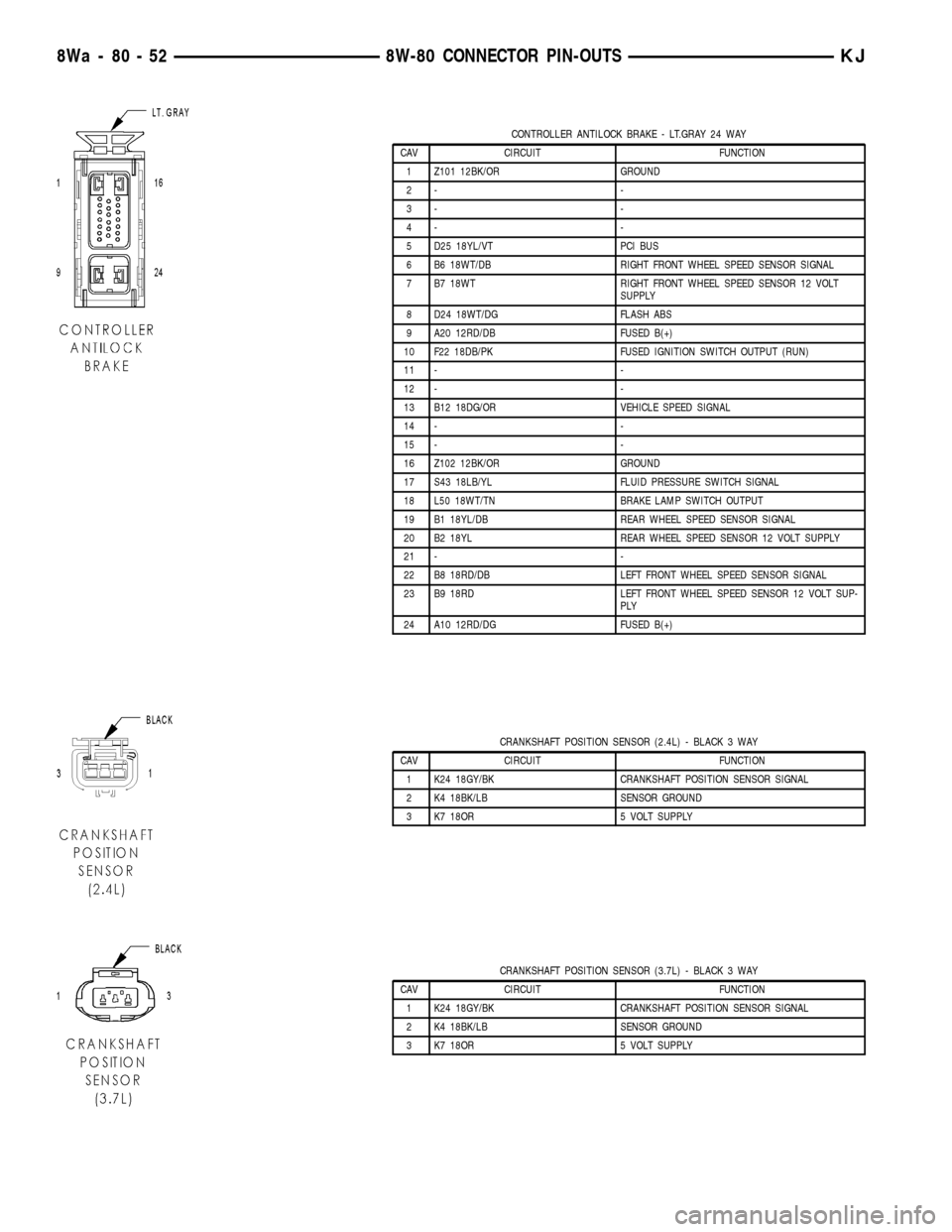
CONTROLLER ANTILOCK BRAKE - LT.GRAY 24 WAY
CAV CIRCUIT FUNCTION
1 Z101 12BK/OR GROUND
2- -
3- -
4- -
5 D25 18YL/VT PCI BUS
6 B6 18WT/DB RIGHT FRONT WHEEL SPEED SENSOR SIGNAL
7 B7 18WT RIGHT FRONT WHEEL SPEED SENSOR 12 VOLT
SUPPLY
8 D24 18WT/DG FLASH ABS
9 A20 12RD/DB FUSED B(+)
10 F22 18DB/PK FUSED IGNITION SWITCH OUTPUT (RUN)
11 - -
12 - -
13 B12 18DG/OR VEHICLE SPEED SIGNAL
14 - -
15 - -
16 Z102 12BK/OR GROUND
17 S43 18LB/YL FLUID PRESSURE SWITCH SIGNAL
18 L50 18WT/TN BRAKE LAMP SWITCH OUTPUT
19 B1 18YL/DB REAR WHEEL SPEED SENSOR SIGNAL
20 B2 18YL REAR WHEEL SPEED SENSOR 12 VOLT SUPPLY
21 - -
22 B8 18RD/DB LEFT FRONT WHEEL SPEED SENSOR SIGNAL
23 B9 18RD LEFT FRONT WHEEL SPEED SENSOR 12 VOLT SUP-
PLY
24 A10 12RD/DG FUSED B(+)
CRANKSHAFT POSITION SENSOR (2.4L) - BLACK 3 WAY
CAV CIRCUIT FUNCTION
1 K24 18GY/BK CRANKSHAFT POSITION SENSOR SIGNAL
2 K4 18BK/LB SENSOR GROUND
3 K7 18OR 5 VOLT SUPPLY
CRANKSHAFT POSITION SENSOR (3.7L) - BLACK 3 WAY
CAV CIRCUIT FUNCTION
1 K24 18GY/BK CRANKSHAFT POSITION SENSOR SIGNAL
2 K4 18BK/LB SENSOR GROUND
3 K7 18OR 5 VOLT SUPPLY
8Wa - 80 - 52 8W-80 CONNECTOR PIN-OUTSKJ
Page 1161 of 1803
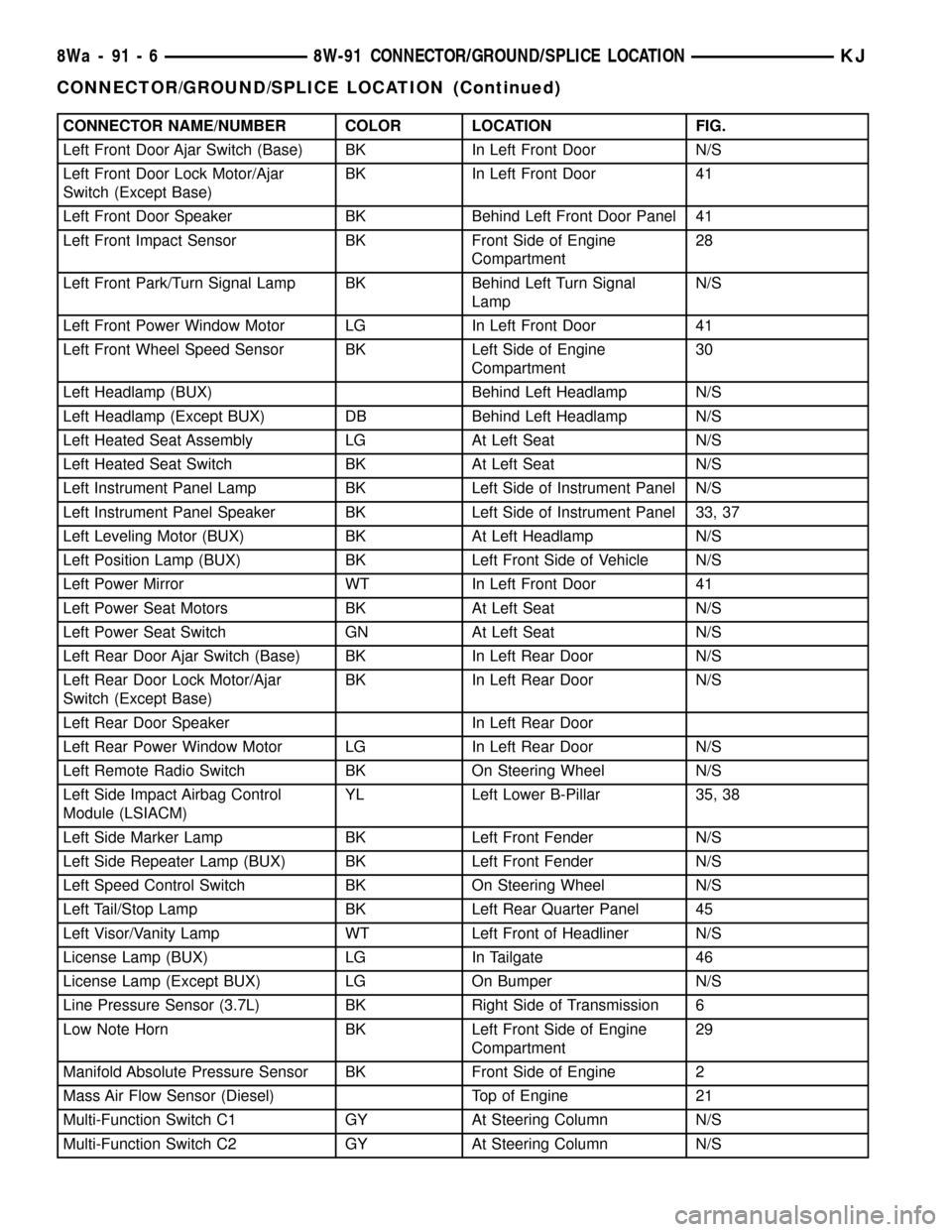
CONNECTOR NAME/NUMBER COLOR LOCATION FIG.
Left Front Door Ajar Switch (Base) BK In Left Front Door N/S
Left Front Door Lock Motor/Ajar
Switch (Except Base)BK In Left Front Door 41
Left Front Door Speaker BK Behind Left Front Door Panel 41
Left Front Impact Sensor BK Front Side of Engine
Compartment28
Left Front Park/Turn Signal Lamp BK Behind Left Turn Signal
LampN/S
Left Front Power Window Motor LG In Left Front Door 41
Left Front Wheel Speed Sensor BK Left Side of Engine
Compartment30
Left Headlamp (BUX) Behind Left Headlamp N/S
Left Headlamp (Except BUX) DB Behind Left Headlamp N/S
Left Heated Seat Assembly LG At Left Seat N/S
Left Heated Seat Switch BK At Left Seat N/S
Left Instrument Panel Lamp BK Left Side of Instrument Panel N/S
Left Instrument Panel Speaker BK Left Side of Instrument Panel 33, 37
Left Leveling Motor (BUX) BK At Left Headlamp N/S
Left Position Lamp (BUX) BK Left Front Side of Vehicle N/S
Left Power Mirror WT In Left Front Door 41
Left Power Seat Motors BK At Left Seat N/S
Left Power Seat Switch GN At Left Seat N/S
Left Rear Door Ajar Switch (Base) BK In Left Rear Door N/S
Left Rear Door Lock Motor/Ajar
Switch (Except Base)BK In Left Rear Door N/S
Left Rear Door Speaker In Left Rear Door
Left Rear Power Window Motor LG In Left Rear Door N/S
Left Remote Radio Switch BK On Steering Wheel N/S
Left Side Impact Airbag Control
Module (LSIACM)YL Left Lower B-Pillar 35, 38
Left Side Marker Lamp BK Left Front Fender N/S
Left Side Repeater Lamp (BUX) BK Left Front Fender N/S
Left Speed Control Switch BK On Steering Wheel N/S
Left Tail/Stop Lamp BK Left Rear Quarter Panel 45
Left Visor/Vanity Lamp WT Left Front of Headliner N/S
License Lamp (BUX) LG In Tailgate 46
License Lamp (Except BUX) LG On Bumper N/S
Line Pressure Sensor (3.7L) BK Right Side of Transmission 6
Low Note Horn BK Left Front Side of Engine
Compartment29
Manifold Absolute Pressure Sensor BK Front Side of Engine 2
Mass Air Flow Sensor (Diesel) Top of Engine 21
Multi-Function Switch C1 GY At Steering Column N/S
Multi-Function Switch C2 GY At Steering Column N/S
8Wa - 91 - 6 8W-91 CONNECTOR/GROUND/SPLICE LOCATIONKJ
CONNECTOR/GROUND/SPLICE LOCATION (Continued)
Page 1420 of 1803

INSTALLATION
2.4L
The intake manifold air temperature (IAT) sensor
is installed into the intake manifold plenum at the
rear end of the intake manifold.
(1) Check condition of sensor o-ring.
(2) Clean sensor mounting hole in intake manifold.
(3) Position sensor into intake manifold and rotate
clockwise until past release tab.
(4) Install electrical connector.
3.7L
The intake manifold air temperature (IAT) sensor
is installed into the left side of intake manifold ple-
num (Fig. 16).
(1) Check condition of sensor o-ring.
(2) Clean sensor mounting hole in intake manifold.
(3) Position sensor into intake manifold and rotate
clockwise until past release tab (Fig. 16).
(4) Install electrical connector.
MAP SENSOR
DESCRIPTION
2.4L
The Manifold Absolute Pressure (MAP) sensor is
mounted into the rear of the intake manifold with 1
screw.
3.7L
The Manifold Absolute Pressure (MAP) sensor is
mounted into the front of the intake manifold with 2
screws.
OPERATION
The MAP sensor is used as an input to the Power-
train Control Module (PCM). It contains a silicon
based sensing unit to provide data on the manifold
vacuum that draws the air/fuel mixture into the com-
bustion chamber. The PCM requires this information
to determine injector pulse width and spark advance.
When manifold absolute pressure (MAP) equals
Barometric pressure, the pulse width will be at max-
imum.
A 5 volt reference is supplied from the PCM and
returns a voltage signal to the PCM that reflects
manifold pressure. The zero pressure reading is 0.5V
and full scale is 4.5V. For a pressure swing of 0±15
psi, the voltage changes 4.0V. To operate the sensor,
it is supplied a regulated 4.8 to 5.1 volts. Ground is
provided through the low-noise, sensor return circuit
at the PCM.The MAP sensor input is the number one contrib-
utor to fuel injector pulse width. The most important
function of the MAP sensor is to determine baromet-
ric pressure. The PCM needs to know if the vehicle is
at sea level or at a higher altitude, because the air
density changes with altitude. It will also help to cor-
rect for varying barometric pressure. Barometric
pressure and altitude have a direct inverse correla-
tion; as altitude goes up, barometric goes down. At
key-on, the PCM powers up and looks at MAP volt-
age, and based upon the voltage it sees, it knows the
current barometric pressure (relative to altitude).
Once the engine starts, the PCM looks at the voltage
again, continuously every 12 milliseconds, and com-
pares the current voltage to what it was at key-on.
The difference between current voltage and what it
was at key-on, is manifold vacuum.
During key-on (engine not running) the sensor
reads (updates) barometric pressure. A normal range
can be obtained by monitoring a known good sensor.
As the altitude increases, the air becomes thinner
(less oxygen). If a vehicle is started and driven to a
very different altitude than where it was at key-on,
the barometric pressure needs to be updated. Any
time the PCM sees Wide Open Throttle (WOT), based
upon Throttle Position Sensor (TPS) angle and RPM,
it will update barometric pressure in the MAP mem-
ory cell. With periodic updates, the PCM can make
its calculations more effectively.
The PCM uses the MAP sensor input to aid in cal-
culating the following:
²Manifold pressure
²Barometric pressure
²Engine load
²Injector pulse-width
²Spark-advance programs
²Shift-point strategies (certain automatic trans-
missions only)
²Idle speed
²Decel fuel shutoff
The MAP sensor signal is provided from a single
piezoresistive element located in the center of a dia-
phragm. The element and diaphragm are both made
of silicone. As manifold pressure changes, the dia-
phragm moves causing the element to deflect, which
stresses the silicone. When silicone is exposed to
stress, its resistance changes. As manifold vacuum
increases, the MAP sensor input voltage decreases
proportionally. The sensor also contains electronics
that condition the signal and provide temperature
compensation.
The PCM recognizes a decrease in manifold pres-
sure by monitoring a decrease in voltage from the
reading stored in the barometric pressure memory
cell. The MAP sensor is a linear sensor; meaning as
pressure changes, voltage changes proportionately.
14 - 38 FUEL INJECTIONKJ
INTAKE AIR TEMPERATURE SENSOR (Continued)