2002 JEEP LIBERTY part time
[x] Cancel search: part timePage 1664 of 1803

A/C COMPRESSOR CLUTCH
DESCRIPTION - 3.7L and 2.4L
The compressor clutch assembly consists of a sta-
tionary electromagnetic coil, a rotor bearing and
rotor assembly, and a clutch plate (Fig. 1). The elec-
tromagnetic coil unit and the rotor bearing and rotor
assembly are each retained on the nose of the com-
pressor front housing with snap rings. The clutch
plate is keyed to the compressor shaft and secured
with a nut. These components provide the means to
engage and disengage the compressor from the
engine serpentine accessory drive belt.
OPERATION - 3.7L and 2.4L
When the clutch coil is energized, it magnetically
draws the clutch into contact with the rotor and
drives the compressor shaft. When the coil is not
energized, the rotor freewheels on the clutch rotor
bearing, which is part of the rotor. The compressor
clutch and coil are the only serviced parts on the
compressor.
The compressor clutch engagement is controlled by
several components: the A/C Heater mode control
switch, the A/C low pressure switch, the A/C high
pressure switch, the compressor clutch relay, and the
Powertrain Control Module (PCM). The PCM may
delay compressor clutch engagement for up to thirty
seconds. Refer to Electronic Control Modules for
more information on the PCM controls.
DIAGNOSIS AND TESTING - A/C COMPRESSOR
CLUTCH COIL
For circuit descriptions and diagrams, (Refer to
Appropriate Wiring Information). The battery must
be fully-charged before performing the following
tests. Refer to Battery for more information.
(1) Connect an ammeter (0 to 10 ampere scale) in
series with the clutch coil terminal. Use a voltmeter
(0 to 20 volt scale) with clip-type leads for measuring
the voltage across the battery and the compressor
clutch coil.
(2) With the A/C Heater mode control switch in
any A/C mode, and the blower motor switch in the
lowest speed position, start the engine and run it at
normal idle.
(3) The compressor clutch coil voltage should read
within 0.2 volts of the battery voltage. If there is
voltage at the clutch coil, but the reading is not
within 0.2 volts of the battery voltage, test the clutch
coil feed circuit for excessive voltage drop and repair
as required. If there is no voltage reading at the
clutch coil, use a DRB IIItscan tool and (Refer to
Appropriate Diagnostic Information) for testing of the
compressor clutch circuit and PCM control. The fol-
lowing components must be checked and repaired as
required before you can complete testing of the clutch
coil:
²Fuses in the junction block and the Power Dis-
tribution Center (PDC)
²A/C heater mode control switch
²Compressor clutch relay
²A/C high pressure switch
²A/C low pressure switch
²Powertrain Control Module (PCM).
(4) The compressor clutch coil is acceptable if the
current draw measured at the clutch coil is 2.0 to 3.9
amperes with the electrical system voltage at 11.5 to
12.5 volts. This should only be checked with the work
area temperature at 21É C (70É F). If system voltage
is more than 12.5 volts, add electrical loads by turn-
ing on electrical accessories until the system voltage
drops below 12.5 volts.
(a) If the clutch coil current reading is four
amperes or more, the coil is shorted and should be
replaced.
(b) If the clutch coil current reading is zero, the
coil is open and should be replaced.
STANDARD PROCEDURE - A/C COMPRESSOR
CLUTCH BREAK-IN
After a new compressor clutch has been installed,
cycle the compressor clutch approximately twenty
times (five seconds on, then five seconds off). During
this procedure, set the A/C Heater control to the
Recirculation Mode, the blower motor switch in the
highest speed position, and the engine speed at 1500
Fig. 1 COMPRESSOR CLUTCH - TYPICAL
1 - CLUTCH PLATE
2 - NOT USED ON KJ
3 - ROTOR
4 - COIL
5 - CLUTCH SHIMS
6 - SNAP RING
7 - SNAP RING
24 - 12 CONTROLSKJ
Page 1692 of 1803

CAUTION - REFRIGERANT HOSES/LINES/
TUBES PRECAUTIONS
Kinks or sharp bends in the refrigerant plumbing will
reduce the capacity of the entire system. High pressures
are produced in the system when it is operating.
Extreme care must be exercised to make sure that all
refrigerant system connections are pressure tight.
A good rule for the flexible hose refrigerant lines is
to keep the radius of all bends at least ten times the
diameter of the hose. Sharp bends will reduce the
flow of refrigerant. The flexible hose lines should be
routed so they are at least 80 millimeters (3 inches)
from the exhaust manifold. It is a good practice to
inspect all flexible refrigerant system hose lines at
least once a year to make sure they are in good con-
dition and properly routed.
There are two types of refrigerant fittings:
²
All fittings with O-rings need to be coated with
refrigerant oil before installation. Use only O-rings that
are the correct size and approved for use with R-134a
refrigerant. Failure to do so may result in a leak.
²Unified plumbing connections with gaskets can-
not be serviced with O-rings. The gaskets are not
reusable and new gaskets do not require lubrication
before installing.
Using the proper tools when making a refrigerant
plumbing connection is very important. Improper
tools or improper use of the tools can damage the
refrigerant fittings. Always use two wrenches when
loosening or tightening tube fittings. Use one wrench
to hold one side of the connection stationary, while
loosening or tightening the other side of the connec-
tion with a second wrench.
The refrigerant must be recovered completely from
the system before opening any fitting or connection.
Open the fittings with caution, even after the refrig-
erant has been recovered. If any pressure is noticed
as a fitting is loosened, tighten the fitting and
recover the refrigerant from the system again.
Do not discharge refrigerant into the atmosphere.
Use an R-134a refrigerant recovery/recycling device
that meets SAE Standard J2210.
The refrigerant system will remain chemically sta-
ble as long as pure, moisture-free R-134a refrigerant
and refrigerant oil is used. Dirt, moisture, or air can
upset this chemical stability. Operational troubles or
serious damage can occur if foreign material is
present in the refrigerant system.
When it is necessary to open the refrigerant sys-
tem, have everything needed to service the system
ready. The refrigerant system should not be left open
to the atmosphere any longer than necessary. Cap or
plug all lines and fittings as soon as they are opened
to prevent the entrance of dirt and moisture. All lines
and components in parts stock should be capped or
sealed until they are to be installed.All tools, including the refrigerant recycling equip-
ment, the manifold gauge set, and test hoses should
be kept clean and dry. All tools and equipment must
be designed for R-134a refrigerant.
STANDARD PROCEDURE
STANDARD PROCEDURE - REFRIGERANT
SYSTEM SERVICE EQUIPMENT
WARNING: REVIEW THE WARNINGS AND CAU-
TIONS IN THE FRONT OF THIS SECTION BEFORE
PERFORMING THE FOLLOWING OPERATION.
(Refer to 24 - HEATING & AIR CONDITIONING/
PLUMBING - WARNING) (Refer to 24 - HEATING &
AIR CONDITIONING/PLUMBING - CAUTION)
When servicing the air conditioning system, a
R-134a refrigerant recovery/recycling/charging sta-
tion that meets SAE Standard J2210 must be used.
Contact an automotive service equipment supplier for
refrigerant recovery/recycling/charging equipment.
Refer to the operating instructions supplied by the
equipment manufacturer for proper care and use of
this equipment.
A manifold gauge set may be needed with some
recovery/recycling/charging equipment (Fig. 1). The
service hoses on the gauge set being used should
have manual (turn wheel), or automatic back-flow
valves at the service port connector ends. This will
prevent refrigerant from being released into the
atmosphere.
MANIFOLD GAUGE SET CONNECTIONS
CAUTION: Do not use an R-12 manifold gauge set
on an R-134a system. The refrigerants are not com-
patible and system damage will result.
LOW PRESSURE GAUGE HOSE The low pressure
hose (Blue with Black stripe) attaches to the suction
service port. This port is located on the suction line
between the accumulator outlet and the compressor.
HIGH PRESSURE GAUGE HOSE The high pres-
sure hose (Red with Black stripe) attaches to the dis-
charge service port. This port is located on the
discharge line between the compressor and the con-
denser inlet.
RECOVERY/RECYCLING/EVACUATION/CHARG-
ING HOSE The center manifold hose (Yellow, or
White, with Black stripe) is used to recover, evacu-
ate, and charge the refrigerant system. When the low
or high pressure valves on the manifold gauge set
are opened, the refrigerant in the system will escape
through this hose.
24 - 40 PLUMBINGKJ
PLUMBING (Continued)
Page 1694 of 1803

used to charge the refrigerant system with R-134a
refrigerant. Refer to the operating instructions sup-
plied by the equipment manufacturer for proper care
and use of this equipment.
SPECIFICATIONS - CHARGE CAPACITY
The R-134a refrigerant system charge capacity for
this vehicle is 0.737 kilograms (1.63 pounds).
A/C COMPRESSOR
DESCRIPTION
DESCRIPTION
The air conditioning system uses a Sanden
PXF-18, reciprocating swash plate-type compressor
on all models. This compressor has a fixed displace-
ment of 180 cubic centimeters (10.984 cubic inches),
and has both the suction and discharge ports located
on the cylinder head. A label identifying the use of
R-134a refrigerant is located on the compressor.
DESCRIPTION - HIGH PRESSURE RELIEF
VALVE
A high pressure relief valve is located on the com-
pressor cylinder head, which is on the rear of the
compressor. This mechanical valve is designed to
vent refrigerant from the system to protect against
damage to the compressor and other system compo-
nents, caused by condenser air flow restriction or an
overcharge of refrigerant.
OPERATION
OPERATION
The compressor is driven by the engine through an
electric clutch, drive rotor and belt arrangement. The
compressor is lubricated by refrigerant oil that is cir-
culated throughout the refrigerant system with the
refrigerant.
The compressor draws in low-pressure refrigerant
vapor from the evaporator through its suction port. It
then compresses the refrigerant into a high-pressure,
high-temperature refrigerant vapor, which is then
pumped to the condenser through the compressor dis-
charge port.
The compressor cannot be repaired. If faulty or
damaged, the entire compressor assembly must be
replaced. The compressor clutch, pulley and clutch
coil are available for service.
OPERATION - HIGH PRESSURE RELIEF VALVE
The high pressure relief valve vents the system
when a discharge pressure of 3445 to 4135 kPa (500
to 600 psi) or above is reached. The valve closes
when a minimum discharge pressure of 2756 kPa
(400 psi) is reached.
The high pressure relief valve vents only enough
refrigerant to reduce the system pressure, and then
re-seats itself. The majority of the refrigerant is con-
served in the system. If the valve vents refrigerant, it
does not mean that the valve is faulty.
The high pressure relief valve is a factory-cali-
brated unit. The valve cannot be adjusted or
repaired, and must not be removed or otherwise dis-
turbed. The valve is only serviced as a part of the
compressor assembly.
DIAGNOSIS AND TESTING - A/C COMPRESSOR
NOISE
When investigating an air conditioning related
noise, you must first know the conditions under
which the noise occurs. These conditions include:
weather, vehicle speed, transmission in gear or neu-
tral, engine speed, engine temperature, and any
other special conditions. Noises that develop during
air conditioning operation can often be misleading.
For example: What sounds like a failed front bearing
or connecting rod, may be caused by loose bolts, nuts,
mounting brackets, or a loose compressor clutch
assembly.
Drive belts are speed sensitive. At different engine
speeds and depending upon belt tension, belts can
develop noises that are mistaken for a compressor
noise. Improper belt tension can cause a misleading
noise when the compressor clutch is engaged, which
may not occur when the compressor clutch is disen-
gaged. Check the serpentine drive belt condition and
tension as described in Cooling before beginning this
procedure.
(1) Select a quiet area for testing. Duplicate the
complaint conditions as much as possible. Switch the
compressor on and off several times to clearly iden-
tify the compressor noise. Listen to the compressor
while the clutch is engaged and disengaged. Probe
the compressor with an engine stethoscope or a long
screwdriver with the handle held to your ear to bet-
ter localize the source of the noise.
(2) Loosen all of the compressor mounting hard-
ware and retighten. Tighten the compressor clutch
mounting nut. Be certain that the clutch coil is
mounted securely to the compressor, and that the
clutch plate and rotor are properly aligned and have
the correct air gap. (Refer to 24 - HEATING & AIR
CONDITIONING/CONTROLS/A/C COMPRESSOR
CLUTCH - INSTALLATION)
24 - 42 PLUMBINGKJ
PLUMBING (Continued)
Page 1708 of 1803
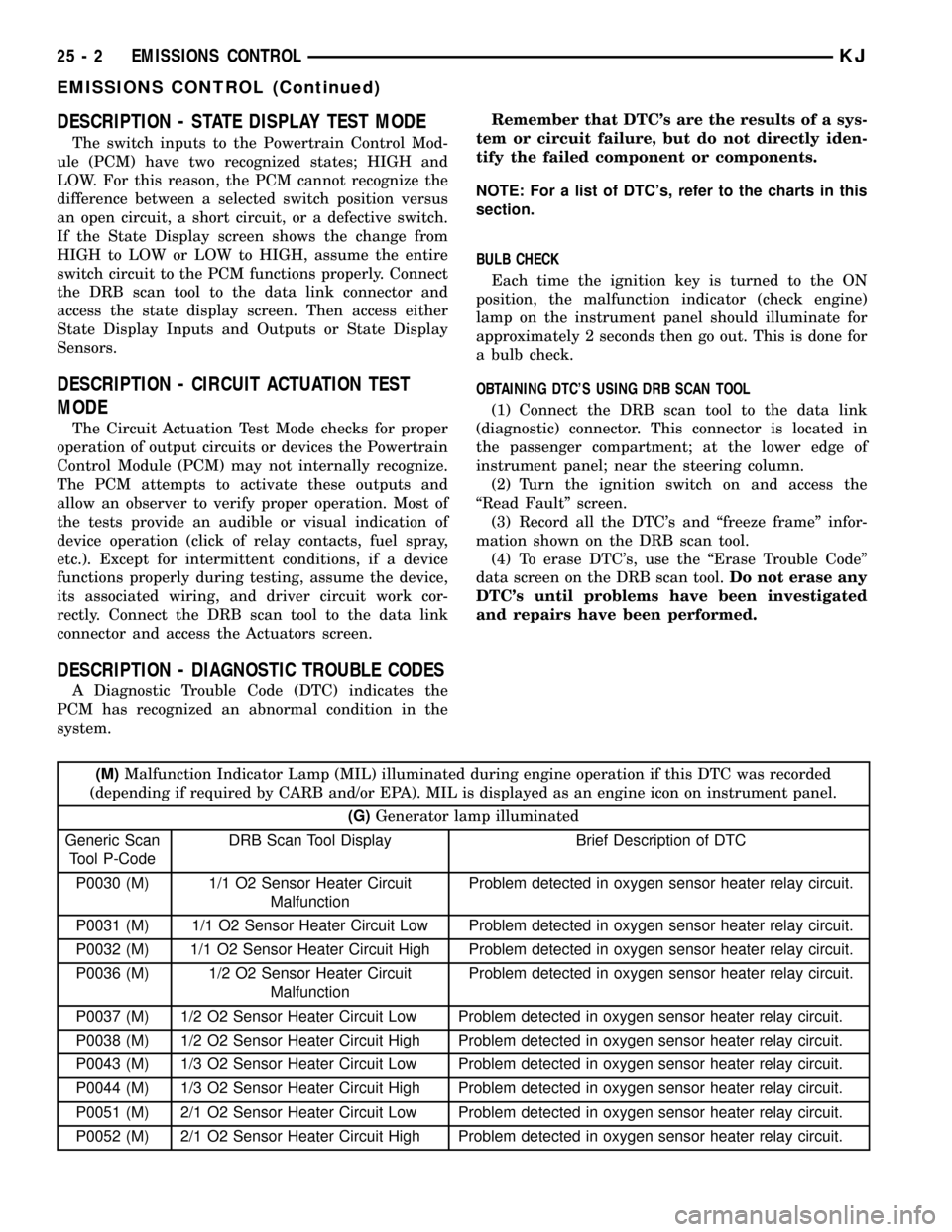
DESCRIPTION - STATE DISPLAY TEST MODE
The switch inputs to the Powertrain Control Mod-
ule (PCM) have two recognized states; HIGH and
LOW. For this reason, the PCM cannot recognize the
difference between a selected switch position versus
an open circuit, a short circuit, or a defective switch.
If the State Display screen shows the change from
HIGH to LOW or LOW to HIGH, assume the entire
switch circuit to the PCM functions properly. Connect
the DRB scan tool to the data link connector and
access the state display screen. Then access either
State Display Inputs and Outputs or State Display
Sensors.
DESCRIPTION - CIRCUIT ACTUATION TEST
MODE
The Circuit Actuation Test Mode checks for proper
operation of output circuits or devices the Powertrain
Control Module (PCM) may not internally recognize.
The PCM attempts to activate these outputs and
allow an observer to verify proper operation. Most of
the tests provide an audible or visual indication of
device operation (click of relay contacts, fuel spray,
etc.). Except for intermittent conditions, if a device
functions properly during testing, assume the device,
its associated wiring, and driver circuit work cor-
rectly. Connect the DRB scan tool to the data link
connector and access the Actuators screen.
DESCRIPTION - DIAGNOSTIC TROUBLE CODES
A Diagnostic Trouble Code (DTC) indicates the
PCM has recognized an abnormal condition in the
system.Remember that DTC's are the results of a sys-
tem or circuit failure, but do not directly iden-
tify the failed component or components.
NOTE: For a list of DTC's, refer to the charts in this
section.
BULB CHECK
Each time the ignition key is turned to the ON
position, the malfunction indicator (check engine)
lamp on the instrument panel should illuminate for
approximately 2 seconds then go out. This is done for
a bulb check.
OBTAINING DTC'S USING DRB SCAN TOOL
(1) Connect the DRB scan tool to the data link
(diagnostic) connector. This connector is located in
the passenger compartment; at the lower edge of
instrument panel; near the steering column.
(2) Turn the ignition switch on and access the
ªRead Faultº screen.
(3) Record all the DTC's and ªfreeze frameº infor-
mation shown on the DRB scan tool.
(4) To erase DTC's, use the ªErase Trouble Codeº
data screen on the DRB scan tool.Do not erase any
DTC's until problems have been investigated
and repairs have been performed.
(M)Malfunction Indicator Lamp (MIL) illuminated during engine operation if this DTC was recorded
(depending if required by CARB and/or EPA). MIL is displayed as an engine icon on instrument panel.
(G)Generator lamp illuminated
Generic Scan
Tool P-CodeDRB Scan Tool Display Brief Description of DTC
P0030 (M) 1/1 O2 Sensor Heater Circuit
MalfunctionProblem detected in oxygen sensor heater relay circuit.
P0031 (M) 1/1 O2 Sensor Heater Circuit Low Problem detected in oxygen sensor heater relay circuit.
P0032 (M) 1/1 O2 Sensor Heater Circuit High Problem detected in oxygen sensor heater relay circuit.
P0036 (M) 1/2 O2 Sensor Heater Circuit
MalfunctionProblem detected in oxygen sensor heater relay circuit.
P0037 (M) 1/2 O2 Sensor Heater Circuit Low Problem detected in oxygen sensor heater relay circuit.
P0038 (M) 1/2 O2 Sensor Heater Circuit High Problem detected in oxygen sensor heater relay circuit.
P0043 (M) 1/3 O2 Sensor Heater Circuit Low Problem detected in oxygen sensor heater relay circuit.
P0044 (M) 1/3 O2 Sensor Heater Circuit High Problem detected in oxygen sensor heater relay circuit.
P0051 (M) 2/1 O2 Sensor Heater Circuit Low Problem detected in oxygen sensor heater relay circuit.
P0052 (M) 2/1 O2 Sensor Heater Circuit High Problem detected in oxygen sensor heater relay circuit.
25 - 2 EMISSIONS CONTROLKJ
EMISSIONS CONTROL (Continued)
Page 1725 of 1803

Normal vehicle miles or engine misfire can cause a
catalyst to decay. This can increase vehicle emissions
and deteriorate engine performance, driveability and
fuel economy.
The catalyst monitor uses dual oxygen sensors
(O2S's) to monitor the efficiency of the converter. The
dual O2S's sensor strategy is based on the fact that
as a catalyst deteriorates, its oxygen storage capacity
and its efficiency are both reduced. By monitoring
the oxygen storage capacity of a catalyst, its effi-
ciency can be indirectly calculated. The upstream
O2S is used to detect the amount of oxygen in the
exhaust gas before the gas enters the catalytic con-
verter. The PCM calculates the A/F mixture from the
output of the O2S. A low voltage indicates high oxy-
gen content (lean mixture). A high voltage indicates a
low content of oxygen (rich mixture).
When the upstream O2S detects a lean condition,
there is an abundance of oxygen in the exhaust gas.
A functioning converter would store this oxygen so it
can use it for the oxidation of HC and CO. As the
converter absorbs the oxygen, there will be a lack of
oxygen downstream of the converter. The output of
the downstream O2S will indicate limited activity in
this condition.
As the converter loses the ability to store oxygen,
the condition can be detected from the behavior of
the downstream O2S. When the efficiency drops, no
chemical reaction takes place. This means the con-
centration of oxygen will be the same downstream as
upstream. The output voltage of the downstream
O2S copies the voltage of the upstream sensor. The
only difference is a time lag (seen by the PCM)
between the switching of the O2S's.
To monitor the system, the number of lean-to-rich
switches of upstream and downstream O2S's is
counted. The ratio of downstream switches to
upstream switches is used to determine whether the
catalyst is operating properly. An effective catalyst
will have fewer downstream switches than it has
upstream switches i.e., a ratio closer to zero. For a
totally ineffective catalyst, this ratio will be one-to-
one, indicating that no oxidation occurs in the device.
The system must be monitored so that when cata-
lyst efficiency deteriorates and exhaust emissions
increase to over the legal limit, the MIL will be illu-
minated.
DESCRIPTION - TRIP DEFINITION
The term ªTripº has different meanings depending
on what the circumstances are. If the MIL (Malfunc-
tion Indicator Lamp) is OFF, a Trip is defined as
when the Oxygen Sensor Monitor and the Catalyst
Monitor have been completed in the same drive cycle.
When any Emission DTC is set, the MIL on the
dash is turned ON. When the MIL is ON, it takes 3good trips to turn the MIL OFF. In this case, it
depends on what type of DTC is set to know what a
ªTripº is.
For the Fuel Monitor or Mis-Fire Monitor (contin-
uous monitor), the vehicle must be operated in the
ªSimilar Condition Windowº for a specified amount of
time to be considered a Good Trip.
If a Non-Contiuous OBDII Monitor fails twice in a
row and turns ON the MIL, re-running that monitor
which previously failed, on the next start-up and
passing the monitor, is considered to be a Good Trip.
These will include the following:
²Oxygen Sensor
²Catalyst Monitor
²Purge Flow Monitor
²Leak Detection Pump Monitor (if equipped)
²EGR Monitor (if equipped)
²Oxygen Sensor Heater Monitor
If any other Emission DTC is set (not an OBDII
Monitor), a Good Trip is considered to be when the
Oxygen Sensor Monitor and Catalyst Monitor have
been completed; or 2 Minutes of engine run time if
the Oxygen Sensor Monitor or Catalyst Monitor have
been stopped from running.
It can take up to 2 Failures in a row to turn on the
MIL. After the MIL is ON, it takes 3 Good Trips to
turn the MIL OFF. After the MIL is OFF, the PCM
will self-erase the DTC after 40 Warm-up cycles. A
Warm-up cycle is counted when the ECT (Engine
Coolant Temperature Sensor) has crossed 160ÉF and
has risen by at least 40ÉF since the engine has been
started.
DESCRIPTION - COMPONENT MONITORS
There are several components that will affect vehi-
cle emissions if they malfunction. If one of these com-
ponents malfunctions the Malfunction Indicator
Lamp (MIL) will illuminate.
Some of the component monitors are checking for
proper operation of the part. Electrically operated
components now have input (rationality) and output
(functionality) checks. Previously, a component like
the Throttle Position sensor (TPS) was checked by
the PCM for an open or shorted circuit. If one of
these conditions occurred, a DTC was set. Now there
is a check to ensure that the component is working.
This is done by watching for a TPS indication of a
greater or lesser throttle opening than MAP and
engine rpm indicate. In the case of the TPS, if engine
vacuum is high and engine rpm is 1600 or greater
and the TPS indicates a large throttle opening, a
DTC will be set. The same applies to low vacuum if
the TPS indicates a small throttle opening.
All open/short circuit checks or any component that
has an associated limp in will set a fault after 1 trip
with the malfunction present. Components without
KJEMISSIONS CONTROL 25 - 19
EMISSIONS CONTROL (Continued)
Page 1733 of 1803

EVAP/PURGE SOLENOID
DESCRIPTION
The duty cycle EVAP canister purge solenoid (DCP)
is located in the engine compartment. It is attached
to a bracket located between the battery and the
Power Distribution Center (PDC). The EVAP system
test port is located near the solenoid.
OPERATION
The duty cycle EVAP canister purge solenoid (DCP)
regulates the rate of vapor flow from the EVAP can-
ister to the intake manifold. The Powertrain Control
Module (PCM) operates the solenoid.
During the cold start warm-up period and the hot
start time delay, the PCM does not energize the sole-
noid. When de-energized, no vapors are purged. The
PCM de-energizes the solenoid during open loop oper-
ation.
The engine enters closed loop operation after it
reaches a specified temperature and the time delay
ends. During closed loop operation, the PCM cycles
(energizes and de-energizes) the solenoid 5 or 10
times per second, depending upon operating condi-
tions. The PCM varies the vapor flow rate by chang-
ing solenoid pulse width. Pulse width is the amount
of time that the solenoid is energized. The PCM
adjusts solenoid pulse width based on engine operat-
ing condition.
REMOVAL
The duty cycle EVAP canister purge solenoid (DCP)
is located in the engine compartment (Fig. 2). It is
attached to a bracket located between the battery
and the Power Distribution Center (PDC). The EVAP
system test port is located near the solenoid (Fig. 2).
(1) Disconnect electrical wiring connector at sole-
noid.
(2) Disconnect vacuum harness at solenoid.
(3) Remove solenoid and its support bracket (pull
straight up).
INSTALLATION
(1) Slip EVAP canister purge solenoid onto its
mounting bracket.
(2) Connect vacuum harness to solenoid.
(3) Connect electrical connector to solenoid.
FUEL FILLER CAP
DESCRIPTION
The plastic fuel tank filler tube cap is threaded
onto the end of the fuel fill tube. All models are
equipped with a 1/4 turn cap.
OPERATION
The loss of any fuel or vapor out of fuel filler tube
is prevented by the use of a pressure-vacuum fuel fill
cap. Relief valves inside the cap will release fuel tank
pressure at predetermined pressures. Fuel tank vac-
uum will also be released at predetermined values.
This cap must be replaced by a similar unit if
replacement is necessary. This is in order for the sys-
tem to remain effective.
CAUTION: Remove fill cap before servicing any fuel
system component to relieve tank pressure. If
equipped with an ORVR system and a Leak Detec-
tion Pump (LDP), the cap must be tightened
securely. If cap is left loose, a Diagnostic Trouble
Code (DTC) may be set.
LEAK DETECTION PUMP
DESCRIPTION
The Leak Detection Pump (LDP) is bolted to the
front of the fuel tank (Fig. 1).
The Leak Detection Pump (LDP) is used only with
certain emission packages.
The LDP is a device used to detect a leak in the
evaporative system.
Fig. 2 EVAP / PURGE SOLENOID LOCATION
1 - BATTERY
2 - EVAP/PURGE SOLENOID LOCATION
3 - MOUNTING BRACKET
4 - POWER DISTRIBUTION CENTER (PDC)
5 - SOLENOID ELECTRICAL CONNECTOR
6 - EVAP SYSTEM TEST PORT
KJEVAPORATIVE EMISSIONS 25 - 27
Page 1752 of 1803

HVAC CONTROL ASSEMBLY WINDOW
DEFOGGER FUNCTION - DIAGNOSIS
AND TESTING, REAR..................8G-9
HVAC HOUSING - ASSEMBLY...........24-34
HVAC HOUSING - DISASSEMBLY........24-34
HVAC HOUSING - INSTALLATION........24-34
HVAC HOUSING - REMOVAL............24-33
HYDRAULIC LASH ADJUSTER -
DIAGNOSIS AND TESTING..........9-19,9-30
HYDRAULIC PRESSURE TEST -
DIAGNOSIS AND TESTING.............21-79
HYDRAULIC SCHEMATICS, SCHEMATICS
AND DIAGRAMS....................21-100
HYDROMETER TEST - STANDARD
PROCEDURE........................8F-11
IDENTIFICATION - DESCRIPTION,
FASTENER.........................Intro.-1
IDENTIFICATION AND INFORMATION -
DESCRIPTION, SECTION.............8W-01-6
IDENTIFICATION NUMBER -
DESCRIPTION, VEHICLE..............Intro.-8
IDLE AIR CONTROL MOTOR -
DESCRIPTION.......................14-35
IDLE AIR CONTROL MOTOR -
INSTALLATION.......................14-36
IDLE AIR CONTROL MOTOR -
OPERATION.........................14-35
IDLE AIR CONTROL MOTOR - REMOVAL . . 14-36
IDLER SHAFT - INSTALLATION...........9-77
IDLER SHAFT - REMOVAL...............9-77
IGNITION CIRCUIT SENSE -
DESCRIPTION.........................8E-13
IGNITION CIRCUIT SENSE - OPERATION . . 8E-15
IGNITION COIL - DESCRIPTION...........8I-9
IGNITION COIL - INSTALLATION.........8I-10
IGNITION COIL - OPERATION.............8I-9
IGNITION COIL - REMOVAL.............8I-10
IGNITION COIL CAPACITOR -
DESCRIPTION........................8I-16
IGNITION COIL CAPACITOR -
INSTALLATION.......................8I-16
IGNITION COIL CAPACITOR - OPERATION . . 8I-16
IGNITION COIL CAPACITOR - REMOVAL . . . 8I-16
IGNITION COIL RESISTANCE, 2.4L.........8I-2
IGNITION COIL RESISTANCE, 3.7L V-6.....8I-3
IGNITION CONTROL - DESCRIPTION.......8I-1
IGNITION CONTROL - OPERATION.........8I-1
IGNITION SWITCH - DESCRIPTION........19-8
IGNITION SWITCH - DESCRIPTION,
KEY-IN.............................19-10
IGNITION SWITCH - DIAGNOSIS AND
TESTING............................19-8
IGNITION SWITCH - DIAGNOSIS AND
TESTING, KEY-IN.....................19-10
IGNITION SWITCH INSTALLATION,
INSTALLATION........................19-9
IGNITION SWITCH REMOVAL, REMOVAL . . . 19-9
IGNITION SYSTEM - TORQUE............8I-3
IGNITION TIMING - SPECIFICATIONS......8I-2
IGNITION-OFF DRAW TEST - STANDARD
PROCEDURE........................8F-14
ILLUMINATION BULB - INSTALLATION,
COMPASS MINI-TRIP
.................8L-75
ILLUMINATION BULB - INSTALLATION,
HEATER-A/C CONTROL
................8L-78
ILLUMINATION BULB - INSTALLATION,
TRANSMISSION RANGE INDICATOR
......8L-83
ILLUMINATION BULB - REMOVAL,
COMPASS MINI-TRIP
.................8L-74
ILLUMINATION BULB - REMOVAL,
HEATER-A/C CONTROL
................8L-78
ILLUMINATION BULB - REMOVAL,
TRANSMISSION RANGE INDICATOR
......8L-82
IMMOBILIZER MODULE - DESCRIPTION,
SENTRY KEY
........................8E-15
IMMOBILIZER MODULE - INSTALLATION,
SENTRY KEY
........................8E-18
IMMOBILIZER MODULE - OPERATION,
SENTRY KEY
........................8E-16
IMMOBILIZER MODULE - REMOVAL,
SENTRY KEY
........................8E-17
IMPACT AIRBAG CONTROL MODULE -
DESCRIPTION, SIDE
..................8O-43
IMPACT AIRBAG CONTROL MODULE -
INSTALLATION, SIDE
.................8O-45
IMPACT AIRBAG CONTROL MODULE -
OPERATION, SIDE
....................8O-43IMPACT AIRBAG CONTROL MODULE -
REMOVAL, SIDE.....................8O-44
IMPACT SENSOR - DESCRIPTION,
FRONT.............................8O-21
IMPACT SENSOR - INSTALLATION,
FRONT.............................8O-22
IMPACT SENSOR - OPERATION, FRONT . . . 8O-21
IMPACT SENSOR - REMOVAL, FRONT....8O-22
INCORRECT FLUID LEVEL - DIAGNOSIS
AND TESTING, EFFECTS OF............21-125
INDICATOR - DESCRIPTION, ABS........8J-11
INDICATOR - DESCRIPTION, AIRBAG.....8J-12
INDICATOR - DESCRIPTION, BRAKE/
PARK BRAKE........................8J-13
INDICATOR - DESCRIPTION, CHARGING . . . 8J-15
INDICATOR - DESCRIPTION, COOLANT
LOW...............................8J-15
INDICATOR - DESCRIPTION, CRUISE.....8J-16
INDICATOR - DESCRIPTION, DOOR AJAR . . 8J-17
INDICATOR - DESCRIPTION, FOUR LOW
MODE.............................8J-29
INDICATOR - DESCRIPTION, FRONT FOG
LAMP..............................8J-19
INDICATOR - DESCRIPTION, FULL TIME . . . 8J-29
INDICATOR - DESCRIPTION, GATE AJAR . . 8J-20
INDICATOR - DESCRIPTION, GLASS
AJAR..............................8J-21
INDICATOR - DESCRIPTION, HIGH BEAM . . 8J-22
INDICATOR - DESCRIPTION, LOW FUEL . . . 8J-22
INDICATOR - DESCRIPTION, LOW OIL
PRESSURE..........................8J-23
INDICATOR - DESCRIPTION, OVERDRIVE
OFF ...............................8J-26
INDICATOR - DESCRIPTION, PART TIME . . 8J-29
INDICATOR - DESCRIPTION, REAR FOG
LAMP..............................8J-27
INDICATOR - DESCRIPTION, SEATBELT . . . 8J-27
INDICATOR - DESCRIPTION, SECURITY . . . 8J-28
INDICATOR - DESCRIPTION, SKIS........8J-31
INDICATOR - DESCRIPTION, TRANS
TEMP..............................8J-33
INDICATOR - DESCRIPTION, TURN
SIGNAL............................8J-34
INDICATOR - DESCRIPTION, WAIT-TO-
START .............................8J-35
INDICATOR - DESCRIPTION, WASHER
FLUID..............................8J-35
INDICATOR - DESCRIPTION, WATER-IN-
FUEL..............................8J-37
INDICATOR - DIAGNOSIS AND TESTING,
BRAKE.............................8J-14
INDICATOR - DIAGNOSIS AND TESTING,
WASHER FLUID......................8J-36
INDICATOR - OPERATION, ABS..........8J-11
INDICATOR - OPERATION, AIRBAG.......8J-12
INDICATOR - OPERATION, BRAKE/PARK
BRAKE.............................8J-13
INDICATOR - OPERATION, CHARGING....8J-15
INDICATOR - OPERATION, COOLANT
LOW...............................8J-16
INDICATOR - OPERATION, CRUISE.......8J-17
INDICATOR - OPERATION, DOOR AJAR . . . 8J-17
INDICATOR - OPERATION, FOUR LOW
MODE.............................8J-30
INDICATOR - OPERATION, FRONT FOG
LAMP..............................8J-19
INDICATOR - OPERATION, FULL TIME....8J-30
INDICATOR - OPERATION, GATE AJAR....8J-20
INDICATOR - OPERATION, GLASS AJAR . . . 8J-21
INDICATOR - OPERATION, HIGH BEAM
....8J-22
INDICATOR - OPERATION, LOW FUEL
.....8J-22
INDICATOR - OPERATION, LOW OIL
PRESSURE
..........................8J-23
INDICATOR - OPERATION, OVERDRIVE
OFF
...............................8J-26
INDICATOR - OPERATION, PART TIME
....8J-29
INDICATOR - OPERATION, REAR FOG
LAMP
..............................8J-27
INDICATOR - OPERATION, SEATBELT
.....8J-28
INDICATOR - OPERATION, SECURITY
.....8J-28
INDICATOR - OPERATION, SKIS
.........8J-31
INDICATOR - OPERATION, TRANS TEMP
. . 8J-34
INDICATOR - OPERATION, TURN SIGNAL
. . 8J-34
INDICATOR - OPERATION, WAIT-TO-
START
.............................8J-35
INDICATOR - OPERATION, WASHER
FLUID
..............................8J-36INDICATOR - OPERATION, WATER-IN-
FUEL..............................8J-37
INDICATOR ILLUMINATION BULB -
INSTALLATION, TRANSMISSION
RANGE.............................8L-83
INDICATOR ILLUMINATION BULB -
REMOVAL, TRANSMISSION RANGE......8L-82
INDICATOR LAMP (MIL) - DESCRIPTION,
MALFUNCTION.......................8J-24
INDICATOR LAMP (MIL) - OPERATION,
MALFUNCTION.......................8J-24
INDICATOR TEST - STANDARD
PROCEDURE, BUILT-IN................8F-10
INDICATORS - DIAGNOSIS AND
TESTING, TREAD WEAR................22-8
INFLATION - DIAGNOSIS AND TESTING,
TIRE................................22-7
INITIAL OPERATION - STANDARD
PROCEDURE, POWER STEERING
PUMP.............................19-18
INITIALIZATION - STANDARD
PROCEDURE, SKIS....................8Q-8
INJECTION - DESCRIPTION, FUEL........14-29
INJECTOR - DESCRIPTION, FUEL........14-33
INJECTOR - DIAGNOSIS AND TESTING,
FUEL..............................14-33
INJECTOR - OPERATION, FUEL..........14-33
INLET FILTER - INSTALLATION..........14-28
INLET FILTER - REMOVAL..............14-28
INPUT - OPERATION, ASD SENSE - PCM . . . 8I-4
INPUT CLUTCH ASSEMBLY - ASSEMBLY . 21-138
INPUT CLUTCH ASSEMBLY -
DESCRIPTION......................21-133
INPUT CLUTCH ASSEMBLY -
DISASSEMBLY......................21-135
INPUT CLUTCH ASSEMBLY - OPERATION . 21-135
INPUT SPEED SENSOR - DESCRIPTION . . 21-143
INPUT SPEED SENSOR - INSTALLATION . 21-143
INPUT SPEED SENSOR - OPERATION....21-143
INPUT SPEED SENSOR - REMOVAL.....21-143
INSTRUMENT CLUSTER - ASSEMBLY.....8J-10
INSTRUMENT CLUSTER - DESCRIPTION . . . 8J-2
INSTRUMENT CLUSTER - DIAGNOSIS
AND TESTING........................8J-7
INSTRUMENT CLUSTER - DISASSEMBLY . . . 8J-9
INSTRUMENT CLUSTER - INSTALLATION . . 8J-11
INSTRUMENT CLUSTER - OPERATION.....8J-4
INSTRUMENT CLUSTER - REMOVAL......8J-9
INSTRUMENT PANEL ANTENNA CABLE -
INSTALLATION.......................8A-8
INSTRUMENT PANEL ANTENNA CABLE -
REMOVAL...........................8A-7
INSTRUMENT PANEL ASSEMBLY -
INSTALLATION......................23-151
INSTRUMENT PANEL ASSEMBLY -
REMOVAL.........................23-149
INSTRUMENT PANEL CENTER BEZEL -
INSTALLATION......................23-154
INSTRUMENT PANEL CENTER BEZEL -
REMOVAL.........................23-154
INSTRUMENT PANEL DRIVER SIDE
BEZELS - INSTALLATION..............23-154
INSTRUMENT PANEL DRIVER SIDE
BEZELS - REMOVAL.................23-153
INSTRUMENT PANEL END CAP -
INSTALLATION
......................23-153
INSTRUMENT PANEL END CAP -
REMOVAL
.........................23-153
INSTRUMENT PANEL PASSENGER SIDE
BEZEL - INSTALLATION
...............23-154
INSTRUMENT PANEL PASSENGER SIDE
BEZEL - REMOVAL
..................23-154
INSTRUMENT PANEL TOP COVER -
INSTALLATION
......................23-153
INSTRUMENT PANEL TOP COVER -
REMOVAL
.........................23-152
INTAKE AIR TEMPERATURE SENSOR -
DESCRIPTION
.......................14-36
INTAKE AIR TEMPERATURE SENSOR -
INSTALLATION
.......................14-38
INTAKE AIR TEMPERATURE SENSOR -
OPERATION
.........................14-36
INTAKE AIR TEMPERATURE SENSOR -
REMOVAL
..........................14-37
INTAKE MANIFOLD - DESCRIPTION
.......9-68
INTAKE MANIFOLD - INSTALLATION
.......9-69
INTAKE MANIFOLD - REMOVAL
..........9-68
KJINDEX 13
Description Group-Page Description Group-Page Description Group-Page
Page 1757 of 1803

OPERATION - DESCRIPTION, MODES OF . . 8E-11
OPERATION - DIAGNOSIS AND TESTING,
AIR CHECKING TRANSMISSION
CLUTCH............................21-80
ORDER, 2.4L 4-CYLINDER - ENGINE
FIRING..............................8I-2
ORDER, 3.7L V-6 - ENGINE FIRING........8I-2
ORIFICE TUBE - DESCRIPTION, A/C......24-50
ORIFICE TUBE - INSTALLATION, A/C......24-50
ORIFICE TUBE - OPERATION, A/C........24-50
ORIFICE TUBE - REMOVAL, A/C.........24-50
ORVR - DESCRIPTION.................25-29
ORVR - OPERATION..................25-29
OUT - ADJUSTMENT, LOCK..............5-30
OUTBOARD SEAT BELT & RETRACTOR -
INSTALLATION, REAR.................8O-34
OUTBOARD SEAT BELT & RETRACTOR -
REMOVAL, REAR....................8O-33
OUTER BELT MOLDING - INSTALLATION,
FRONT DOOR......................23-186
OUTER BELT MOLDING - INSTALLATION,
REAR DOOR.......................23-186
OUTER BELT MOLDING - REMOVAL,
FRONT DOOR......................23-186
OUTER BELT MOLDING - REMOVAL,
REAR DOOR.......................23-186
OUTER TIE ROD END REMOVAL TOOL,
SPECIAL TOOLS.....................19-15
OUTLET - DESCRIPTION, CIGAR
LIGHTER.........................8W-97-2
OUTLET - DESCRIPTION, POWER......8W-97-11
OUTLET - DIAGNOSIS AND TESTING,
CIGAR LIGHTER...................8W-97-2
OUTLET - DIAGNOSIS AND TESTING,
POWER.........................8W-97-11
OUTLET - INSTALLATION, POWER....8W-97-13
OUTLET - OPERATION, CIGAR LIGHTER . 8W-97-2
OUTLET - OPERATION, POWER......8W-97-11
OUTLET - REMOVAL, POWER........8W-97-12
OUTLET BARRELS - INSTALLATION,
PANEL.............................24-29
OUTLET BARRELS - REMOVAL, PANEL . . . 24-29
OUTLETS - DESCRIPTION, DEMISTER....24-29
OUTPUT - DESCRIPTION, PCM...........8I-4
OUTPUT - OPERATION, PCM............14-33
OUTPUT - OPERATION, PCM.............8I-4
OUTPUT SHAFT SEAL - INSTALLATION,
FRONT......................21-208,21-246
OUTPUT SHAFT SEAL - INSTALLATION,
REAR.............................21-212
OUTPUT SHAFT SEAL - REMOVAL,
FRONT......................21-208,21-246
OUTPUT SHAFT SEAL - REMOVAL, REAR . 21-210
OUTPUT SPEED SENSOR - DESCRIPTION . 21-152
OUTPUT SPEED SENSOR -
INSTALLATION......................21-152
OUTPUT SPEED SENSOR - OPERATION . . 21-152
OUTPUT SPEED SENSOR - REMOVAL . . . 21-152
OVERDRIVE OFF INDICATOR -
DESCRIPTION.......................8J-26
OVERDRIVE OFF INDICATOR -
OPERATION.........................8J-26
OVERDRIVE SWITCH - DESCRIPTION....21-153
OVERDRIVE SWITCH - OPERATION.....21-153
OVERHEAD CONSOLE - DESCRIPTION....8M-1
OVERHEAD CONSOLE - OPERATION......8M-2
OVERHEAD CONSOLE, REMOVAL........8M-4
OVERRIDE RELAY - DESCRIPTION,
CLUTCH SWITCH......................6-10
OVERRIDE RELAY - INSTALLATION,
CLUTCH SWITCH......................6-10
OVERRIDE RELAY - OPERATION,
CLUTCH SWITCH......................6-10
OVERRIDE RELAY - REMOVAL, CLUTCH
SWITCH.............................6-10
OXYGEN SENSOR - DESCRIPTION.......14-40
OXYGEN SENSOR - INSTALLATION.......14-43
OXYGEN SENSOR - OPERATION.........14-40
OXYGEN SENSOR - REMOVAL..........14-41
PADS - INSTALLATION, FRONT BRAKE.....5-11
PADS - REMOVAL, FRONT BRAKE........5-11
PAINT CODE - DESCRIPTION..........23-162
PAINT CODES - SPECIFICATIONS.......23-162
PAINT TOUCH-UP - DESCRIPTION
......23-163
PAN - CLEANING, OIL
..................9-63
PAN - DESCRIPTION, OIL
...............9-63
PAN - INSPECTION, OIL
................9-63
PAN - INSTALLATION, OIL
...............9-64PAN - REMOVAL, OIL..................9-63
PANEL - DESCRIPTION, LATCH - ACCESS . 23-139
PANEL - INSTALLATION, GLASS........23-178
PANEL - INSTALLATION, LATCH -
ACCESS...........................23-139
PANEL - INSTALLATION, QUARTER TRIM . 23-159
PANEL - INSTALLATION, TRIM . . . 23-126,23-132,
23-138
PANEL - REMOVAL, GLASS............23-178
PANEL - REMOVAL, LATCH - ACCESS . . . 23-139
PANEL - REMOVAL, QUARTER TRIM....23-159
PANEL - REMOVAL, TRIM . 23-125,23-132,23-138
PANEL ADJUSTMENT, ADJUSTMENTS -
SUNROOF GLASS...................23-178
PANEL ANTENNA CABLE -
INSTALLATION, INSTRUMENT............8A-8
PANEL ANTENNA CABLE - REMOVAL,
INSTRUMENT........................8A-7
PANEL ASSEMBLY - INSTALLATION,
INSTRUMENT......................23-151
PANEL ASSEMBLY - REMOVAL,
INSTRUMENT......................23-149
PANEL CENTER BEZEL - INSTALLATION,
INSTRUMENT......................23-154
PANEL CENTER BEZEL - REMOVAL,
INSTRUMENT......................23-154
PANEL DOOR - INSTALLATION..........24-36
PANEL DOOR ACTUATOR -
INSTALLATION.......................24-25
PANEL DOOR ACTUATOR - REMOVAL....24-24
PANEL DRIVER SIDE BEZELS -
INSTALLATION, INSTRUMENT..........23-154
PANEL DRIVER SIDE BEZELS -
REMOVAL, INSTRUMENT.............23-153
PANEL END CAP - INSTALLATION,
INSTRUMENT......................23-153
PANEL END CAP - REMOVAL,
INSTRUMENT......................23-153
PANEL OUTLET BARRELS -
INSTALLATION.......................24-29
PANEL OUTLET BARRELS - REMOVAL....24-29
PANEL PASSENGER SIDE BEZEL -
INSTALLATION, INSTRUMENT..........23-154
PANEL PASSENGER SIDE BEZEL -
REMOVAL, INSTRUMENT.............23-154
PANEL SEAL - INSTALLATION, GLASS . . . 23-178
PANEL SEAL - REMOVAL, GLASS.......23-178
PANEL TOP COVER - INSTALLATION,
INSTRUMENT......................23-153
PANEL TOP COVER - REMOVAL,
INSTRUMENT......................23-152
PARK - INTERLOCK CABLE -
INSTALLATION......................21-153
PARK - INTERLOCK CABLE - REMOVAL . . 21-153
PARK LAMP RELAY - DESCRIPTION......8L-54
PARK LAMP RELAY - DIAGNOSIS AND
TESTING...........................8L-55
PARK LAMP RELAY - INSTALLATION.....8L-56
PARK LAMP RELAY - OPERATION.......8L-54
PARK LAMP RELAY - REMOVAL.........8L-55
PARK RAMP - INSTALLATION, WIPER
ARM ..............................8R-43
PARK RAMP - REMOVAL, WIPER ARM . . . 8R-43
PARKING BRAKE - DESCRIPTION.........5-29
PARKING BRAKE - OPERATION...........5-29
PARK-INTERLOCK CABLE -
ADJUSTMENTS.....................21-154
PART TIME INDICATOR - DESCRIPTION . . . 8J-29
PART TIME INDICATOR - OPERATION.....8J-29
PASSENGER AIRBAG - DESCRIPTION....8O-27
PASSENGER AIRBAG - INSTALLATION....8O-29
PASSENGER AIRBAG - OPERATION......8O-27
PASSENGER AIRBAG - REMOVAL........8O-28
PASSENGER AIRBAG DOOR -
INSTALLATION......................8O-30
PASSENGER AIRBAG DOOR - REMOVAL . . 8O-29
PASSENGER AIRBAG MOUNTING
BRACKET - INSTALLATION.............8O-31
PASSENGER AIRBAG MOUNTING
BRACKET - REMOVAL
.................8O-31
PASSENGER SEAT HEATER SWITCH -
DESCRIPTION
.......................8G-14
PASSENGER SEAT HEATER SWITCH -
INSTALLATION
......................8G-15
PASSENGER SEAT HEATER SWITCH -
OPERATION
.........................8G-14
PASSENGER SEAT HEATER SWITCH -
REMOVAL
..........................8G-15PASSENGER SIDE BEZEL -
INSTALLATION, INSTRUMENT PANEL....23-154
PASSENGER SIDE BEZEL - REMOVAL,
INSTRUMENT PANEL.................23-154
PATTERNS - DIAGNOSIS AND TESTING,
TIRE WEAR..........................22-8
PCM - DESCRIPTION..................8E-11
PCM - OPERATION...................8E-14
PCM INPUT - OPERATION, ASD SENSE.....8I-4
PCM OUTPUT - DESCRIPTION............8I-4
PCM OUTPUT - OPERATION............14-33
PCM OUTPUT - OPERATION.............8I-4
PCM/SKIM PROGRAMMING - STANDARD
PROCEDURE.........................8E-1
PCV VALVE - DESCRIPTION............25-29
PCV VALVE - DIAGNOSIS AND TESTING . . . 25-31
PCV VALVE - INSTALLATION............25-32
PCV VALVE - OPERATION..............25-31
PCV VALVE - REMOVAL...............25-32
PEDAL - DESCRIPTION.................5-20
PEDAL - INSTALLATION................5-20
PEDAL - INSTALLATION, ACCELERATOR . . . 14-30
PEDAL - INSTALLATION, CLUTCH.........6-10
PEDAL - OPERATION...................5-20
PEDAL - REMOVAL....................5-20
PEDAL - REMOVAL, ACCELERATOR......14-29
PEDAL - REMOVAL, CLUTCH............6-10
PEDAL POSITION SWITCH -
DESCRIPTION, CLUTCH.................6-11
PEDAL POSITION SWITCH - DIAGNOSIS
AND TESTING, CLUTCH.................6-11
PEDAL POSITION SWITCH - OPERATION,
CLUTCH.............................6-11
PERFORMANCE - DIAGNOSIS AND
TESTING, A/C........................24-2
PERFORMANCE - DIAGNOSIS AND
TESTING, ENGINE DIAGNOSIS............9-4
PERFORMANCE - DIAGNOSIS AND
TESTING, HEATER.....................24-6
PILOT BEARING - INSTALLATION..........6-8
PILOT BEARING - REMOVAL..............6-8
PINION GEAR/RING GEAR -
INSTALLATION........................3-46
PINION GEAR/RING GEAR - REMOVAL.....3-44
PINION GEAR/RING GEAR/TONE RING -
INSTALLATION...................3-112,3-82
PINION GEAR/RING GEAR/TONE RING -
REMOVAL......................3-110,3-79
PINION SEAL - INSTALLATION . . 3-103,3-39,3-68
PINION SEAL - REMOVAL......3-102,3-38,3-68
PIPE - INSTALLATION, CROSS-OVER......11-3
PIPE - REMOVAL, CROSS-OVER..........11-3
PISTON & CONNECTING ROD -
DESCRIPTION........................9-49
PISTON FITTING - STANDARD
PROCEDURE.........................9-50
PISTON RING FITTING - STANDARD
PROCEDURE.........................9-52
PISTONS - DESCRIPTION.............21-155
PISTONS - OPERATION...............21-155
PLANETARY GEARTRAIN - ASSEMBLY . . . 21-160
PLANETARY GEARTRAIN - CLEANING....21-159
PLANETARY GEARTRAIN - DESCRIPTION . 21-157
PLANETARY GEARTRAIN -
DISASSEMBLY......................21-159
PLANETARY GEARTRAIN - INSPECTION . . 21-159
PLANETARY GEARTRAIN - OPERATION . . 21-157
PLATE - INSTALLATION, DOOR SILL
SCUFF............................23-157
PLATE - INSTALLATION, FLEX............9-49
PLATE - INSTALLATION, FRONT SKID......13-6
PLATE - INSTALLATION, FUEL TANK
SKID...............................13-9
PLATE - INSTALLATION, REAR DOOR
SCUFF............................23-160
PLATE - INSTALLATION, TRANSFER
CASE SKID..........................13-7
PLATE - REMOVAL, DOOR SILL SCUFF . . . 23-157
PLATE - REMOVAL, FLEX...............9-49
PLATE - REMOVAL, FRONT SKID.........13-6
PLATE - REMOVAL, FUEL TANK SKID
......13-9
PLATE - REMOVAL, REAR DOOR SCUFF
. . 23-160
PLATE - REMOVAL, TRANSFER CASE
SKID
...............................13-7
PLATE LAMP BULB - INSTALLATION,
LICENSE
...........................8L-45
PLATE LAMP BULB - REMOVAL,
LICENSE
...........................8L-44
18 INDEXKJ
Description Group-Page Description Group-Page Description Group-Page