2002 Hyundai Grandeur tires
[x] Cancel search: tiresPage 132 of 230
DRIVING YOUR HYUNDAI 2- 3
C020A01A-AAT BEFORE STARTING THE EN- GINE Before you start the engine, you should always:
1. Look around the vehicle to be sure
there are no flat tires, puddles of oil, water or other indications of pos- sible trouble.
2. After entering the car, check to be
sure the parking brake is engaged.
3. Check that all windows, and lights are clean.
4. Check that the interior and exterior
mirrors are clean and in position.
5. Check your seat, seatback and
headrest to be sure they are in theirproper positions.
6. Lock all the doors.
7. Fasten your seat belt and be sure
that all other occupants have fas- tened theirs.
8. Turn off all lights and accessories that are not needed.
9. When you turn the ignition switch to "ON", check that all appropriatewarning lights are operating andthat you have sufficient fuel. C030A01A-GAT COMBINATION IGNITION SWITCHTo Start the Engine
o If your Hyundai is equipped with a
manual transaxle, place the shift lever in neutral and depress the clutch pedal fully.
o If your Hyundai has an automatic
transaxle, place the shift lever in "P" (park).
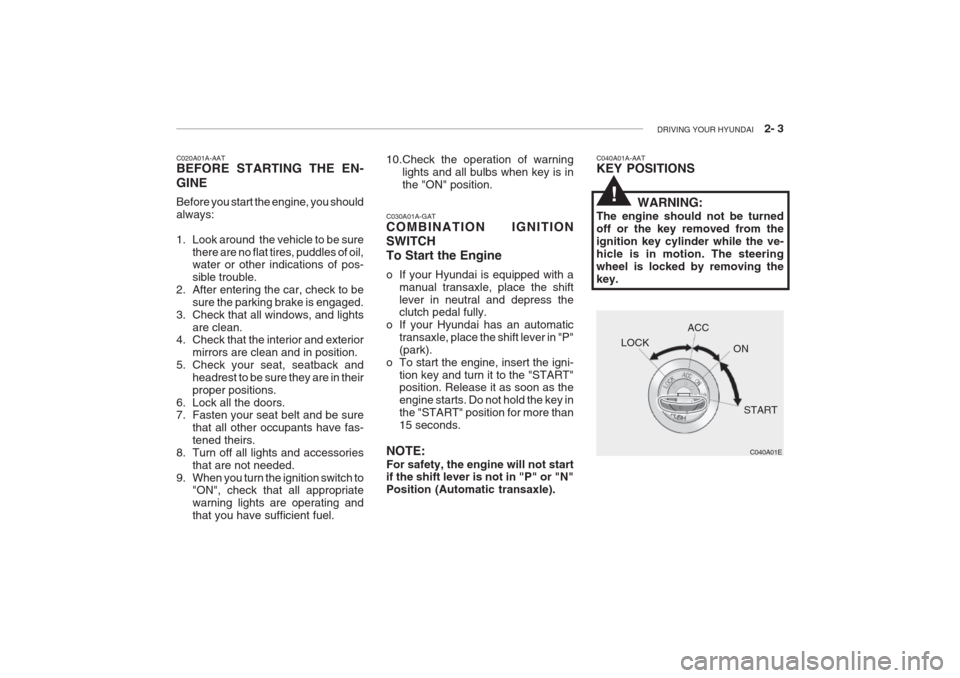
o To start the engine, insert the igni- tion key and turn it to the "START" position. Release it as soon as the engine starts. Do not hold the key inthe "START" position for more than15 seconds.
NOTE: For safety, the engine will not start if the shift lever is not in "P" or "N" Position (Automatic transaxle).
10.Check the operation of warning
lights and all bulbs when key is inthe "ON" position.C040A01A-AAT KEY POSITIONS
WARNING:
The engine should not be turned off or the key removed from theignition key cylinder while the ve-hicle is in motion. The steeringwheel is locked by removing thekey.
C040A01E
LOCK
ACC
ON
START
!
Page 143 of 230
2- 14 DRIVING YOUR HYUNDAI
o Drive at a moderate speed. The
faster you drive, the more fuel your car uses. Driving at a moderatespeed, especially on the highway, isone of the most effective ways to reduce fuel consumption.
o Don't "ride" the brake or clutch pedal. This can increase fuel consumption and also increase wear on thesecomponents. In addition, driving withyour foot resting on the brake pedal may cause the brakes to overheat, which reduces their effectivenessand may lead to more serious con-sequences.
o Take care of your tires. Keep them
inflated to the recommended pres- sure. Incorrect inflation, either too much or too little, results in unnec-essary tire wear. Check the tire pres-sures at least once a month.
o Be sure that the wheels are aligned correctly. Improper alignment can result from hitting curbs or driving too fast over irregular surfaces. Pooralignment causes faster tire wearand may also result in other prob-lems as well as greater fuel con-sumption.
transaxle) and block the rear wheelsso the car cannot roll. Then releasethe parking brake.
o Do not hold the vehicle on the up- grade with the accelerator pedal. This can cause the transaxle to overheat. Always use the brakepedal or parking brake.
C140A01A-AAT DRIVING FOR ECONOMY You can save fuel and get more miles from your car if you follow these sug-gestions:
o Drive smoothly. Accelerate at a moderate rate. Don't make "jack- rabbit" starts or full-throttle shiftsand maintain a steady cruisingspeed. Don't race between stop-lights. Try to adjust your speed tothat of the other traffic so you don't have to change speeds unneces- sarily. Avoid heavy traffic wheneverpossible. Always maintain a safedistance from other vehicles so youcan avoid unnecessary braking. Thisalso reduces brake wear.
o If your car is equipped with an auto-
matic transaxle, don't let your carcreep forward. To avoid creepingforward, keep your foot on the brake
pedal when the car is stopped.
o Use caution when parking on a hill.
Engage the parking brake and placethe gear selector lever in "P" (auto-matic transaxle) or in first or reversegear (manual transaxle). If your caris facing downhill, turn the front wheels into the curb to help keep the car from rolling. If your car is facinguphill, turn the front wheels awayfrom the curb to help keep the carfrom rolling.If there is no curb or if it is required by other conditions to keep the car from rolling, block the wheels.
o Under some conditions your park-
ing brake can freeze in the engagedposition. This is most likely to hap-pen when there is an accumulation of snow or ice around or near the rear brakes or if the brakes are wet.If there is a risk that the parkingbrake may freeze, apply it only tem-porarily while you put the gear se-lector lever in "P" (automatic) or in first or reverse gear (manual
Page 144 of 230
DRIVING YOUR HYUNDAI 2- 15
C150A01A-AAT SMOOTH CORNERING Avoid braking or gear changing in cor- ners, especially when roads are wet.Ideally, corners should always be takenunder gentle acceleration. If you followthese suggestions, tire wear will be held to a minimum. C160A01A-AAT WINTER DRIVING The more severe weather conditions of winter result in greater wear andother problems. To minimize the prob-lems of winter driving, you should fol-low these suggestions:
o Keep your car in good condition. For
better fuel economy and reducedmaintenance costs, maintain yourcar in accordance with the mainte-nance schedule in Section 5. If you drive your car in severe conditions, more frequent maintenance is re-quired (see Section 5 for details).
o Keep your car clean. For maximum service, your Hyundai should bekept clean and free of corrosive materials. It is especially important that mud, dirt, ice, etc. not be al-lowed to accumulate on the under-side of the car. This extra weightcan result in increased fuel con-sumption and also contribute to cor- rosion.
o Travel lightly. Don't carry unneces- sary weight in your car. Weight re- duces fuel economy.
o Don't let the engine idle longer than
necessary. If you are waiting (and not in traffic), turn off your engine and restart only when you're readyto go. C160B01A-GAT Snowy or Icy Conditions To drive your vehicle in deep snow, it may be necessary to use snow tires or to install tire chains on your tires. Ifsnow tires are needed, it is necessaryto select tires equivalent in size andtype of the original equipment tires. Failure to do so may adversely affect the safety and handling of your car.Furthermore, speeding, rapid accel-eration, sudden brake applications, andsharp turns are potentially very haz-ardous practices. During deceleration, use engine brak- ing to the fullest extent. Sudden brakeapplications on snowy or icy roadsmay cause skids to occur. You need tokeep sufficient distance between thevehicle in front and your vehicle. Also, apply the brake gently. It should be
o Remember, your Hyundai does not
require extended warm-up. As soon as the engine is running smoothly,you can drive away. In very coldweather, however, give your engine a slightly longer warm-up period.
o Don't "lug" or "over-rev" the engine. Lugging is driving too slowly in too high a gear resulting in the enginebucking. If this happens, shift to alower gear. Over-revving is racing the engine beyond its safe limit. This can be avoided by shifting atthe recommended speeds.
o Use your air conditioning sparingly. The air conditioning system is oper-ated by engine power so your fuel economy is reduced when you use it.
Page 146 of 230

DRIVING YOUR HYUNDAI 2- 17
C160I01A-AAT Don't Let Your Parking Brake Freeze Under some conditions your parking brake can freeze in the engaged posi-tion. This is most likely to happenwhen there is an accumulation of snow or ice around or near the rear brakes or if the brakes are wet. If there is a riskthe parking brake may freeze, apply itonly temporarily while you put the gearselector lever in "P" (automatic) or infirst or reverse gear (manual transaxle) and block the rear wheels so the car cannot roll. Then release the parkingbrake.
C160H01A-AAT Use Approved Anti-Freeze in Window Washer System To keep the water in the window washer system from freezing, add an approvedanti-freeze solution in accordance withinstructions on the container. Windowwasher anti-freeze is available fromHyundai dealers and most auto parts outlets. Do not use engine coolant or other types of anti-freeze as thesemay damage the finish.
C160K01A-AAT Carry Emergency Equipment Depending on the severity of the weather where you drive your car, youshould carry appropriate emergency equipment. Some of the items you may want to carry include tire chains,tow straps or chains, flashlight, emer-gency flares, sand, a shovel, jumpercables, a window scraper, gloves,ground cloth, coveralls, a blanket, etc.
C160J01A-AAT Don't Let Ice and Snow Accumu- late Underneath Under some conditions, snow and ice can build up under the fenders andinterfere with the steering. When driv-ing in severe winter conditions wherethis may happen, you should periodi- cally check underneath the car to be sure the movement of the front wheelsand the steering components is notobstructed.
C170A01A-AAT HIGH SPEED MOTORING Pre-Trip Inspections 1. Tires: Adjust the tire inflation pressures tospecification. Low tire inflation pres-sures will result in overheating andpossible failure of the tires. Avoid using worn or damaged tires which may result in reduced traction ortire failure. NOTE: Never exceed the maximum tire in- flation pressure shown on the tires. 2. Fuel, engine coolant and engine oil: High speed travel consumes 1.5 timesmore fuel than urban motoring. Do notforget to check both engine coolantand engine oil. 3. Drive belt: A loose or damaged drive belt mayresult in overheating of the engine.
Page 149 of 230
2- 20 DRIVING YOUR HYUNDAI
With Brake
WithoutBrake Tongue
75 (165.4)
Maximum Towable Weight
kg. (Lbs)
Trailer
1800 (3968)
750 (1653)
WARNING:
Improperly loading your car and trailer can seriously affect its steer-ing and braking performance caus- ing a crash which could cause seri- ous injury or death. C190F01Y-GAT Trailer or Vehicle Towing Tips
1. Before towing, check hitch and
safety chain connections as well as proper operation of the trailer run-ning lights, brake lights, and turnsignals.
2. Always drive your vehicle at a mod-
erate speed (Less than 100 km/h)
3. Trailer towing requires more fuel
than normal conditions.
4. To maintain engine braking effi-
ciency and electrical charging per- formance, do not use fifth gear (manual transaxle).
5. Always secure items in the trailer to prevent load shift while driving.
6. Check the condition and air pres-
sure of all tires on the trailer and your car. Low tire pressure can seriously affect the handling. Alsocheck the spare tire.
7. The vehicle/trailer combination is more affected by crosswind andbuffeting. When being passed by a large ve- hicle, keep a constant speed andsteer straight ahead. If there is toomuch wind buffeting slow down to
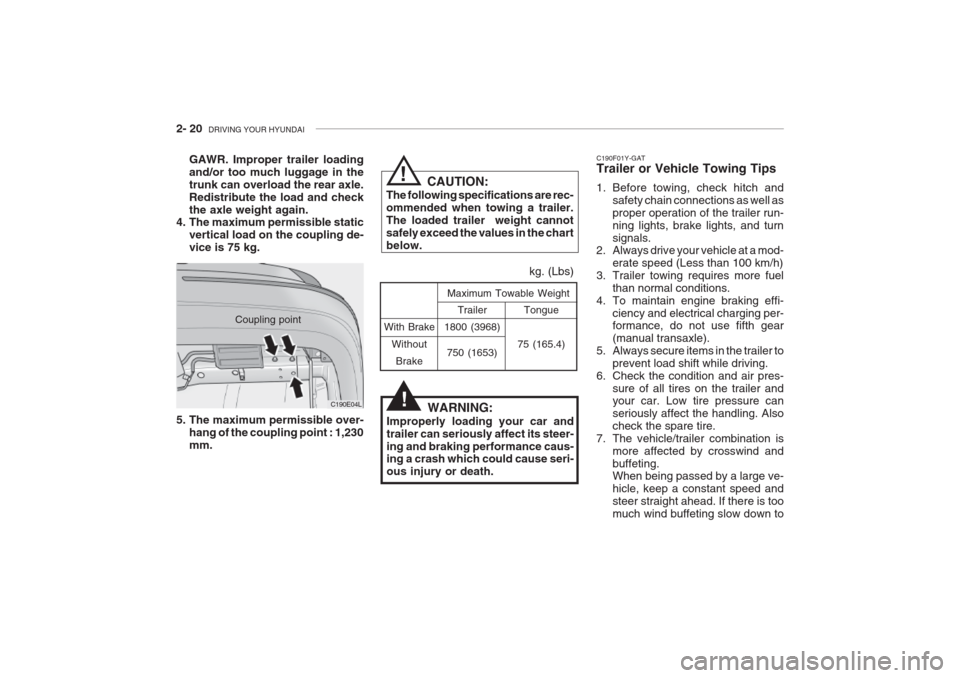
Coupling point
C190E04L
GAWR. Improper trailer loadingand/or too much luggage in thetrunk can overload the rear axle.Redistribute the load and checkthe axle weight again.
4. The maximum permissible static
vertical load on the coupling de-vice is 75 kg. CAUTION:
The following specifications are rec-ommended when towing a trailer.The loaded trailer weight cannotsafely exceed the values in the chartbelow.
!
!
5. The maximum permissible over- hang of the coupling point : 1,230 mm.
Page 150 of 230

DRIVING YOUR HYUNDAI 2- 21
14.When going down a hill, shift into a
lower gear and use the engine brak- ing effect.When ascending a long grade,downshift the transaxle to a lower gear and reduce speed to reduce chances of engine overloading and/or overheating.
15.If you have to stop while going uphill, do not hold the vehicle inplace by pressing on the accelera- tor. This can cause the automatic transaxle to overheat. Use the park-ing brake or footbrake.
NOTE: When towing, check transaxle fluid more frequently.
CAUTION:
If overheating should occur whentowing, (temperature gauge readsnear red zone), taking the followingaction may reduce or eliminate theproblem.
get out of the other vehicle's airturbulence.
8. When parking your car and trailer,
especially on a hill, be sure to followall the normal precautions. Turn your front wheel into the curb, set the parking brake firmly, and putthe transaxle in 1st or Reverse(manual) or Park (automatic). Inaddition, place wheel chocks ateach of the trailer's tires.
9. If the trailer has electric brakes,
start your vehicle and trailer mov-ing, and then apply the trailer brakecontroller by hand to be sure thebrakes are working. This lets youcheck your electrical connection at the same time.
10.During your trip, check occasion- ally to be sure that the load is secure, and that the lights and anytrailer brakes are still working.
11.Avoid jerky starts, sudden accel- eration or sudden stops.
12.Avoid sharp turns and rapid lane changes.
13.Avoid holding the brake pedal down too long or too frequently. This couldcause the brakes to overheat, re- sulting in reduced braking efficien- cy. 1. Turn off the air conditioner.
2. Reduce highway speed.
3. Select a lower gear when going
uphill.
4. While in stop and go traffic, place the gear selector in park or neutraland idle the engine at a higher speed.
!
Page 156 of 230
3- 6 WHAT TO DO IN AN EMERGENCY
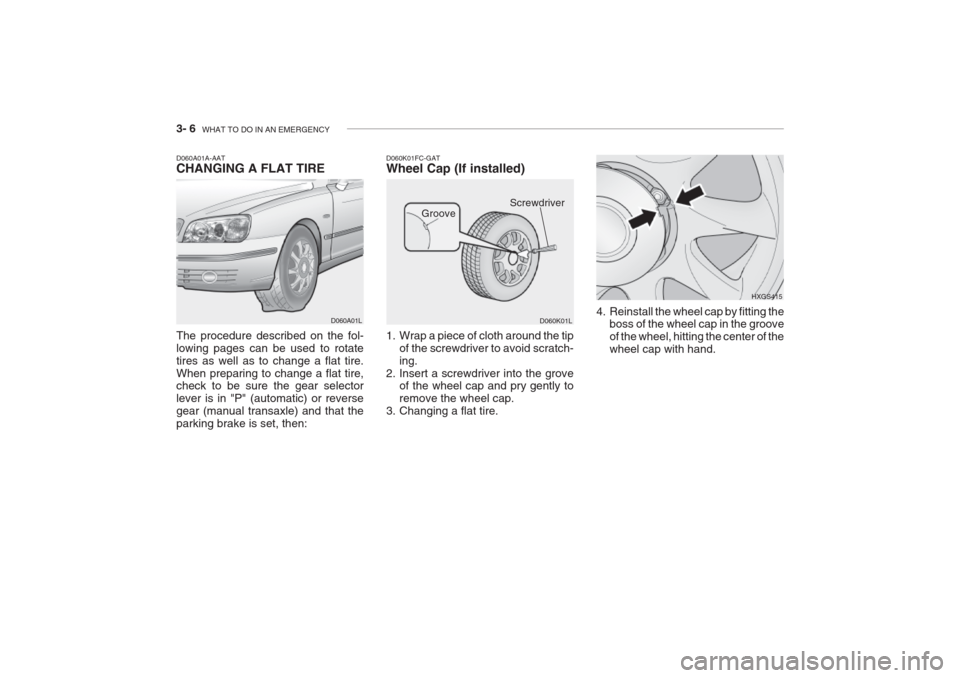
D060K01FC-GAT Wheel Cap (If installed)
D060K01L HXGS415
1. Wrap a piece of cloth around the tip of the screwdriver to avoid scratch- ing.
2. Insert a screwdriver into the grove of the wheel cap and pry gently toremove the wheel cap.
3. Changing a flat tire. 4. Reinstall the wheel cap by fitting the
boss of the wheel cap in the grooveof the wheel, hitting the center of thewheel cap with hand.
D060A01A-AAT CHANGING A FLAT TIRE The procedure described on the fol- lowing pages can be used to rotatetires as well as to change a flat tire.When preparing to change a flat tire, check to be sure the gear selector lever is in "P" (automatic) or reversegear (manual transaxle) and that theparking brake is set, then:
D060A01L Screwdriver
Groove
Page 166 of 230
4- 4 CORROSION PREVENTION AND APPEARANCE CARE
trol chemicals are used, you should pay particular attention to the under-side of the car. Start by rinsing the carto remove dust and loose dirt. In win-ter, or if you have driven through mud or muddy water, be sure to thoroughly clean the underside as well. Use ahard direct stream of water to removeaccumulations of mud or corrosivematerials. High pressure car washesmay cause water to enter your vehicle. Use a good quality car-washing solu- tion and follow the manufacturer's di-rections on the package. These areavailable at your Hyundai dealer orauto parts outlet. Don't use stronghousehold detergents, gasoline, strong solvents or abrasive cleaning powders as these may damage the finish.Use a clean sponge or cloth, rinse itfrequently and don't damage the finishby rubbing too hard. For stubborn spots,dampen them frequently and remove them a little at a time. To clean whitewall tires, use a stiff brush or soapy steel-wool scouringpad.To clean plastic wheel covers, use aclean sponge or soft cloth and water. To clean cast aluminum alloy wheels, use a mild soap or neutral detergent.Do not use abrasive cleaners. Protectthe bare-metal surfaces by cleaning,polishing and waxing. Because alumi- num is subject to corrosion, be sure to give aluminum alloy wheels specialattention in winter. If you drive onsalted roads, clean the wheels thor-oughly afterwards. After washing, be sure to rinse thor- oughly. If soapy water dries on thefinish, streaking will result. When the weather is warm and the humidity low, you may find it neces- sary to rinse each section immediately after washing to avoid streaking. After rinsing, dry the car using a dampchamois or soft, absorbent cloth. Thereason for drying the car is to removewater from the car so it will dry withoutwater spots. Don't rub, this can dam- age the finish. If you find any nicks or scratches in the paint, use touch-up paint to coverthem to prevent corrosion. To protectthe paintwork of the car against corro- sion, you must clean your Hyundai (at least once a month). Give special at-tention to the removal of salt, mud andother substances on the underside ofthe splashboards of the car. Makesure that the outlets and the underside of the doors are open. Paint damage can be caused by small accumulationof tar, industrial precipitation, tree resin,insects and bird droppings, when notremoved immediately. If water alone isnot strong enough to remove the accu- mulated dirt, use a mild car washing solution. Be sure to rinse the surfaceafter washing to remove the solution.Never allow the solution to dry on thepainted surfaces.