2002 Hyundai Getz warning
[x] Cancel search: warningPage 355 of 428
WHAT TO DO IN AN EMERGENCY 3- 9
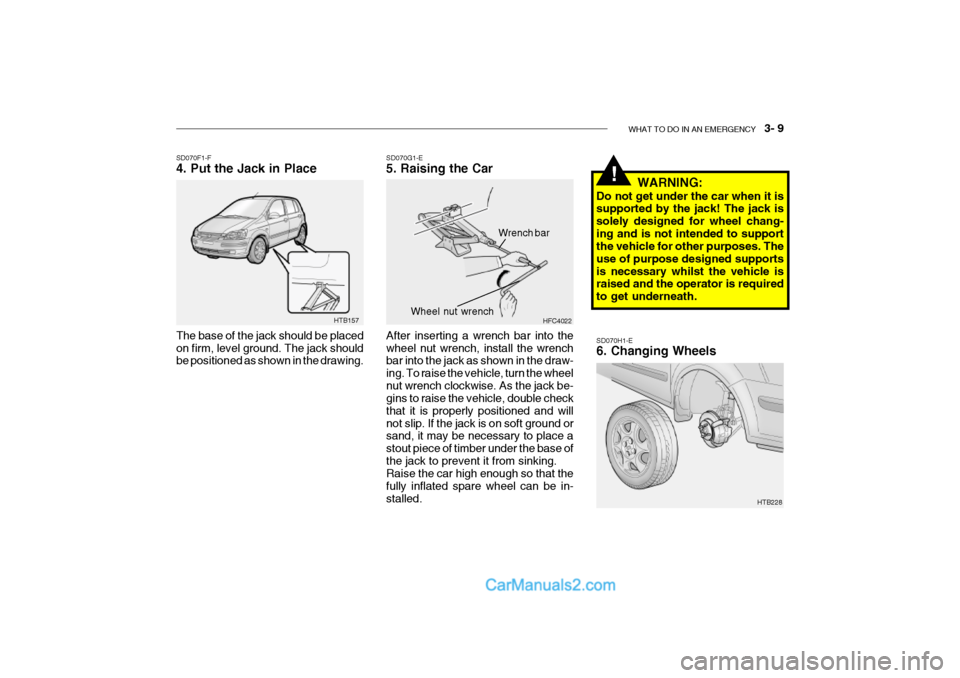
SD070H1-E 6. Changing Wheels
HTB157
SD070F1-F 4. Put the Jack in Place The base of the jack should be placed on firm, level ground. The jack should be positioned as shown in the drawing.
SD070G1-E 5. Raising the Car After inserting a wrench bar into the wheel nut wrench, install the wrench bar into the jack as shown in the draw- ing. To raise the vehicle, turn the wheelnut wrench clockwise. As the jack be- gins to raise the vehicle, double check that it is properly positioned and willnot slip. If the jack is on soft ground or sand, it may be necessary to place a stout piece of timber under the base ofthe jack to prevent it from sinking. Raise the car high enough so that the fully inflated spare wheel can be in-stalled. HFC4022
Wrench bar
Wheel nut wrench
WARNING:
Do not get under the car when it is supported by the jack! The jack is solely designed for wheel chang-ing and is not intended to support the vehicle for other purposes. The use of purpose designed supportsis necessary whilst the vehicle is raised and the operator is required to get underneath.!
HTB228
Page 356 of 428
3- 10 WHAT TO DO IN AN EMERGENCY
HTB150
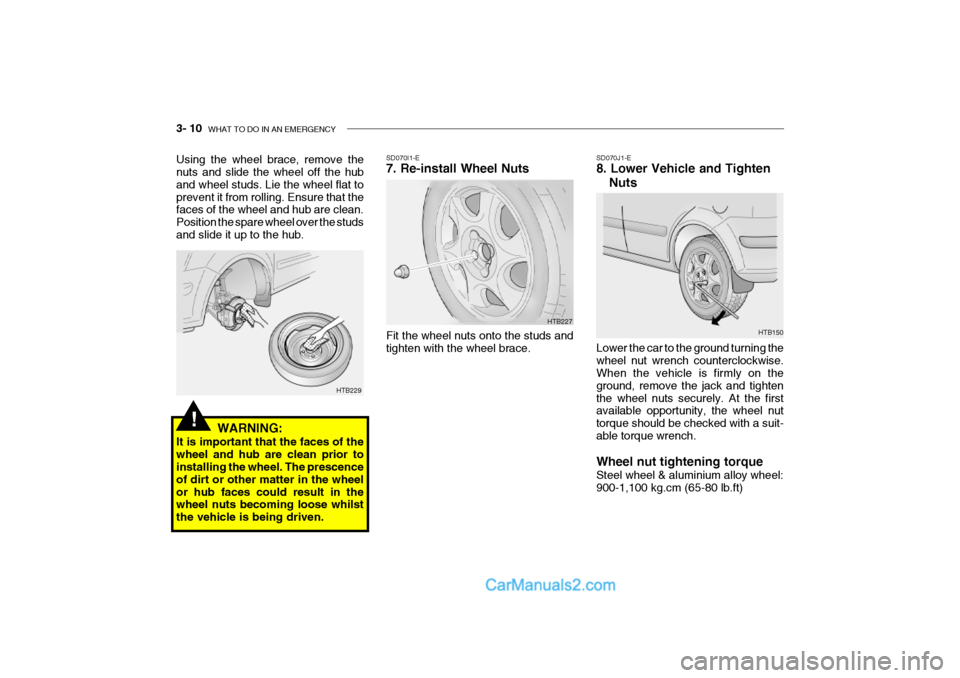
SD070J1-E 8. Lower Vehicle and Tighten
Nuts
Lower the car to the ground turning the wheel nut wrench counterclockwise. When the vehicle is firmly on the ground, remove the jack and tightenthe wheel nuts securely. At the first available opportunity, the wheel nut torque should be checked with a suit-able torque wrench. Wheel nut tightening torque Steel wheel & aluminium alloy wheel: 900-1,100 kg.cm (65-80 lb.ft)
SD070I1-E 7. Re-install Wheel NutsFit the wheel nuts onto the studs and tighten with the wheel brace.
HTB227
Using the wheel brace, remove the nuts and slide the wheel off the hub and wheel studs. Lie the wheel flat toprevent it from rolling. Ensure that the faces of the wheel and hub are clean. Position the spare wheel over the studsand slide it up to the hub.
!
HTB229
WARNING:
It is important that the faces of the wheel and hub are clean prior to installing the wheel. The prescence of dirt or other matter in the wheelor hub faces could result in the wheel nuts becoming loose whilst the vehicle is being driven.
Page 371 of 428

VEHICLE MAINTENANCE REQUIREMENTS 5- 7
6ZF060A1-A
EXPLANATION OF SCHEDULED MAINTENANCE ITEMS
6ZF060M1-A
o Engine oil and filter
The engine oil and filter should be changed at the intervals specified inthe maintenance schedule. If the car is being driven in severe conditions, more frequent oil and filter changesare required. 6ZF060B1-A
o Drive belts
Inspect all drive belts for evidence of cuts, cracks, excessive wear or oilsaturation and replace if necessary. Drive belts should be checked peri- odically for proper tension and ad-justed as necessary. 6ZF060C1-A
o Fuel filter
A clogged filter can limit the speed at
which the vehicle may be driven, dam- age the emission system and cause hard starting. If an excessive amountof foreign matter accumulates in the fuel tank, the filter may require re- placement more frequently.
After installing a new filter, run the
engine for several minutes, and checkfor leaks at the connections.
F060D01TB-EAT
o Fuel lines, fuel hoses and con- nections
Check the fuel lines, fuel hoses and
connections for leakage and damage. Replace any damaged or leaking parts immediately.
6ZF060E1-A o Timing belt Replace timimg belt and inspect all associated parts related for damageand deformation. Replace any dam- aged parts immediately.
!WARNING (Diesel only):
Never work on injection system with engine running or within 30 seconds after shutting off engine. High pressure pump, rail, injectorsand high pressure pipes are sub- jected to high pressure even after the engine has been switched off.The fuel jet produced by fuel leaks may cause serious injury, if it con- tacts with the body. People usingpacemakers should not move closer than 30cm to the ECU or wiring harness within the engine room with the engine running, since the high currents in the CommonRail system produce considerable magnetic fields.
Page 380 of 428

6- 6 DO-IT-YOURSELF MAINTENANCE
SG020B1-E DAILY OPERATING CHECKS The following items should be checked on a daily basis or whenever the vehicleis refuelled, whichever occurs sooner.
o Engine oil level.
o Engine coolant level.
o Power steering fluid level.
o Brake fluid level.
o Windscreen washer fluid level.
o Battery condition.
o Tyre condition and pressures.
o Operation and cleanliness of all light-
ing equipment.
o Windscreen wiper and washer opera- tion.
o Horn operation.
o Warning light operation.
o Adjustment and cleanliness of mir- rors.
o Seat and seat belt adjustment and operation.
o Fluid leakage. The vehicle must not be driven if the daily operating checks indicate that any item of equipment related to thesafety or roadworthiness of the vehicle is not functioning correctly. G030B02A-EAT Recommended Oil
1. Petrol engine A multi grade oil having a specification which meets A.P.I. specification of SGor above is recommended. The oil vis- cosity should be selected according to the operating environment of the engineby means of the table shown in the illustration. The engine oil recommen- dations are complete in themselvesand the use of additives is neither required nor recommended. The use of engine oil additives may result in invali-dation of the vehicle warranty.
G030A01FC-EAT ENGINE OIL The correct engine oil level is of para- mount importance. An excessively highor low oil level may result in irreparable damage being sustained by the engine. The engine oil level must be checkedon a daily basis, whenever the vehicle is refuelled or before starting a long trip, whichever occurs sooner.In addition, it is imperative that only an approved grade and specification of oil is used to avoid the possibility of seri-ous engine damage and premature wear. The use of "budget price" oil is a false economy that must be avoided if themaximum reliability and useful life is to be obtained from the vehicle.
G030B01L
Page 384 of 428

6- 10 DO-IT-YOURSELF MAINTENANCE
HTB170
Petrol engine SG050A1-E ENGINE COOLANT CHECKING AND REPLACING
SG050B1-E Coolant recommendations WARNING:
Do not remove the radiator cap when the engine is hot, since the system is pressurized and coolant may beejected from the radiator resulting in scalding.
!
!
3. Prepare a suitable receptacle to col- lect the displaced oil and remove the drain plug from the sump.
4. When the oil has drained from the sump, replace the drain plug using anew washer ensuring that the plug is not over tightened. Tightening torque is: 3.5 ~ 4.5 kgf.m
5. Remove the oil filter by rotating coun- terclockwise, using a proprietary oil filter removal tool if necessary. Notethat the oil filter will contain approxi- mately 0.5 litres of oil and this should be collected in a suitable receptacle.
6. Install a new oil filter having smeared the sealing ring with clean oil androtating clockwise until the filter con-tacts the mounting and then a further one half turn. Do not over-tighten CAUTION:
The oil being drained from the en- gine will be hot. Care should beexercised to prevent scalding.
! Tightening torque: Petrol -
1.2 ~ 1.6 kgf.m
Diesel(RHD) - 2.3 ~ 2.5 kgf.m
7. Pour the specified quantity of the recommended oil into the engine and replace the filler cap. Start the en- gine and ensure that no oil leaks exist. Turn off the engine and after acouple minutes, recheck the oil level.
WARNING:
Prolonged and repeated contact with used engine oils may result in seri- ous skin disorders including derma-titis and cancer. Avoid contact with skin as far as possible and always wash thoroughly after any contact.Keep used oils out of reach of chil- dren. It is illegal to pollute drains, water courses and soil. Use onlyauthorized waste collection facili- ties including civic amenity sites and garages for the disposal of usedoil and oil filters. If in doubt, contact the local authority for disposal in- structions.
Page 386 of 428

6- 12 DO-IT-YOURSELF MAINTENANCE
HTB172
!
HTB171
1. Park the vehicle on level ground and
ensure that the parking brake is firmly applied, and the engine allowed tocool. Do not attempt this operation whilst the engine is hot since burning orscalding may result.
2. Prepare a suitable receptacle to col-
lect the displaced coolant and posi-tion this under the radiator drain tap.
3. With the heater temperature control
set to the "HOT" position, removethe radiator cap and open the radiator drain tap. 5. Prepare a suitable quantity of new
engine coolant (refer to section 9)and pour this into the radiator.
6. Start the engine with the radiator cap
still removed and continue to addcoolant as the level decreases as air is expelled from the system. Whenthe level remains constant, replace the radiator cap and replenish the coolant reservoir.
7. When the engine is hot, check to ensure that no coolant leaks arepresent.
4. When the engine coolant has drained completely, close the drain tap en-suring that this is not over tightened. WARNING:
The cooling fan is controlled by en-gine coolant temperature and may sometimes operate even when the engine is not running. Use extremecaution when working near the blades of the cooling fan so that you are not injured by a rotating fanblade. As the engine coolant tem- perature decreases, the fan will auto- matically shut off. This is a normalcondition.
Page 389 of 428

DO-IT-YOURSELF MAINTENANCE 6- 15
SG100A1-E MANUAL TRANSAXLE LUBRICANT
SG090A2-E WINDSCREEN WASHER RES- ERVOIR REPLENISHMENT The level of windscreen washer fluid available should be checked on a daily basis. The level of fluid will be visiblethrough the side of the reservoir. When the fluid is to be replenished, only a proprietary screen wash additive shouldbe used and in the concentration rec- ommended by the manufacturer. The windscreen washer reservoir has a totalcapacity of 3 litres. CAUTION:
Engine coolant anti freeze must notbe used in the windscreen washersystem since damage to the paintwork may result. Undiluted windscreen washer addi-tive must not be allowed to come into contact with the paintwork. If spillage occurs, flush the affectedarea immediately with water. Do not operate the windscreen washer for more than 15 seconds continuouslyor when the reservoir is empty since damage to the washer pump will result.
!
HTB173
HXGS506
Drain plug
Filler plug
The manual transaxle lubricant must be checked and or changed at the inter-vals specified in the maintenance sched- ule. Only those lubricants specified below should be used in order to pre-vent gear shifting difficulties or transaxle damage.
!WARNING:
The transaxle lubricant level should only be checked when the engine iscold to preclude the possibility of personal injury by contact with hot components.
Page 391 of 428
DO-IT-YOURSELF MAINTENANCE 6- 17
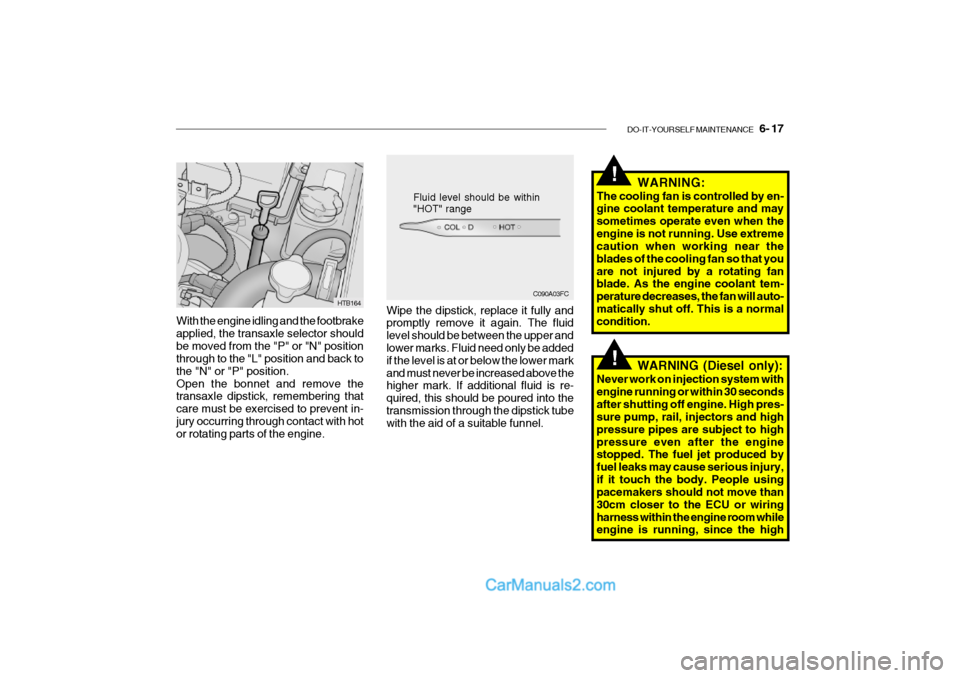
With the engine idling and the footbrake applied, the transaxle selector shouldbe moved from the "P" or "N" position through to the "L" position and back to the "N" or "P" position.Open the bonnet and remove the transaxle dipstick, remembering that care must be exercised to prevent in-jury occurring through contact with hot or rotating parts of the engine.
C090A03FC
Fluid level should be within "HOT" range
HTB164 Wipe the dipstick, replace it fully and promptly remove it again. The fluid level should be between the upper and lower marks. Fluid need only be added if the level is at or below the lower markand must never be increased above the higher mark. If additional fluid is re- quired, this should be poured into thetransmission through the dipstick tube with the aid of a suitable funnel. WARNING:
The cooling fan is controlled by en-gine coolant temperature and may sometimes operate even when theengine is not running. Use extreme caution when working near the blades of the cooling fan so that youare not injured by a rotating fan blade. As the engine coolant tem- perature decreases, the fan will auto-matically shut off. This is a normal condition.
!
!WARNING (Diesel only):
Never work on injection system with engine running or within 30 secondsafter shutting off engine. High pres- sure pump, rail, injectors and high pressure pipes are subject to highpressure even after the engine stopped. The fuel jet produced by fuel leaks may cause serious injury,if it touch the body. People using pacemakers should not move than 30cm closer to the ECU or wiringharness within the engine room while engine is running, since the high