2002 HONDA PASSPORT flat tire
[x] Cancel search: flat tirePage 172 of 294

169Driving Tips
Wheel Replacement
Considerations
Damaged wheels must be
replaced. For example, replace
wheels if they are bent, cracked or
heavily rusted, or if wheel nuts
often become loose. Also replace
wheels that leak air (except some
aluminum wheels that can be
repaired). See your Honda dealer.
Do not use bent wheels that have
been straightened, and do not use
tubes in leaking wheels designed
for tubeless tires. Such wheels
may have structural damage and
could fail without warning.
Maximum loads, maximum
inflation pressures, wheel
identification codes, and wheel
sizes are stamped on each wheel.
Service-tested and approvedwheels are available from your
Honda dealer.
When obtaining wheels for any
reason from any other source, the
replacement wheels should be
equal in load capacity, inflation
pressure capacity, diameter, width,
offset and mounting configuration
to those originally installed on
your vehicle. A wheel of the
wrong size or type may adversely
affect load carrying capacity,
wheel and bearing life, brake
cooling, speedometer/odometer
calibration, stopping ability,
headlight aim, bumper height,
vehicle ground clearance, and tire
or tire chain clearance to the body
and chassis. Replacement with
used wheels is not advised: They
may have been subjected to harsh
treatment or very high mileage and
could fail without warning.
Installing wheels and/or tires that
have a higher load carrying limit
than those that originally came on
your vehicle does not increase the
GAWR or GVWR of the vehicle.
Page 174 of 294

171Driving Tips
air cleaner, so it’
s important to
replace the air cleaner filter at
required intervals. See “Care and
Maintenance.” A dirty air cleaner
filter reduces engine performance
and can waste fuel.
Air Conditioning
Turn off the air conditioning when
it is not needed. The air
conditioning compressor is not on
in this position and the reduced
engine load can improve fuel
economy.
Tuned Engine
An engine that is properly
maintained will provide better
fuel economy than one that is not.
One misfiring spark plug will cut
fuel economy significantly, and
will make a difference in the
amount of pollution emitted from
your vehicle. Excessive Weight
Fuel economy is related to the
work the engine must do. The
heavier the load, the more fuel it
takes to run your vehicle. Keep
weight to a minimum by removing
unnecessary luggage or cargo.
Tire Inflation
Underinflation not only causes
needless tire wear but can also
waste fuel. It’
s a good idea to
check tire pressure often and keep
your tires inflated to the pressures
shown on the tire placard located
on the driver ’s doorjamb. Wheel Alignment
Improper alignment will cause the
front tires to roll at an angle that
will result in faster tire wear. It
takes power to overcome this
improper alignment, which, in
turn, wastes fuel.
Use of 4-Wheel Drive
In normal driving, put the
4WD-2WD switch in the 2WD
position.
Page 177 of 294

174 Driving Tips
systems, such as the
SRS
and
anti-lock brake system.
However, if electronic accessories
are improperly installed, or
exceed your vehicle ’s electrical
system capacity, they can interfere
with the operation of your vehicle,
or even cause the airbags to
deploy.
Before installing any accessory:
• Make sure the accessory does
not obscure any lights, or
interfere with proper vehicle
operation or performance.
• Be sure electronic accessories
do not overload electrical
circuits (see page 240).
•Have the installer contact your
Honda dealer for assistance
before installing any electronic
accessory. If possible, have your dealer
inspect the final installation.
Modifications
Do not remove any original
equipment or modify your vehicle
in any way that would alter its
design or operation. This could
make your vehicle unsafe and
illegal to drive.
For example, do not make any
modifications that would change
the ride height of your vehicle, or
install wheels and tires with a
different overall diameter.
Such modifications can adversely
affect handling, and interfere with
the operation of the vehicle
’s
anti-lock brakes and other
systems.
In addition, any modifications that
decrease ground clearance increase the chance of
undercarriage parts striking a
curb, speed bump, or other raised
object, which could cause your
airbags to deploy.
Do not modify your steering
wheel or any other part of your
Supplemental Restraint System.
Modifications could make the
system ineffective.
Additional Safety Precaution
Do not attach or place objects on
the airbag covers. Any object
attached to, or placed on, the
covers marked “
SRS,” in the
center of the steering wheel and
on top of the dashboard, could
interfere with the proper operation
of the airbags. Or, if the airbags
inflate, the objects could be
propelled inside the vehicle and
hurt someone.
Page 184 of 294

181Driving Tips
Safety Chain
Always use suitable safety chains
between your vehicle and the
trailer.
Check with your trailer
manufacturer for the required
equipment. Cross the safety
chains under the hitch and attach
them to the trailer hitch hardware.
This will prevent the trailer from
dropping to the ground in the
event the hitch disengages. For
proper use and installation,
consult your trailer manufacturer.
Trailer Lights
Trailer lights and equipment must
comply with federal, state and
local regulations. Check with your
local recreational vehicle dealer
for the requirements in your area.Use only equipment designed for
your vehicle.
Improper equipment or
installation can cause damage to
your vehicle’
s electrical system
and affect your vehicle warranty.
Consult your Honda dealer for
installation.
Tires
Always check the condition of
your vehicle’ s tires and trailer ’s
tires before operation. Replace
worn or damaged tires before
operation.
Inflate tire pressure to the
recommended cold tire pressure
indicated in the tire
manufacturer ’ s warranty booklet
in the glove box packet. Check the tire manufacturer
’s
requirements when replacement
tires are installed on your vehicle.
Trailer tire condition, size, load
rating, and proper inflation
pressure should be in accordance
with the tire manufacturer ’s
specifications. Improper tire size
and inflation can cause tire
failure, possibly resulting in
vehicle damage and personal
injury.
Trailer Brakes
Trailers with a total weight of
1,000 pounds or more require
trailer brakes. If your trailer is
equipped with a braking system,
make sure it conforms to federal,
state, and local equipment
regulations.
Page 189 of 294

186 In Case of Emergency
6.
Start the engine of the vehicle
that has the discharged battery.
7. Remove the battery cables by
reversing the above sequence
exactly. Start by removing the
last clamp first; that is,
remove the jumper cable from
the engine of the vehicle with
the discharged battery as the
first step. If you have a flat tire while
driving, stop in a safe place to
change it. Stopping in traffic or on
the shoulder of a busy road is
dangerous. Drive slowly along the
shoulder until you get to an exit or
an area to stop that is far away
from the traffic lanes.
The vehicle can easily roll off
the jack, seriously injuring
anyone underneath.
Follow the directions for
changing a tire exactly, and
never get under the vehicle
when it is supported only by
the jack.
1.
Park on a level surface and set
the parking brake firmly. Turn
on the hazard warning flasher,
and turn the ignition switch to
LOCK.
2. Set the automatic transmission
in “Park” (the manual
transmission in “Reverse”)
and transfer case in gear if it
is a four-wheel drive vehicle.
3. Have your passengers get out
of the vehicle.
4. Remove the jacking tools (see
page 188) and spare tire from
their stowage areas.
Changing a Tire
Page 191 of 294

188In Case of Emergency
8. Turn the jack handle
clockwise with a slow, smooth
motion to raise the vehicle so
the inflated spare tire will
clear the surface.
9. Remove the wheel nuts and the wheel.
10. Install the wheel and replace the wheel nuts with the
cone-shaped end toward the
wheel, then hand-tighten each
nut. The wheel must be seated
on the hub.
11. Lower the vehicle by turning the jack handle counter-
clockwise, then fully tighten
the wheel nuts in a crisscross
sequence by turning the
wrench clockwise. Have the
wheel nut torque checked at
the nearest automotive service
facility.
87 lb-ft (118 N·m) 12. Stow the jacking tools and flat
tire in their proper locations.
EX model
Use the screwdriver to remove the
center cap from the wheel before
stowing the flat tire.
Loose items can fly around the
interior in a crash and could
seriously injure the occupants.
Store the wheel, jack, and
tools securely before driving.
The jack is stored in a
compartment on the driver ’s side
rear wheel panel.
To remove the jack from its
compartment, turn the handle
counterclockwise. Disconnect the
hold-down strap.
Tool Locations
Page 198 of 294

195Care and Maintenance
This section explains why it is
important to keep your vehicle
well maintained and to follow
basic maintenance safety
precautions.
This section also includes
Maintenance Schedules for
normal driving and severe driving
conditions, a Maintenance
Record, and instructions for
simple maintenance tasks you
may want to take care of yourself.
If you have the skills and tools
required
to perform more complex
maintenance tasks on your Honda,
you may want to purchase the
Service Manual. See page 253 for
information on how to obtain a
copy, or see your Honda dealer. Service Station Information
197
.
Fuel Fill Cap 197
. . . . . . . . . .
Fuel Recommendation 198
. . .
Fuel Tank Capacity 198
. . . . .
Engine Oil
Recommendation 198
. . . . . .
Windshield Washer 198
. . . . .
Tire Inflation Pressures 198
. .
Battery 198
. . . . . . . . . . . . . . .
Hood Release 199
. . . . . . . . . .
Engine Oil Dipstick 200
. . . . .
Fuel Requirements 200
. . . . . . . .
Oxygenated Fuels 200
. . . . . .
Maintenance Safety 201
. . . . . . .
Important Safety
Precautions 202
. . . . . . . . . .
Maintenance Schedule 203
. . . . .
Required Maintenance Record 206
Owner Safety Checks 208
. . . . . .
Engine Oil and Filter 211
. . . . . .
Proper Quality Oil 211
. . . . . . Change Interval
211
. . . . . . . .
Oil Change 212
. . . . . . . . . . .
Oil Filter Installation 212
.
Oil Viscosity 213
. . . . . . . . . .
Oil Level Check 213
. . . . . . .
Engine Oil Additives 214
. . .
Air Cleaner Filter 214
. . . . . . . .
Manual Transmission Fluid 215
Automatic Transmission
Fluid 216
. . . . . . . . . . . . . . . . . .
Front (4
WD) and
Rear Axles 216
. . . . . . . . . . . . .
Engine Cooling System 217
. . .
Other Required Maintenance 219
Brake Master Cylinder 219
. .
Shift-on-the-Fly System 220
.
Front Wheel Bearings 220
. . .
Hood Latch and Hinges 221
.
Air Conditioning 221
. . . . . . .
Body Lubrication 221
. . . . . .
Care and Maintenance
Page 201 of 294
198Care and Maintenance
Fuel Recommendation
Use only unleaded gasoline. For
additional information see “Fuel
Requirements” in this section.
Fuel Tank Capacity
19.5 U.S. gallons (75 liters)
Engine Oil Recommendation
Use only SJ quality oil.
The chart shown under “Engine
Oil and Filter” in this section will
serve as a guide for choosing the
proper viscosity oil.
Windshield Washer
Check the reservoir fluid level
regularly. Use a commercially
available windshield washer fluid.
The windshield washer reservoir
is located on the front right side of
the engine compartment.
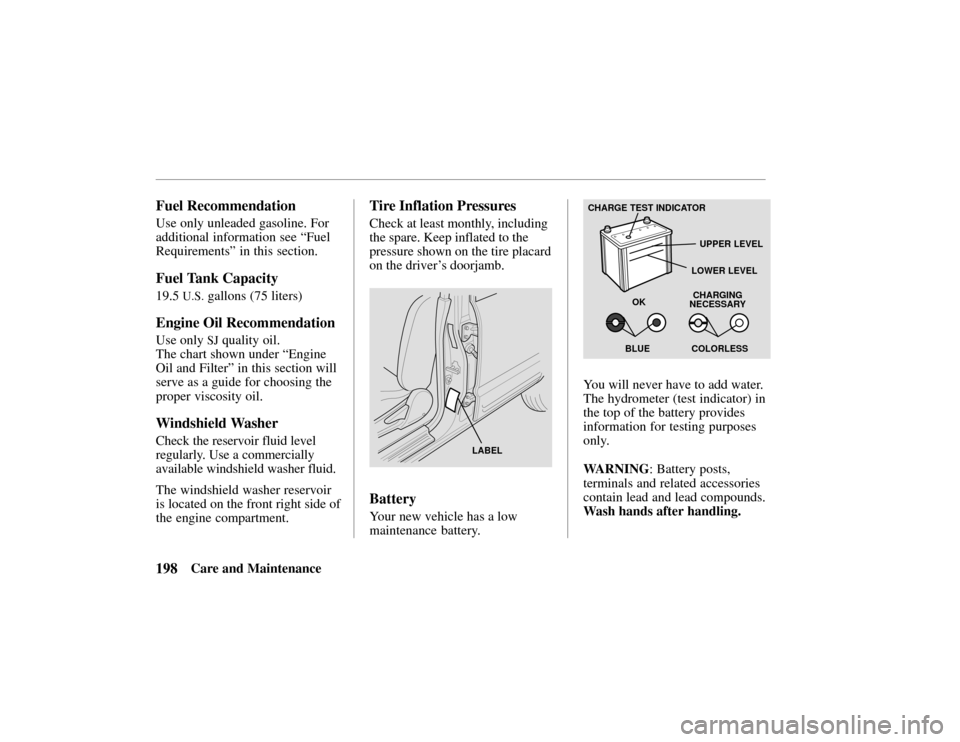
Tire Inflation Pressures
Check at least monthly, including
the spare. Keep inflated to the
pressure shown on the tire placard
on the driver’s doorjamb.
LABEL
Battery
Your new vehicle has a low
maintenance battery.
CHARGE TEST INDICATOR
UPPER LEVEL
LOWER LEVEL CHARGING
NECESSARY
OK
BLUE COLORLESS
You will never have to add water.
The hydrometer (test indicator) in
the top of the battery provides
information for testing purposes
only.
WARNING : Battery posts,
terminals and related accessories
contain lead and lead compounds.
Wash hands after handling.