Page 295 of 399
When the coolant stops draining,
tightenthedrainplugatthe
bottom of the radiator.
Tighten the drain bolt at the rear
of the engine cylinder block
securely.
Tightening torque:
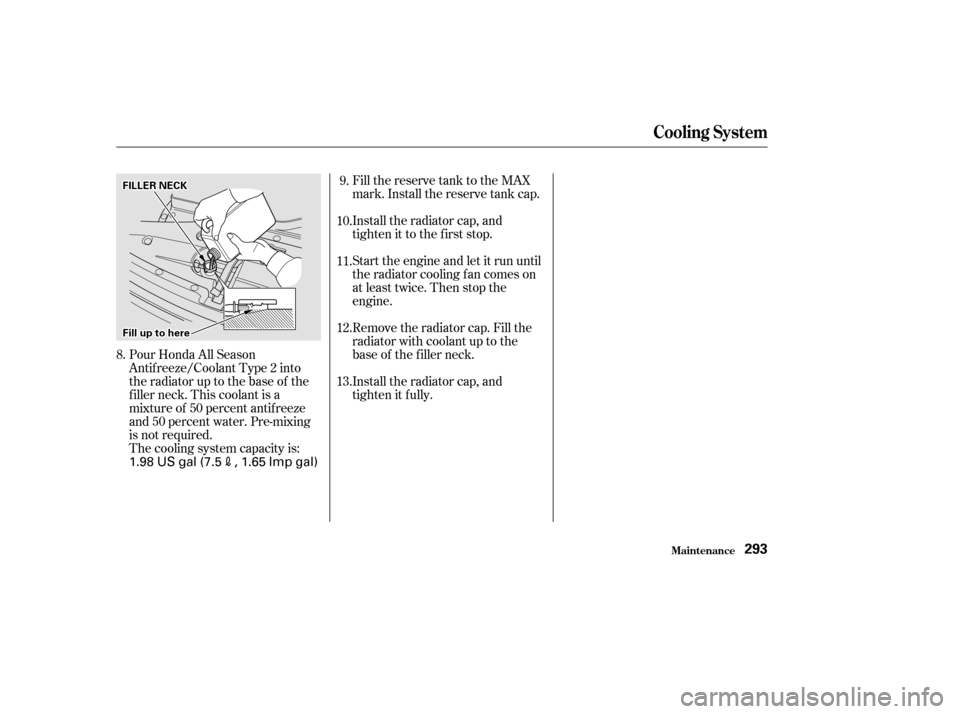
Remove the reserve tank f rom its
holder by pulling it straight up.
Drain the coolant, then put the
tank back in its holder.
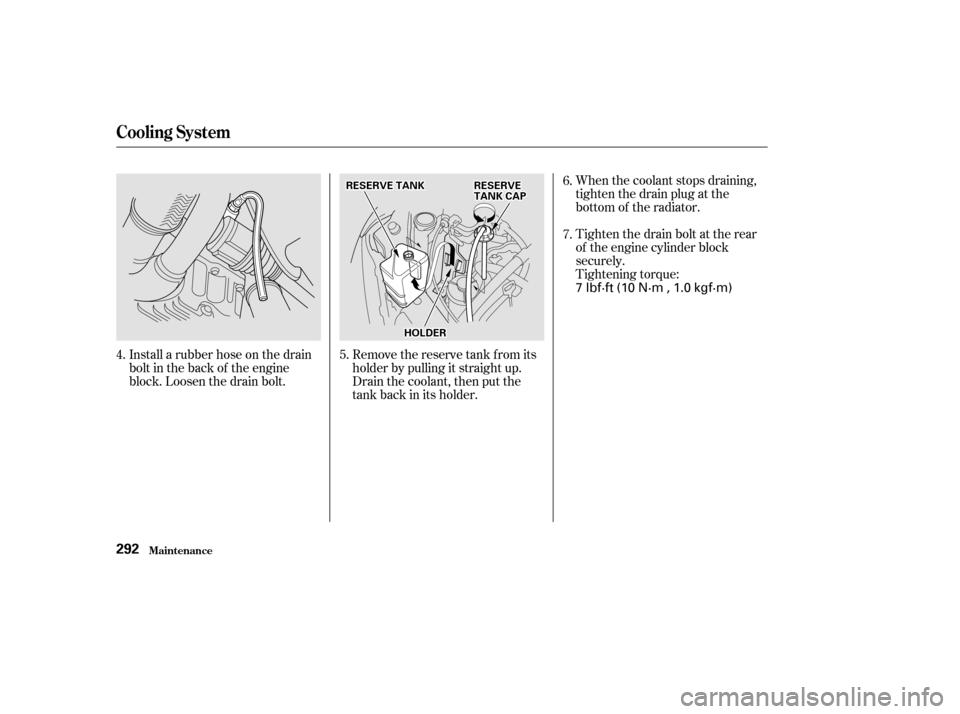
Install a rubber hose on the drain
bolt in the back of the engine
block. Loosen the drain bolt. 6.
4. 5. 7.
Cooling Syst em
Maint enance292
R RE
ES
SE ER
RV V E
E T
TA
A N
NK K R
REES
SE ER
RV V E
E
T
T A
A N
NK K C
CAA P
P
H
H O
OL LDD E
ER
R
7 lbf·ft (10 N·m , 1.0 kgf·m)
Page 296 of 399
Fill the reserve tank to the MAX
mark. Install the reserve tank cap.
Install the radiator cap, and
tighten it to the first stop.
Start the engine and let it run until
the radiator cooling f an comes on
at least twice. Then stop the
engine.
Remove the radiator cap. Fill the
radiator with coolant up to the
base of the f iller neck.
Install the radiator cap, and
tighten it fully.
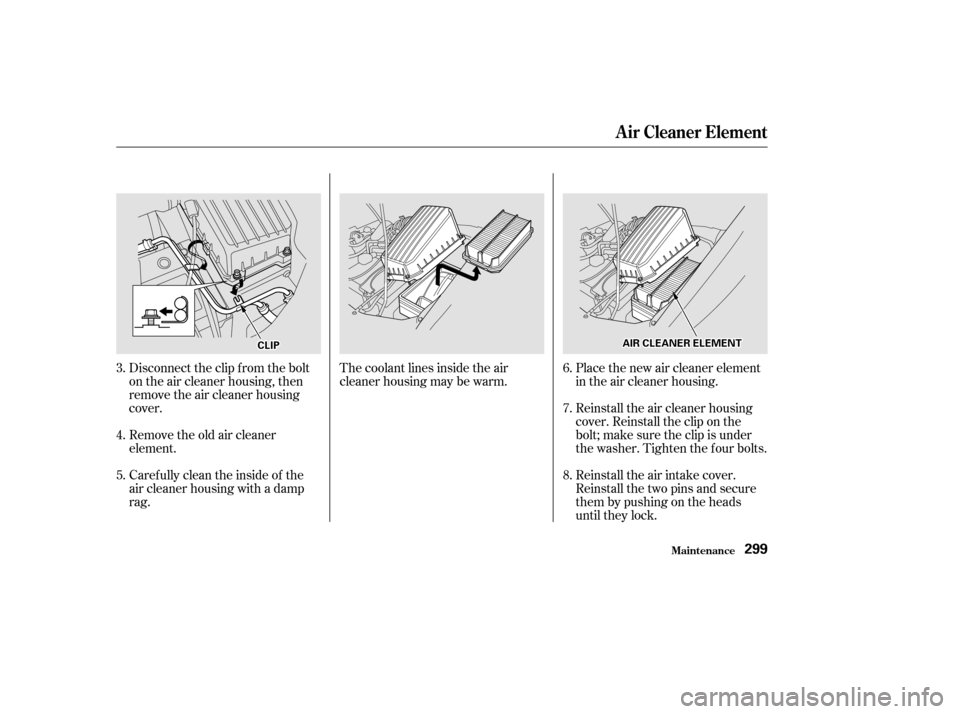
Pour Honda All Season
Antif reeze/Coolant Type 2 into
the radiator up to the base of the
f iller neck. This coolant is a
mixture of 50 percent antif reeze
and 50 percent water. Pre-mixing
is not required.
The cooling system capacity is:
8. 10.
11.
12.
13.9.
Cooling Syst em
Maint enance293
F FI
ILLL LEE R
R N
NEEC
CK K
F
Fi illll u
u p
p t
too h
he
erree
1.98 US gal (7.5, 1.65 Imp gal)
Page 302 of 399
Disconnect the clip f rom the bolt
on the air cleaner housing, then
remove the air cleaner housing
cover.Place the new air cleaner element
in the air cleaner housing.
Reinstall the air cleaner housing
cover. Reinstall the clip on the
bolt; make sure the clip is under
the washer. Tighten the four bolts.
Reinstall the air intake cover.
Reinstall the two pins and secure
thembypushingontheheads
until they lock.
The coolant lines inside the air
cleaner housing may be warm.
Caref ully clean the inside of the
air cleaner housing with a damp
rag. Remove the old air cleaner
element.
3.
4.
6.
7.
5. 8.
A ir Cleaner Element
Maint enance299
C CLLIIPP A
A
I
IRR C
CLLEE A
A N
NE ER
R E
EL
LEE M
M E
EN
NT T
Page 354 of 399

Once your vehicle is running,
disconnect the negative cable f rom
your vehicle, then f rom the
booster battery. Disconnect the
positive cable f rom your vehicle,
then the booster battery.The pointer of your vehicle’s
temperature gauge should stay in
the midrange under most conditions.
Itmaygohigherif youaredrivingup
a long steep hill on a very hot day. If
it climbs to the red mark, you should
determine the reason. Your vehicle can overheat for several
reasons, such as lack of coolant or a
mechanical problem. The only
indication may be the temperature
gauge climbing to or above the red
mark. Or you may see steam or
spray coming f rom under the hood.
In either case, you should take
immediate action.
Keep the ends of the jumper cables
away from each other and any metal
on the vehicle until all are
disconnected. Otherwise, you may
cause an electrical short. 7.
CONT INUED
Jump Starting, If Your Engine Overheats
If Your Engine Overheats
T aking Care of t he Unexpect ed351
Steam and spray from an
overheated engine can
seriously scald you.
Do not open the hood if steam
is coming out.
Driving with the temperature gauge
pointer at the red mark can cause
serious damage to your engine.
Page 355 of 399

Saf ely pull to the side of the road.
Put the transmission in Neutral or
Park and set the parking brake.
Turn of f the heating and cooling/
climate control system and all
otheraccessories.Turnonthe
hazard warning indicators.
If you see steam and/or spray
coming f rom under the hood, turn
of f the engine.If you do not see steam or spray,
leave the engine running and
watch the temperature gauge. If
the high heat is due to overloading
(climbing a long, steep hill on a
hot day with the A/C running, f or
example), the engine should start
to cool down almost immediately.
If it does, wait until the tempera-
ture gauge comes down to the mid-
point then continue driving.
If the temperature gauge stays at
the red mark, turn of f the engine.
Wait until you see no more signs
of steam or spray, then open the
hood.Look f or any obvious coolant leaks,
such as a split radiator hose.
Everything is still extremely hot,
so use caution. If you f ind a leak, it
must be repaired bef ore you
continue driving (see
on page ).
If you don’t f ind an obvious leak,
check the coolant level in the
radiator reserve tank (see page ). If the level is below the
MIN mark, add coolant to halfway
between the MIN and MAX marks.
1.
2.
3.
7. 6.
5. 4. 237365
If Your Engine Overheats
T aking Care of t he Unexpect ed
Emergency
Towing
352
Page 356 of 399

If there was no coolant in the
reserve tank, you may also have to
add coolant to the radiator. Let the
engine cool down until the pointer
reaches the middle of the tempera-
ture gauge, or lower, bef ore check-
ing the radiator.Using gloves or a large heavy
cloth, turn the radiator cap
counterclockwise, without pushing
down, to the f irst stop. This
releases any remaining pressure in
the cooling system. After the
pressure releases, push down on
the cap and turn it until it comes
off.
Start the engine and set the
temperature control dial to
maximum (climate control to
FULL AUTO at 90°F/32°C). Add
coolant to the radiator up to the
base of the f iller neck. If you do
not have the proper coolant
mixture available, you can add
plain water. Remember to have
the cooling system drained and
ref illed with the proper mixture as
soon as you can.Put the radiator cap back on
tightly. Run the engine and watch
the temperature gauge. If it goes
back to the red mark, the engine
needs repair. (See
on page .)
If the temperature stays normal,
check the coolant level in the
radiator reserve tank. If it has
gone down, add coolant to the
MAX mark. Put the cap back on
tightly.
8.
9.
10. 12. 11.
365Emergency
Towing
If Your Engine Overheats
T aking Care of t he Unexpect ed353
Removing the radiator cap
while the engine is hot can
cause the coolant to spray out,
seriously scalding you.
Always let the engine and
radiator cool down before
removing the radiator cap.
Page 373 of 399

�µ�µ�Î
�Î
�Î
�Î
�Î
�Î
�Î
�Î
Specif ications
T echnical Inf ormation370
Dimensions
Weights
Air Conditioning Capacities
201.2 in (5,110 mm)
75.6 in (1,920 mm)
5.3 US qt (5.0
, 4.4 Imp qt)
2.6 US qt (2.5
, 2.2 Imp qt)
Including the coolant in the reserve tank and that remaining in the
engine.
Reserve tank capacity:
0.16 US gal (0.6
, 0.13 Imp gal)
Excluding the oil remaining in the engine. 4.6 US qt (4.4
, 3.9 Imp qt)
4.2 US qt (4.0
, 3.5 Imp qt)
2.48 US gal (9.4
, 2.07 Imp gal)
3.5 US qt (3.3
, 2.9 Imp qt)
8.3 US qt (7.9, 7.0 Imp qt)
4.8 US qt (4.5
, 4.0 Imp qt)
HFC-134a (R-134a)
66.1 in (1,680 mm) 66.1 in (1,680 mm)
118.1 in (3,000 mm) 68.5 in (1,740 mm)
32 34 oz (850 900 g) ND-OIL8 20.00 US gal (75.7
, 16.65 Imp gal)
1.98 US gal (7.5, 1.65 Imp gal)
69.7 in (1,770 mm)
Length
Width
Height
Wheelbase
Track
Gross vehicle weight rating
Gross combined weight
rating (GCWR) See the tire information label atta-
ched to the driver’s doorjamb.
Refrigerant type
Charge quantity
Lubricant type Fuel tank
Engine
coolant
Engine oil
Automatic
transmission
fluid
Windshield
washer
reservoir
8,265 lbs (3,750 kg) Approx.
Front
Rear
1:
2:Change
Total
Change
Including
filter
Without
filter
Total
Change
Total
U.S. Vehicles
Canada Vehicles
1: LX
2: EX,EX-L1
2
1
2
Page 391 of 399
�Î
Bulb Replacement.........................
Rear Bulbs .320, 321
............................
Specif ications .371
....................
Turn Signal Lights . 319
..............................
Bulbs, Halogen .318
................
DANGER, Explanation of . ii
...................................
Dashboard .2, 62
................
Daytime Running Lights . 73
............
Def ects, Reporting Saf ety . 384
................
Def ogger, Rear Window . 77
......
Def rosting the Windows . 137,147
....................................
Dimensions .370
................................
Cancel Button .224
............................
Capacities Chart .370
.............
Carbon Monoxide Hazard . 59
..........................
Cargo Area Light .129
.................................
Cargo Hooks .244
......................................
Cargo Net .244
.............................
Carrying Cargo .241
Cassette Player ............................................
Care .186
...................
Operation . 162,183,197
..............
CAUTION, Explanation of . ii
..................
CD Changer . 165,179,202
......................
CD Player .165, 177,200
...............................
Center Pocket .124
..................................
Center Table .118
........................
Certif ication Label .368
............................................
Chains .315 Changing Oil
........................................
How to .287
......................................
When to .276
....................
Changing a Flat Tire .339
............
Changing Engine Coolant . 291
...
Charging System Indicator . 64,355
............
Checklist, Bef ore Driving . 246
..................
Childproof Door Locks . 88
.....................................
Child Saf ety .22
.........................................
Child Seat .28
..........
Tether Anchorage Points . 45
....................
Cleaner Element, Air . 298
Cleaning ....................
Aluminum Wheels .331
...................................
Carpeting .332
......................................
Exterior .330
.........................................
Fabric .333
.......................................
Interior .332
...................................
Seat Belts .333
...........................................
Vinyl .333
....................................
Windows .334
...............
Climate Control System . 140
.........................
Clock, Setting the .118
......................................
Coat Hook .125
.....................
Code, Audio System .188
........................
CO in the Exhaust .376 ...................................
Coin Holder .124
............
Cold Weather, Starting in . 247
..............................
Compact Spare .338
...............
Consumer Inf ormation . 382
.............
Controls, Instruments and . 61
Coolant ........................................
Adding .289
....................................
Checking .237
.........................
Proper Solution .289
...................................
Replacing .291
...................
Temperature Gauge . 69
....................
Corrosion Protection .335
Crankcase Emissions Control ........................................
System .376
............
Cruise Control Operation . 222
..........
Customer Relations Of f ice . 382
Index
C
D
II