Page 268 of 399

Towing can require a variety of
equipment, depending on the size of
your trailer, how it will be used, and
how much load you are towing.
Discuss your needs with your trailer
sales or rental agency, and f ollow the
guidelines in the rest of this section.
Also make sure that all equipment is
properly installed and that it meets
f ederal, state, province, and local
regulations.Always use a saf ety chain. Make
sure that it is secured to both the
trailer and hitch, and that it crosses
under the tongue so it can catch the
trailer if it becomes unhitched.
Leave enough slack to allow the
trailer to turn corners easily, but do
not let the chain drag on the ground.
Any hitch used on your vehicle must
be properly bolted to the underbody,
using the six threaded holes
provided. A hitch and the required
f luid coolers designed especially f or
your Odyssey can be obtained f rom
your Honda dealer. If the total trailer weight is more
than 1,850 lbs (840 kg), you must
also use a weight distributing hitch.
This device transf ers weight f rom
the vehicle’s rear wheels to the f ront
wheels, and to the trailer’s wheels.
Caref ully f ollow the hitch maker’s
instructions f or proper installation
and adjustment.
If the total trailer weight exceeds
2,000 lbs (900 kg), you should install
a sway control device to minimize
swaying that can occur in crosswinds
and in normal and emergency
driving maneuvers. Your trailer
maker can tell you what kind of sway
control you need and how to install it.
You must also have a transmission
f luid cooler and a power steering
f luid cooler installed. These coolers
are available only f rom your Honda
dealer.
CONT INUED
T owing Equipment and
A ccessories
HitchesWeight Distributing Hitch
Saf ety Chain Sway Cont rol
T ransmission Fluid Cooler andPower St eering Fluid Cooler
Towing a Trailer
Driving265
Page 333 of 399

Frequent washing helps preserve
your vehicle’s beauty. Dirt and grit
can scratch the paint, while tree sap
and bird droppings can permanently
ruin the f inish.
Wash your vehicle in a shady area,
not in direct sunlight. If the vehicle is
parked in the sun, move it into the
shade and let the exterior cool down
bef ore you start.When you have washed and rinsed
the whole exterior, dry it with a
chamois or sof t towel. Letting it
air-dry will cause dulling and water
spots.
As you dry the vehicle, inspect it f or
chips and scratches that could allow
corrosion to start. Repair them with
touch-up paint (see page ).
Rinse the vehicle thoroughly with
cool water to remove loose dirt.
Only use the solvents and cleaners
recommendedinthisOwner’s
Manual. Fill a bucket with cool water. Mix
in a mild detergent, such as
dishwashing liquid or a product
made especially f or car washing.
Wash the vehicle using the water
and detergent solution and a sof t-
bristle brush, sponge, or sof t cloth.
Start at the top and work your way
down. Rinse f requently.
Check the body f or road tar, tree
sap, etc. Remove these stains with
tar remover or turpentine. Rinse it
of f immediately so it does not
harm the f inish. Remember to re-
wax these areas, even if the rest of
the vehicle does not need waxing.
331
Exterior Care
Appearance Care
Washing
330
Chemical solvents and strong cleaners
can damage the paint, metal, and
plastic on your vehicle.
The radio antenna on your vehicle does
not need to be removed when you use a
‘‘drive-through’’ car wash. However, if
you remove the antenna, make sure to
reinstall it and tighten it securely using
an appropriate tool.
Page 338 of 399

Two f actors normally contribute to
causing corrosion in your vehicle:Moisture trapped in body cavities.
Dirtandroadsaltthatcollectsin
hollows on the underside of the
vehicle stays damp, promoting
corrosion in that area.
Removal of paint and protective
coatings f rom the exterior and
underside of the vehicle. Repair chips and scratches in the
paint as soon as you discover them.
Many corrosion-preventive measures
are built into your Honda. You can
help keep your vehicle f rom
corroding by perf orming some
simple periodic maintenance:
Inspect and clean out the drain
holes in the bottom of the doors
and body.
Check the f loor coverings f or
dampness. Carpeting and f loor
mats may remain damp f or a long
time, especially in winter. This
dampness can eventually cause
the f loor panels to corrode. Use a high-pressure spray to clean
the underside of your vehicle. This
is especially important in areas
that use road salt in winter. It is
also a good idea in humid climates
and areas subject to salt air. Be
caref ul of the ABS wheel sensors
and wiring at each wheel.
Have the corrosion-preventive
coatings on the underside of your
vehicle inspected and repaired
periodically.
1.
2.
Corrosion Prot ect ion
Appearance Care335
Page 341 of 399
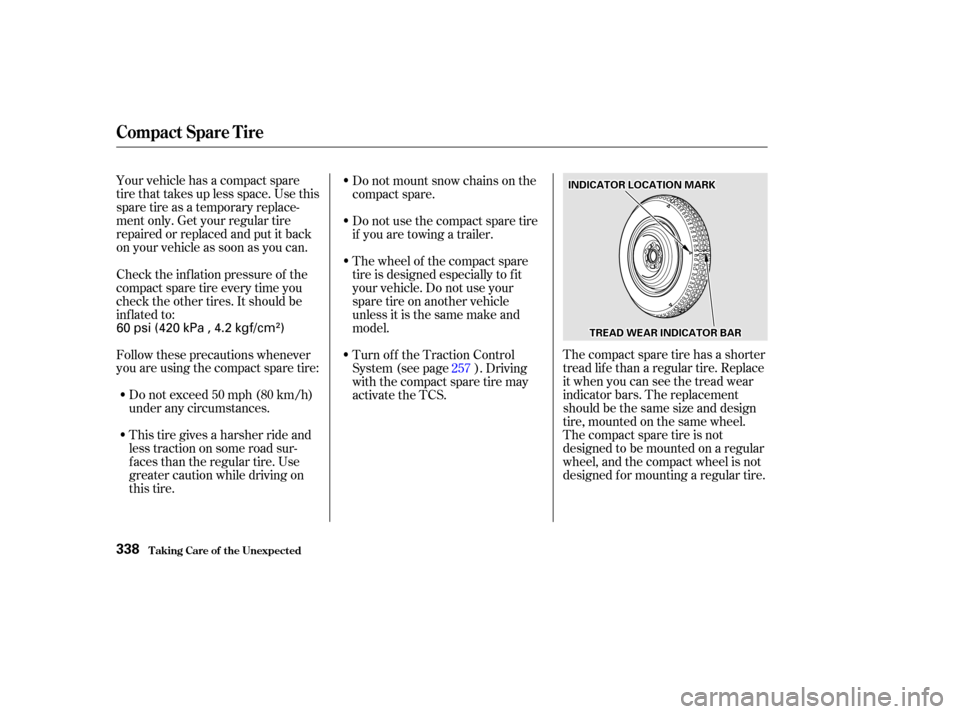
Your vehicle has a compact spare
tire that takes up less space. Use this
sparetireasatemporaryreplace-
ment only. Get your regular tire
repaired or replaced and put it back
on your vehicle as soon as you can.Thecompactsparetirehasashorter
tread lif e than a regular tire. Replace
it when you can see the tread wear
indicator bars. The replacement
should be the same size and design
tire, mounted on the same wheel.
Thecompactsparetireisnot
designed to be mounted on a regular
wheel, and the compact wheel is not
designed f or mounting a regular tire.
Check the inf lation pressure of the
compact spare tire every time you
check the other tires. It should be
inf lated to:
This tire gives a harsher ride and
less traction on some road sur-
f aces than the regular tire. Use
greater caution while driving on
this tire. Do not exceed 50 mph (80 km/h)
under any circumstances.
Follow these precautions whenever
you are using the compact spare tire: Do not mount snow chains on the
compact spare.
Do not use the compact spare tire
if you are towing a trailer.
The wheel of the compact spare
tire is designed especially to f it
your vehicle. Do not use your
sparetireonanothervehicle
unlessitisthesamemakeand
model.
Turn off the Traction Control
System (see page ). Driving
withthecompactsparetiremay
activate the TCS.
257
Compact Spare Tire
T aking Care of t he Unexpect ed338
I IN
ND DI
ICCA A T
TO
OR R L
LOOC CAA T
TI
IOON N M
MA
AR
RKK
T
T R
RE EA
A D
D W
WE EA
A R
R I
INND DI
ICCA A T
TO
OR R B
BAA R
R
60 psi (420 kPa , 4.2 kgf/cm)
Page 350 of 399
Unclip the hook f rom the seat
back handle on the driver’s seat
and lower the f loor lid and the
carpet.
Make sure to adjust the f ront
seats properly bef ore you start
driving (see page ).
Store the jack in its holder. Turn
the jack’s end bracket clockwise to
lock it in place. Store the tools.
Replace the cover.
Close the tailgate.
Store the plastic screw in the spare
tire well.
Store the wheel cover in the spare
tire well. Make sure it will not get
scratched or damaged.
Storethesparetirebasketinthe
spare tire well.
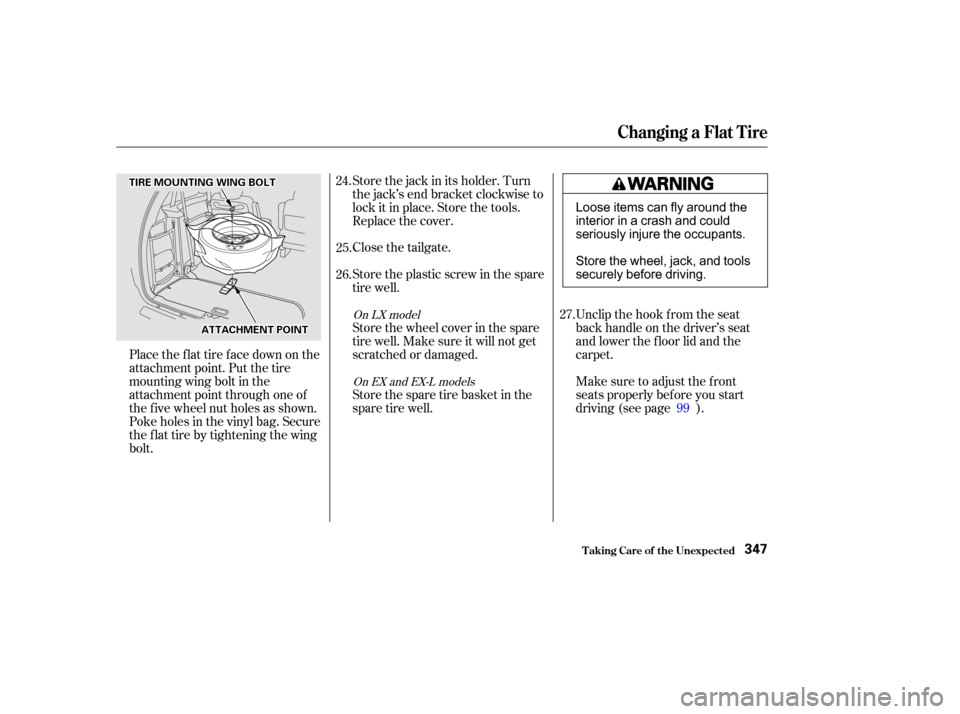
Place the flat tire face down on the
attachment point. Put the tire
mountingwingboltinthe
attachment point through one of
the f ive wheel nut holes as shown.
Poke holes in the vinyl bag. Secure
the f lat tire by tightening the wing
bolt. 24.
25.
26.
27.
99On LX modelOn EX and EX-L models
Changing a Flat T ire
T aking Care of t he Unexpect ed347
T TI
IRRE E M
M O
OUUNNTTI
INNG G W
WIINNG G B
BOOL LTT
A
A T
TT
TA
A C
CHH M
M E
EN
NT T P
PO
OI INNT T
Loose items can fly around the
interiorinacrashandcould
seriously injure the occupants.
Store the wheel, jack, and tools
securely before driving.
Page 376 of 399

�µ
The temperature grades are A (the
highest), B, and C, representing the
tire’s resistance to the generation of
heat and its ability to dissipate heat
when tested under controlled
conditions on a specif ied indoor
laboratory test wheel. Sustained high
temperature can cause the material
of the tire to degenerate and reduce
tire life, and excessive temperature
can lead to sudden tire f ailure. The
grade C corresponds to a level of
perf ormance which all passenger car
tires must meet under the Federal
Motor Vehicle Saf ety Standard No.
109. Grades B and A represent
higher levels of perf ormance on the
laboratory test wheel than the
minimum required by law. Warning: The temperature grade f or
this tire is established f or a tire that
is properly inf lated and not over-
loaded. Excessive speed, underinf la-
tion, or excessive loading, either
separately or in combination, can
cause heat buildup and possible tire
f ailure.
DOT T ire Quality Grading (U.S. Vehicles)
T echnical Inf ormation
Temperature A,B,C
373
Page:
< prev 1-8 9-16 17-24