Page 296 of 372
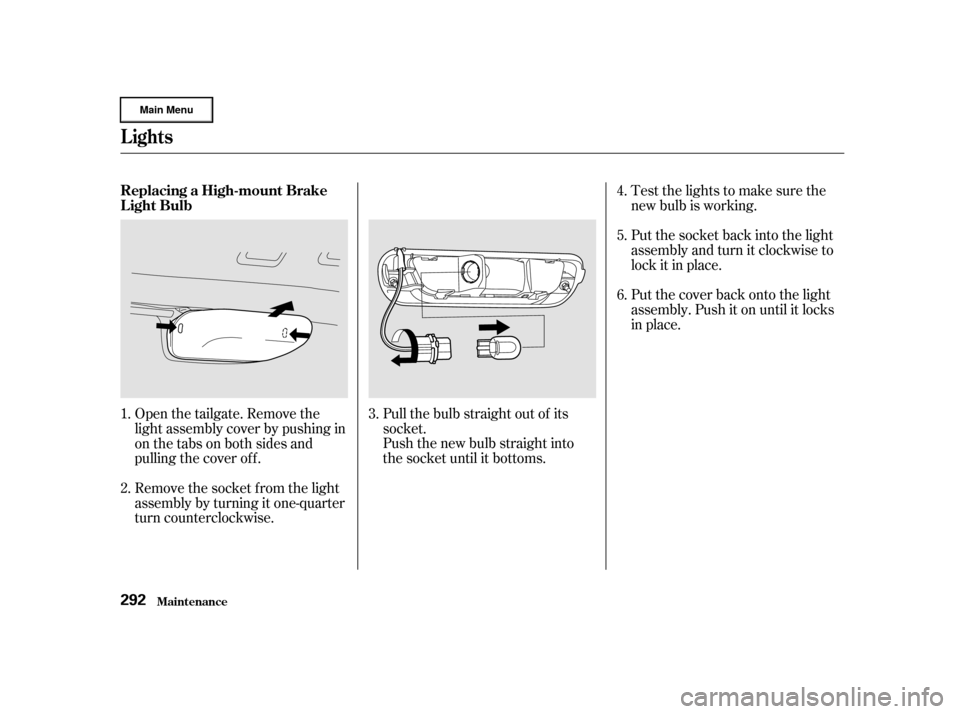
Pull the bulb straight out of its
socket.
Push the new bulb straight into
the socket until it bottoms.Testthelightstomakesurethe
new bulb is working.
Put the socket back into the light
assembly and turn it clockwise to
lock it in place.
Put the cover back onto the light
assembly. Push it on until it locks
in place.
Open the tailgate. Remove the
light assembly cover by pushing in
on the tabs on both sides and
pulling the cover of f .
Remove the socket f rom the light
assembly by turning it one-quarter
turn counterclockwise.
1.
2.
3.4.
5.
6.
Replacing a High-mount Brake
Light Bulb
Lights
Maint enance292
Page 299 of 372

If you need to park your vehicle f or
an extended period (more than one
month), there are several things you
should do to prepare it f or storage.
Proper preparation helps prevent
deterioration and makes it easier to
get your vehicle back on the road. If
possible, store your vehicle indoors.Block the rear wheels.
If the vehicle is to be stored f or a
longer period, it should be
supported on jackstands so the
tires are of f the ground.
Leave one window open slightly (if
the vehicle is being stored
indoors).Cover the vehicle with a
‘‘breathable’’ cover, one made
f rom a porous material such as
cotton. Nonporous materials, such
as plastic sheeting, trap moisture,
which can damage the paint.
Fill the f uel tank.
Change the engine oil and f ilter
(see page ).
Wash and dry the exterior
completely.
Cleantheinterior.Makesurethe
carpeting, floor mats, etc. are
completely dry. To minimize sticking, apply a
silicone spray lubricant to all door
and tailgate seals. Also, apply a
vehiclebodywaxtothepainted
surfaces that mate with the door
and tailgate seals. Support the f ront and rear wiper
blade arms with a f olded towel or
ragsotheydonottouchthe
windshield. Disconnect the battery.
Leave the parking brake off. Put
the transmission in Reverse
(5-speed manual) or Park
(automatic). If possible, run the engine f or a
while periodically (pref erably once
amonth).
If you store your vehicle f or 12
months or longer, have your Honda
dealer perf orm the inspections called
f or in the 24 months maintenance
schedule (Normal Conditions) as
soon as you take it out of storage
(see page ). The replacements
called f or in the maintenance
schedule are not needed unless the
vehicle has actually reached that
time or mileage.
249
238
Maint enance
St oring Your Vehicle
295
Page 311 of 372

This section covers the more-
common problems that motorists
experience with their vehicles. It
gives you inf ormation about how to
safely evaluate the problem and what
to do to correct it. If the problem has
stranded you on the side of the road,
you may be able to get going again.
If not, you will also f ind instructions
on getting your vehicle towed.....................
Changing a Flat Tire .308
..........
If Your Engine Won’t Start . 318
Nothing Happens or the Starter Motor Operates Very .....................................
Slowly .318
The Starter Operates ................................
Normally .319
................................
Jump Starting .320
............
If Your Engine Overheats . 323
.........
Low Oil Pressure Indicator . 325
..........
Charging System Indicator . 326
.......
Malf unction Indicator Lamp . 327
.......................
Readiness Codes .328
...............
Brake System Indicator . 329
..................
Closing the Moonroof . 330
..............................................
Fuses .331
..........
Checking and Replacing . 332
......................
Emergency Towing .337
Taking Care of the Unexpected
T aking Care of t he Unexpect ed307
Page 312 of 372
If you have a f lat tire while driving,
stop in a saf e place to change it.
Stopping in traf f ic or on the shoulder
of a busy road is dangerous. Drive
slowly along the shoulder until you
gettoanexitoranareatostopthat
is far away from the traffic lanes.Park the vehicle on f irm, level and
non-slippery ground away f rom
traf f ic. Put the transmission in
Park (automatic) or Reverse
(manual). Apply the parking brake.
Turn on the hazard warning lights
and turn the ignition switch to
LOCK (0). Have all the
passengers get out of the vehicle
while you change the tire. If you are towing a trailer, unhitch
the trailer.Open the tailgate.
1.
2. 3.
T aking Care of t he Unexpect ed
Changing a Flat T ire
308
S SP
PA
A R
REE T
TI
IRRE E
J
JA A C
CKK
The vehicle can easily roll off
the jack, seriously injuring
anyone underneath.
Follow the directions for
changing a tire exactly, and
never get under the vehicle
when it is supported only by the
jack.
Page 324 of 372

If your vehicle’s battery has run
down,youmaybeabletostartthe
engine by using a booster battery.
Although this seems like a simple
procedure, you should take several
precautions.To jump start your vehicle, f ollow
these directions closely:
Open the hood and check the
physical condition of the battery
(see page ). In very cold
weather, check the condition of
the electrolyte. If it seems slushy
or like ice, do not try jump starting
until it thaws.
Turn of f all the electrical acces-
sories: heater, A/C, stereo system,
lights, etc.
Put the transmission in Neutral or
Park, and set the parking brake.
You cannot start a Honda with an
automatic transmission by pushing
or pulling it. 1.
2.269
Jump Starting
T aking Care of t he Unexpect ed320
A battery can explode if you do
not follow the correct procedure,
seriously injuring anyone
nearby.
Keep all sparks, open flames,
and smoking materials away
from the battery.
If a battery sits in extreme cold, the
electrolyte inside can f reeze.
Attempting to jump start with a f rozen
battery can cause it to rupture.
Page 327 of 372

If you see steam and/or spray
coming f rom under the hood, turn
of f the engine.If you do not see steam or spray,
leave the engine running and
watch the temperature gauge. If
the high heat is due to overloading
(climbing a long, steep hill on a
hot day with the A/C running, f or
example), the engine should start
to cool down almost immediately.
If it does, wait until the tempera-
ture gauge comes down to the mid-
point then continue driving.
The pointer of your vehicle’s
temperature gauge should stay in
the midrange under most conditions.
Itmaygohigherif youaredrivingup
a long steep hill on a very hot day. If
it climbs to the red mark, you should
determine the reason.
Saf ely pull to the side of the road.
Put the transmission in Neutral or
Park, and set the parking brake.
Turn of f the heating and cooling
system and all other accessories.
Turn on the hazard warning
indicators.If the temperature gauge stays at
the red mark, turn of f the engine.
Wait until you see no more signs
of steam or spray, then open the
hood.
Your vehicle can overheat for several
reasons, such as lack of coolant or a
mechanical problem. The only
indicationmaybethetemperature
gauge climbing to or above the red
mark. Or you may see steam or
spray coming f rom under the hood.
In either case, you should take
immediate action. 1.
2.3.
4.
5.
CONT INUED
If Your Engine Overheats
T aking Care of t he Unexpect ed323
Steam and spray from an
overheated engine can
seriously scald you.
Do not open the hood if steam
is coming out.
Driving with the temperature gauge
pointer at the red mark can cause
serious damage to your engine.
Page 333 of 372
�Î
�Î�Î
�Î
If you must drive the vehicle a short
distance in this condition, drive
slowly and cautiously.
If it comes on at any other time, it
indicates a problem with the vehicle’s
brake system. In most cases, the
problem is a low f luid level in the
brake f luid reservoir. Press lightly on
the brake pedal to see if it f eels
normal. If it does, check the brake
f luid level the next time you stop at a
service station (see page ). If the
f luid level is low, take the vehicle to
your dealer and have the brake
system inspected f or leaks or worn
brake pads.
However, if the brake pedal does not
f eel normal, you should take
immediate action. Because of the
brake system’s dual-circuit design, a
problem in one part of the system
will still give you braking at two
wheels. You will f eel the brake pedal
go down much f arther bef ore the
vehicle begins to slow down, and you
will have to press harder on the
pedal. The distance needed to stop
will be much longer. Slow down by shif ting to a lower
gear, and pull to the side of the road
when it is saf e. Because of the
longer distance needed to stop, it is
hazardous to drive the vehicle. You
should have it towed, and repaired as
soon as possible. (See
on page .)
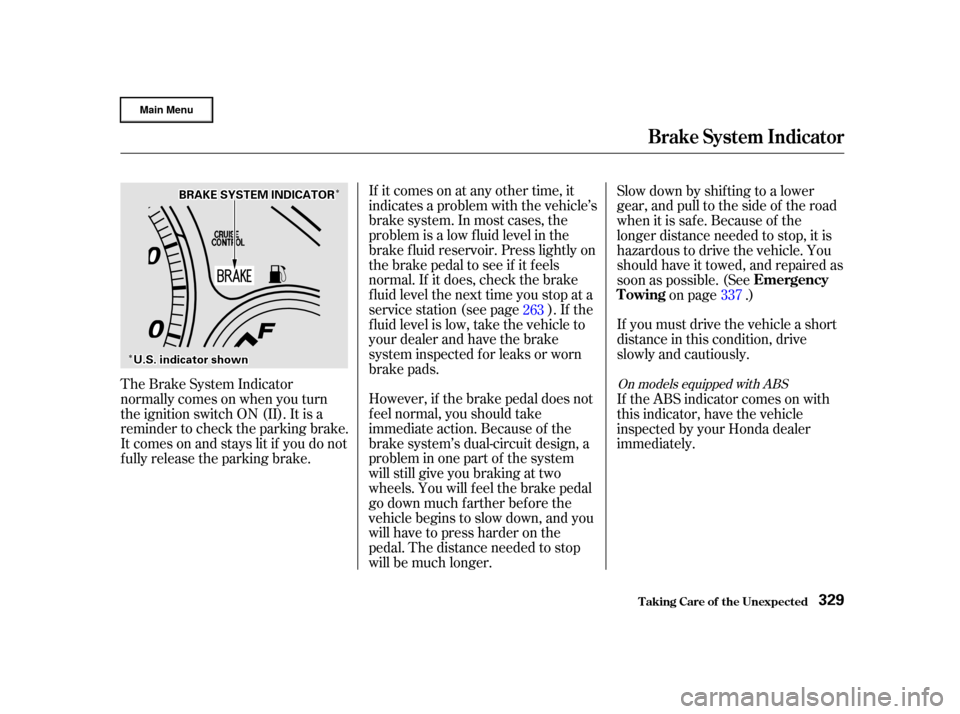
The Brake System Indicator
normallycomesonwhenyouturn
the ignition switch ON (II). It is a
reminder to check the parking brake.
It comes on and stays lit if you do not
f ully release the parking brake. If the ABS indicator comes on with
this indicator, have the vehicle
inspected by your Honda dealer
immediately.
263
337
On models equipped with ABS
Emergency
Towing
Brake System Indicator
T aking Care of t he Unexpect ed329
U U. .SS. .i
inn d
di
icca at too r
r s
shh o
ow
wn n
B
BR
RAA K
KEE S
SYYSSTTE
EM
M I
INND DI
ICCA A T
TO
OR R
Page 347 of 372

�µ�µ�µ
�µ
�µ
�µ
�µ
�µ
�µ
�µ
�µ
�µ
�µ
�µ
�µ
�µ
�µ
Specif ications
T echnical Inf ormation343
Air Conditioning
Battery
Tires Alignment Fuses
Lights HFC-134a (R-134a)
17.0 18.7 oz (480 530 g) SP-10
12 V
12 V 60/55 W
21/5 W
36 AH/5 HR
12 V 12 V
12 V
12 V
12 V
12 V
12 V
12 V
12 V
21 W
3CP
8W
4CP
8W
5W
21 W
21/5 W
21 W
12 V 3 CP
Refrigerant type
Charge quantity
Lubricant type
Capacity
12 V See page
335or the fuse label
attached to the inside of the fuse
box door under the steering
column.
45 AH/20 HR
12 V 26 psi (180 kPa , 1.8 kgf/cm
)
26 psi (180 kPa , 1.8 kgf/cm)
P205/70R15 95S
Size
Pressure Toe-in
Camber
Caster 1°45’1°
0°
0.08 in (2.0 mm) 0.0in(0mm)
See page
336or the fuse box
cover.
Interior
Under-hood
Headlights
Front turn signal/side marker
lights
Parking lights
Rear turn signal lights
Stop/Taillights
Back-up lights
License plate light
Ceiling light
Spotlights
Cargo area Light
Rear side marker lights
High-mount brake light Front
Rear
Front
Rear
Front
Front/Rear
Front
Rear
(H4/HB2)