Page 267 of 372

The f luid level should be between
theMINandMAXmarksontheside
of the reservoir. If the level is at or
below the MIN mark, your brake
system needs attention. Have the
brake system inspected f or leaks or
worn brake pads.
Always use Honda Heavy Duty
Brake Fluid DOT 3. If it is not
available, you should use only DOT 3
or DOT 4 f luid, f rom a sealed
container, as a temporary
replacement. However, the use of
any non-Honda brake fluid can cause
corrosion and decrease the lif e of the
system. Have the brake system
f lushed and ref illed with Honda
Heavy Duty Brake Fluid DOT 3 as
soon as possible.
Check the f luid level in the reser-
voirs monthly. There are up to two
reservoirs, depending on the model.
They are:
Brake f luid reservoir (all models)
Clutch f luid reservoir
(manual transmission only)
The brake f luid should be replaced
according to the time recommenda-
tion in the maintenance schedule. Brake f luid marked DOT 5 is not
compatible with your vehicle’s
braking system and can cause
extensive damage.Brake System
Brake and Clutch Fluid
Maint enance263
M M
A
AX
X
M
MI
INN
Page 269 of 372
To replace it:
The air cleaner element should be
replaced according to the distance
recommendation in the maintenance
schedule.
The air cleaner element is inside the
air cleaner housing on the lef t side of
the engine compartment.Loosen the five bolts with a
Phillips-head screwdriver or a
wrench, then lif t up the air cleaner
housing cover. Remove the old air cleaner
element.
Caref ully clean the inside of the
air cleaner housing with a damp
rag.
1. 2.
3.
CONT INUED
Replacement
A ir Cleaner Element
Maint enance265
B BO
OL LTT S
S
A
AI
IRR C
CLLEE A
A N
NE ER
R E
EL
LEE M
M E
EN
NT T
B
BO
OL LTT S
S
Page 270 of 372
Place the new air cleaner element
in the air cleaner housing.
Reinstall the air cleaner housing
cover, and tighten the five bolts.Clean the hood latch assembly with a
mild cleaner, then lubricate it with a
multipurpose grease. Lubricate all
the moving parts (as shown),
including the pivot. Follow the time
and distance recommendations in
the Maintenance Schedule. If you
are not sure how to clean and grease
the latch, contact your Honda dealer.
4.
5.
A ir Cleaner Element, Hood L atch
Maint enance
Hood L atch
266
L LA
A T
TC
CH H A
AS
SSSEEM
M B
BLLYY
Page 271 of 372

CONT INUED
Clean up any dirt and oil that have
collected around the ignition coils.
Use a wrench to remove the bolt
holding the ignition coil. Pull the
ignition coil up slightly.
Disconnect the wire connector
f rom the ignition coil by pushing
on the lock tab and pulling on the
connector. Pull on the plastic
connector, not the wires.Remove the ignition coil.
Remove the spark plug with
a f ive-eighths inch (16 mm) spark
plug socket.
Put the new spark plug into the
socket, then screw it into the hole.
Screw it in by hand so you do not
crossthread it.
Remove the f our nuts with a
wrench, then remove the coil
cover.
The spark plugs in your vehicle are a
special iridium-tipped design f or
longer lif e. The spark plugs should
be replaced according to the distance
recommendation in the maintenance
schedule.
1.
6.
7. 5.
2.
4. 3.
Maint enance
Spark Plugs
Replacement
267
B BO OL LTT
I
IG GN NIITT I
IOON N C
COOI ILL
N
NU
UTTS
S N
NUUTTS
S C
CO
ON NNNEEC
CT TO
OR R
L
LO OC CKK T
TA
A B
B
Page 281 of 372
Check the condition of the drive belt.
Examine the edges of belt for cracks
or f raying.An auto-tensioner adjusts the tension
of the drive belt. The pointer on the
auto-tensioner should be in the
proper range. It should be checked
accordingtothetimeanddistance
recommendations in the
maintenance schedule.If the pointer is not within the proper
range or you see signs of wear, have
the drive belt replaced by your
Honda dealer as soon as possible.
Drive Belt
Maint enance277
I IN
ND DI
ICCA A T
TO
OR R
P
P
r
roo p
pe
err r
raan n g
ge
e
Page 299 of 372

If you need to park your vehicle f or
an extended period (more than one
month), there are several things you
should do to prepare it f or storage.
Proper preparation helps prevent
deterioration and makes it easier to
get your vehicle back on the road. If
possible, store your vehicle indoors.Block the rear wheels.
If the vehicle is to be stored f or a
longer period, it should be
supported on jackstands so the
tires are of f the ground.
Leave one window open slightly (if
the vehicle is being stored
indoors).Cover the vehicle with a
‘‘breathable’’ cover, one made
f rom a porous material such as
cotton. Nonporous materials, such
as plastic sheeting, trap moisture,
which can damage the paint.
Fill the f uel tank.
Change the engine oil and f ilter
(see page ).
Wash and dry the exterior
completely.
Cleantheinterior.Makesurethe
carpeting, floor mats, etc. are
completely dry. To minimize sticking, apply a
silicone spray lubricant to all door
and tailgate seals. Also, apply a
vehiclebodywaxtothepainted
surfaces that mate with the door
and tailgate seals. Support the f ront and rear wiper
blade arms with a f olded towel or
ragsotheydonottouchthe
windshield. Disconnect the battery.
Leave the parking brake off. Put
the transmission in Reverse
(5-speed manual) or Park
(automatic). If possible, run the engine f or a
while periodically (pref erably once
amonth).
If you store your vehicle f or 12
months or longer, have your Honda
dealer perf orm the inspections called
f or in the 24 months maintenance
schedule (Normal Conditions) as
soon as you take it out of storage
(see page ). The replacements
called f or in the maintenance
schedule are not needed unless the
vehicle has actually reached that
time or mileage.
249
238
Maint enance
St oring Your Vehicle
295
Page 352 of 372

�Î
�ÎThe burning of gasoline in your
vehicle’s engine produces several by-
products. Some of these are carbon
monoxide (CO), oxides of nitrogen
(NOx) and hydrocarbons (HC).
Gasoline evaporating f rom the tank
also produces hydrocarbons. Con-
trolling the production of NOx, CO,
and HC is important to the environ-
ment. Under certain conditions of
sunlight and climate, NOx and HC
react to f orm photochemical ‘‘smog.’’
Carbon monoxide does not contri-
bute to smog creation, but it is a
poisonous gas. The United States Clean Air Act
sets standards f or automobile
emissions. It also requires that
automobile manufacturers explain to
owners how their emissions controls
workandwhattodotomaintain
them. This section summarizes how
the emissions controls work.
Scheduled maintenance is on page
.
In Canada, Honda vehicles comply
with the Canadian Motor Vehicle
Saf ety Standards (CMVSS) f or
Emissions valid at the time they are
manuf actured.
Your vehicle has a Positive
Crankcase Ventilation System. This
keeps gasses that build up in the
engine’s crankcase f rom going into
the atmosphere. The Positive Crank-
case Ventilation valve routes them from the crankcase back to the
intake manif old. They are then
drawn into the engine and burned.
As gasoline evaporates in the f uel
tank, an evaporative emissions
control canister f illed with charcoal
adsorbs the vapor. It is stored in this
canister while the engine is of f . Af ter
the engine is started and warmed up,
the vapor is drawn into the engine
and burned during driving.
The Onboard Ref ueling Vapor
Recovery (ORVR) system captures
the f uel vapors during ref ueling. The
vapors are adsorbed in a canister
f illed with activated carbon. While
driving, the f uel vapors are drawn
into the engine and burned of f .
238
The Clean Air Act
Crankcase Emissions Control
System Evaporative Emissions Control
System
Onboard Ref ueling Vapor
Recovery
Emissions Cont rols
T echnical Inf ormation348
Page 367 of 372
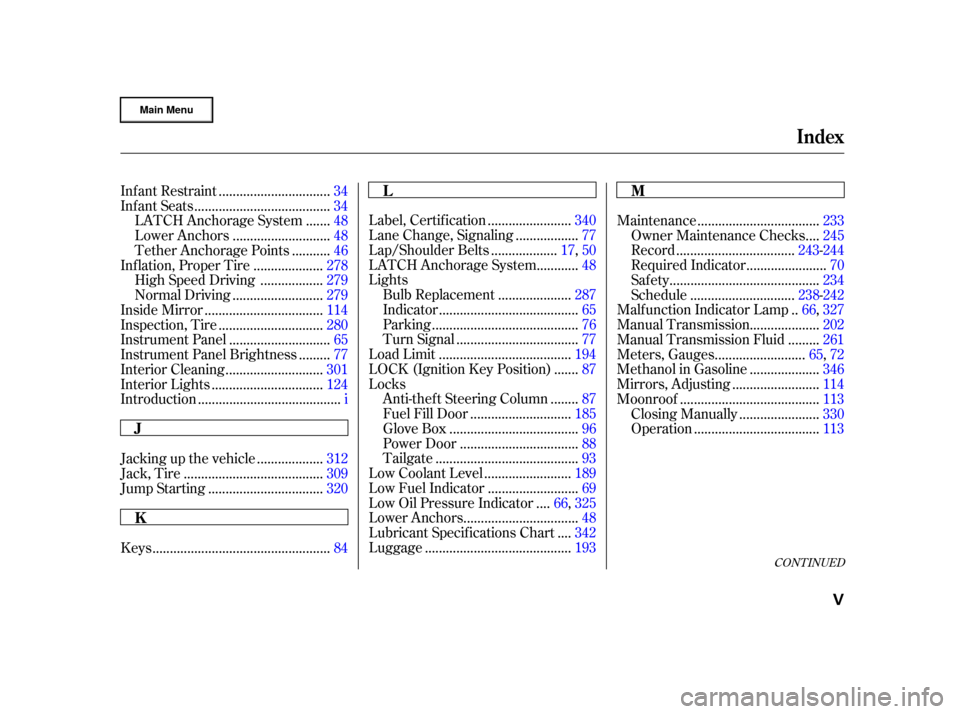
CONT INUED
.......................
Label, Certif ication .340
.................
Lane Change, Signaling . 77
..................
Lap/Shoulder Belts . 17,50
...........
LATCH Anchorage System . 48
Lights ....................
Bulb Replacement .287
.......................................
Indicator .65
.........................................
Parking .76
..................................
Turn Signal .77
.....................................
Load Limit .194
......
LOCK (Ignition Key Position) . 87
Locks .......
Anti-thef t Steering Column . 87
............................
Fuel Fill Door .185
....................................
Glove Box .96
.................................
Power Door .88
........................................
Tailgate .93
........................
Low Coolant Level .189
.........................
Low Fuel Indicator .69
...
Low Oil Pressure Indicator . 66,325
................................
Lower Anchors .48
...
Lubricant Specif ications Chart . 342
.........................................
Luggage .193 ..................................
Maintenance .233
...
Owner Maintenance Checks . 245
.................................
Record .243-244
......................
Required Indicator .70
..........................................
Saf ety .234
.............................
Schedule .238-242
.
Malf unction Indicator Lamp . 66,327
...................
Manual Transmission . 202
........
Manual Transmission Fluid . 261
.........................
Meters, Gauges .65, 72
...................
Methanol in Gasoline . 346
........................
Mirrors, Adjusting .114
.......................................
Moonroof .113
......................
Closing Manually .330
...................................
Operation .113
...............................
Inf ant Restraint .34
......................................
Inf ant Seats .34
......
LATCH Anchorage System . 48
...........................
Lower Anchors .48
..........
Tether Anchorage Points . 46
...................
Inf lation, Proper Tire . 278
.................
High Speed Driving . 279
.........................
Normal Driving .279
.................................
Inside Mirror .114
.............................
Inspection, Tire .280
............................
Instrument Panel .65
........
Instrument Panel Brightness . 77
...........................
Interior Cleaning .301
...............................
Interior Lights .124
........................................
Introduction .i
..................................................
Keys .84
..................
Jacking up the vehicle . 312
.......................................
Jack, Tire .309
................................
Jump Starting .320
Index
LM
K J
V


