Page 213 of 321
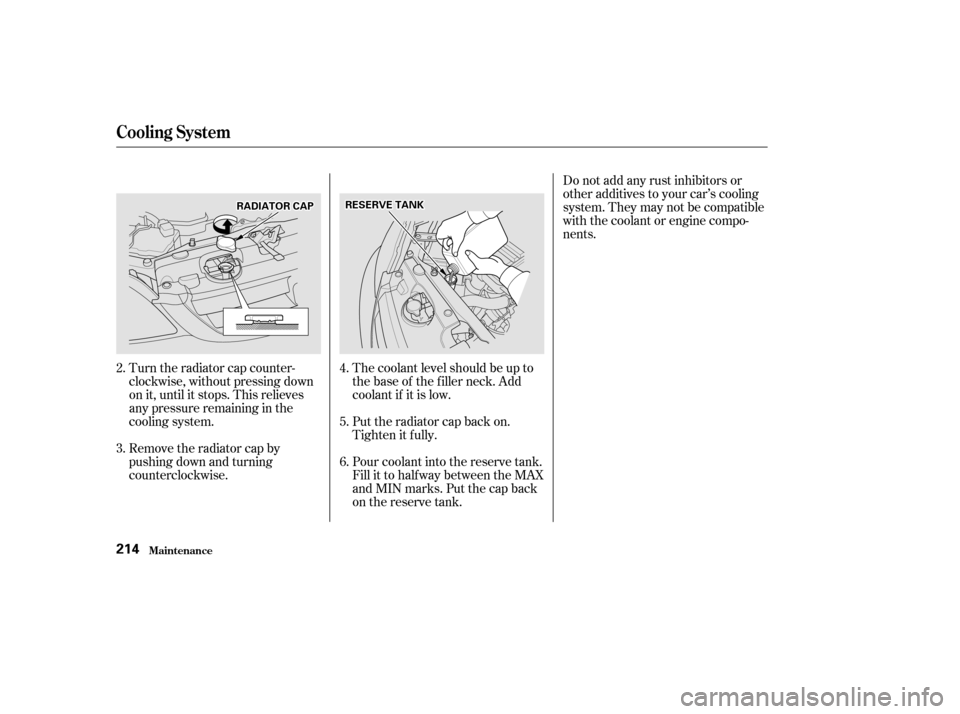
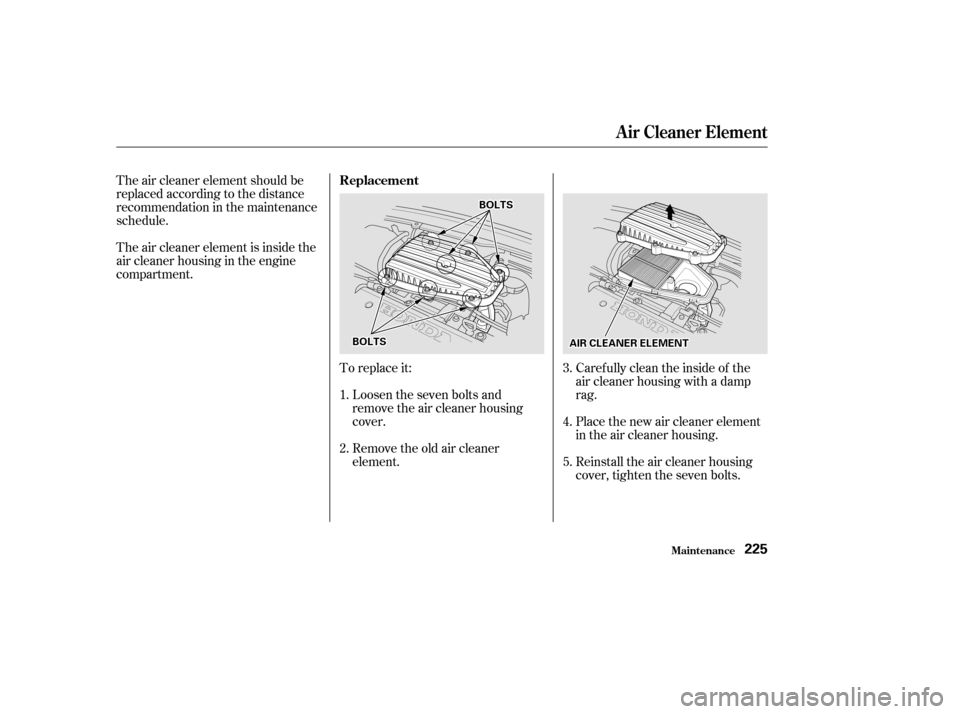
Remove the radiator cap by
pushing down and turning
counterclockwise.
Turn the radiator cap counter-
clockwise, without pressing down
on it, until it stops. This relieves
any pressure remaining in the
cooling system.
Pour coolant into the reserve tank.
Fill it to half way between the MAX
and MIN marks. Put the cap back
on the reserve tank.
Put the radiator cap back on.
Tighten it f ully.
The coolant level should be up to
the base of the f iller neck. Add
coolant if it is low. Do not add any rust inhibitors or
other additives to your car’s cooling
system. They may not be compatible
with the coolant or engine compo-
nents.
2. 3. 4. 5. 6.
Cooling Syst em
Maint enance214
RRAADDIIAATTOORRCCAAPPRREESSEERRVVEETTAANNKK
Page 214 of 321
CONT INUED
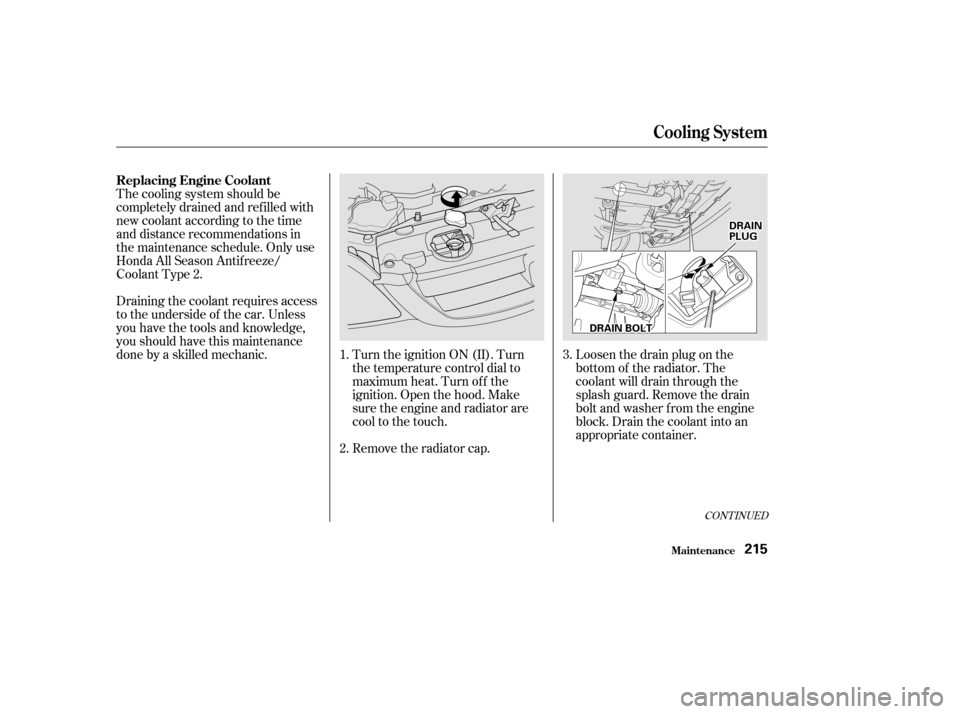
Remove the radiator cap.
Turn the ignition ON (II). Turn
the temperature control dial to
maximum heat. Turn of f the
ignition. Open the hood. Make
sure the engine and radiator are
cool to the touch.
Draining the coolant requires access
to the underside of the car. Unless
you have the tools and knowledge,
you should have this maintenance
done by a skilled mechanic.
Thecoolingsystemshouldbe
completely drained and ref illed with
new coolant according to the time
and distance recommendations in
the maintenance schedule. Only use
Honda All Season Antif reeze/
Coolant Type 2.
Loosen the drain plug on the
bottom of the radiator. The
coolant will drain through the
splash guard. Remove the drain
bolt and washer f rom the engine
block. Drain the coolant into an
appropriate container.
1.
3.
2.
Replacing Engine Coolant
Cooling Syst em
Maint enance215
DDRRAAIINNPPLLUUGG
DDRRAAIINNBBOOLLTT
Page 216 of 321
CONT INUED
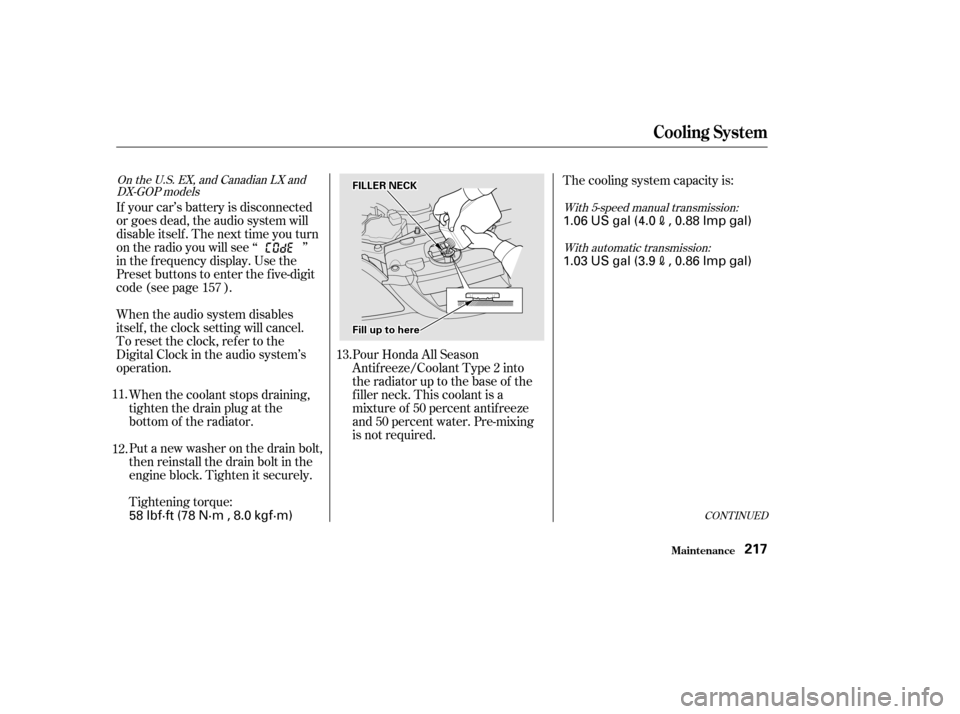
Pour Honda All Season
Antif reeze/Coolant Type 2 into
the radiator up to the base of the
f iller neck. This coolant is a
mixture of 50 percent antif reeze
and 50 percent water. Pre-mixing
is not required.The cooling system capacity is:
Tightening torque:
Put a new washer on the drain bolt,
then reinstall the drain bolt in the
engine block. Tighten it securely.
When the coolant stops draining,
tightenthedrainplugatthe
bottom of the radiator.
When the audio system disables
itself , the clock setting will cancel.
To reset the clock, ref er to the
Digital Clock in the audio system’s
operation.
If your car’s battery is disconnected
or goes dead, the audio system will
disableitself.Thenexttimeyouturn
on the radio you will see ‘‘ ’’
in the f requency display. Use the
Preset buttons to enter the five-digit
code (see page ).
12.
11.
13.
157
With 5-speed manual transmission:
With automatic transmission:
On the U.S. EX, and Canadian LX and
DX-GOP models
Cooling Syst em
Maint enance217
FFIILLLLEERRNNEECCKK
FFiilllluuppttoohheerree
1.06 US gal (4.0, 0.88 Imp gal)
1.03 US gal (3.9
, 0.86 Imp gal)
58 lbf·ft (78 N·m , 8.0 kgf·m)
Page 217 of 321
Start the engine and hold it at
1,500 rpm until the radiator f an
comes on. Turn of f the engine.
Check the coolant level in the
radiator and add coolant if needed.
Install the radiator cap, and
tighten it fully.
If necessary, f ill the reserve tank
to the MAX mark. Install the
reserve tank cap.
Start the engine and let it run f or
about 30 seconds. Then turn of f
the engine.
Check the level in the radiator,
add coolant if needed.
Fill the reserve tank to the MAX
mark. Install the reserve tank cap.
Install the radiator cap, and
tighten it to the first stop.
Start the engine and let it run until
the radiator cooling f an comes on
at least twice. Then stop the
engine.
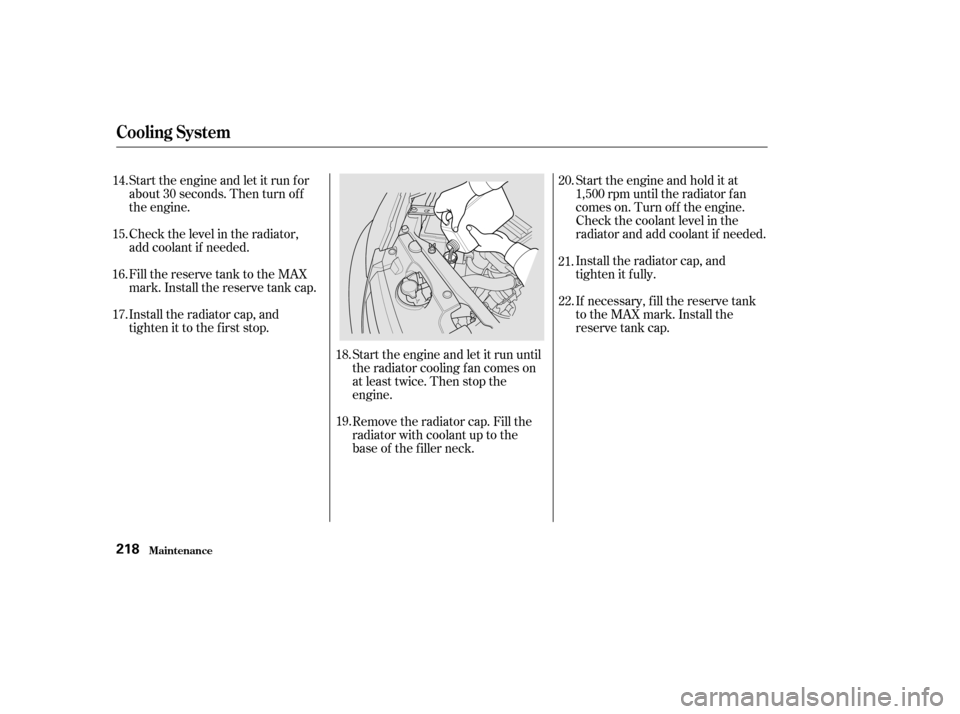
Remove the radiator cap. Fill the
radiator with coolant up to the
base of the f iller neck.
14.
15.
16.
17. 18.
19. 20.
21. 22.
Cooling Syst em
Maint enance218
Page 218 of 321
Check the level in the windshield
washer reservoir at least monthly
during normal usage. In bad weather,
when you use the washers of ten,
check the level every time you stop
for fuel.When you ref ill the reservoir, clean
the edges of the windshield wiper
blades with windshield washer f luid
on a clean cloth. This will help to
condition the blade edges.
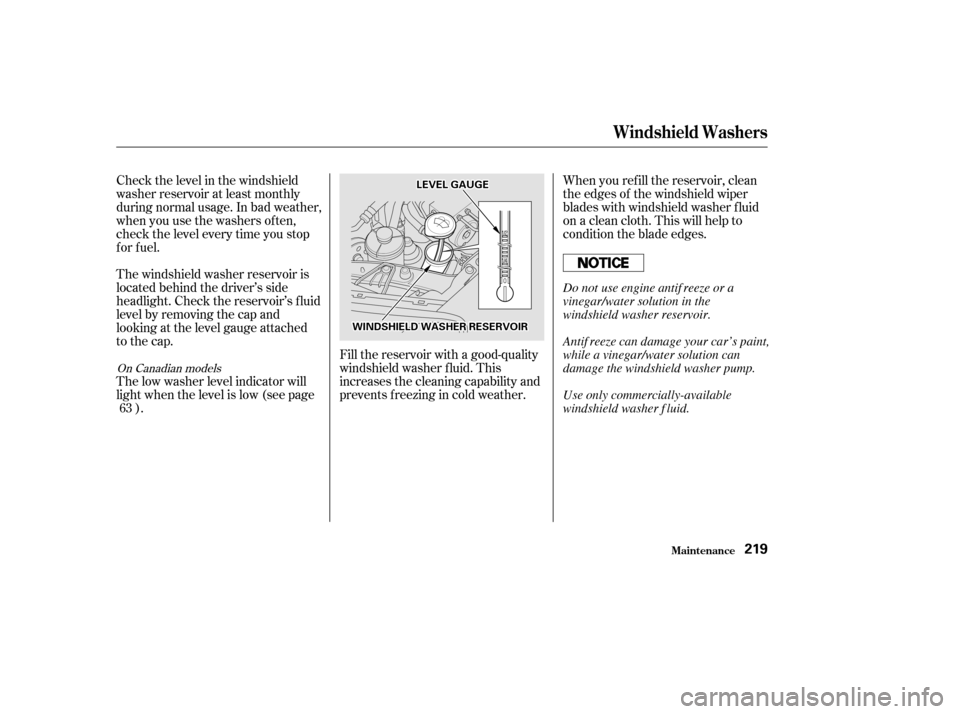
The windshield washer reservoir is
located behind the driver’s side
headlight. Check the reservoir’s f luid
level by removing the cap and
looking at the level gauge attached
to the cap. Fill the reservoir with a good-quality
windshield washer f luid. This
increases the cleaning capability and
prevents f reezing in cold weather.
The low washer level indicator will
light when the level is low (see page
).
63
On Canadian models
Windshield Washers
Maint enance219
LLEEVVEELLGGAAUUGGEE
WWIINNDDSSHHIIEELLDDWWAASSHHEERRRREESSEERRVVOOIIRR
Do not use engine antif reeze or a
vinegar/water solution in the
windshield washer reservoir.
Antif reeze can damage your car’s paint,
while a vinegar/water solution can
damage the windshield washer pump.
Use only commercially-available
windshield washer f luid.
Page 219 of 321

Insert the dipstick all the way into
the transmission securely as
shown in the illustration.
Remove the dipstick and check
the f luid level. It should be
between the upper and lower
marks.
Check the f luid level with the engine
at normal operating temperature.
Remove the dipstick (yellow loop)
f rom the transmission and wipe it
with a clean cloth.
Park the car on level ground. Shut
of f the engine. If the level is below the lower
mark, add f luid into the f iller hole
to bring it to the upper mark.
Always use Honda ATF-Z1
(Automatic Transmission Fluid). If
it is not available, you may use a
DEXRON
III automatic
transmission f luid as a temporary
replacement. However, continued
use can affect shift quality. Have
the transmission f lushed and
ref illed with Honda ATF-Z1 as
soon as it is convenient.
To thoroughly f lush the
transmission, the technician
should drain and ref ill it with
Honda ATF-Z1, then drive the
vehicle a short distance. Do this
three times. Then drain and ref ill
the transmission a final time.
3. 4. 5.
1. 2.
Automatic Transmission
T ransmission Fluid
Maint enance220
DDIIPPSSTTIICCKK
UUPPPPEERRMMAARRKKLLOOWWEERRMMAARRKK
Page 223 of 321
A low power steering f luid level can
indicate a leak in the system. Check
the f luid level f requently and have
the system inspected as soon as
possible.
Always use Honda Power Steering
Fluid. If it is not available, you may
use another power steering f luid as
an emergency replacement.
However, continued use can cause
increased wear and poor steering in
cold weather. Have the power
steering system f lushed and ref illed
with Honda PSF as soon as possible.
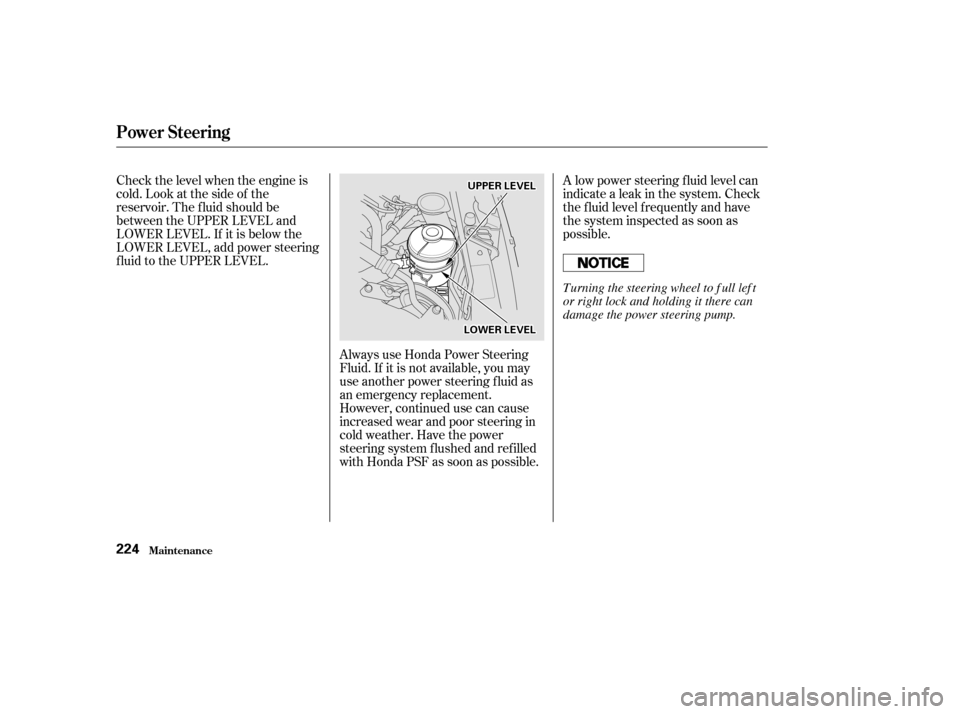
Check the level when the engine is
cold. Look at the side of the
reservoir. The f luid should be
between the UPPER LEVEL and
LOWER LEVEL. If it is below the
LOWER LEVEL, add power steering
f luid to the UPPER LEVEL.
Power Steering
Maint enance224
UUPPPPEERRLLEEVVEELL
LLOOWWEERRLLEEVVEELL
T urning the steering wheel to f ull lef t
or right lock and holding it there can
damage the power steering pump.
Page 224 of 321
Caref ully clean the inside of the
air cleaner housing with a damp
rag.
Place the new air cleaner element
in the air cleaner housing.
The air cleaner element is inside the
air cleaner housing in the engine
compartment.
To replace it:Loosen the seven bolts and
remove the air cleaner housing
cover.
Remove the old air cleaner
element. Reinstall the air cleaner housing cover, tighten the seven bolts.
The air cleaner element should be
replaced according to the distance
recommendation in the maintenance
schedule.
1.3.
2. 4. 5.
Replacement
Maint enance
A ir Cleaner Element
225
AAIIRRCCLLEEAANNEERREELLEEMMEENNTT
BBOOLLTTSS
BBOOLLTTSS