�µ�µ
�Ø �Ø�Ø�Ø�Ø�Ø�Ø�Ø �Ø �Ø �Ø �Ø�Ø�Ø�Ø�Ø�Ø�Ø�Ø
�Ø �Ø �Ø �Ø �Ø
�Ì
�Ì �Ì
�Î
�Ì�Î�Î �Î
�Î �Î�Î
CONT INUED
Maint enance243
A, B, C, D, E
U.S. Owners
Canadian Owners
AB C D E
Service at the indicated distance or time, whichever comes first. Do the items in as required for each distance/time.
Refer to page to determine which schedule to use.
Use the Maintenance Schedule for Severe Conditions. Replace engine oil and filter.
Inspect front and rear brakes.
Rotate tires (follow pattern on page ).
Inspect tie rod ends, steering gear box and boots.
Inspect suspension components.
Inspect driveshaft boots.
Check parking brake adjustment.
Lubricate all hinges, locks and latches with
multipurpose grease.
Inspect brake hoses and lines (including ABS)
Check all fluid leves, condition of fluids, and check
for leaks.
Inspect cooling system hoses and connections.Inspect exhaust system.
Inspect fuel lines and connections
Check all lights.
Inspect the underbody.
Replace air cleaner element.
Inspect and adjust drive belts.
Replace dust and pollen filter .
Replace brake fluid every 3 years
(independent of mileage).
Do items in A.
Do items in A, B.
Do items in A.
Clean air cleaner element.
DoitemsinA,B,C.
Do items in A.
Do items in A, B.
Do items in A.
DoitemsinA,B,C,D.
Do items in A.
Do items in A, B.
Do items in A.
Do item in E.
Clean air cleaner element. Do items in A, B, C.
Do items in A.
Do items in A, B.
Do items in A.
Replace MT fluid.
Replace AT fluid.
Replace timing belt , balancer belt , inspect
water pump.
DoitemsinA,B,C,D.
Do items in A.
3,750 mi/6,000 km
7,500 mi/12,000 km
11,250 mi/18,000 km
15,000 mi/24,000 km/1 yr
18,750 mi/30,000 km
22,500 mi/36,000 km
26,250 mi/42,000 km
30,000 mi/48,000 km/2 yrs
33,750 mi/54,000 km
37,500 mi/60,000 km
41,250 mi/66,000 km
3 yrs (independent ofmileage)
45,000 mi/72,000 km/3 yrs
48,750 mi/78,000 km
52,500 mi/84,000 km
56,250 mi/90,000 km
60,000 mi/96,000 km/3 yrs
60,000 mi/96,000 km/3 yrs,
then replace every 30,000 mi/
48,000 km/2 yrs.
60,000 mi/96,000 km/4 yrs
63,750 mi/102,000 km
287
:
242
Check engine oil and coolant at each fuel stop.
Check and adjust valve clearance, cold engine, only if noisy.
See information on maintenance and emissions warranty, last
column, page .
See timing belt on page to determine need for replacement.
Balancer belt applies to 4-cylinder models only.
See Dust and Pollen Filter on page for replacement
information under special driving conditions. NOTE:
283
282 239
1:2:3:
3
11 ,2
Maintenance Schedule for Severe Conditions (listed by distance/time)
Start the engine and hold it at
1,500 rpm until the cooling f an
comes on. Turn of f the engine.
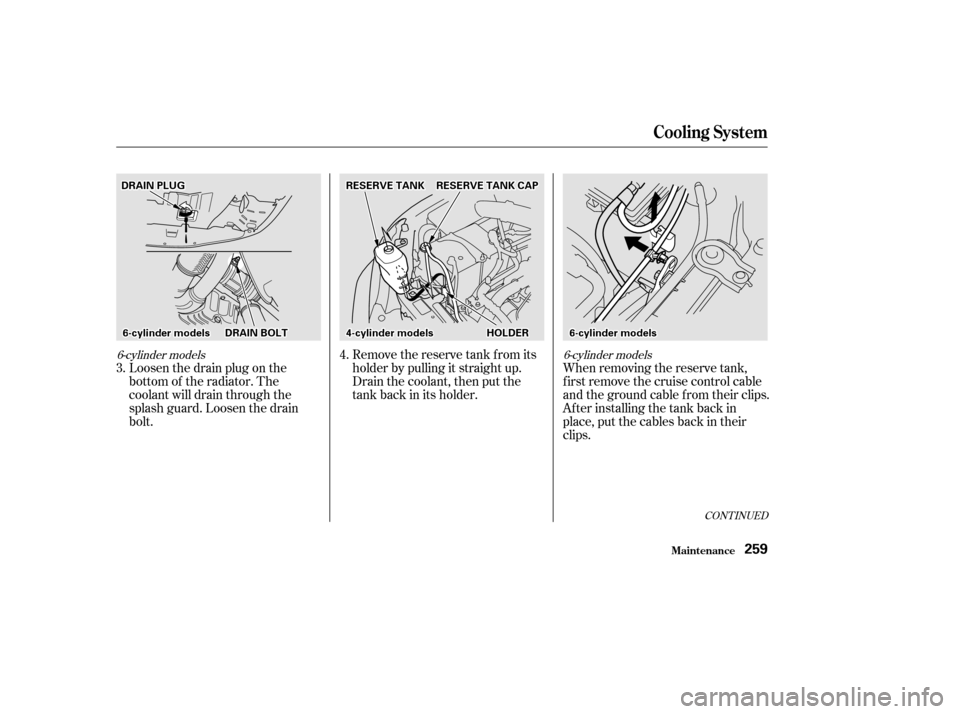
Check the coolant level in the
radiator and add coolant if needed.
Start the engine and let it run f or
about 30 seconds. Then turn of f
the engine.
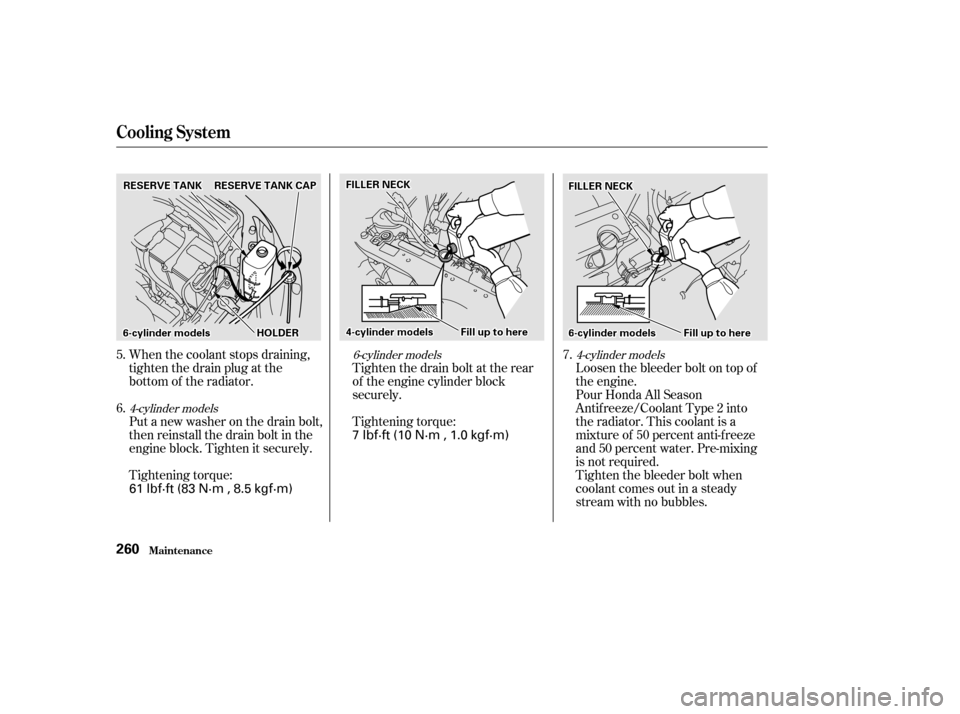
Fill the radiator with coolant up to
the base of the f iller neck.
Fill the reserve tank to the MAX
mark. Install the reserve tank cap.
Install the radiator cap, and
tighten it to the first stop.
Start the engine and let it run until
the radiator cooling f an comes on
at least twice. Then stop the
engine.
Remove the radiator cap. Pour
coolant into the radiator up to the
base of the f iller neck and into the
reserve tank up to the MAX mark. If necessary, f ill the reserve tank
to the MAX mark. Install the
reserve tank cap.
Install the radiator cap, and
tighten it fully.
Pour coolant into the radiator up
to the base of the f iller neck.
The cooling system capacity is: 8. 9.
10. 11.12. 13. 14. 15. 16.
With automatic transmission:
6-cylinder models
With 5-speed manual transmission:
6-cylinder models
Cooling Syst em
Maint enance261
44--ccyylliinnddeerrmmooddeellssBBLLEEEEDDEERRBBOOLLTT
1.45 US gal (5.5, 1.21 Imp gal)
1.43 US gal (5.4
, 1.19 Imp gal)
1.48 US gal (5.6
, 1.23 Imp gal)
If the temperature gauge stays at
the red mark, turn of f the engine.
Wait until you see no more signs
of steam or spray, then open thehood.
If there was no coolant in the
reserve tank, you may also have to
add coolant to the radiator. Let the
engine cool down until the pointerreaches the middle of the tempera-
ture gauge, or lower, bef ore check-
ing the radiator.
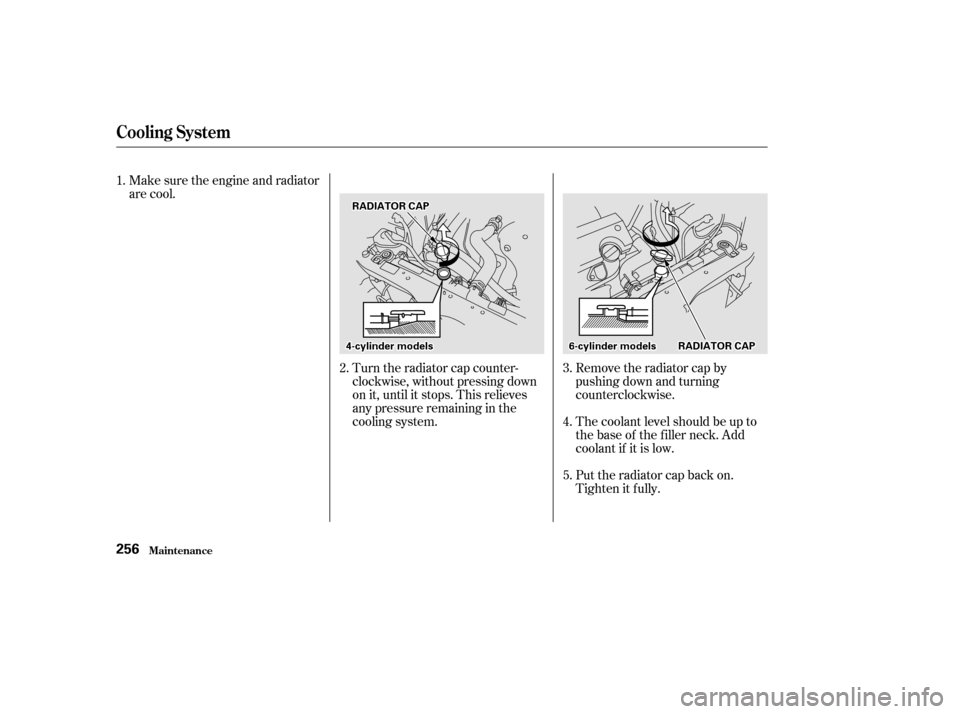
Using gloves or a large heavy
cloth, turn the radiator cap
counterclockwise, without pushing
down, to the f irst stop. This
releases any remaining pressure in
the cooling system. After the
pressure releases, push down on
the cap and turn it until it comes
off.
If you don’t f ind an obvious leak,
check the coolant level in the
radiator reserve tank (see page
). If the level is below the
MIN mark, add coolant to halfway
between the MIN and MAX marks. Start the engine and set the
temperature control dial to
maximum (climate control to
FULL AUTO at 90°F/32°C). Add
coolant to the radiator up to the
base of the f iller neck. If you do
not have the proper coolant
mixture available, you can add
plain water. Remember to have
the cooling system drained and
ref illed with the proper mixture as
soon as you can.
If the temperature stays normal,
check the coolant level in the
radiator reserve tank. If it has
gone down, add coolant to the
MAX mark. Put the cap back on
tightly.
Look f or any obvious coolant leaks,
such as a split radiator hose.
Everything is still extremely hot,
so use caution. If you f ind a leak, it
must be repaired bef ore you
continue driving (see
on page ). Put the radiator cap back on
tightly. Run the engine and watch
the temperature gauge. If it goes
back to the red mark, the engine
needs repair. (See on page .)
4. 5.
6. 7. 8. 9.
11.12.10.
336
200 336
T aking Care of t he Unexpect ed
If Your Engine Overheats
Emergency
Towing
Emergency
Towing
324
Removing the radiator cap
while the engine is hot can
cause the coolant to spray out,
seriously scalding you.
Always let the engine and
radiator cool down before
removing the radiator cap.