2002 FORD MUSTANG engine
[x] Cancel search: enginePage 218 of 264

8. Reinstall the radiator cap.
9. Start and idle the engine until the upper radiator
hose is warm (this indicates the thermostat is open
and coolant is flowing through the entire system).
10. Immediately shut the engine off.
11. Wrap a thick cloth around the radiator cap and
cautiously remove the radiator cap.
12. Add a50/50 mixtureof engine coolant and
distilled water to the radiator until full.
13. Reinstall the radiator cap.
14. Check the coolant level in the reservoir before
you drive your vehicle the next few times (with the
engine cool).
15. If necessary, add a50/50 mixtureof engine
coolant and distilled water to the engine coolant
reservoir until the coolant level is at the ªcold fill
levelº as listed on the reservoir.
If you are unsure of how to operate the cooling
system vent plug when adding engine coolant to the
3.8L V6 engine, contact your dealer.
Engine coolant refill procedure-4.6L V8 engine
The following procedure should be used when
refilling the cooling system of a 4.6L V8 engine after
it has been drained or become extremely low.
1. Remove the pressure relief cap from the engine
coolant reservoir as previously outlined.
2. Slowly add a50/50 mixtureof engine coolant
and distilled water to the engine coolant reservoir
until the coolant level is at the ªcold fill levelº as
listed on the reservoir.
3. Reinstall the pressure relief cap.
4. Start and idle the engine until the upper radiator
hose is warm (this indicates the thermostat is open
and coolant is flowing through the entire system).
5. Shut the engine off and let it cool.
Maintenance and Specifications
218
Page 219 of 264

6. Remove the pressure relief cap from the engine
coolant reservoir as previously outlined.
7. Add a50/50 mixtureof engine coolant and
distilled water to the engine coolant reservoir until
the coolant level is at the ªcold fill levelº as listed on
the reservoir.
8. Reinstall the pressure relief cap.
9. Check the coolant level in the reservoir before
you drive your vehicle the next few times (with the
engine cool).
10. If necessary, add a50/50 mixtureof engine
coolant and distilled water to the engine coolant
reservoir until the coolant level is at the ªcold fill
levelº as listed on the reservoir.
After any coolant has been added, check the coolant
concentration see Checking Engine Coolant section).
If the concentration is not 50/50 (protection to ±34É
F/±36É C), drain some coolant and adjust the
concentration. It may take several drains and
additions to obtain a 50/50 coolant concentration.
Whenever coolant has been added, the coolant level
in the coolant reservoir should be checked the next
few times you drive the vehicle. If necessary, add
enough 50/50 concentration of engine coolant and
distilled water to bring the liquid level to the proper
level.
If you have to add more than 1.0 liter (1.0 quart) of
engine coolant per month, have your dealer check
the engine cooling system. Your cooling system may
have a leak. Operating an engine with a low level of
coolant can result in engine overheating and possible
engine damage.
Maintenance and Specifications
219
Page 220 of 264
Recycled engine coolant
Ford Motor Company recommends the use of a
recycled engine coolant produced by Ford-approved
processes in vehicles originally equipped with
Motorcraft Premium Engine Coolant (green-colored).
However, not all coolant recycling processes produce
coolant that meets Ford specification
ESE-M97B44±A. Use of such coolant may harm the
engine and cooling system components.
Ford Motor Company does NOT recommend the use
of recycled engine coolant in vehicles originally
equipped with Motorcraft Premium Gold Engine
Coolant since a Ford-approved recycling process is
not yet available.
Used engine coolant should be disposed of in
an appropriate manner. Follow your community's
regulations and standards for recycling and disposing
of automotive fluids.
Coolant refill capacity
To find out how much fluid your vehicle's cooling
system can hold, refer toRefill capacitiesin this
chapter.
Fill your engine coolant reservoir as outlined in
Adding engine coolantin this chapter.
Severe climates
If you drive in extremely cold climates (less than
±36É C [±34É F]):
²It may be necessary to increase the coolant
concentration above 50%.
²NEVER increase the coolant concentration
above 60%.
²Increased engine coolant concentrations
above 60% will decrease the overheat
protection characteristics of the engine
coolant and may cause engine damage.
Maintenance and Specifications
220
Page 221 of 264
²Refer to the chart on the coolant container
to ensure the coolant concentration in your
vehicle will provide adequate freeze
protection at the temperatures in which you
drive in the winter months.
If you drive in extremely hot climates:
²It is still necessary to maintain the coolant
concentration above 40%.
²NEVER decrease the coolant concentration
below 40%.
²Decreased engine coolant concentrations
below 40% will decrease the corrosion
protection characteristics of the engine
coolant and may cause engine damage.
²Decreased engine coolant concentrations
below 40% will decrease the freeze
protection characteristics of the engine
coolant and may cause engine damage.
²Refer to the chart on the coolant container
to ensure the coolant concentration in your
vehicle will provide adequate protection at
the temperatures in which you drive.
Vehicles driven year-round in non-extreme climates
should use a 50/50 mixture of engine coolant and
distilled water for optimum cooling system and
engine protection.
WHAT YOU SHOULD KNOW ABOUT
AUTOMOTIVE FUELS
Important safety precautions
Do not overfill the fuel tank. The pressure in
an overfilled tank may cause leakage and
lead to fuel spray and fire.
Maintenance and Specifications
221
Page 223 of 264
²Avoid inhaling fuel vapors. Inhaling too much fuel
vapor of any kind can lead to eye and respiratory
tract irritation. In severe cases, excessive or
prolonged breathing of fuel vapor can cause
serious illness and permanent injury.
²Avoid getting fuel liquid in your eyes. If fuel is
splashed in the eyes, remove contact lenses (if
worn), flush with water for 15 minutes and seek
medical attention. Failure to seek proper medical
attention could lead to permanent injury.
²Fuels can also be harmful if absorbed through the
skin. If fuel is splashed on the skin and/or
clothing, promptly remove contaminated clothing
and wash skin thoroughly with soap and water.
Repeated or prolonged skin contact with fuel
liquid or vapor causes skin irritation.
²Be particularly careful if you are taking
ªAntabuseº or other forms of disulfiram for the
treatment of alcoholism. Breathing gasoline
vapors, or skin contact could cause an adverse
reaction. In sensitive individuals, serious personal
injury or sickness may result. If fuel is splashed
on the skin, promptly wash skin thoroughly with
soap and water. Consult a physician immediately
if you experience an adverse reaction.
When refueling always shut the engine off
and never allow sparks or open flames near
the filler neck. Never smoke while refueling. Fuel
vapor is extremely hazardous under certain
conditions. Care should be taken to avoid inhaling
excess fumes.
The flow of fuel through a fuel pump nozzle
can produce static electricity, which can
cause a fire if fuel is pumped into an ungrounded
fuel container.
Maintenance and Specifications
223
Page 224 of 264

Use the following guidelines to avoid static build-up
when filling an ungrounded fuel container:
²Place approved fuel container on the ground.
²DO NOT fill a fuel container while it is in the
vehicle (including the cargo area).
²Keep the fuel pump nozzle in contact with the
fuel container while filling.
²DO NOT use a device that would hold the fuel
pump handle in the fill position.
Fuel Filler Cap
Your fuel tank filler cap has an indexed design with
a 1/8 turn on/off feature.
When fueling your vehicle:
1. Turn the engine off.
2. Carefully turn the filler cap counterclockwise 1/8
of a turn until it stops.
3. Pull to remove the cap from the fuel filler pipe.
4. To install the cap, align the tabs on the cap with
the notches on the filler pipe.
5. Turn the filler cap clockwise 1/8 of a turn until it
stops.
ªCheck Fuel Capº illuminates when the ignition is
turned to the ON position to ensure your bulb is
working. When this light turns on, check the fuel
filler cap. Continuing to operate the vehicle with the
Check Fuel Cap light on, can activate the Service
Engine Soon warning. When the fuel filler cap is
properly re-installed, the light(s) will turn off after a
period of normal driving.It may take a long
period of time for the system to detect an
improperly installed fuel filler cap.
If you must replace the fuel filler cap, replace
it with a fuel filler cap that is designed for
your vehicle. The customer warranty may be
void for any damage to the fuel tank or fuel
system if the correct genuine Ford or
Motorcraft fuel filler cap is not used.
Maintenance and Specifications
224
Page 225 of 264
The fuel system may be under pressure. If
the fuel filler cap is venting vapor or if you
hear a hissing sound, wait until it stops before
completely removing the fuel filler cap. Otherwise,
fuel may spray out and injure you or others.
If you do not use the proper fuel filler cap,
excessive pressure or vacuum in the fuel
tank may damage the fuel system or cause the fuel
cap to disengage in a collision, which may result in
possible personal injury.
Choosing the right fuel
Use only UNLEADED FUEL. The use of leaded fuel
is prohibited by law and could damage your vehicle.
Do not use fuel containing methanol. It can damage
critical fuel system components.
Your vehicle was not designed to use fuel or fuel
additives with metallic compounds, including
manganese-based compounds containing MMT.
Repairs to correct the effects of using a fuel for
which your vehicle was not designed may not be
covered by your warranty.
Octane recommendations
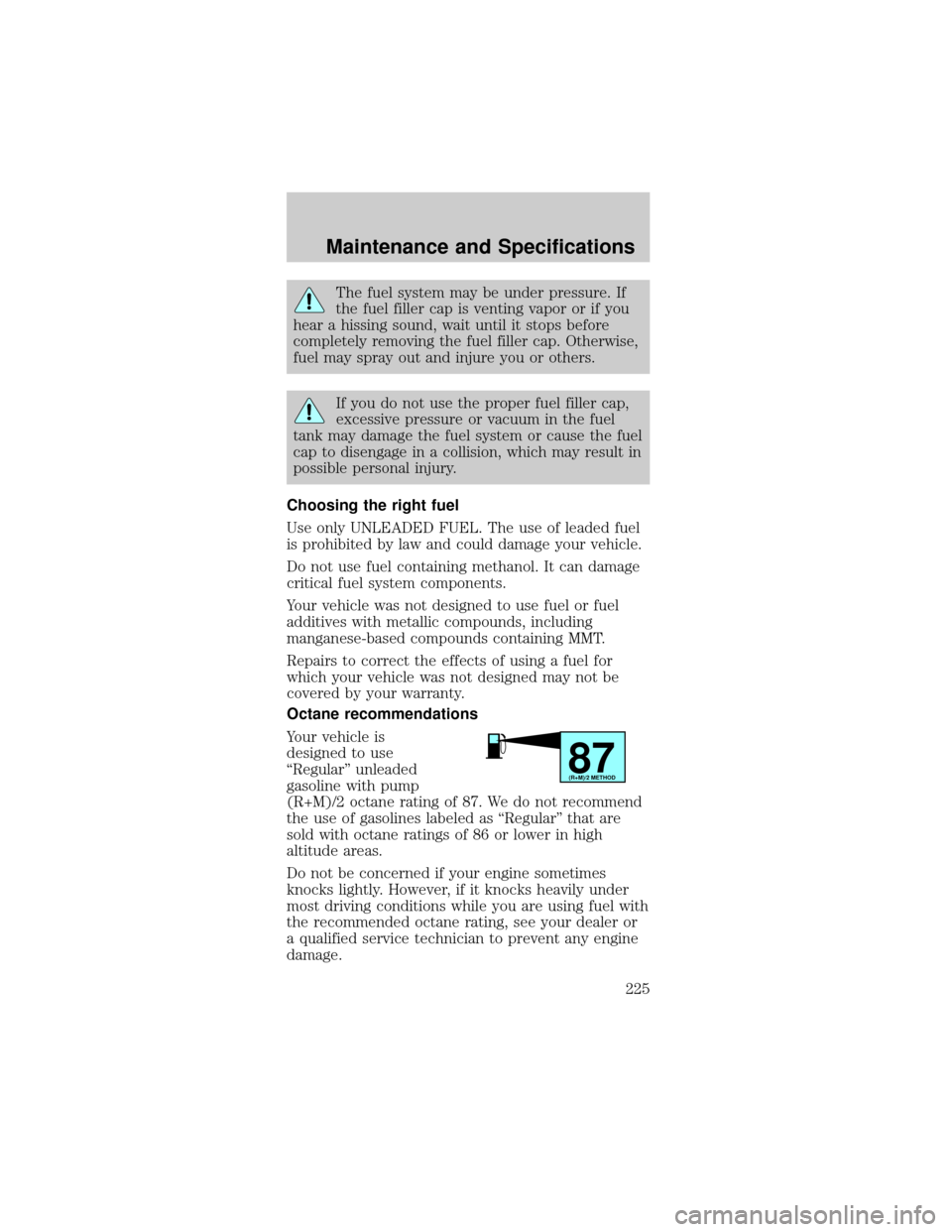
Your vehicle is
designed to use
ªRegularº unleaded
gasoline with pump
(R+M)/2 octane rating of 87. We do not recommend
the use of gasolines labeled as ªRegularº that are
sold with octane ratings of 86 or lower in high
altitude areas.
Do not be concerned if your engine sometimes
knocks lightly. However, if it knocks heavily under
most driving conditions while you are using fuel with
the recommended octane rating, see your dealer or
a qualified service technician to prevent any engine
damage.
87(R+M)/2 METHOD
Maintenance and Specifications
225
Page 227 of 264
If you have run out of fuel:
²You may need to cycle the ignition from OFF to
ON several times after refueling, to allow the fuel
system to pump the fuel from the tank to the
engine.
²Your ªService Engine Soonº indicator may come
on. For more information on the ªService Engine
Soonº indicator, refer to theInstrument Cluster
chapter.
Fuel Filter
For fuel filter replacement, see your dealer or a
qualified service technician. Refer to the scheduled
maintenance guide for the appropriate intervals for
changing the fuel filter.
Replace the fuel filter with an authorized
Motorcraft part. The customer warranty may
be void for any damage to the fuel system if an
authorized Motorcraft fuel filter is not used.
ESSENTIALS OF GOOD FUEL ECONOMY
Measuring techniques
Your best source of information about actual fuel
economy is you, the driver. You must gather
information as accurately and consistently as
possible. Fuel expense, frequency of fillups or fuel
gauge readings are NOT accurate as a measure of
fuel economy. We do not recommend taking fuel
economy measurements during the first 1 600 km
(1 000 miles) of driving (engine break-in period).
You will get a more accurate measurement after
3 000 km±5 000 km (2 000 miles-3 000 miles).
Filling the tank
The advertised fuel capacity of the fuel tank on your
vehicle is equal to the rated refill capacity of the fuel
tank as listed in theRefill capacitiessection of this
chapter.
Maintenance and Specifications
227