Page 228 of 264

The advertised capacity is the amount of the
indicated capacity and the empty reserve combined.
Indicated capacity is the difference in the amount of
fuel in a full tank and a tank when the fuel gauge
indicates empty. Empty reserve is the small amount
of fuel remaining in the fuel tank after the fuel
gauge indicates empty.
The amount of usable fuel in the empty reserve
varies and should not be relied upon to
increase driving range. When refueling your
vehicle after the fuel gauge indicates empty,
you might not be able to refuel the full amount
of the advertised capacity of the fuel tank due
to the empty reserve still present in the tank.
For consistent results when filling the fuel tank:
²Turn the engine/ignition switch to the off position
prior to refueling, an error in the reading will
result if the engine is left running.
²Use the same filling rate setting (low Ð medium
Ð high) each time the tank is filled.
²Allow no more than 2 automatic click-offs when
filling.
²Always use fuel with the recommended octane
rating.
²Use a known quality gasoline, preferably a
national brand.
²Use the same side of the same pump and have
the vehicle facing the same direction each time
you fill up.
²Have the vehicle loading and distribution the
same every time.
Your results will be most accurate if your filling
method is consistent.
Maintenance and Specifications
228
Page 230 of 264

²Anticipate stopping; slowing down may eliminate
the need to stop.
²Sudden or hard accelerations may reduce fuel
economy.
²Slow down gradually.
²Driving at reasonable speeds (traveling at 88 km/h
[55 mph] uses 15% less fuel than traveling at
105 km/h [65 mph]).
²Revving the engine before turning it off may
reduce fuel economy.
²Using the air conditioner or defroster may reduce
fuel economy.
²You may want to turn off the speed control in
hilly terrain if unnecessary shifting between third
and fourth gear occurs. Unnecessary shifting of
this type could result in reduced fuel economy.
²Warming up a vehicle on cold mornings is not
required and may reduce fuel economy.
²Resting your foot on the brake pedal while driving
may reduce fuel economy.
²Combine errands and minimize stop-and-go
driving.
Maintenance
²Keep tires properly inflated and use only
recommended size.
²Operating a vehicle with the wheels out of
alignment will reduce fuel economy.
²Use recommended engine oil. Refer toLubricant
specificationsin this chapter.
²Perform all regularly scheduled maintenance
items. Follow the recommended maintenance
schedule and owner maintenance checks found in
your vehicle scheduled maintenance guide.
Maintenance and Specifications
230
Page 232 of 264
EMISSION CONTROL SYSTEM
Your vehicle is equipped with various emission
control components and a catalytic converter which
will enable your vehicle to comply with applicable
exhaust emission standards. To make sure that the
catalytic converter and other emission control
components continue to work properly:
²Use only the specified fuel listed.
²Avoid running out of fuel.
²Do not turn off the ignition while your vehicle is
moving, especially at high speeds.
²Have the items listed in your scheduled
maintenance guide performed according to the
specified schedule.
The scheduled maintenance items listed in the
scheduled maintenance guide are essential to the life
and performance of your vehicle and to its emissions
system.
If other than Ford, Motorcraft or Ford-authorized parts
are used for maintenance replacements or for service
of components affecting emission control, such
non-Ford parts should be equivalent to genuine Ford
Motor Company parts in performance and durability.
Do not park, idle, or drive your vehicle in
dry grass or other dry ground cover. The
emission system heats up the engine compartment
and exhaust system, which can start a fire.
Illumination of the ªService Engine Soonº light,
charging system warning light or the temperature
warning light, fluid leaks, strange odors, smoke or
loss of engine power, could indicate that the
emission control system is not working properly.
Exhaust leaks may result in entry of harmful
and potentially lethal fumes into the
passenger compartment.
Maintenance and Specifications
232
Page 233 of 264

Do not make any unauthorized changes to your
vehicle or engine. By law, vehicle owners and anyone
who manufactures, repairs, services, sells, leases,
trades vehicles, or supervises a fleet of vehicles are
not permitted to intentionally remove an emission
control device or prevent it from working.
Information about your vehicle's emission system is
on the Vehicle Emission Control Information Decal
located on or near the engine. This decal identifies
engine displacement and gives some tune up
specifications.
Please consult yourWarranty Guidefor complete
emission warranty information.
Readiness for Inspection/Maintenance (I/M)
testing
In some localities, it may be a legal requirement to
pass an I/M test of the on-board diagnostics system.
If your ªCheck Engine/Service Engine Soonº light is
on, refer to the description in theWarning lights
and chimessection of theInstrument Cluster
chapter. Your vehicle may not pass the I/M test with
the ªCheck Engine/Service Engine Soonº light on.
If the vehicle's powertrain system or its battery has
just been serviced, the on-board diagnostics system
is reset to a ªnot ready for I/M testº condition. To
ready the on-board diagnostics system for I/M
testing, a minimum of 30 minutes of city and
highway driving is necessary as described below:
²First, at least 10 minutes of driving on an
expressway or highway.
²Next, at least 20 minutes driving in stop-and-go,
city-type traffic with at least four idle periods.
Allow the vehicle to sit for at least eight hours
without starting the engine. Then, start the engine
and complete the above driving cycle. The engine
must warm up to its normal operating temperature.
Once started, do not turn off the engine until the
above driving cycle is complete.
Maintenance and Specifications
233
Page 234 of 264

CHECKING AND ADDING POWER STEERING
FLUID
Check the power steering fluid. Refer to the
scheduled maintenance guide for the service interval
schedules. If adding fluid is necessary, use only
MERCONtAT F.
If your vehicle is
equipped with the
3.8L V6 engine,check
the power steering
fluid level with the
engine at normal
operating temperature.
1. Start the engine and
let it run until it
reaches normal
operating temperature
(the engine coolant
temperature gauge
indicator will be near
the center of the
normal area between H
and C).
2. While the engine idles, turn the steering wheel
left and right several times.
3. Turn the engine off.
4. Check the fluid level on the dipstick. It should be
within the FULL HOT range. Do not add fluid if the
level is within this range.
5. If the fluid is low, add fluid in small amounts,
continuously checking the level until it reaches the
correct operating range. Be sure to put the cap back
on the reservoir.
FILL
HOT
Maintenance and Specifications
234
Page 235 of 264
If your vehicle is
equipped with a 4.6L
V8 engine,check the
power steering fluid
level with the engine at
ambient temperature.
Allow at least one-half
hour after driving for
the power steering
fluid to cool.
1. Start the engine and
allow the engine to
idle.
2. Turn the steering
wheel left and right
several times.
3. Turn the engine off.
4. Check the fluid level in the reservoir. It should be
between the MIN and MAX lines. Do not add fluid if
the level is within this range.
5. If the fluid is low, add fluid in small amounts,
continuously checking the level until it reaches the
correct operating range. Be sure to put the cap back
on the reservoir.
BRAKE FLUID
Checking and adding brake fluid
Brake fluid should be checked and refilled as
needed. Refer to the scheduled maintenance guide
for the service interval schedules.
MAXMIN
Maintenance and Specifications
235
Page 236 of 264
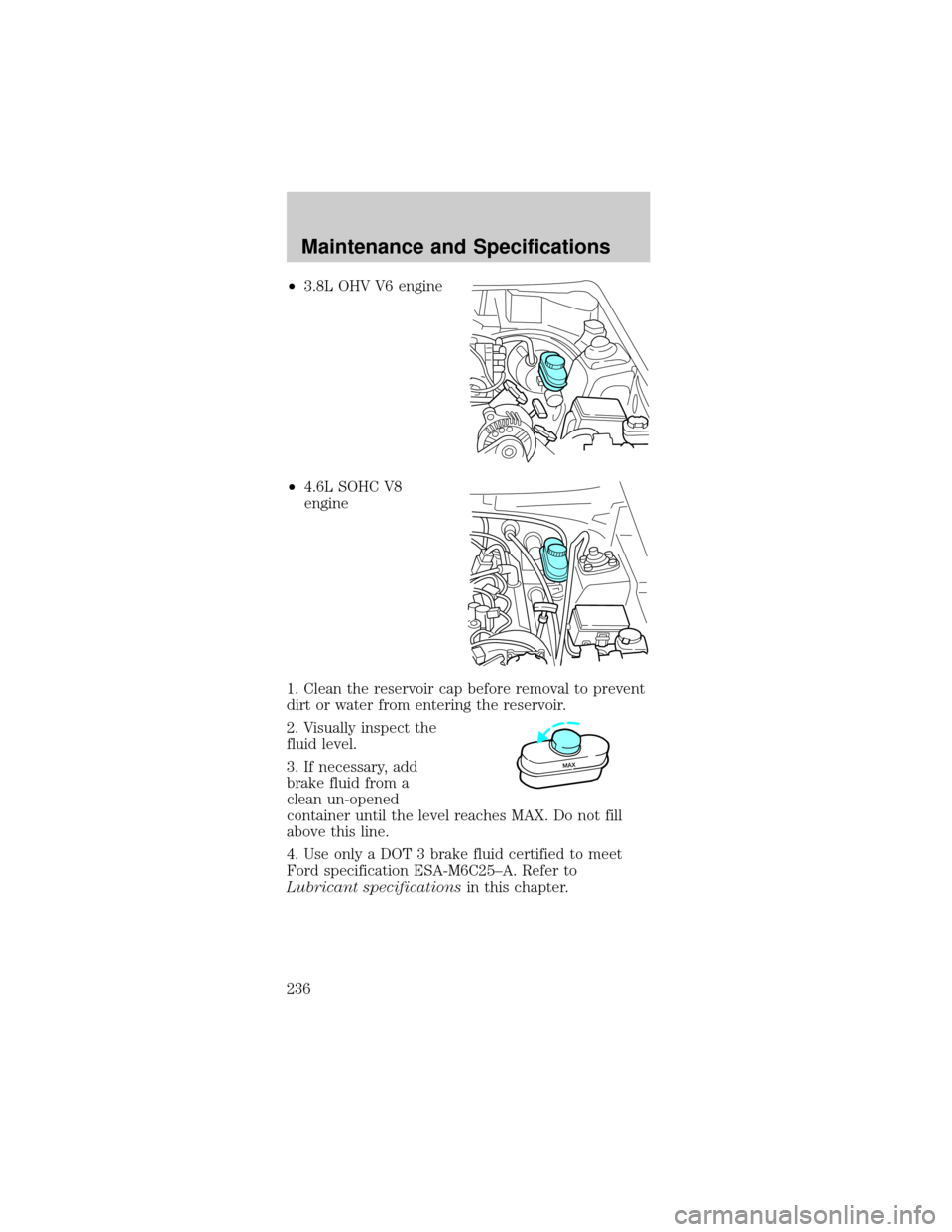
²3.8L OHV V6 engine
²4.6L SOHC V8
engine
1. Clean the reservoir cap before removal to prevent
dirt or water from entering the reservoir.
2. Visually inspect the
fluid level.
3. If necessary, add
brake fluid from a
clean un-opened
container until the level reaches MAX. Do not fill
above this line.
4. Use only a DOT 3 brake fluid certified to meet
Ford specification ESA-M6C25±A. Refer to
Lubricant specificationsin this chapter.
MAX
Maintenance and Specifications
236
Page 237 of 264
Brake fluid is toxic. If brake fluid contacts
the eyes, flush eyes with running water for
15 minutes. Seek medical attention if irritation
persists. If taken internally, drink water and induce
vomiting. Seek medical attention immediately.
If you use a brake fluid that is not DOT 3,
you will cause permanent damage to your
brakes.
Do not let the reservoir for the master
cylinder run dry. This may cause the brakes
to fail.
CLUTCH ADJUSTMENT (IF EQUIPPED)
Check the clutch
adjustment. Refer to
the scheduled
maintenance guide for
the service interval
schedules.
The clutch on your
vehicle is operated by
a cable. As necessary, adjust the clutch as described
below.
1. Turn the engine off and shift into 1 (First).
2. Put your foot under the clutch pedal and gently
pull it up until the pedal stops.
3. Push the clutch pedal down slowly. You will hear a
click as the clutch adjusts itself.
Maintenance and Specifications
237