Page 218 of 320
Fuse/Relay
LocationFuse Amp
RatingPower Distribution Box
Description
3 30A* Main Light Switch, Headlamp
Relay, Multifunction Switch
4 Ð Not Used
5 20A* Trailer Tow Backup/Park Lamps
6 15A* Main Light Switch, Park Lamp
Relay
7 20A* Horn
8 15A* Power Door Locks, CSM, Lock
Relays
9 15A* Daytime Running Lamps (DRL),
Fog Lamps
10 20A* Fuel Pump
11 20A* Alternator Field
12 20A* Rear Auxiliary Power Point
13 15A* A/C Clutch
14 Ð Not Used
15 10A Running Board Lamps
16 Ð Not Used
17 Ð Not Used
18 15A* Powertrain Control Module, Fuel
Injectors, Fuel Pump Relay, Mass
Air Flow Sensor
19 10A* Trailer/Camper Adapter (Right
Stop and Right Turn Lamp)
20 10A* Trailer/Camper Adapter (Left Stop
and Left Turn Lamp)
21 Ð Not Used
22 Ð Not Used
23 15A* HEGO Sensor, Automatic
Transmission
24 Ð Not Used
101 30A** Trailer Tow Battery Charge
Roadside Emergencies
218
Page 219 of 320
Fuse/Relay
LocationFuse Amp
RatingPower Distribution Box
Description
102 50/20A** Four Wheel Antilock Brake
Module/Rear Wheel Antilock
Brake Module, Ignition Switch
103 50A** Central Junction Box
104 30A** 4x4 Shift Motor & Clutch
105 40A** Climate Control Front Blower
106 20A** Inter Cooler Pump (Supercharged
engine only)
107 Ð Not Used
108 30A** Trailer Tow Electric Brake
109 Ð Not Used
110 30A** ACC Delay Relay
111 40A** Ignition Switch Battery Feed
(Start and Run Circuits)
112 30A** Drivers Power Seat, Adjustable
Pedal switch
113 40A** Ignition Switch Battery Feed (Run
and Accessory Circuits)
114 Ð Not Used
115 20A** Power Door Locks
116 Ð Not Used
117 Ð Not Used
118 30A** Heated Seats
201 Ð Trailer Tow Park Lamp Relay
202 Ð Front Wiper Run/Park Relay
203 Ð Trailer Tow Backup Lamp Relay
204 Ð A/C Clutch Relay
205 Ð Horn Relay
206 Ð Fog Lamp Relay
207 Ð Front Washer Pump Relay
208 Ð Inter Cooler Pump Relay
(Supercharged engine only)
Roadside Emergencies
219
Page 220 of 320

Fuse/Relay
LocationFuse Amp
RatingPower Distribution Box
Description
209 Ð Front Wiper Hi/Lo Relay
301 Ð Fuel Pump Relay
302 Ð Trailer Tow Battery Charge Relay
303 Ð Not Used
304 Ð Powertrain Control Module Relay
305 Ð Fuel Pump Hi/Lo Relay
(Supercharged engine only)
306 Ð Inertia Switch Relay
(Supercharged engine only)
401 Ð Not Used
501 Ð Powertrain Control Module Diode
502 Ð A/C Compressor Diode
503 Ð Not Used
601 CB Power Windows, Moonroof
602 Ð Not Used
*Mini fuses **Maxi fuses
CHANGING THE TIRES
If you get a flat tire while driving, do not apply the brake heavily.
Instead, gradually decrease your speed. Hold the steering wheel firmly
and slowly move to a safe place on the side of the road.
Spare tire information
Your vehicle is equipped with a spare tire that may be used as a spare or
a regular tire. The spare tire wheel may not match the road wheel, and is
not equipped with wheel trim. The wheel trim from the wheel/tire may
be used on the spare if the wheels match.
If your vehicle is equipped with 4WD, a spare tire of a different
size than the road tires should not be used. Such a tire could
result in damage to driveline components and make the vehicle
difficult to control.
Roadside Emergencies
220
Page 221 of 320
Location of the spare tire and tools
The spare tire and tools for your vehicle are stowed in the following
locations:
Tool Location
Spare tire Under the vehicle, just forward of
the rear bumper
Jack, lug nut wrench Regular cab: Under the seat on the
passenger side
Super Cab: Under the front or rear
seat on the passenger side
Super Crew cab: In the passenger
side rear storage compartment
Jack handle On top of the radiator support at
the front of the engine
compartment
Key, spare tire lock In the glove box
Removing the spare tire
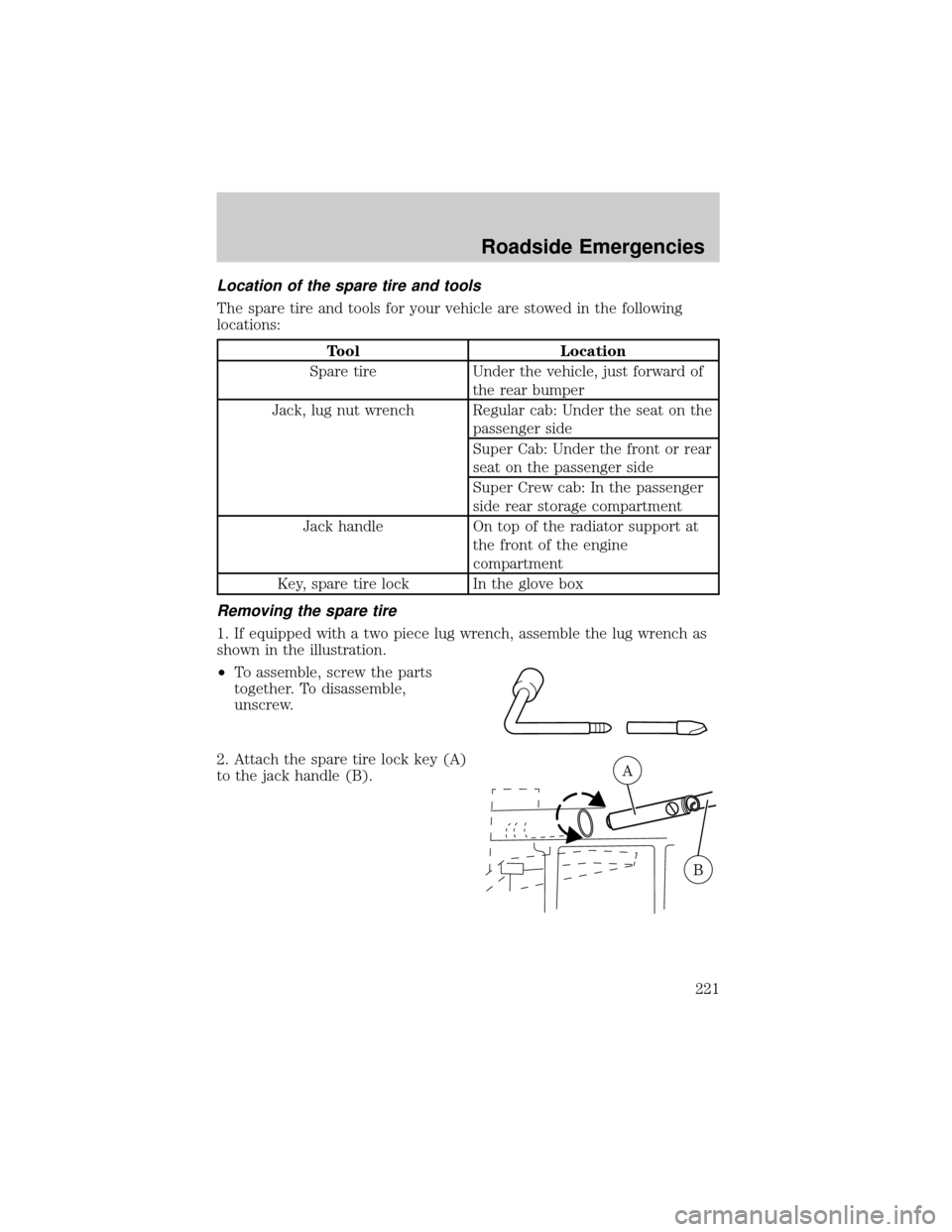
1. If equipped with a two piece lug wrench, assemble the lug wrench as
shown in the illustration.
²To assemble, screw the parts
together. To disassemble,
unscrew.
2. Attach the spare tire lock key (A)
to the jack handle (B).
Roadside Emergencies
221
Page 222 of 320
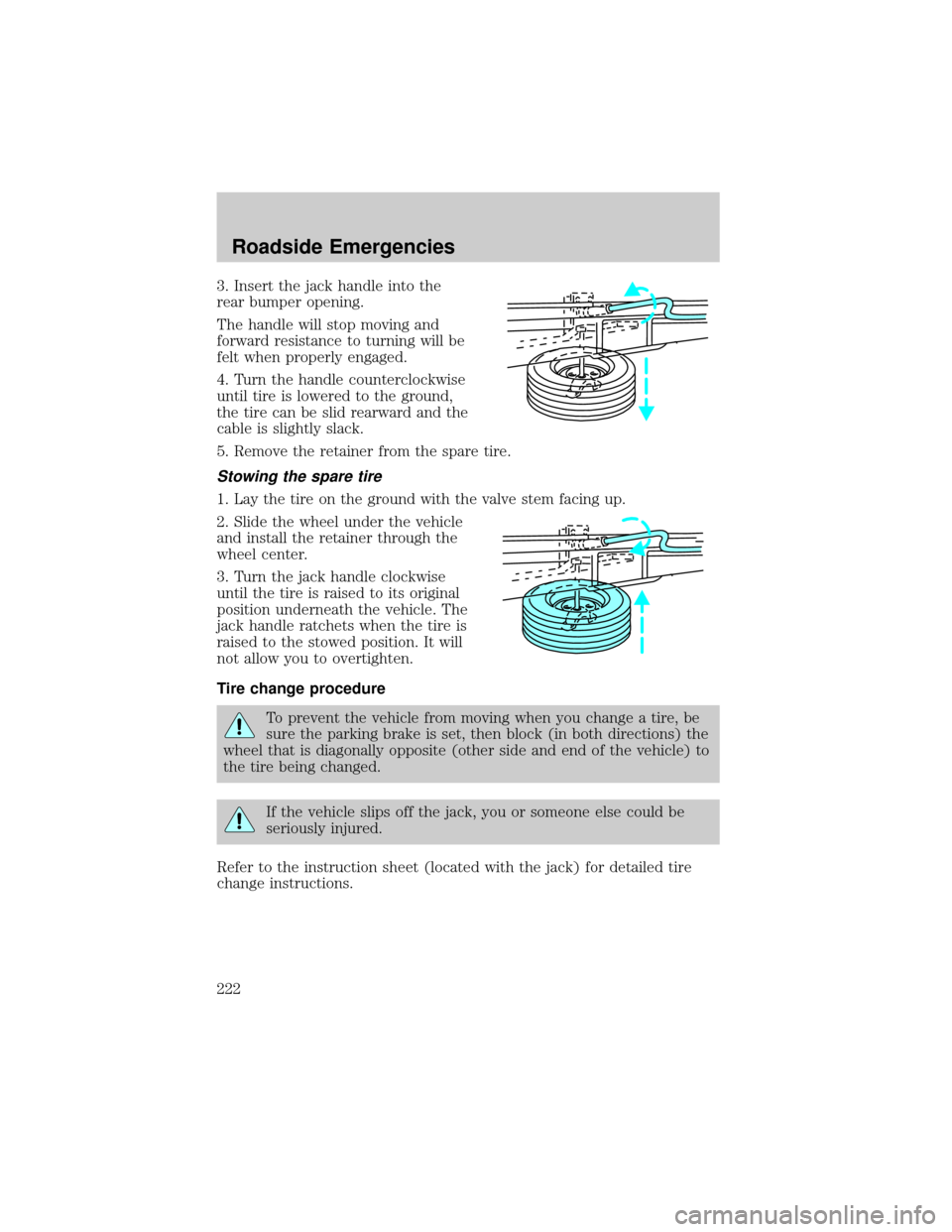
3. Insert the jack handle into the
rear bumper opening.
The handle will stop moving and
forward resistance to turning will be
felt when properly engaged.
4. Turn the handle counterclockwise
until tire is lowered to the ground,
the tire can be slid rearward and the
cable is slightly slack.
5. Remove the retainer from the spare tire.
Stowing the spare tire
1. Lay the tire on the ground with the valve stem facing up.
2. Slide the wheel under the vehicle
and install the retainer through the
wheel center.
3. Turn the jack handle clockwise
until the tire is raised to its original
position underneath the vehicle. The
jack handle ratchets when the tire is
raised to the stowed position. It will
not allow you to overtighten.
Tire change procedure
To prevent the vehicle from moving when you change a tire, be
sure the parking brake is set, then block (in both directions) the
wheel that is diagonally opposite (other side and end of the vehicle) to
the tire being changed.
If the vehicle slips off the jack, you or someone else could be
seriously injured.
Refer to the instruction sheet (located with the jack) for detailed tire
change instructions.
Roadside Emergencies
222
Page 225 of 320
²Rear
To lessen the risk of
personal injury, do not put
any part of your body under the
vehicle while changing a tire. Do
not start the engine when your
vehicle is on the jack. The jack is
only meant for changing the tire.
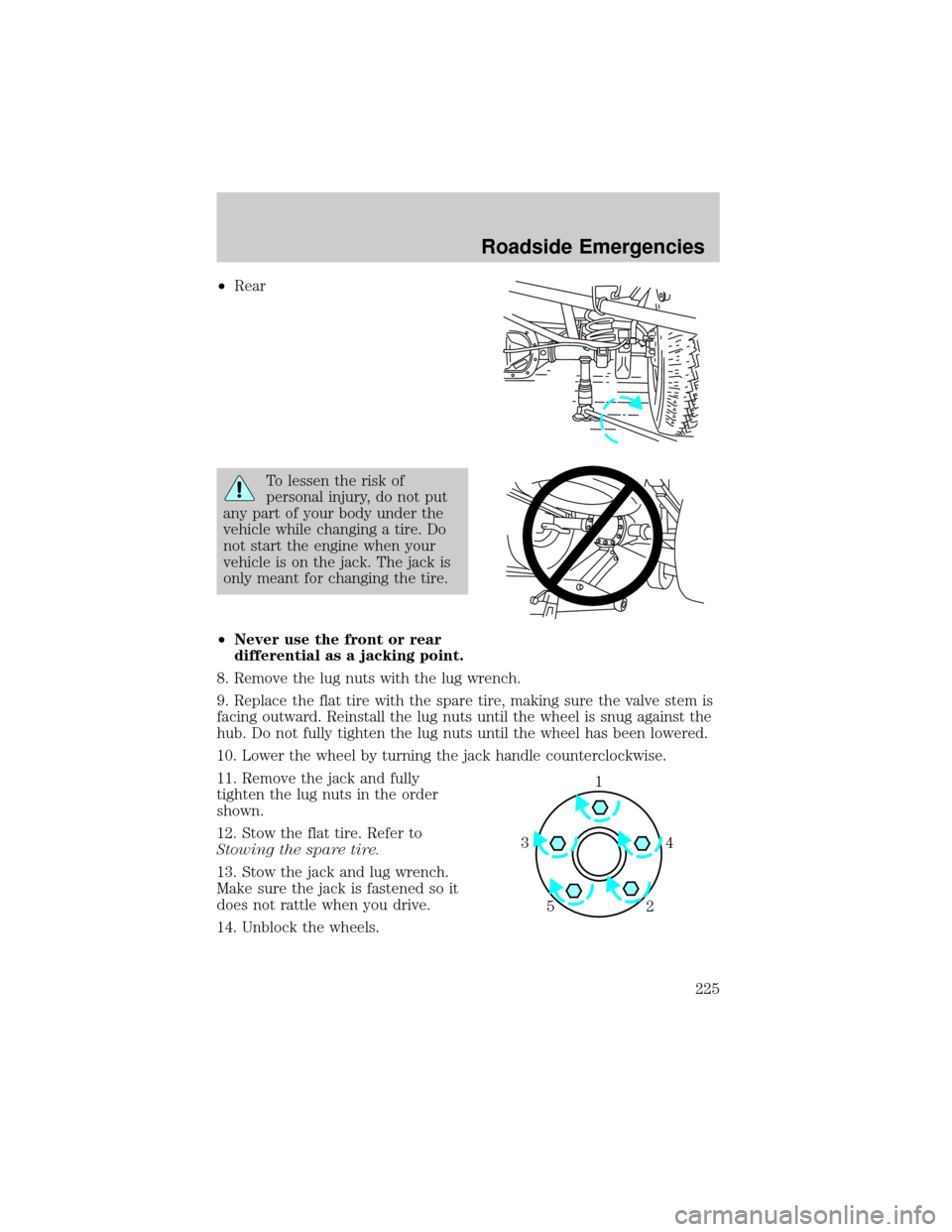
²Never use the front or rear
differential as a jacking point.
8. Remove the lug nuts with the lug wrench.
9. Replace the flat tire with the spare tire, making sure the valve stem is
facing outward. Reinstall the lug nuts until the wheel is snug against the
hub. Do not fully tighten the lug nuts until the wheel has been lowered.
10. Lower the wheel by turning the jack handle counterclockwise.
11. Remove the jack and fully
tighten the lug nuts in the order
shown.
12. Stow the flat tire. Refer to
Stowing the spare tire.
13. Stow the jack and lug wrench.
Make sure the jack is fastened so it
does not rattle when you drive.
14. Unblock the wheels.
1
4 3
2 5
Roadside Emergencies
225
Page 231 of 320
WRECKER TOWING
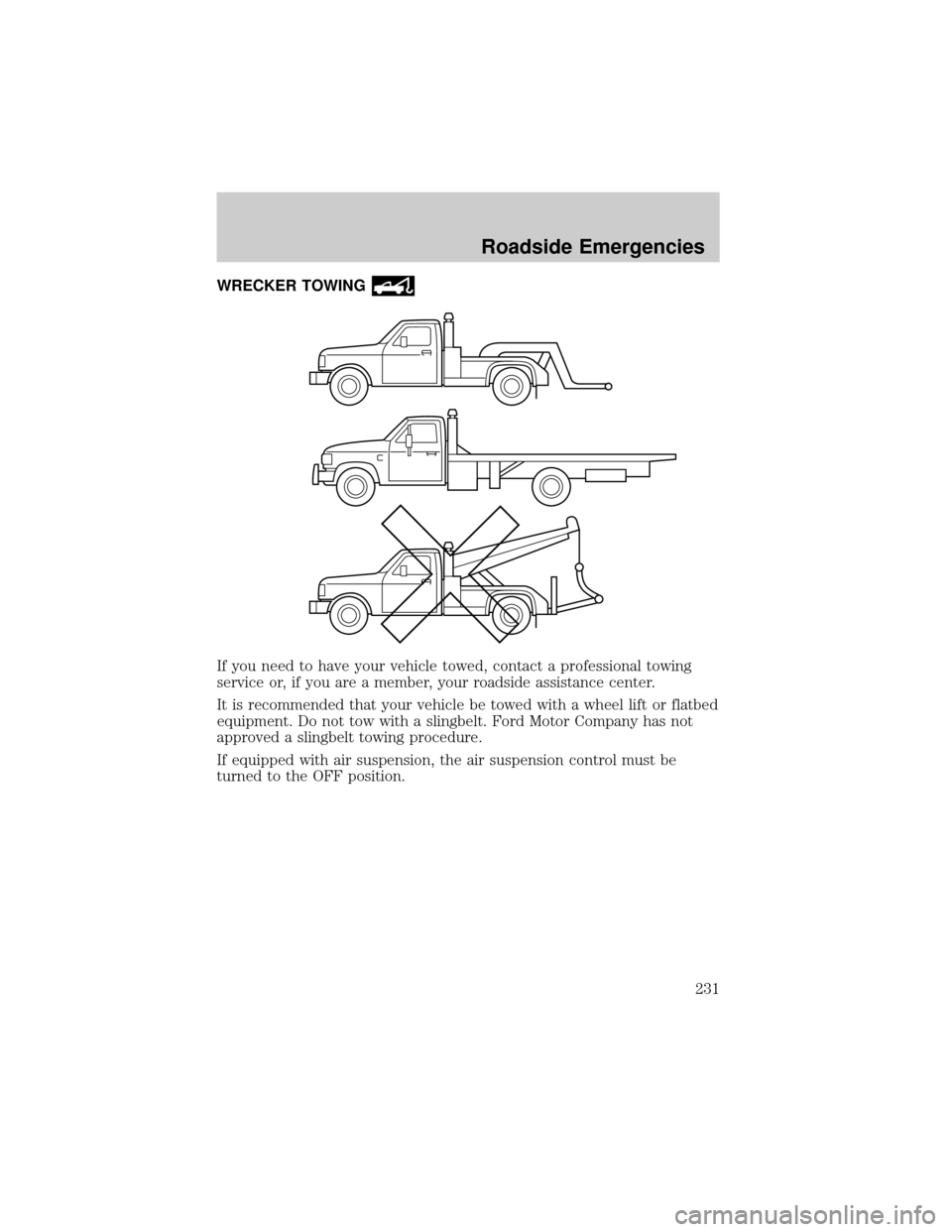
If you need to have your vehicle towed, contact a professional towing
service or, if you are a member, your roadside assistance center.
It is recommended that your vehicle be towed with a wheel lift or flatbed
equipment. Do not tow with a slingbelt. Ford Motor Company has not
approved a slingbelt towing procedure.
If equipped with air suspension, the air suspension control must be
turned to the OFF position.
Roadside Emergencies
231
Page 232 of 320
On 4x2 vehicles, it is acceptable to tow the vehicle with the front wheels
on the ground (without dollies) and the rear wheels off the ground.
On 4x4 vehicles, it is recommended that your vehicle be towed with a
wheel lift and dollies or flatbed equipment with all the wheels off the
ground.
If you are towing a NASCAR Special Edition F-150 or a Harley-Davidson
F-150 using flatbed equipment, you must place two 4X4 boards at the
end of the ramp to allow for bumper clearance.
If the vehicle is towed by other means or incorrectly, vehicle
damage may occur.
Ford Motor Company provides a towing manual for all authorized tow
truck operators. Have your tow truck operator refer to this manual for
proper hook-up and towing procedures for your vehicle.
Roadside Emergencies
232