Page 176 of 320
Always set the parking brake fully and make sure the gearshift is
latched in P (Park). Turn off the ignition whenever you leave
your vehicle.
If the parking brake is fully released, but the brake warning lamp
remains illuminated, the brakes may not be working properly.
See your dealer or a qualified service technician.
Driving with a 4±speed automatic transmission
Understanding gearshift positions
To put your vehicle in gear, start the engine, depress the brake pedal,
then move gearshift lever out of P (Park).
Hold the brake pedal down while you move the gearshift lever
from P (Park) to another position. If you do not hold the brake
pedal down, your vehicle may move unexpectedly and injure someone.
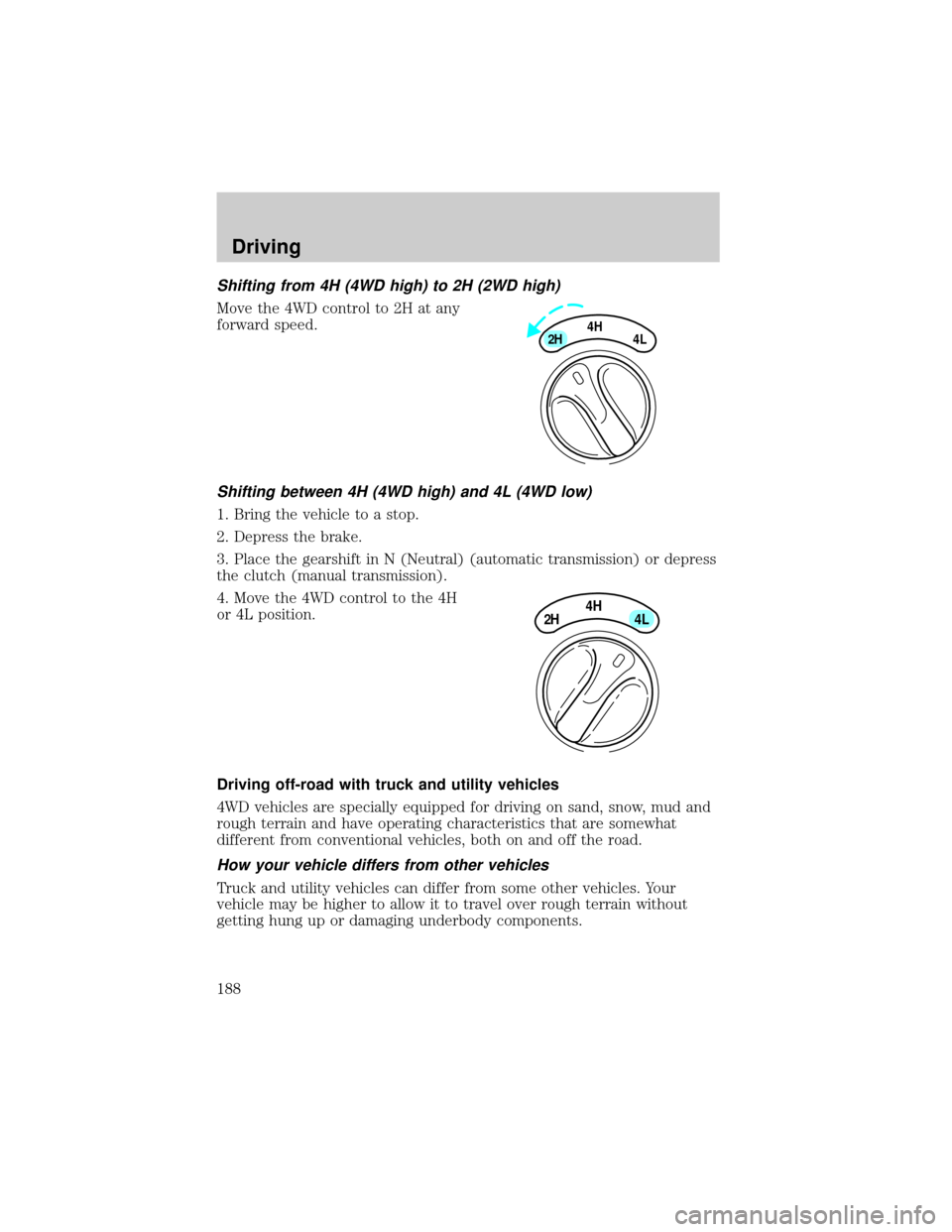
P (Park)
Always come to a complete stop
before shifting into P (Park). Make
sure the gearshift lever is securely
latched in P (Park). This position
locks the transmission and prevents
the rear wheels from turning.
Always set the parking brake fully and make sure the gearshift
lever is latched in P (Park). Turn off the ignition whenever you
leave your vehicle.
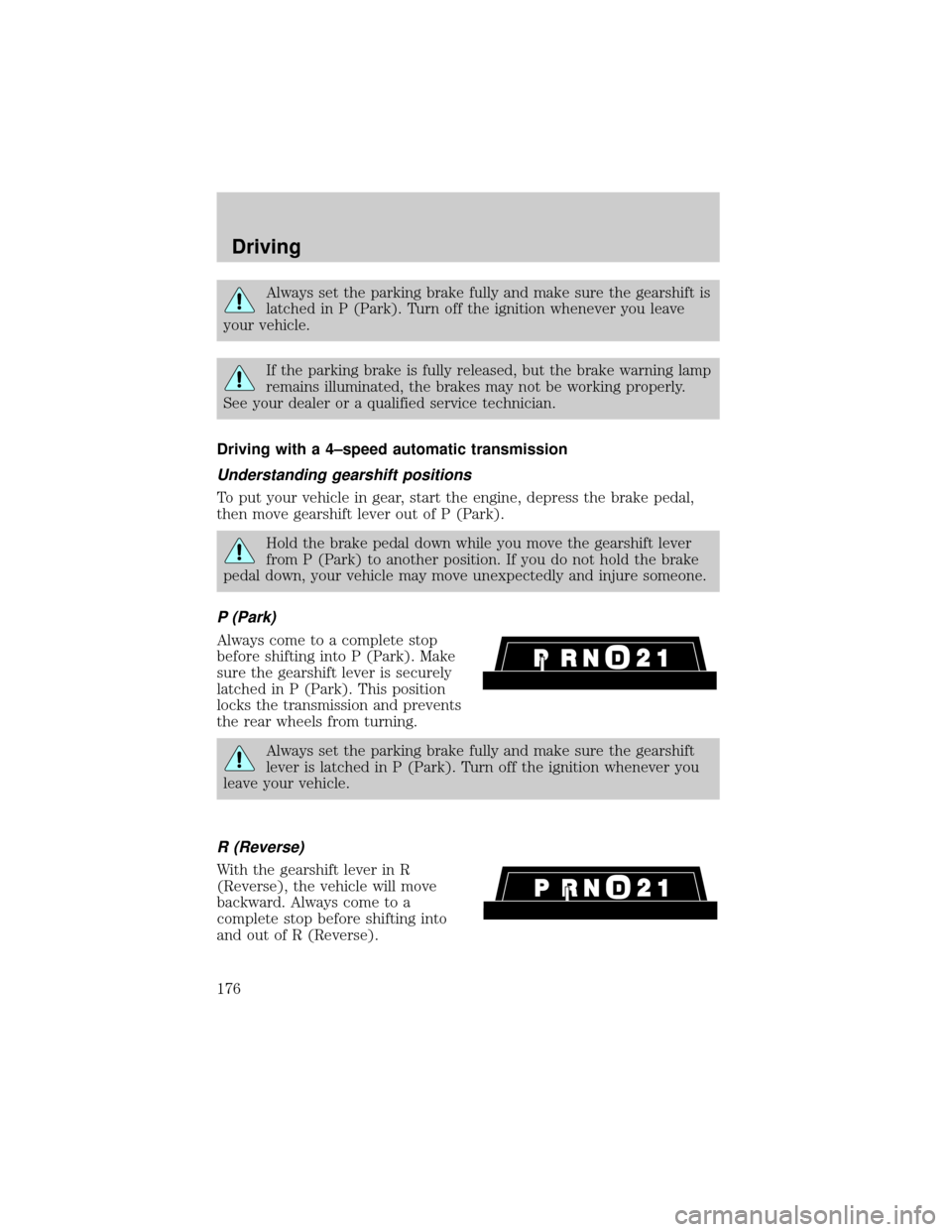
R (Reverse)
With the gearshift lever in R
(Reverse), the vehicle will move
backward. Always come to a
complete stop before shifting into
and out of R (Reverse).
Driving
176
Page 177 of 320
N (Neutral)
With the gearshift lever in N
(Neutral), the vehicle can be started
and is free to roll. Hold the brake
pedal down while in this gear.
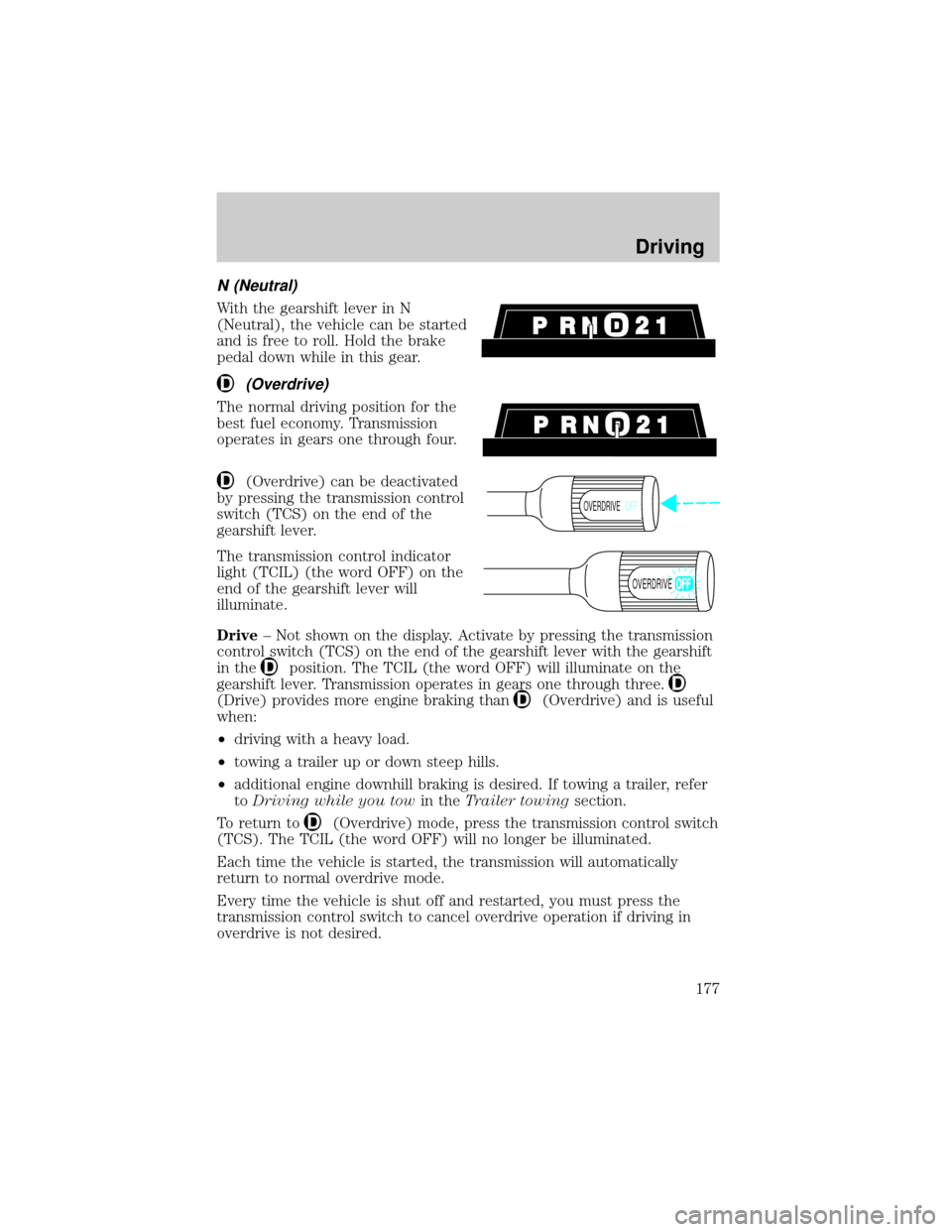
(Overdrive)
The normal driving position for the
best fuel economy. Transmission
operates in gears one through four.
(Overdrive) can be deactivated
by pressing the transmission control
switch (TCS) on the end of the
gearshift lever.
The transmission control indicator
light (TCIL) (the word OFF) on the
end of the gearshift lever will
illuminate.
Drive± Not shown on the display. Activate by pressing the transmission
control switch (TCS) on the end of the gearshift lever with the gearshift
in the
position. The TCIL (the word OFF) will illuminate on the
gearshift lever. Transmission operates in gears one through three.
(Drive) provides more engine braking than(Overdrive) and is useful
when:
²driving with a heavy load.
²towing a trailer up or down steep hills.
²additional engine downhill braking is desired. If towing a trailer, refer
toDriving while you towin theTrailer towingsection.
To return to
(Overdrive) mode, press the transmission control switch
(TCS). The TCIL (the word OFF) will no longer be illuminated.
Each time the vehicle is started, the transmission will automatically
return to normal overdrive mode.
Every time the vehicle is shut off and restarted, you must press the
transmission control switch to cancel overdrive operation if driving in
overdrive is not desired.
OVERDRIVEOFF
OVERDRIVE
Driving
177
Page 178 of 320
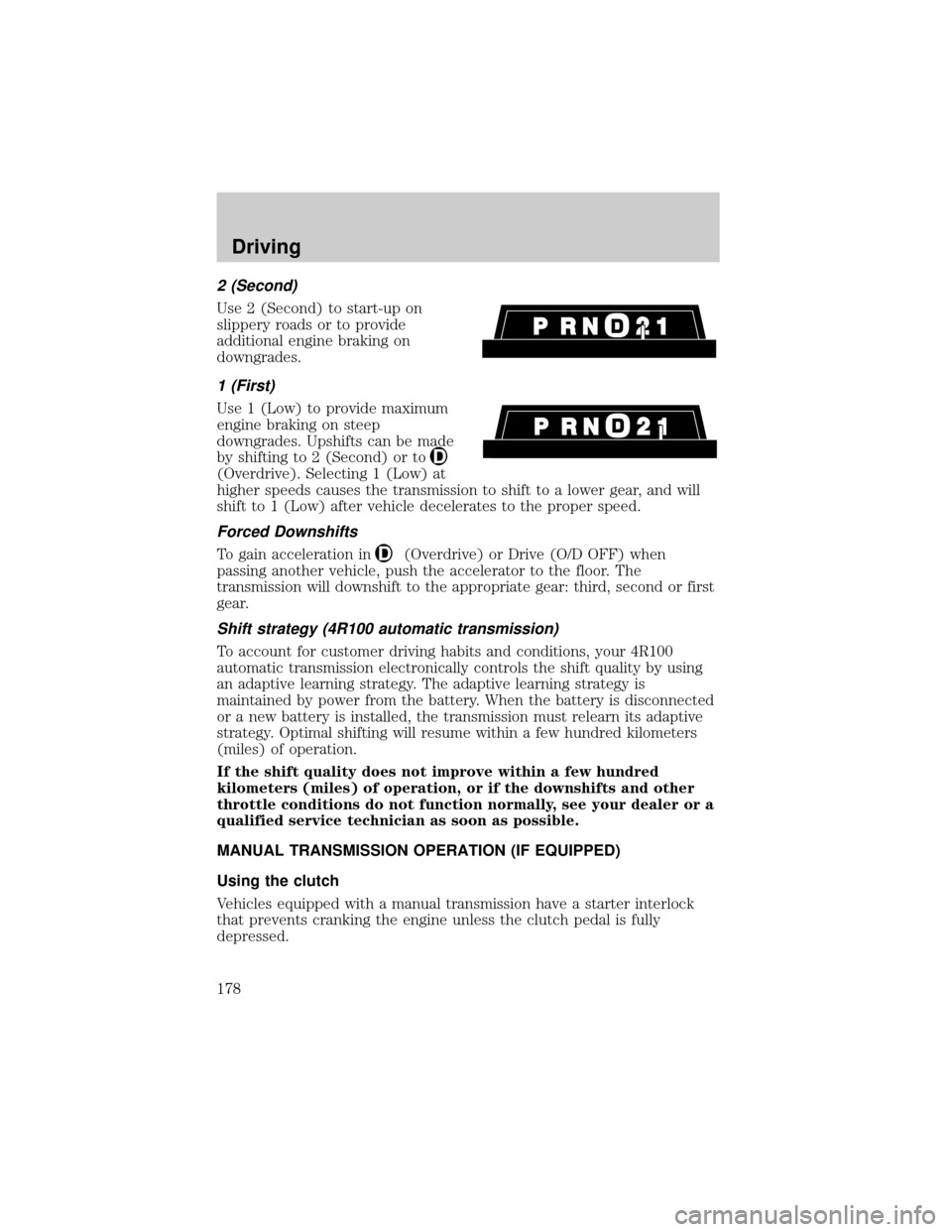
2 (Second)
Use 2 (Second) to start-up on
slippery roads or to provide
additional engine braking on
downgrades.
1 (First)
Use 1 (Low) to provide maximum
engine braking on steep
downgrades. Upshifts can be made
by shifting to 2 (Second) or to
(Overdrive). Selecting 1 (Low) at
higher speeds causes the transmission to shift to a lower gear, and will
shift to 1 (Low) after vehicle decelerates to the proper speed.
Forced Downshifts
To gain acceleration in(Overdrive) or Drive (O/D OFF) when
passing another vehicle, push the accelerator to the floor. The
transmission will downshift to the appropriate gear: third, second or first
gear.
Shift strategy (4R100 automatic transmission)
To account for customer driving habits and conditions, your 4R100
automatic transmission electronically controls the shift quality by using
an adaptive learning strategy. The adaptive learning strategy is
maintained by power from the battery. When the battery is disconnected
or a new battery is installed, the transmission must relearn its adaptive
strategy. Optimal shifting will resume within a few hundred kilometers
(miles) of operation.
If the shift quality does not improve within a few hundred
kilometers (miles) of operation, or if the downshifts and other
throttle conditions do not function normally, see your dealer or a
qualified service technician as soon as possible.
MANUAL TRANSMISSION OPERATION (IF EQUIPPED)
Using the clutch
Vehicles equipped with a manual transmission have a starter interlock
that prevents cranking the engine unless the clutch pedal is fully
depressed.
Driving
178
Page 186 of 320
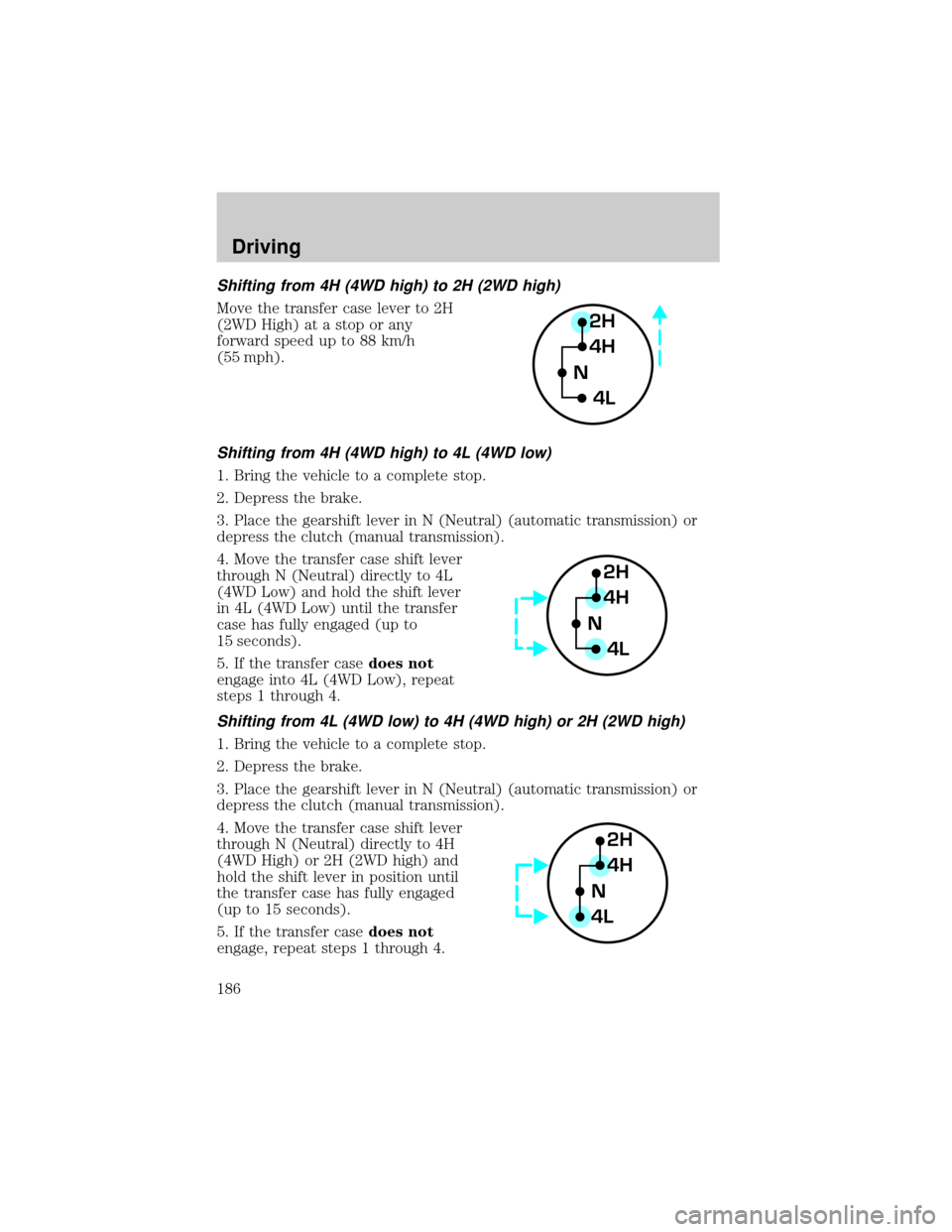
Shifting from 4H (4WD high) to 2H (2WD high)
Move the transfer case lever to 2H
(2WD High) at a stop or any
forward speed up to 88 km/h
(55 mph).
Shifting from 4H (4WD high) to 4L (4WD low)
1. Bring the vehicle to a complete stop.
2. Depress the brake.
3. Place the gearshift lever in N (Neutral) (automatic transmission) or
depress the clutch (manual transmission).
4. Move the transfer case shift lever
through N (Neutral) directly to 4L
(4WD Low) and hold the shift lever
in 4L (4WD Low) until the transfer
case has fully engaged (up to
15 seconds).
5. If the transfer casedoes not
engage into 4L (4WD Low), repeat
steps 1 through 4.
Shifting from 4L (4WD low) to 4H (4WD high) or 2H (2WD high)
1. Bring the vehicle to a complete stop.
2. Depress the brake.
3. Place the gearshift lever in N (Neutral) (automatic transmission) or
depress the clutch (manual transmission).
4. Move the transfer case shift lever
through N (Neutral) directly to 4H
(4WD High) or 2H (2WD high) and
hold the shift lever in position until
the transfer case has fully engaged
(up to 15 seconds).
5. If the transfer casedoes not
engage, repeat steps 1 through 4.
2H
4H
4L N
2H
4H
4L N
2H
4H
4LN
Driving
186
Page 188 of 320
Shifting from 4H (4WD high) to 2H (2WD high)
Move the 4WD control to 2H at any
forward speed.
Shifting between 4H (4WD high) and 4L (4WD low)
1. Bring the vehicle to a stop.
2. Depress the brake.
3. Place the gearshift in N (Neutral) (automatic transmission) or depress
the clutch (manual transmission).
4. Move the 4WD control to the 4H
or 4L position.
Driving off-road with truck and utility vehicles
4WD vehicles are specially equipped for driving on sand, snow, mud and
rough terrain and have operating characteristics that are somewhat
different from conventional vehicles, both on and off the road.
How your vehicle differs from other vehicles
Truck and utility vehicles can differ from some other vehicles. Your
vehicle may be higher to allow it to travel over rough terrain without
getting hung up or damaging underbody components.
4H
2H
4L
4H
2H
4L
Driving
188
Page 190 of 320
If your vehicle gets stuck
If the vehicle is stuck it may be rocked out by shifting from forward and
reverse gears, stopping between shifts, in a steady pattern. Press lightly
on the accelerator in each gear.
Do not rock the vehicle for more than a few minutes or damage
to the transmission and tires may occur or the engine may
overheat.
Do not spin the wheels at over 56 km/h (35 mph). The tires may
fail and injure a passenger or bystander.
Emergency maneuvers
²In an unavoidable emergency situation where a sudden sharp turn
must be made, remember to avoid ªover-drivingº your vehicle, i.e.,
turn the steering wheel only as rapidly and as far as required to avoid
the emergency. Excessive steering will result in less vehicle control,
not more. Additionally, smooth variations of the accelerator and/or
brake pedal pressure should be utilized if changes in vehicle speed are
called for. Avoid abrupt steering, acceleration or braking. Use all
available road surface to return the vehicle to a safe direction of
travel.
²In the event of an emergency stop, avoid skidding the tires and do not
attempt any sharp steering wheel movements.
²If the vehicle goes from one type of surface to another (i.e., from
concrete to gravel) there will be a change in the way the vehicle
responds to a maneuver (steering, acceleration or barking). Again,
avoid these abrupt inputs.
Parking
On some 4WD vehicles, when the transfer case is in the N (Neutral)
position, the engine and transmission are disconnected from the rest of
the driveline. Therefore, the vehicle is free to roll even if the automatic
transmission is in P (Park) or the manual transmission is in gear. Do not
leave the vehicle unattended with the transfer case in N (Neutral)
position. Always set the parking brake fully and turn off the ignition
when leaving the vehicle.
Driving
190
Page 200 of 320
Do not exceed the GVWR or the GAWR specified on the
certification label.
Towing trailers beyond the maximum recommended gross trailer
weight could result in engine damage, transmission/axle damage,
structural damage, loss of control, and personal injury.
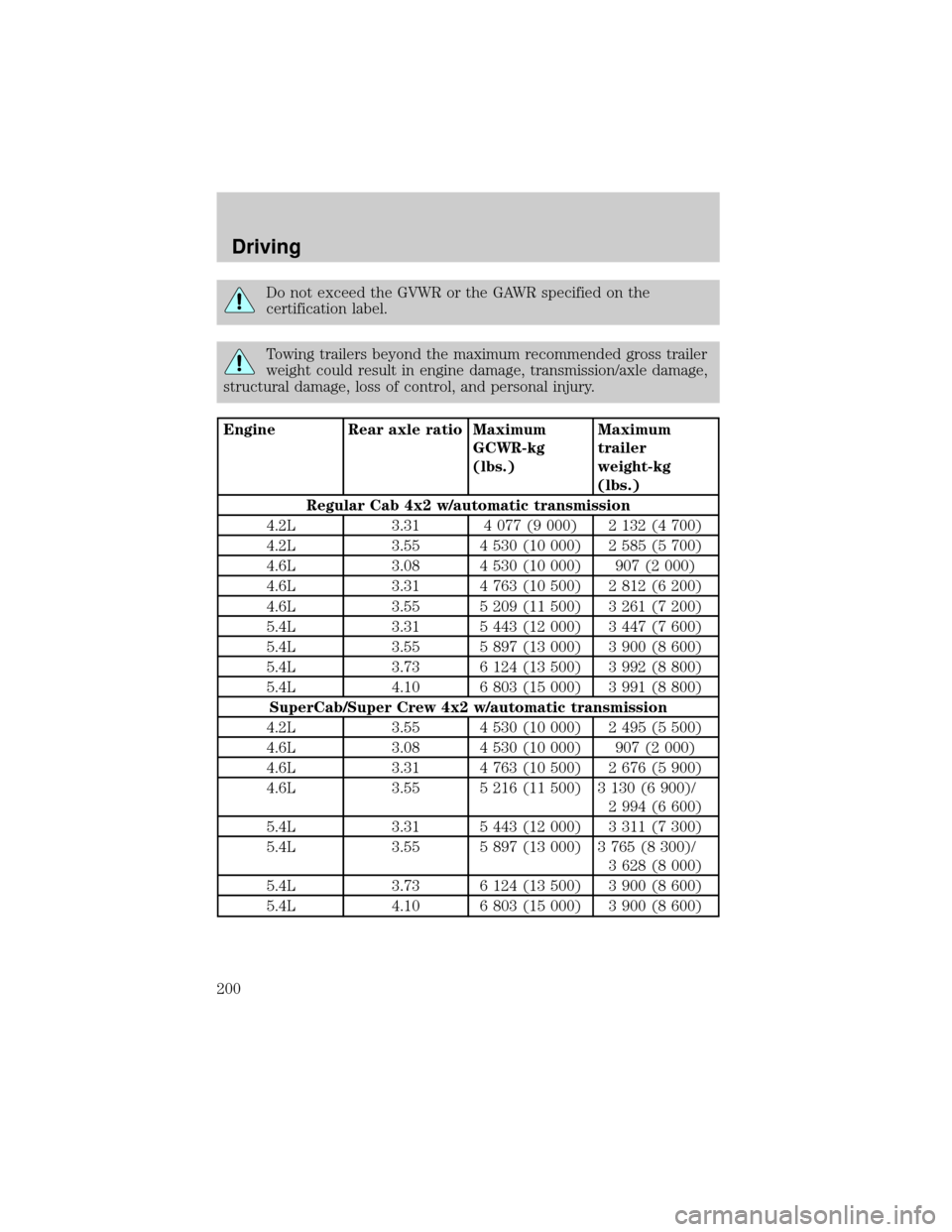
Engine Rear axle ratio Maximum
GCWR-kg
(lbs.)Maximum
trailer
weight-kg
(lbs.)
Regular Cab 4x2 w/automatic transmission
4.2L 3.31 4 077 (9 000) 2 132 (4 700)
4.2L 3.55 4 530 (10 000) 2 585 (5 700)
4.6L 3.08 4 530 (10 000) 907 (2 000)
4.6L 3.31 4 763 (10 500) 2 812 (6 200)
4.6L 3.55 5 209 (11 500) 3 261 (7 200)
5.4L 3.31 5 443 (12 000) 3 447 (7 600)
5.4L 3.55 5 897 (13 000) 3 900 (8 600)
5.4L 3.73 6 124 (13 500) 3 992 (8 800)
5.4L 4.10 6 803 (15 000) 3 991 (8 800)
SuperCab/Super Crew 4x2 w/automatic transmission
4.2L 3.55 4 530 (10 000) 2 495 (5 500)
4.6L 3.08 4 530 (10 000) 907 (2 000)
4.6L 3.31 4 763 (10 500) 2 676 (5 900)
4.6L 3.55 5 216 (11 500) 3 130 (6 900)/
2 994 (6 600)
5.4L 3.31 5 443 (12 000) 3 311 (7 300)
5.4L 3.55 5 897 (13 000) 3 765 (8 300)/
3 628 (8 000)
5.4L 3.73 6 124 (13 500) 3 900 (8 600)
5.4L 4.10 6 803 (15 000) 3 900 (8 600)
Driving
200
Page 201 of 320
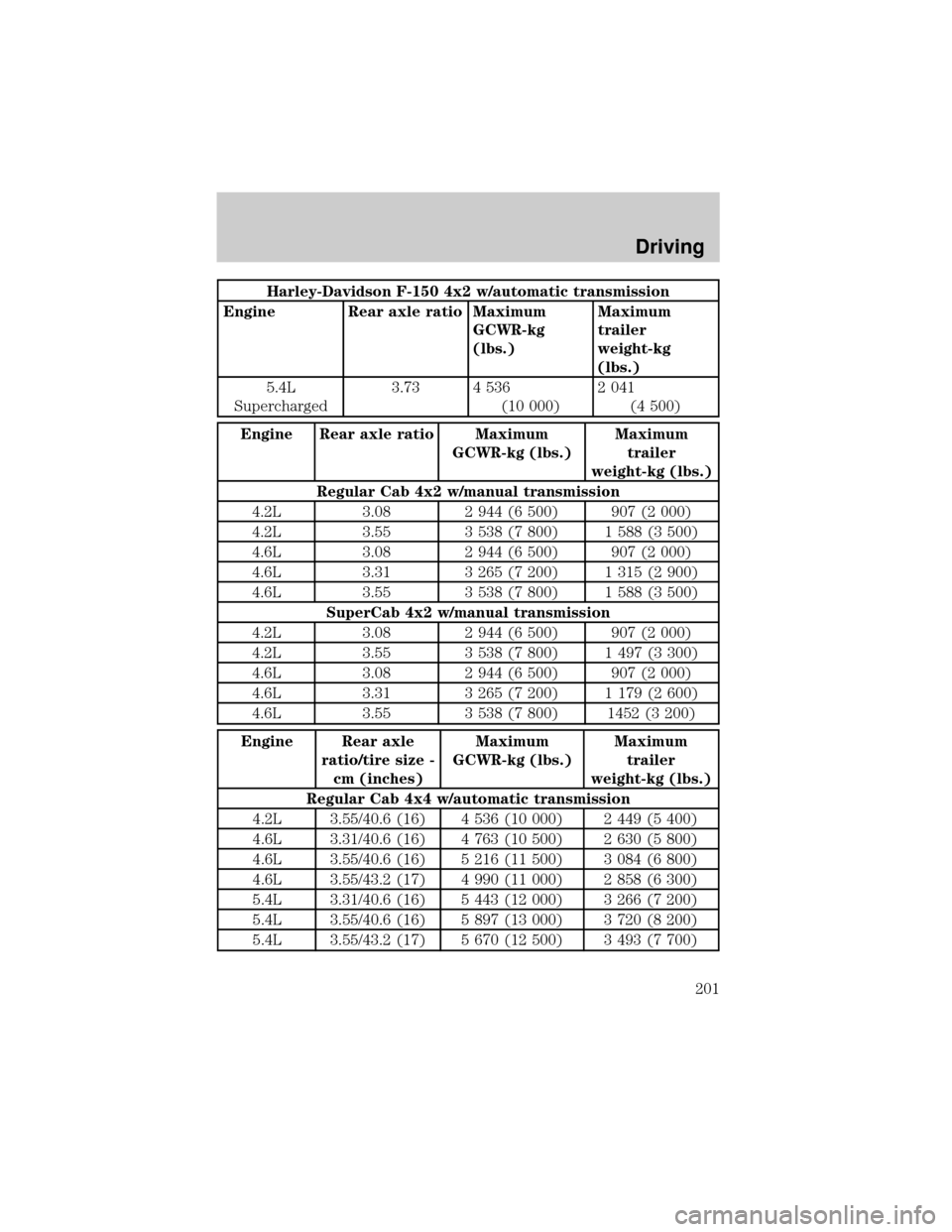
Harley-Davidson F-150 4x2 w/automatic transmission
Engine Rear axle ratio Maximum
GCWR-kg
(lbs.)Maximum
trailer
weight-kg
(lbs.)
5.4L
Supercharged3.73 4 536
(10 000)2 041
(4 500)
Engine Rear axle ratio Maximum
GCWR-kg (lbs.)Maximum
trailer
weight-kg (lbs.)
Regular Cab 4x2 w/manual transmission
4.2L 3.08 2 944 (6 500) 907 (2 000)
4.2L 3.55 3 538 (7 800) 1 588 (3 500)
4.6L 3.08 2 944 (6 500) 907 (2 000)
4.6L 3.31 3 265 (7 200) 1 315 (2 900)
4.6L 3.55 3 538 (7 800) 1 588 (3 500)
SuperCab 4x2 w/manual transmission
4.2L 3.08 2 944 (6 500) 907 (2 000)
4.2L 3.55 3 538 (7 800) 1 497 (3 300)
4.6L 3.08 2 944 (6 500) 907 (2 000)
4.6L 3.31 3 265 (7 200) 1 179 (2 600)
4.6L 3.55 3 538 (7 800) 1452 (3 200)
Engine Rear axle
ratio/tire size -
cm (inches)Maximum
GCWR-kg (lbs.)Maximum
trailer
weight-kg (lbs.)
Regular Cab 4x4 w/automatic transmission
4.2L 3.55/40.6 (16) 4 536 (10 000) 2 449 (5 400)
4.6L 3.31/40.6 (16) 4 763 (10 500) 2 630 (5 800)
4.6L 3.55/40.6 (16) 5 216 (11 500) 3 084 (6 800)
4.6L 3.55/43.2 (17) 4 990 (11 000) 2 858 (6 300)
5.4L 3.31/40.6 (16) 5 443 (12 000) 3 266 (7 200)
5.4L 3.55/40.6 (16) 5 897 (13 000) 3 720 (8 200)
5.4L 3.55/43.2 (17) 5 670 (12 500) 3 493 (7 700)
Driving
201