Page 112 of 184
If you need to arrange roadside assistance for yourself, Ford Motor
Company will reimburse a reasonable amount. To obtain reimbursement
information, U.S. Ford or Mercury vehicles customers call
1-800-241-3673; Lincoln vehicle customers call 1–800–521–4140.
Canadian customers who need to obtain reimbursement information, call
1–800–665–2006.
Roadside coverage beyond basic warranty
In the United States, you may purchase additional roadside assistance
coverage beyond this period through the Ford Auto Club by contacting
your Ford or Lincoln Mercury dealer.
Similarly in Canada, for uninterrupted Roadside Assistance coverage, you
may purchase extended coverage prior to your Basic Warranty’s Roadside
Assistance expiring. For more information and enrollment, contact
1–877–294–2582 or visit our website at www.ford.ca.
HAZARD FLASHER
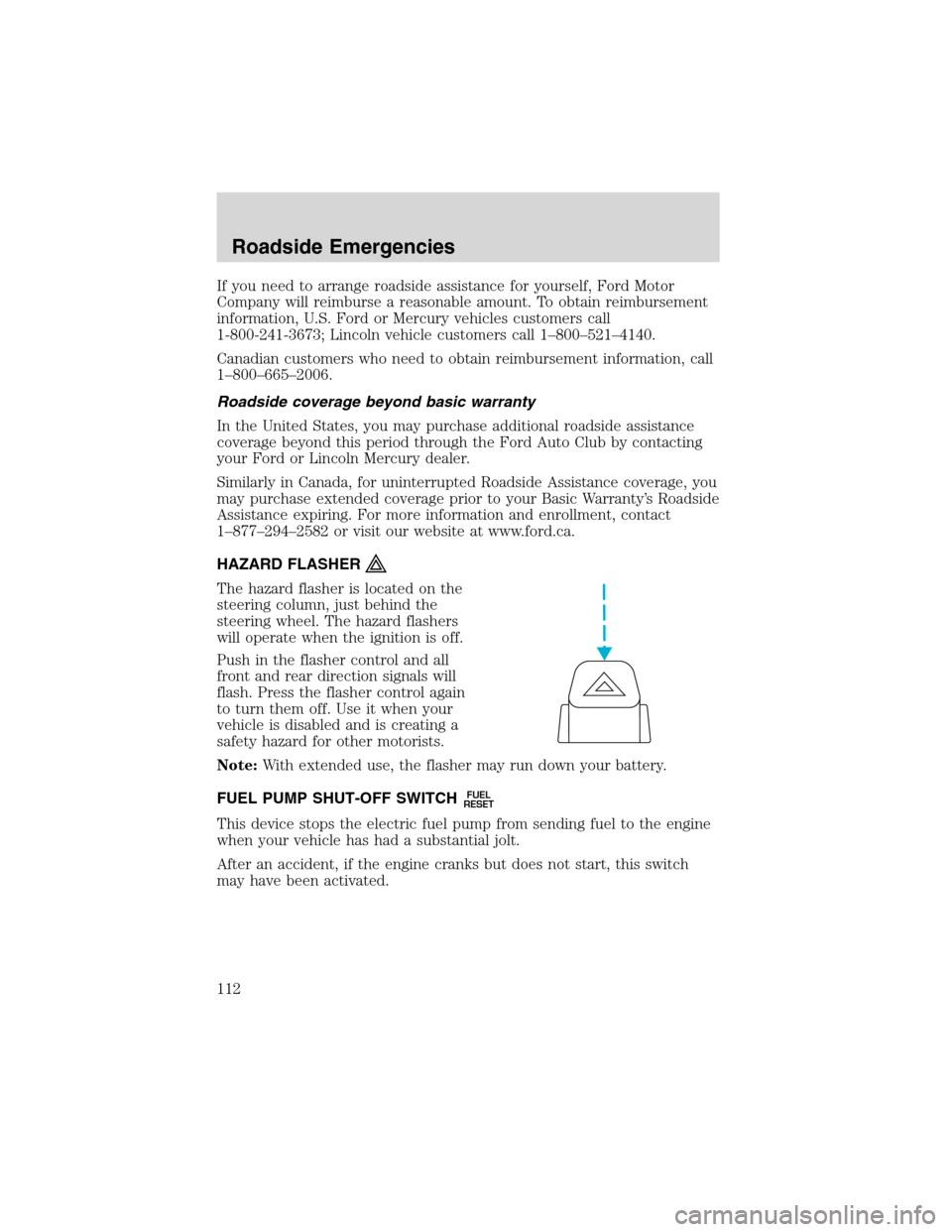
The hazard flasher is located on the
steering column, just behind the
steering wheel. The hazard flashers
will operate when the ignition is off.
Push in the flasher control and all
front and rear direction signals will
flash. Press the flasher control again
to turn them off. Use it when your
vehicle is disabled and is creating a
safety hazard for other motorists.
Note:With extended use, the flasher may run down your battery.
FUEL PUMP SHUT-OFF SWITCH
FUEL
RESET
This device stops the electric fuel pump from sending fuel to the engine
when your vehicle has had a substantial jolt.
After an accident, if the engine cranks but does not start, this switch
may have been activated.
Roadside Emergencies
112
Page 113 of 184
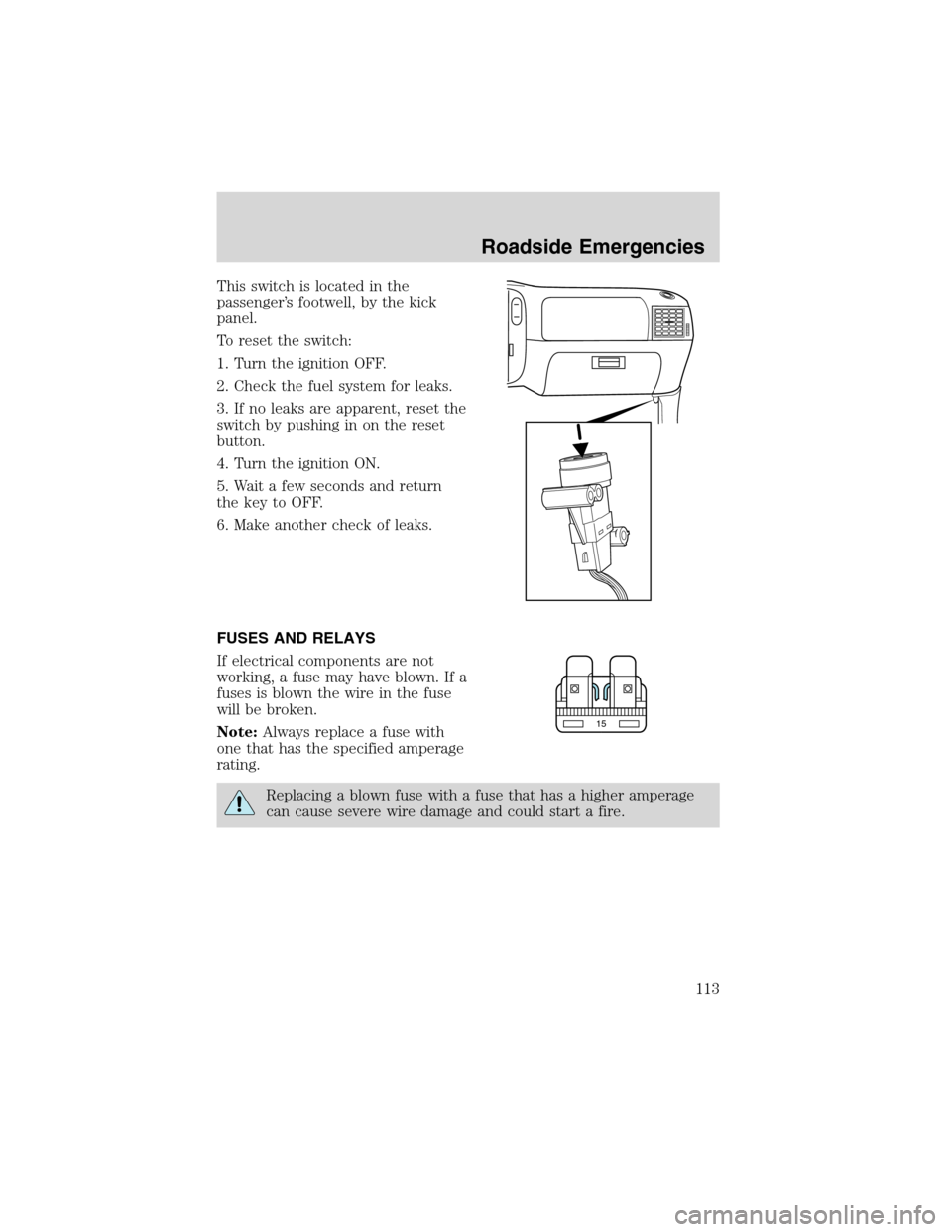
This switch is located in the
passenger’s footwell, by the kick
panel.
To reset the switch:
1. Turn the ignition OFF.
2. Check the fuel system for leaks.
3. If no leaks are apparent, reset the
switch by pushing in on the reset
button.
4. Turn the ignition ON.
5. Wait a few seconds and return
the key to OFF.
6. Make another check of leaks.
FUSES AND RELAYS
If electrical components are not
working, a fuse may have blown. If a
fuses is blown the wire in the fuse
will be broken.
Note:Always replace a fuse with
one that has the specified amperage
rating.
Replacing a blown fuse with a fuse that has a higher amperage
can cause severe wire damage and could start a fire.
15
Roadside Emergencies
113
Page 157 of 184
The following signs could indicate a problem with your emission control
system:
•Fluid leaks
•Strange odors
•Smoke
•Loss of engine power
•Illumination of the charging system, temperature, or“Check Engine”
light in the instrument panel.
Exhaust leaks may result in harmful and potentially lethal fumes
entering the passenger compartment.
It is unlawful to intentionally remove an emission control device or
prevent it from working. Information about your vehicle’s emission
system is on the Vehicle Emission Control Information decal located on
or near the engine.
READINESS FOR INSPECTION/MAINTENANCE (I/M) TESTING
It may be a legal requirement in your area to pass an I/M test of the
on-board diagnostics system. If the system or battery has just been
serviced, the on-board diagnostic system is reset to a“not ready for I/M
test”condition. To ready the system, allow the vehicle to sit for at least
eight hours without starting. Then, start the engine and complete the
following driving cycle:
1. Drive on an expressway or highway for at least 10 minutes.
2. Drive in stop-and-go traffic for at least 20 minutes with a minimum of
four idle periods.
The engine must warm up to its normal operating temperature. Once
started, do not turn off the engine until the above drive cycle is
complete.
Note:If your“Check Engine”light is on, your vehicle may not pass an
I/M test.
Maintenance and Specifications
157