2002 FORD EXPEDITION fuel filter
[x] Cancel search: fuel filterPage 3 of 280
Maintenance and specifications 225
Hood 226
Engine compartment 227
Engine oil 228
Battery 231
Fuel information 240
Air filter(s) 254
Part numbers 259
Refill capacities 260
Lubricant specifications 263
Engine data 265
Vehicle dimensions 266
Accessories 269
Index 273
All rights reserved. Reproduction by any means, electronic or mechanical
including photocopying, recording or by any information storage and retrieval
system or translation in whole or part is not permitted without written
authorization from Ford Motor Company. Ford may change the contents without
notice and without incurring obligation.
Copyright 2001 Ford Motor Company
Table of contents
3
Page 9 of 280
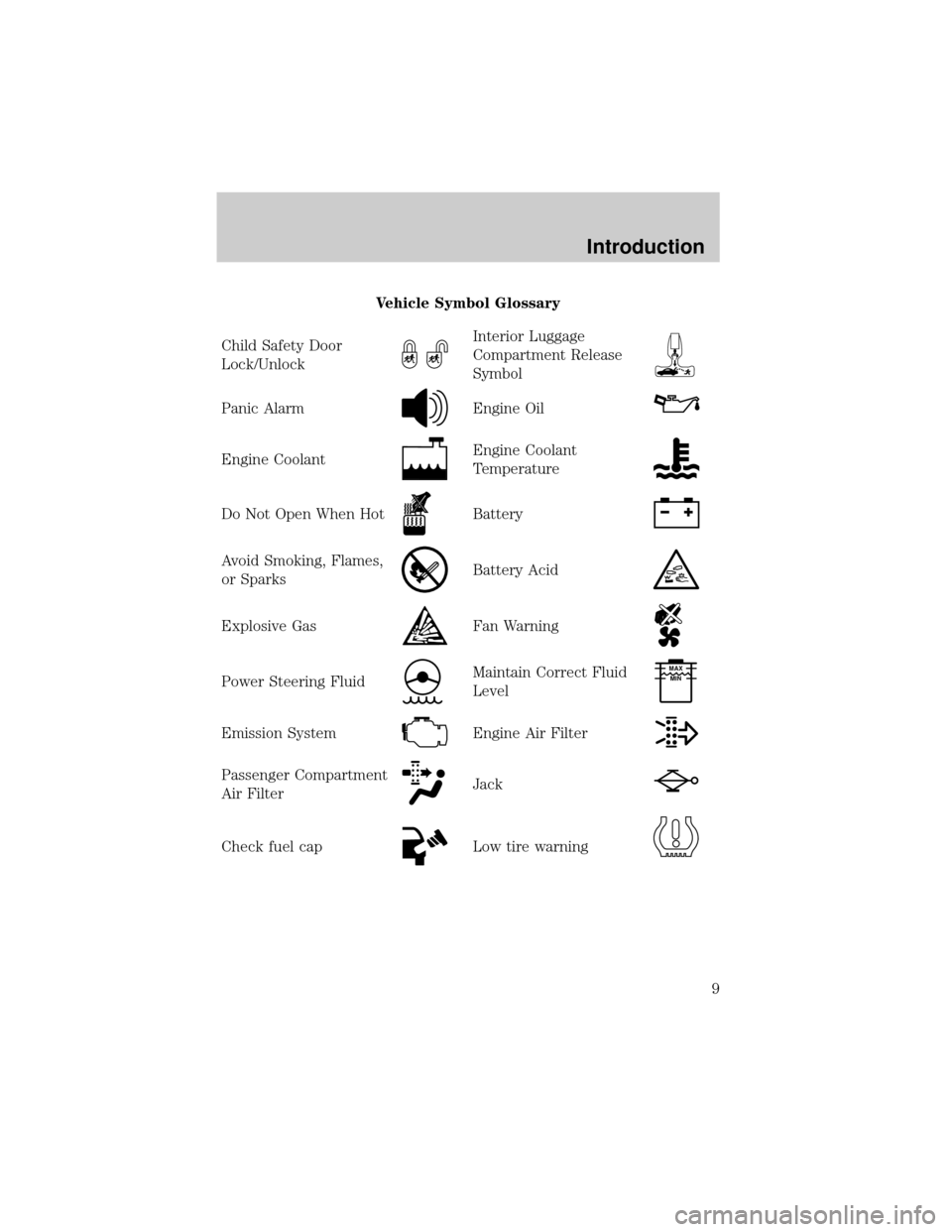
Vehicle Symbol Glossary
Child Safety Door
Lock/Unlock
Interior Luggage
Compartment Release
Symbol
Panic AlarmEngine Oil
Engine CoolantEngine Coolant
Temperature
Do Not Open When HotBattery
Avoid Smoking, Flames,
or SparksBattery Acid
Explosive GasFan Warning
Power Steering FluidMaintain Correct Fluid
LevelMAX
MIN
Emission SystemEngine Air Filter
Passenger Compartment
Air FilterJack
Check fuel capLow tire warning
Introduction
9
Page 230 of 280
Adding engine oil
1. Check the engine oil. For instructions, refer toChecking the engine
oilin this chapter.
2. If the engine oil level is not within the normal range, add only certified
engine oil of the recommended viscosity. Remove the engine oil filler cap
and use a funnel to pour the engine oil into the opening.
3. Recheck the engine oil level. Make sure the oil level is not above the
MAX mark on the engine oil level indicator (dipstick).
4. Install the indicator and ensure it is fully seated.
5. Fully install the engine oil filler cap by turning the filler cap clockwise
1/4 of a turn until three clicks are heard or until the cap is fully seated.
To avoid possible oil loss, DO NOT operate the vehicle with the
engine oil level indicator and/or the engine oil filler cap removed.
Engine oil and filter recommendations
Look for this certification
trademark.
SAE 5W-20 engine oil is recommended.
Only use oils ªCertified For Gasoline Enginesº by the American
Petroleum Institute (API). Use Motorcraft or an equivalent oil meeting
Ford specification WSS-M2C153±H.SAE 5W-20 oil provides optimum
fuel economy and durability performance meeting all
requirements for your vehicle's engine.
Do not use supplemental engine oil additives, oil treatments or engine
treatments. They are unnecessary and could, under certain conditions,
lead to engine damage which is not covered by your warranty.
Change your engine oil and filter according to the appropriate schedule
listed in the scheduled maintenance guide.
Ford production and aftermarket (Motorcraft) oil filters are designed for
added engine protection and long life. If a replacement oil filter is used
Maintenance and specifications
230
Page 244 of 280
more pronounced. If the problems persist, see your dealer or a qualified
service technician.
It should not be necessary to add any aftermarket products to your fuel
tank if you continue to use high quality fuel of the recommended octane
rating. Aftermarket products could cause damage to the fuel system.
Repairs to correct the effects of using an aftermarket product in your
fuel may not be covered by your warranty.
Many of the world's automakers
issued the World-wide Fuel Charter
that recommends gasoline
specifications to provide improved
performance and emission control
system protection for your vehicle.
Gasolines that meet the World-wide
Fuel Charter should be used when
available. Ask your fuel supplier
about gasolines that meet the
World-wide Fuel Charter. In Canada,
look for fuels that display theAuto Makers' Choiceylogo.
Cleaner air
Ford endorses the use of reformulated ªcleaner-burningº gasolines to
improve air quality.
Running out of fuel
Avoid running out of fuel because this situation may have an adverse
affect on powertrain components.
If you have run out of fuel:
²You may need to cycle the ignition from OFF to ON several times after
refueling, to allow the fuel system to pump the fuel from the tank to
the engine.
²Your ªService Engine Soonº indicator may come on. For more
information on the ªService Engine Soonº indicator, refer to the
Instrument Clusterchapter.
Fuel Filter
For fuel filter replacement, see your dealer or a qualified service
technician. Refer to the scheduled maintenance guide for the appropriate
intervals for changing the fuel filter.
Maintenance and specifications
244
Page 245 of 280
Replace the fuel filter with an authorized Motorcraft part. The
customer warranty may be void for any damage to the fuel system
if an authorized Motorcraft fuel filter is not used.
ESSENTIALS OF GOOD FUEL ECONOMY
Measuring techniques
Your best source of information about actual fuel economy is you, the
driver. You must gather information as accurately and consistently as
possible. Fuel expense, frequency of fillups or fuel gauge readings are
NOT accurate as a measure of fuel economy. We do not recommend
taking fuel economy measurements during the first 1 600 km (1 000
miles) of driving (engine break-in period). You will get a more accurate
measurement after 3 000 km±5 000 km (2 000 miles-3 000 miles).
Filling the tank
The advertised fuel capacity of the fuel tank on your vehicle is equal to
the rated refill capacity of the fuel tank as listed in theRefill capacities
section of this chapter.
The advertised capacity is the amount of the indicated capacity and the
empty reserve combined. Indicated capacity is the difference in the
amount of fuel in a full tank and a tank when the fuel gauge indicates
empty. Empty reserve is the small amount of fuel remaining in the fuel
tank after the fuel gauge indicates empty.
The amount of usable fuel in the empty reserve varies and should
not be relied upon to increase driving range. When refueling your
vehicle after the fuel gauge indicates empty, you might not be
able to refuel the full amount of the advertised capacity of the
fuel tank due to the empty reserve still present in the tank.
For consistent results when filling the fuel tank:
²Turn the engine/ignition switch to the off position prior to refueling,
an error in the reading will result if the engine is left running.
²Use the same filling rate setting (low Ð medium Ð high) each time
the tank is filled.
²Allow no more than 2 automatic click-offs when filling.
²Always use fuel with the recommended octane rating.
²Use a known quality gasoline, preferably a national brand.
Maintenance and specifications
245
Page 259 of 280
SNOW TIRES AND CHAINS
Snow tires must be the same size and grade as the tires you
currently have on your vehicle.
The tires on your vehicle have all weather treads to provide traction in
rain and snow. However, in some climates, you may need to use snow
tires and chains.
Follow these guidelines when using snow tires and chains:
²Use only cable type chains offered by Ford as an accessory or
equivalent. SAE class ªSº or other conventional link type chains may
contact and cause damage to the vehicle's wheel house and/or body.
²Install chains securely, verifying that the chains do not touch any
wiring, brake lines or fuel lines.
²Drive cautiously. If you hear the chains rub or bang against your
vehicle, stop and re-tighten the chains. If this does not work, remove
the chains to prevent damage to your vehicle.
²If possible, avoid fully loading your vehicle.
²Remove the tire chains when they are no longer needed. Do not use
tire chains on dry roads.
²The suspension insulation and bumpers will help prevent vehicle
damage. Do not remove these components from your vehicle when
using snow tires and chains.
²Do not exceed 48 km/h (30 mph) with tire chains on your vehicle.
MOTORCRAFT PART NUMBERS
Component 4.6L V8 engine 5.4L V8 engine
Air filter element FA-1634 FA-1634
Battery BTX-65-650 BTX-65-650
Fuel filter FG-986B FG-986B
Oil filter FL-820-S FL-820-S
PCV valve EV-233 EV-233
Spark plugs* AWSF-32P AWSF-22W
* Refer to Vehicle Emissions Control Information (VECI) decal for spark
plug gap information.
Maintenance and specifications
259
Page 260 of 280
REFILL CAPACITIES
Fluid Ford Part
NameApplication Capacity
Brake fluid High
Performance
DOT 3 Motor
Vehicle Brake
FluidAll Fill to line on
reservoir
Engine oil
(includes filter
change)Motorcraft SAE
5W-20 Super
Premium Motor
OilAll 5.7L
(6.0 quarts)
Fuel tank N/A 4X2 with
standard
suspension98.6L
(26.0 gallons)
4X4 and 4X2
with rear load
level suspension113.6L
(30.0 gallons)
Power steering
fluidMotorcraft
MERCONtAT FAll Fill to line on
reservoir
Transmission
fluid
1Motorcraft
MERCONtV
AT F4R70W 13.1L
(13.9 quarts)2
Motorcraft
MERCONtAT F4R100 (4x2) 15.0L
(15.9 quarts)2
4R100 (4x4) 15.5L
(16.4 quarts)2
Transfer case
fluidMotorcraft
MERCONtAT F4x4 vehicles 1.9L
(2.0 quarts)
Maintenance and specifications
260
Page 275 of 280

E
Emergencies, roadside
jump-starting ..........................202
Emission control system ..........248
Engine ................................265±266
check engine/
service engine soon light .........10
cleaning ...................................219
coolant .....................................234
fail-safe coolant ......................238
idle speed control ...................231
lubrication
specifications ..................263, 265
refill capacities ........................260
service points ..........................227
starting after a collision .........187
Engine block heater .................153
Engine oil ..................................228
change oil soon warning,
message center .......................228
checking and adding ..............228
dipstick ....................................228
filter, specifications ........230, 259
recommendations ...................230
refill capacities ........................260
specifications ..................263, 265
Exhaust fumes ..........................154
F
Fail safe cooling ........................238
Floor mats ...................................93
Fluid capacities .........................260
Foglamps .....................................59
Four-Wheel Drive
vehicles ................................14, 167
control trac .............................167description ..............................167
driving off road .......................169
electronic shift ........................168
indicator light ...........................14
preparing to
drive your vehicle ...................160
Fuel ............................................240
calculating fuel economy .......245
cap ...........................................242
capacity ...................................260
choosing the right fuel ...........243
comparisons with EPA fuel
economy estimates .................248
detergent in fuel .....................244
filling your vehicle
with fuel ..................240, 242, 245
filter, specifications ........244, 259
fuel pump shut-off switch .....187
gauge .........................................16
improving fuel economy ........245
low fuel warning light ..............12
octane rating ...........243, 265±266
quality ......................................243
running out of fuel .................244
safety information relating
to automotive fuels ................240
Fuses ..................................189±190
G
Garage door opener ..............72, 86
Gas cap (see Fuel cap) ............242
Gas mileage
(see Fuel economy) .................245
Gauges .........................................14
battery voltage gauge ...............16
engine coolant
temperature gauge ...................15
engine oil pressure gauge ........15
fuel gauge ..................................16
Index
275