2002 DODGE RAM ignition
[x] Cancel search: ignitionPage 2146 of 2255
DIAGNOSIS AND TESTING - BLOWER MOTOR
SWITCH
For circuit descriptions and diagrams, (Refer to
Appropriate Wiring Information).
WARNING: ON VEHICLES EQUIPPED WITH AIR-
BAGS, DISABLE THE AIRBAG SYSTEM BEFORE
ATTEMPTING ANY STEERING WHEEL, STEERING
COLUMN, OR INSTRUMENT PANEL COMPONENT
DIAGNOSIS OR SERVICE. DISCONNECT AND ISO-
LATE THE BATTERY NEGATIVE (GROUND) CABLE,
THEN WAIT TWO MINUTES FOR THE AIRBAG SYS-
TEM CAPACITOR TO DISCHARGE BEFORE PER-
FORMING FURTHER DIAGNOSIS OR SERVICE. THIS
IS THE ONLY SURE WAY TO DISABLE THE AIRBAG
SYSTEM. FAILURE TO TAKE THE PROPER PRE-
CAUTIONS COULD RESULT IN AN ACCIDENTAL
AIRBAG DEPLOYMENT AND POSSIBLE PERSONAL
INJURY.
(1) Check for battery voltage at the fuse in the
Power Distribution Center (PDC). If OK, go to Step
2. If not OK, repair the shorted circuit or component
as required and replace the faulty fuse.
(2) Turn the ignition switch to the Off position.
Disconnect and isolate the battery negative cable.
Remove the a/c heater control from the instrument
panel. (Refer to 24 - HEATING & AIR CONDITION-
ING/CONTROLS/A/C HEATER CONTROL -
REMOVAL) Check for continuity between the ground
circuit cavity of the a/c heater control wire harness
connector and a good ground. There should be conti-
nuity. If OK, go to Step 3. If not OK, repair the open
circuit to ground as required.
(3) With the a/c heater control wire harness con-
nector unplugged, place the a/c heater mode control
switch knob in any position except the Off position.
Check for continuity between the ground circuit ter-
minal and each of the blower motor driver circuit ter-
minals of the a/c heater control as you move the
blower motor switch knob to each of the four speed
positions. There should be continuity at each driver
circuit terminal in only one blower motor switch
speed position. If OK, test and repair the blower
driver circuits between the a/c heater control connec-
tor and the blower motor resistor as required. If not
OK, replace the faulty a/c heater control unit.
REMOVAL
The blower motor switch cannot be repaired and, if
faulty or damaged, the entire heater-only or a/c
heater control unit must be replaced. (Refer to 24 -
HEATING & AIR CONDITIONING/CONTROLS/A/C
HEATER CONTROL - REMOVAL) The blower motor
switch knob is serviced separately.
BLEND DOOR ACTUATOR
REMOVAL
WARNING: ON VEHICLES EQUIPPED WITH AIR-
BAGS, DISABLE THE AIRBAG SYSTEM BEFORE
ATTEMPTING ANY STEERING WHEEL, STEERING
COLUMN, OR INSTRUMENT PANEL COMPONENT
DIAGNOSIS OR SERVICE. DISCONNECT AND ISO-
LATE THE BATTERY NEGATIVE (GROUND) CABLE,
THEN WAIT TWO MINUTES FOR THE AIRBAG SYS-
TEM CAPACITOR TO DISCHARGE BEFORE PER-
FORMING FURTHER DIAGNOSIS OR SERVICE. THIS
IS THE ONLY SURE WAY TO DISABLE THE AIRBAG
SYSTEM. FAILURE TO TAKE THE PROPER PRE-
CAUTIONS COULD RESULT IN AN ACCIDENTAL
AIRBAG DEPLOYMENT AND POSSIBLE PERSONAL
INJURY.
(1) Turn the ignition switch to the run position.
(2) Locate the temperature control knob in the mid
(12 o'clock) position.
(3) Turn the ignition switch to the off position.
(4) Disconnect and isolate the battery negative
cable.
(5) Remove the instrument panel from the vehi-
cle(Refer to 23 - BODY/INSTRUMENT PANEL/IN-
STRUMENT PANEL ASSEMBLY - REMOVAL).
(6) Remove the HVAC housing from the vehicle.
(Refer to 24 - HEATING & AIR CONDITIONING/
DISTRIBUTION/HVAC HOUSING - REMOVAL)
(7) Unplug the wire harness connector from the
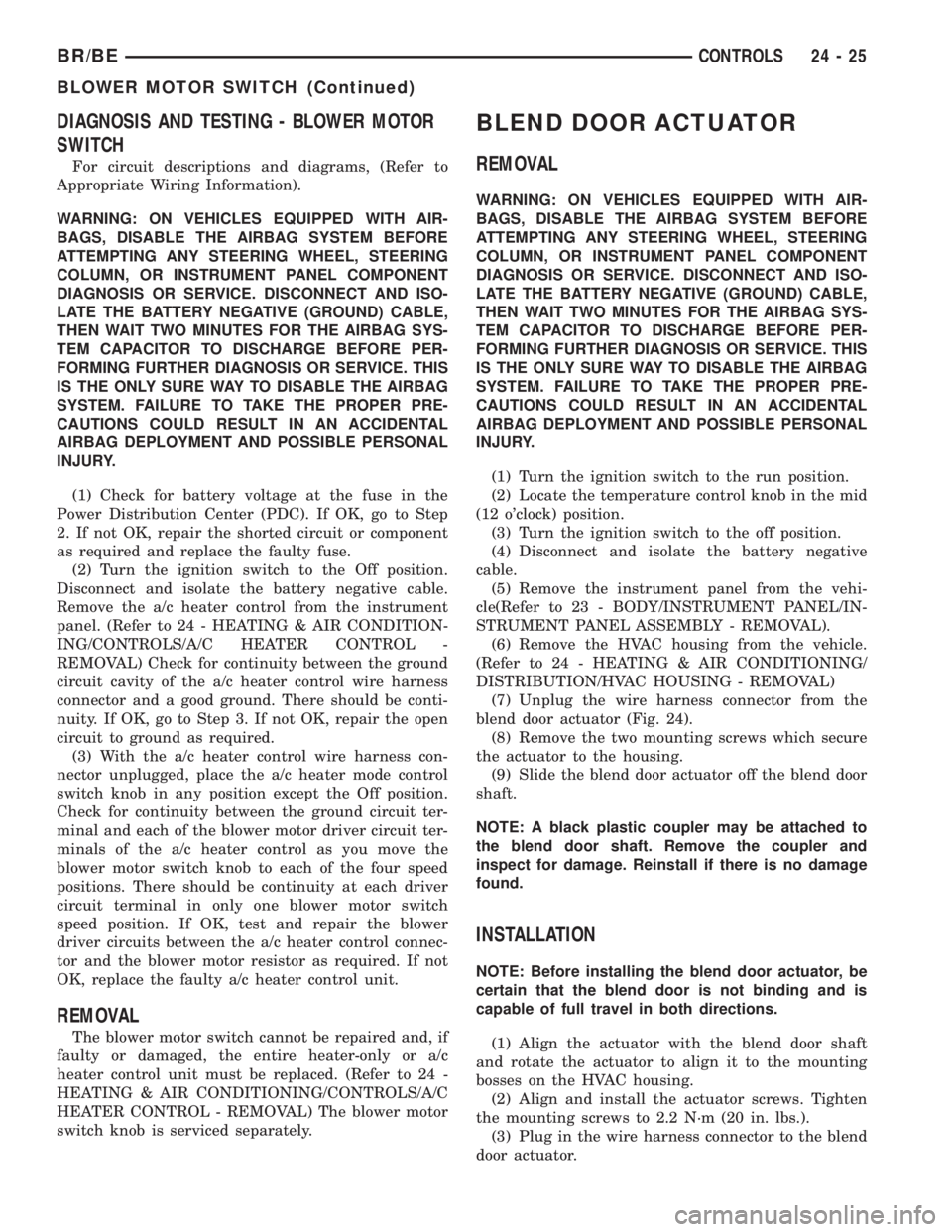
blend door actuator (Fig. 24).
(8) Remove the two mounting screws which secure
the actuator to the housing.
(9) Slide the blend door actuator off the blend door
shaft.
NOTE: A black plastic coupler may be attached to
the blend door shaft. Remove the coupler and
inspect for damage. Reinstall if there is no damage
found.
INSTALLATION
NOTE: Before installing the blend door actuator, be
certain that the blend door is not binding and is
capable of full travel in both directions.
(1) Align the actuator with the blend door shaft
and rotate the actuator to align it to the mounting
bosses on the HVAC housing.
(2) Align and install the actuator screws. Tighten
the mounting screws to 2.2 N´m (20 in. lbs.).
(3) Plug in the wire harness connector to the blend
door actuator.
BR/BECONTROLS 24 - 25
BLOWER MOTOR SWITCH (Continued)
Page 2181 of 2255
DESCRIPTION - CIRCUIT ACTUATION TEST
MODE
The Circuit Actuation Test Mode checks for proper
operation of output circuits or devices the Powertrain
Control Module (PCM) may not internally recognize.
The PCM attempts to activate these outputs and
allow an observer to verify proper operation. Most of
the tests provide an audible or visual indication of
device operation (click of relay contacts, fuel spray,
etc.). Except for intermittent conditions, if a device
functions properly during testing, assume the device,its associated wiring, and driver circuit work cor-
rectly. Connect the DRB scan tool to the data link
connector and access the Actuators screen.
DESCRIPTION - DIAGNOSTIC TROUBLE CODES
A Diagnostic Trouble Code (DTC) indicates the
PCM has recognized an abnormal condition in the
system.
Remember that DTC's are the results of a sys-
tem or circuit failure, but do not directly iden-
tify the failed component or components.
NOTE: For a list of DTC's, refer to the charts in this
section.
BULB CHECK
Each time the ignition key is turned to the ON
position, the malfunction indicator (check engine)
lamp on the instrument panel should illuminate for
approximately 2 seconds then go out. This is done for
a bulb check.
OBTAINING DTC'S USING DRB SCAN TOOL
(1) Connect the DRB scan tool to the data link
(diagnostic) connector. This connector is located in
the passenger compartment; at the lower edge of
instrument panel; near the steering column.
(2) Turn the ignition switch on and access the
ªRead Faultº screen.
(3) Record all the DTC's and ªfreeze frameº infor-
mation shown on the DRB scan tool.
(4) To erase DTC's, use the ªErase Trouble Codeº
data screen on the DRB scan tool.Do not erase any
DTC's until problems have been investigated
and repairs have been performed.
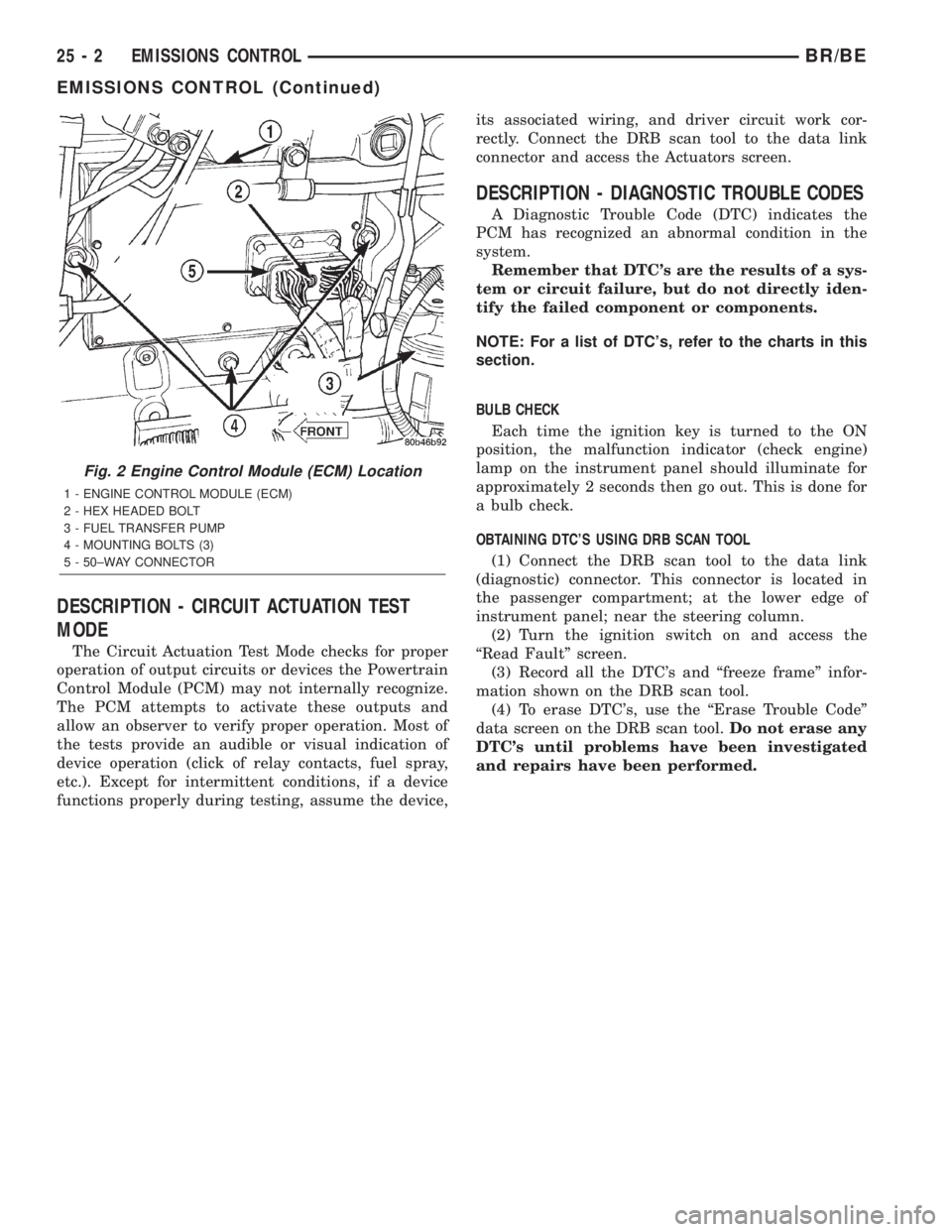
Fig. 2 Engine Control Module (ECM) Location
1 - ENGINE CONTROL MODULE (ECM)
2 - HEX HEADED BOLT
3 - FUEL TRANSFER PUMP
4 - MOUNTING BOLTS (3)
5 - 50±WAY CONNECTOR
25 - 2 EMISSIONS CONTROLBR/BE
EMISSIONS CONTROL (Continued)
Page 2186 of 2255
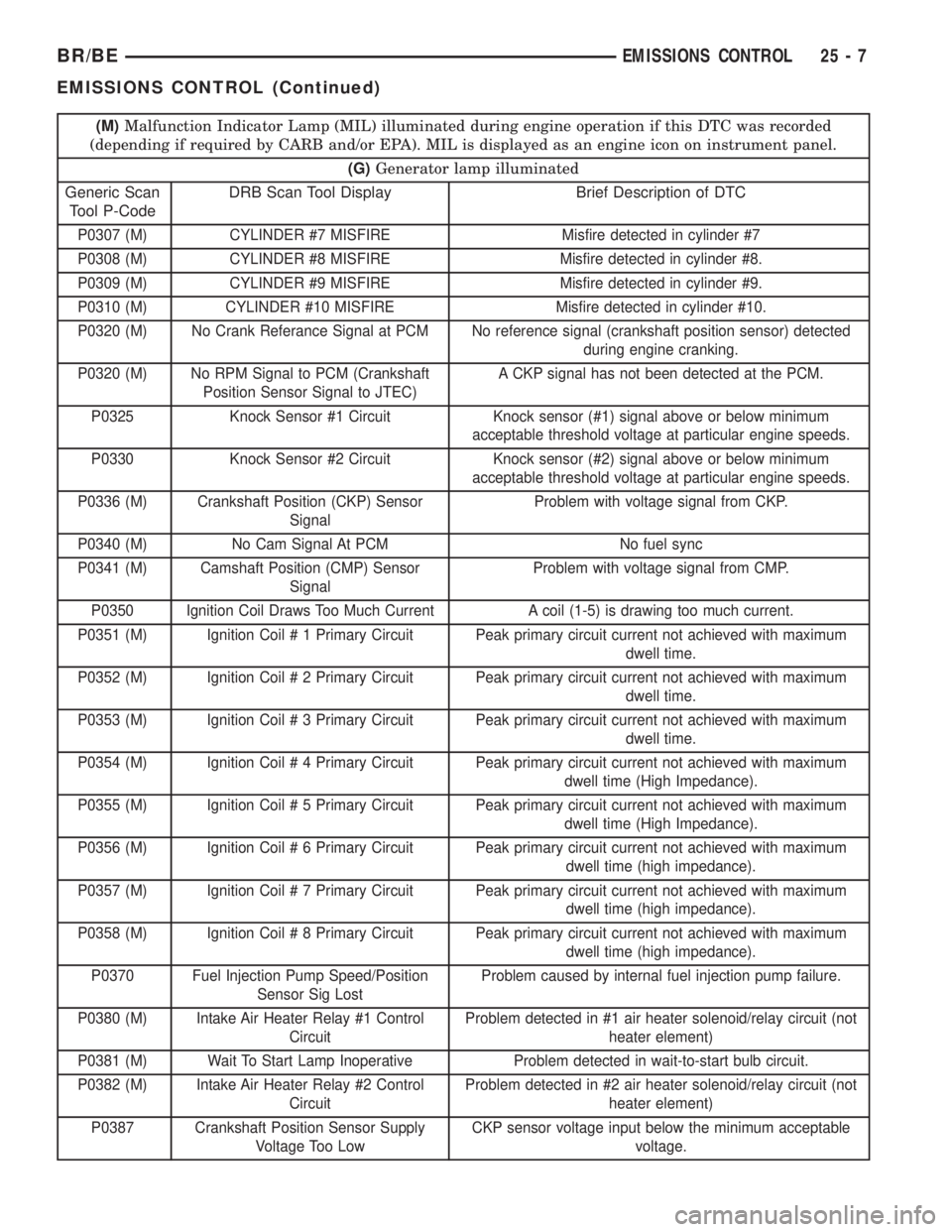
(M)Malfunction Indicator Lamp (MIL) illuminated during engine operation if this DTC was recorded
(depending if required by CARB and/or EPA). MIL is displayed as an engine icon on instrument panel.
(G)Generator lamp illuminated
Generic Scan
Tool P-CodeDRB Scan Tool Display Brief Description of DTC
P0307 (M) CYLINDER #7 MISFIRE Misfire detected in cylinder #7
P0308 (M) CYLINDER #8 MISFIRE Misfire detected in cylinder #8.
P0309 (M) CYLINDER #9 MISFIRE Misfire detected in cylinder #9.
P0310 (M) CYLINDER #10 MISFIRE Misfire detected in cylinder #10.
P0320 (M) No Crank Referance Signal at PCM No reference signal (crankshaft position sensor) detected
during engine cranking.
P0320 (M) No RPM Signal to PCM (Crankshaft
Position Sensor Signal to JTEC)A CKP signal has not been detected at the PCM.
P0325 Knock Sensor #1 Circuit Knock sensor (#1) signal above or below minimum
acceptable threshold voltage at particular engine speeds.
P0330 Knock Sensor #2 Circuit Knock sensor (#2) signal above or below minimum
acceptable threshold voltage at particular engine speeds.
P0336 (M) Crankshaft Position (CKP) Sensor
SignalProblem with voltage signal from CKP.
P0340 (M) No Cam Signal At PCM No fuel sync
P0341 (M) Camshaft Position (CMP) Sensor
SignalProblem with voltage signal from CMP.
P0350 Ignition Coil Draws Too Much Current A coil (1-5) is drawing too much current.
P0351 (M) Ignition Coil # 1 Primary Circuit Peak primary circuit current not achieved with maximum
dwell time.
P0352 (M) Ignition Coil # 2 Primary Circuit Peak primary circuit current not achieved with maximum
dwell time.
P0353 (M) Ignition Coil # 3 Primary Circuit Peak primary circuit current not achieved with maximum
dwell time.
P0354 (M) Ignition Coil # 4 Primary Circuit Peak primary circuit current not achieved with maximum
dwell time (High Impedance).
P0355 (M) Ignition Coil # 5 Primary Circuit Peak primary circuit current not achieved with maximum
dwell time (High Impedance).
P0356 (M) Ignition Coil # 6 Primary Circuit Peak primary circuit current not achieved with maximum
dwell time (high impedance).
P0357 (M) Ignition Coil # 7 Primary Circuit Peak primary circuit current not achieved with maximum
dwell time (high impedance).
P0358 (M) Ignition Coil # 8 Primary Circuit Peak primary circuit current not achieved with maximum
dwell time (high impedance).
P0370 Fuel Injection Pump Speed/Position
Sensor Sig LostProblem caused by internal fuel injection pump failure.
P0380 (M) Intake Air Heater Relay #1 Control
CircuitProblem detected in #1 air heater solenoid/relay circuit (not
heater element)
P0381 (M) Wait To Start Lamp Inoperative Problem detected in wait-to-start bulb circuit.
P0382 (M) Intake Air Heater Relay #2 Control
CircuitProblem detected in #2 air heater solenoid/relay circuit (not
heater element)
P0387 Crankshaft Position Sensor Supply
Voltage Too LowCKP sensor voltage input below the minimum acceptable
voltage.
BR/BEEMISSIONS CONTROL 25 - 7
EMISSIONS CONTROL (Continued)
Page 2196 of 2255
DESCRIPTION - TASK MANAGER
The PCM is responsible for efficiently coordinating
the operation of all the emissions-related compo-
nents. The PCM is also responsible for determining if
the diagnostic systems are operating properly. The
software designed to carry out these responsibilities
is call the 'Task Manager'.
DESCRIPTION - MONITORED SYSTEMS
There are new electronic circuit monitors that
check fuel, emission, engine and ignition perfor-
mance. These monitors use information from various
sensor circuits to indicate the overall operation of the
fuel, engine, ignition and emission systems and thus
the emissions performance of the vehicle.
The fuel, engine, ignition and emission systems
monitors do not indicate a specific component prob-
lem. They do indicate that there is an implied prob-
lem within one of the systems and that a specific
problem must be diagnosed.
If any of these monitors detect a problem affecting
vehicle emissions, the Malfunction Indicator Lamp
(MIL) will be illuminated. These monitors generate
Diagnostic Trouble Codes that can be displayed with
the MIL or a scan tool.
The following is a list of the system monitors:
²Misfire Monitor
²Fuel System Monitor
²Oxygen Sensor Monitor
²Oxygen Sensor Heater Monitor
²Catalyst Monitor
²Leak Detection Pump Monitor (if equipped)
All these system monitors require two consecutive
trips with the malfunction present to set a fault.
Refer to the appropriate Powertrain Diagnos-
tics Procedures manual for diagnostic proce-
dures.
The following is an operation and description of
each system monitor :
OXYGEN SENSOR (O2S) MONITOR
Effective control of exhaust emissions is achieved
by an oxygen feedback system. The most important
element of the feedback system is the O2S. The O2S
is located in the exhaust path. Once it reaches oper-
ating temperature 300É to 350ÉC (572É to 662ÉF), the
sensor generates a voltage that is inversely propor-
tional to the amount of oxygen in the exhaust. The
information obtained by the sensor is used to calcu-
late the fuel injector pulse width. This maintains a
14.7 to 1 Air Fuel (A/F) ratio. At this mixture ratio,
the catalyst works best to remove hydrocarbons (HC),
carbon monoxide (CO) and nitrogen oxide (NOx) from
the exhaust.
The O2S is also the main sensing element for the
Catalyst and Fuel Monitors.The O2S can fail in any or all of the following
manners:
²slow response rate
²reduced output voltage
²dynamic shift
²shorted or open circuits
Response rate is the time required for the sensor to
switch from lean to rich once it is exposed to a richer
than optimum A/F mixture or vice versa. As the sen-
sor starts malfunctioning, it could take longer to
detect the changes in the oxygen content of the
exhaust gas.
The output voltage of the O2S ranges from 0 to 1
volt. A good sensor can easily generate any output
voltage in this range as it is exposed to different con-
centrations of oxygen. To detect a shift in the A/F
mixture (lean or rich), the output voltage has to
change beyond a threshold value. A malfunctioning
sensor could have difficulty changing beyond the
threshold value.
OXYGEN SENSOR HEATER MONITOR
If there is an oxygen sensor (O2S) shorted to voltage
DTC, as well as a O2S heater DTC, the O2S fault
MUST be repaired first. Before checking the O2S fault,
verify that the heater circuit is operating correctly.
Effective control of exhaust emissions is achieved
by an oxygen feedback system. The most important
element of the feedback system is the O2S. The O2S
is located in the exhaust path. Once it reaches oper-
ating temperature 300É to 350ÉC (572 É to 662ÉF), the
sensor generates a voltage that is inversely propor-
tional to the amount of oxygen in the exhaust. The
information obtained by the sensor is used to calcu-
late the fuel injector pulse width. This maintains a
14.7 to 1 Air Fuel (A/F) ratio. At this mixture ratio,
the catalyst works best to remove hydrocarbons (HC),
carbon monoxide (CO) and nitrogen oxide (NOx) from
the exhaust.
The voltage readings taken from the O2S sensor
are very temperature sensitive. The readings are not
accurate below 300ÉC. Heating of the O2S sensor is
done to allow the engine controller to shift to closed
loop control as soon as possible. The heating element
used to heat the O2S sensor must be tested to ensure
that it is heating the sensor properly.
The O2S sensor circuit is monitored for a drop in
voltage. The sensor output is used to test the heater
by isolating the effect of the heater element on the
O2S sensor output voltage from the other effects.
LEAK DETECTION PUMP MONITOR (IF EQUIPPED)
The leak detection assembly incorporates two pri-
mary functions: it must detect a leak in the evapora-
tive system and seal the evaporative system so the
leak detection test can be run.
BR/BEEMISSIONS CONTROL 25 - 17
EMISSIONS CONTROL (Continued)
Page 2199 of 2255
DESCRIPTION - COMPONENT MONITORS -
DIESEL ENGINES
There are several electrical components that will
affect vehicle emissions if they malfunction. If one of
these components is malfunctioning, a Diagnostic
Trouble Code (DTC) will be set by either the Power-
train Control Module (PCM) or the Engine Control
Module (ECM). The Malfunction Indicator Lamp
(MIL) will then be illuminated when the engine is
running.
These electrically operated components have input
(rationality) and output (functionality) checks. A
check is done by one or more components to check
the operation of another component.
Example:The Intake Manifold Air Temperature
(IAT) sensor is used to monitor intake manifold air
temperature over a period of time after a cold start.
If the temperature has not risen to a certain specifi-
cation during a specified time, a Diagnostic Trouble
Code (DTC) will be set for a problem in the manifold
air heater system.
All open/short circuit checks, or any component
that has an associated limp-in will set a DTC and
trigger the MIL after 1 trip with the malfunction
present. Components without an associated limp-in
will take two trips to illuminate the MIL.
OPERATION
OPERATION - GAS ENGINES
The Powertrain Control Module (PCM) monitors
many different circuits in the fuel injection, ignition,
emission and engine systems. If the PCM senses a
problem with a monitored circuit often enough to
indicate an actual problem, it stores a Diagnostic
Trouble Code (DTC) in the PCM's memory. If the
problem is repaired or ceases to exist, the PCM can-
cels the code after 40 warm-up cycles. Diagnostic
trouble codes that affect vehicle emissions illuminate
the Malfunction Indicator Lamp (MIL). The MIL is
displayed as an engine icon (graphic) on the instru-
ment panel. Refer to Malfunction Indicator Lamp in
this section.
Certain criteria must be met before the PCM
stores a DTC in memory. The criteria may be a spe-
cific range of engine RPM, engine temperature,
and/or input voltage to the PCM.
The PCM might not store a DTC for a monitored
circuit even though a malfunction has occurred. This
may happen because one of the DTC criteria for the
circuit has not been met.For example, assume the
diagnostic trouble code criteria requires the PCM to
monitor the circuit only when the engine operates
between 750 and 2000 RPM. Suppose the sensor's
output circuit shorts to ground when engine operatesabove 2400 RPM (resulting in 0 volt input to the
PCM). Because the condition happens at an engine
speed above the maximum threshold (2000 rpm), the
PCM will not store a DTC.
There are several operating conditions for which
the PCM monitors and sets DTC's. Refer to Moni-
tored Systems, Components, and Non-Monitored Cir-
cuits in this section.
Technicians must retrieve stored DTC's by connect-
ing the DRB scan tool (or an equivalent scan tool) to
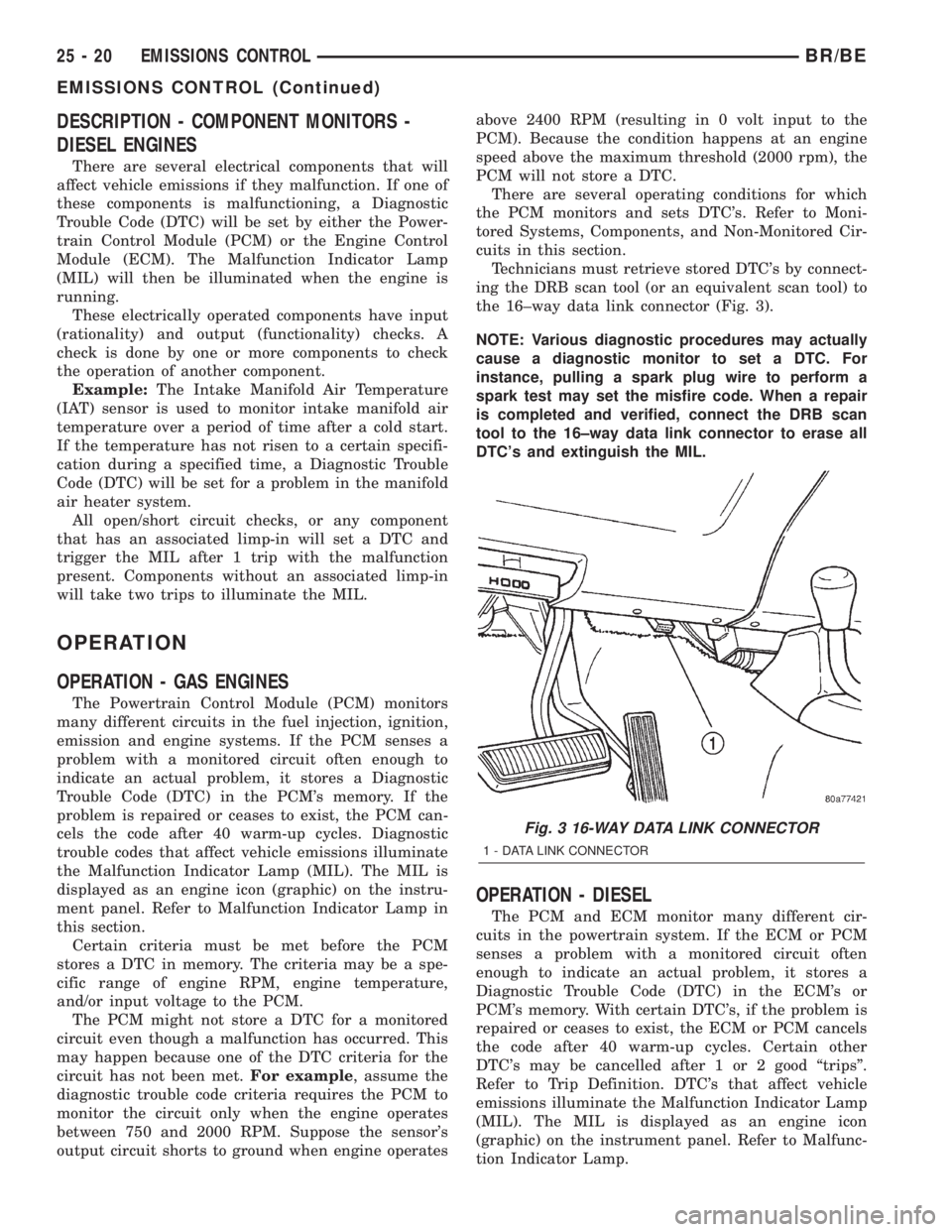
the 16±way data link connector (Fig. 3).
NOTE: Various diagnostic procedures may actually
cause a diagnostic monitor to set a DTC. For
instance, pulling a spark plug wire to perform a
spark test may set the misfire code. When a repair
is completed and verified, connect the DRB scan
tool to the 16±way data link connector to erase all
DTC's and extinguish the MIL.
OPERATION - DIESEL
The PCM and ECM monitor many different cir-
cuits in the powertrain system. If the ECM or PCM
senses a problem with a monitored circuit often
enough to indicate an actual problem, it stores a
Diagnostic Trouble Code (DTC) in the ECM's or
PCM's memory. With certain DTC's, if the problem is
repaired or ceases to exist, the ECM or PCM cancels
the code after 40 warm-up cycles. Certain other
DTC's may be cancelled after 1 or 2 good ªtripsº.
Refer to Trip Definition. DTC's that affect vehicle
emissions illuminate the Malfunction Indicator Lamp
(MIL). The MIL is displayed as an engine icon
(graphic) on the instrument panel. Refer to Malfunc-
tion Indicator Lamp.
Fig. 3 16-WAY DATA LINK CONNECTOR
1 - DATA LINK CONNECTOR
25 - 20 EMISSIONS CONTROLBR/BE
EMISSIONS CONTROL (Continued)
Page 2203 of 2255
²Absolute MAP When Misfire OccurredÐ
The stored MAP reading at the time of failure.
Informs the user at what engine load the failure
occurred.
²Absolute MAPÐ A live reading of engine load
to aid the user in accessing the Similar Conditions
Window.
²RPM When Misfire OccurredÐ The stored
RPM reading at the time of failure. Informs the user
at what engine RPM the failure occurred.
²Engine RPMÐ A live reading of engine RPM
to aid the user in accessing the Similar Conditions
Window.
²Adaptive Memory FactorÐ The PCM utilizes
both Short Term Compensation and Long Term Adap-
tive to calculate the Adaptive Memory Factor for
total fuel correction.
²200 Rev CounterÐ Counts 0±100 720 degree
cycles.
²SCW Cat 200 Rev CounterÐ Counts when in
similar conditions.
²SCW FTP 1000 Rev CounterÐ Counts 0±4
when in similar conditions.
²Misfire Good Trip CounterÐ Counts up to
three to turn OFF the MIL.
²Misfire DataÐ Data collected during test.
²Test Done This TripÐ Indicates YES when the
test is done.
OPERATION - NON-MONITORED CIRCUITS -
GAS ENGINES
The PCM does not monitor the following circuits,
systems and conditions that could have malfunctions
causing driveability problems. The PCM might not
store diagnostic trouble codes for these conditions.
However, problems with these systems may cause the
PCM to store diagnostic trouble codes for other sys-
tems or components.EXAMPLE:a fuel pressure
problem will not register a fault directly, but could
cause a rich/lean condition or misfire. This could
cause the PCM to store an oxygen sensor or misfire
diagnostic trouble code
FUEL PRESSURE
The fuel pressure regulator controls fuel system
pressure. The PCM cannot detect a clogged fuel
pump inlet filter, clogged in-line fuel filter, or a
pinched fuel supply or return line. However, these
could result in a rich or lean condition causing the
PCM to store an oxygen sensor or fuel system diag-
nostic trouble code.
SECONDARY IGNITION CIRCUIT
The PCM cannot detect an inoperative ignition coil,
fouled or worn spark plugs, ignition cross firing, or
open spark plug cables.CYLINDER COMPRESSION
The PCM cannot detect uneven, low, or high engine
cylinder compression.
EXHAUST SYSTEM
The PCM cannot detect a plugged, restricted or
leaking exhaust system, although it may set a fuel
system fault.
FUEL INJECTOR MECHANICAL MALFUNCTIONS
The PCM cannot determine if a fuel injector is
clogged, the needle is sticking or if the wrong injector
is installed. However, these could result in a rich or
lean condition causing the PCM to store a diagnostic
trouble code for either misfire, an oxygen sensor, or
the fuel system.
EXCESSIVE OIL CONSUMPTION
Although the PCM monitors engine exhaust oxygen
content when the system is in closed loop, it cannot
determine excessive oil consumption.
THROTTLE BODY AIR FLOW
The PCM cannot detect a clogged or restricted air
cleaner inlet or filter element.
VACUUM ASSIST
The PCM cannot detect leaks or restrictions in the
vacuum circuits of vacuum assisted engine control
system devices. However, these could cause the PCM
to store a MAP sensor diagnostic trouble code and
cause a high idle condition.
PCM SYSTEM GROUND
The PCM cannot determine a poor system ground.
However, one or more diagnostic trouble codes may
be generated as a result of this condition. The mod-
ule should be mounted to the body at all times, also
during diagnostic.
PCM CONNECTOR ENGAGEMENT
The PCM may not be able to determine spread or
damaged connector pins. However, it might store
diagnostic trouble codes as a result of spread connec-
tor pins.
OPERATION - NON-MONITORED CIRCUITS -
DIESEL
The PCM and/or the ECM will not monitor certain
malfunctioning circuits or components that could
cause driveability problems. Also, a Diagnostic Trou-
ble Code (DTC) might not be stored for these mal-
functions. However, problems with these circuits or
components may cause the PCM/ECM to store DTC's
for other circuits or components.EXAMPLES:A cyl-
inder with low compression will not set a DTC
25 - 24 EMISSIONS CONTROLBR/BE
EMISSIONS CONTROL (Continued)
Page 2223 of 2255
CENTRAL TIMER MODULE - REMOVAL....8E-5
CERTIFICATION LABEL - DESCRIPTION,
VEHICLE SAFETY...................Intro.-1
CHAIN COVER(S) - INSTALLATION,
TIMING BELT....................9-110,9-54
CHAIN COVER(S) - REMOVAL, TIMING
BELT ..........................9-110,9-53
CHAIN STRETCH - INSPECTION,
MEASURING TIMING..............9-111,9-54
CHANNEL - INSTALLATION, GLASS RUN . . 23-71
CHANNEL - REMOVAL, GLASS RUN......23-71
CHARGE - STANDARD PROCEDURE,
REFRIGERANT SYSTEM...............24-46
CHARGE AIR COOLER AND PLUMBING -
CLEANING..........................11-19
CHARGE AIR COOLER AND PLUMBING -
DESCRIPTION.......................11-18
CHARGE AIR COOLER AND PLUMBING -
INSPECTION........................11-19
CHARGE AIR COOLER AND PLUMBING -
INSTALLATION.......................11-20
CHARGE AIR COOLER AND PLUMBING -
OPERATION.........................11-18
CHARGE AIR COOLER AND PLUMBING -
REMOVAL..........................11-18
CHARGE AIR COOLER SYSTEM - LEAKS
- DIAGNOSIS AND TESTING............11-18
CHARGING - DESCRIPTION.............8F-25
CHARGING - OPERATION..............8F-25
CHARGING - STANDARD PROCEDURE,
BATTERY............................8F-8
CHARGING SYSTEM - DIAGNOSIS AND
TESTING...........................8F-25
CHART, SPECIFICATIONS - TORQUE....5-3,5-37
CHART, SPECIFICATIONS -
TORQUE.............19-21,19-41,19-43,19-9
CHART, SPECIFICATIONS -
TORQUE.....................2-15,2-26,2-8
CHART, SPECIFICATIONS - TORQUE......22-11
CHARTS - DIAGNOSIS AND TESTING,
DIAGNOSIS..................21-102,21-274
CHARTS - DIAGNOSIS AND TESTING,
SMOKE DIAGNOSIS...................9-118
CHASSIS ADAPTER BRACKET -
INSTALLATION, CAB..................13-10
CHASSIS ADAPTER BRACKET -
REMOVAL, CAB......................13-10
CHECK - INSTALLATION...............23-78
CHECK - REMOVAL...................23-78
CHECK - STANDARD PROCEDURE,
COOLANT LEVEL......................7-16
CHECK - STANDARD PROCEDURE, FLUID
LEVEL......................21-157,21-328
CHECK - STANDARD PROCEDURE, OIL
PUMP VOLUME...............21-166,21-336
CHECK CABLE - INSTALLATION.........23-67
CHECK CABLE - REMOVAL.............23-67
CHECK GAUGES INDICATOR -
DESCRIPTION.......................8J-17
CHECK GAUGES INDICATOR -
OPERATION.........................8J-17
CHECK VALVE - DESCRIPTION, FUEL
TANK ..............................14-21
CHECK VALVE - DESCRIPTION, ONE WAY . 25-31
CHECK VALVE - DESCRIPTION, VACUUM . . 24-28
CHECK VALVE - DIAGNOSIS AND
TESTING, ONE-WAY..................25-31
CHECK VALVE - INSTALLATION, FUEL
TANK ..............................14-23
CHECK VALVE - INSTALLATION, ONE
WAY...............................25-31
CHECK VALVE - INSTALLATION, VACUUM
. 24-29
CHECK VALVE - OPERATION, ONE WAY
. . . 25-31
CHECK VALVE - OPERATION, VACUUM
....24-28
CHECK VALVE - REMOVAL, FUEL TANK
. . . 14-22
CHECK VALVE - REMOVAL, ONE WAY
....25-31
CHECK VALVE - REMOVAL, VACUUM
.....24-29
CHECKS - DIAGNOSIS AND TESTING,
PRELIMINARY
.........................7-4
CHILD TETHER - INSTALLATION
..........8O-9
CHILD TETHER - REMOVAL
.............8O-9
CHIME WARNING SYSTEM -
DESCRIPTION
........................8B-1
CHIME WARNING SYSTEM - DIAGNOSIS
AND TESTING
........................8B-2
CHIME WARNING SYSTEM - OPERATION
. . . 8B-1
CHOKE RELAY - DESCRIPTION, RADIO
....8A-7CHOKE RELAY - DIAGNOSIS AND
TESTING, RADIO......................8A-8
CHOKE RELAY - INSTALLATION, RADIO....8A-9
CHOKE RELAY - OPERATION, RADIO......8A-8
CHOKE RELAY - REMOVAL, RADIO.......8A-8
CIGAR LIGHTER OUTLET - DESCRIPTION . 8W-97-2
CIGAR LIGHTER OUTLET - DIAGNOSIS
AND TESTING.....................8W-97-2
CIGAR LIGHTER OUTLET -
INSTALLATION....................8W-97-4
CIGAR LIGHTER OUTLET - OPERATION . 8W-97-2
CIGAR LIGHTER OUTLET - REMOVAL . . 8W-97-3
CIRCUIT ACTUATION TEST MODE -
DESCRIPTION........................25-2
CIRCUIT BREAKER - DESCRIPTION....8W-97-4
CIRCUIT BREAKER - DIAGNOSIS AND
TESTING.........................8W-97-4
CIRCUIT FUNCTIONS - DESCRIPTION . . 8W-01-4
CIRCUIT INFORMATION - DESCRIPTION . 8W-01-4
CIRCUIT SENSE - DESCRIPTION,
IGNITION...........................8E-17
CIRCUIT SENSE - OPERATION, IGNITION . . 8E-19
CIRCUITS - DIESEL - OPERATION,
NON-MONITORED....................25-24
CIRCUITS - GAS ENGINES - OPERATION,
NON-MONITORED....................25-24
CLAMPS - DESCRIPTION, HOSE...........7-4
CLAMPS - OPERATION, HOSE.............7-4
CLASSIFICATION OF LUBRICANTS -
STANDARD PROCEDURE..................0-1
CLEANER ELEMENT - INSTALLATION,
AIR ...............................9-130
CLEANER ELEMENT - REMOVAL, AIR.....9-129
CLEANING AND INSPECTION, OIL
COOLER & LINES....................9-179
CLEANING, BATTERY SYSTEM...........8F-5
CLEANING, CHARGE AIR COOLER AND
PLUMBING.........................11-19
CLEANING, CROSSHEADS..............9-134
CLEANING, CYLINDER HEAD.......9-134,9-77
CLEANING, CYLINDER HEAD
COVER(S)..................9-137,9-23,9-79
CLEANING, ENGINE BLOCK..........9-27,9-85
CLEANING, EXHAUST
MANIFOLD.................9-109,9-185,9-53
CLEANING, FRONT SERVO......21-164,21-334
CLEANING FUEL SYSTEM PARTS -
STANDARD PROCEDURES..............14-61
CLEANING, HYDRAULIC LIFTERS.....9-37,9-92
CLEANING, INTAKE MANIFOLD . 9-107,9-184,9-51
CLEANING, INTAKE/EXHAUST VALVES &
SEATS ..............................9-26
CLEANING, MANUAL - NV4500..........21-20
CLEANING, MANUAL - NV5600..........21-63
CLEANING, OIL PAN.........9-103,9-179,9-46
CLEANING, OIL PRESSURE RELIEF
VALVE .............................9-180
CLEANING, OIL PUMP............9-104,9-181
CLEANING, OIL PUMP..........21-168,21-338
CLEANING, OPERATION.................9-22
CLEANING, OVERDRIVE UNIT....21-179,21-353
CLEANING, OVERRUNNING CLUTCH
CAM/OVERDRIVE PISTON
RETAINER...................21-192,21-364
CLEANING, PISTON & CONNECTING
ROD.......................9-169,9-39,9-94
CLEANING, PUSHRODS................9-134
CLEANING, RADIATOR - 5.9L............7-59
CLEANING, RADIATOR - 5.9L DIESEL......7-64
CLEANING, RADIATOR - 8.0L............7-61
CLEANING, RADIATOR FAN - 5.9L
DIESEL.............................7-43
CLEANING, RADIATOR FAN - 5.9L/8.0L....7-42
CLEANING, REAR CLUTCH
......21-204,21-377
CLEANING, REAR SERVO
.......21-207,21-379
CLEANING, ROCKER ARM / ADJUSTER
ASSY
..............................9-146
CLEANING, SOLID LIFTERS/TAPPETS
.....9-164
CLEANING, SPARK PLUG
...............8I-20
CLEANING, TRANSFER CASE - NV241HD
. 21-476
CLEANING, TRANSFER CASE - NV241LD
. 21-441
CLEANING, TURBOCHARGER
...........11-16
CLEANING, VALVE BODY
........21-244,21-418
CLEANING, WATER PUMP - 5.9L
.........7-68
CLEANING, WATER PUMP - 5.9L DIESEL
. . . 7-72
CLEANING, WATER PUMP - 8.0L
.........7-71
CLEANING, WIPER & WASHER SYSTEM
. . . 8R-6CLEANING/REVERSE FLUSHING -
STANDARD PROCEDURE, COOLING
SYSTEM............................7-17
CLEARANCE - STANDARD PROCEDURE,
CONNECTING ROD BEARING AND
CRANKSHAFT JOURNAL...............9-158
CLEARANCE - STANDARD PROCEDURE,
MAIN BEARING......................9-159
CLEARANCE LAMP - INSTALLATION.......8L-7
CLEARANCE LAMP - REMOVAL..........8L-7
CLOCKSPRING - DESCRIPTION.........8O-10
CLOCKSPRING - INSTALLATION.........8O-13
CLOCKSPRING - OPERATION...........8O-10
CLOCKSPRING - REMOVAL............8O-12
CLOCKSPRING CENTERING - STANDARD
PROCEDURE........................8O-11
CLOSURE PANEL TRIM - INSTALLATION,
REAR.............................23-121
CLOSURE PANEL TRIM - REMOVAL,
REAR.............................23-120
CLUB/QUAD CAB - INSTALLATION.......8O-20
CLUB/QUAD CAB - REMOVAL...........8O-19
CLUSTER - ASSEMBLY, INSTRUMENT....8J-12
CLUSTER - DESCRIPTION, INSTRUMENT . . . 8J-2
CLUSTER - DIAGNOSIS AND TESTING,
INSTRUMENT........................8J-6
CLUSTER - DISASSEMBLY, INSTRUMENT . . 8J-10
CLUSTER - INSTALLATION, INSTRUMENT . 8J-13
CLUSTER - OPERATION, INSTRUMENT.....8J-3
CLUSTER - REMOVAL, INSTRUMENT......8J-10
CLUSTER BEZEL - INSTALLATION.......23-108
CLUSTER BEZEL - REMOVAL..........23-108
CLUTCH - 5.9L DIESEL - DESCRIPTION,
FAN DRIVE VISCOUS...................7-56
CLUTCH - 5.9L DIESEL - OPERATION,
FAN DRIVE VISCOUS...................7-56
CLUTCH - 5.9L/8.0L - DESCRIPTION,
FAN DRIVE VISCOUS...................7-55
CLUTCH - 5.9L/8.0L - OPERATION, FAN
DRIVE VISCOUS......................7-55
CLUTCH - ASSEMBLY, FRONT....21-162,21-333
CLUTCH - ASSEMBLY, REAR.....21-205,21-377
CLUTCH - CLEANING, REAR.....21-204,21-377
CLUTCH - DESCRIPTION.................6-1
CLUTCH - DESCRIPTION, A/C
COMPRESSOR.......................24-11
CLUTCH - DESCRIPTION, FRONT . 21-160,21-330
CLUTCH - DESCRIPTION, OVERDRIVE . . . 21-172,
21-343
CLUTCH - DESCRIPTION, REAR . . 21-203,21-375
CLUTCH - DIAGNOSIS AND TESTING
.......6-2
CLUTCH - DISASSEMBLY, FRONT
. 21-161,21-331
CLUTCH - DISASSEMBLY, REAR
. . 21-204,21-376
CLUTCH - INSPECTION, A/C
COMPRESSOR
.......................24-15
CLUTCH - INSPECTION, FRONT
. . 21-162,21-332
CLUTCH - INSPECTION, REAR
. . . 21-204,21-377
CLUTCH - INSTALLATION, A/C
COMPRESSOR
.......................24-15
CLUTCH - OPERATION
..................6-2
CLUTCH - OPERATION, A/C
COMPRESSOR
.......................24-13
CLUTCH - OPERATION, FRONT
. . . 21-160,21-330
CLUTCH - OPERATION, OVERDRIVE
....21-172,
21-343
CLUTCH - OPERATION, REAR
....21-203,21-375
CLUTCH - REMOVAL, A/C COMPRESSOR
. . 24-13
CLUTCH - SPECIFICATIONS
...............6-7
CLUTCH - WARNING
....................6-2
CLUTCH AND BAND OPERATION -
DIAGNOSIS AND TESTING, AIR
TESTING TRANSMISSION
.......21-100,21-272
CLUTCH BREAK-IN - STANDARD
PROCEDURE, A/C COMPRESSOR
........24-13
CLUTCH CAM/OVERDRIVE PISTON
RETAINER - ASSEMBLY,
OVERRUNNING
...............21-193,21-364
CLUTCH CAM/OVERDRIVE PISTON
RETAINER - CLEANING, OVERRUNNING
. 21-192,
21-364
CLUTCH CAM/OVERDRIVE PISTON
RETAINER - DESCRIPTION,
OVERRUNNING
...............21-192,21-363
CLUTCH CAM/OVERDRIVE PISTON
RETAINER - DISASSEMBLY,
OVERRUNNING
...............21-192,21-364
6 INDEXBR/BE
Description Group-Page Description Group-Page Description Group-Page
Page 2224 of 2255
CLUTCH CAM/OVERDRIVE PISTON
RETAINER - INSPECTION,
OVERRUNNING...............21-193,21-364
CLUTCH CAM/OVERDRIVE PISTON
RETAINER - OPERATION,
OVERRUNNING...............21-192,21-363
CLUTCH COIL - DIAGNOSIS AND
TESTING, A/C COMPRESSOR...........24-13
CLUTCH DISC - INSTALLATION............6-8
CLUTCH DISC - REMOVAL...............6-7
CLUTCH HOUSING - DIAGNOSIS AND
TESTING.............................6-9
CLUTCH HOUSING - INSTALLATION.......6-11
CLUTCH HOUSING - REMOVAL...........6-11
CLUTCH PEDAL - INSTALLATION.........6-15
CLUTCH PEDAL - REMOVAL.............6-15
CLUTCH PEDAL POSITION SWITCH -
DESCRIPTION........................6-17
CLUTCH PEDAL POSITION SWITCH -
OPERATION..........................6-17
CLUTCH RELAY - DESCRIPTION, A/C
COMPRESSOR.......................24-17
CLUTCH RELAY - DIAGNOSIS AND
TESTING, A/C COMPRESSOR...........24-17
CLUTCH RELAY - INSTALLATION, A/C
COMPRESSOR.......................24-18
CLUTCH RELAY - OPERATION, A/C
COMPRESSOR.......................24-17
CLUTCH RELAY - REMOVAL, A/C
COMPRESSOR.......................24-18
CLUTCH RELEASE BEARING -
INSTALLATION........................6-12
CLUTCH RELEASE BEARING - REMOVAL . . . 6-12
COAT FINISH - DESCRIPTION, BASE
COAT/CLEAR.......................23-129
COAT FINISH - OPERATION, BASE
COAT/CLEAR.......................23-129
COAT HOOK - INSTALLATION..........23-125
COAT HOOK - REMOVAL..............23-124
COAT/CLEAR COAT FINISH -
DESCRIPTION, BASE.................23-129
COAT/CLEAR COAT FINISH - OPERATION,
BASE.............................23-129
CODE - DESCRIPTION, PAINT..........23-129
CODE PLATE - DESCRIPTION, BODY....Intro.-4
CODES - DESCRIPTION, DIAGNOSTIC
TROUBLE............................25-2
CODES, SPECIFICATIONS - 2002 BR/BE
PAINT COLOR......................23-129
COIL - DIAGNOSIS AND TESTING, A/C
COMPRESSOR CLUTCH...............24-13
COIL RESISTANCE, 5.9L ENGINES -
IGNITION............................8I-3
COIL RESISTANCE, 8.0L V-10 ENGINE -
IGNITION............................8I-4
COLOR CODES, SPECIFICATIONS - 2002
BR/BE PAINT.......................23-129
COLUMN - DESCRIPTION...............19-6
COLUMN OPENING COVER -
INSTALLATION, STEERING............23-114
COLUMN OPENING COVER - REMOVAL,
STEERING.........................23-113
COMBINATION FLASHER - DESCRIPTION . . . 8L-7
COMBINATION FLASHER -
INSTALLATION........................8L-9
COMBINATION FLASHER - OPERATION....8L-7
COMBINATION FLASHER - REMOVAL
......8L-8
COMBINATION VALVE - DESCRIPTION
......5-8
COMBINATION VALVE - DIAGNOSIS AND
TESTING
.............................5-9
COMBINATION VALVE - INSTALLATION
......5-9
COMBINATION VALVE - OPERATION
........5-9
COMBINATION VALVE - REMOVAL
.........5-9
COMBUSTION PRESSURE LEAKAGE -
DIAGNOSIS AND TESTING, CYLINDER
. . 9-64,9-9
COMPASS CALIBRATION - STANDARD
PROCEDURE
.........................8M-4
COMPASS DEMAGNETIZING -
STANDARD PROCEDURE
...............8M-5
COMPASS MINI-TRIP COMPUTER -
DIAGNOSIS AND TESTING
.............8M-10
COMPASS VARIATION ADJUSTMENT -
STANDARD PROCEDURE
...............8M-4
COMPASS/MINI-TRIP COMPUTER -
DESCRIPTION
........................8M-9
COMPASS/MINI-TRIP COMPUTER -
INSTALLATION
......................8M-11COMPASS/MINI-TRIP COMPUTER -
OPERATION.........................8M-9
COMPASS/MINI-TRIP COMPUTER -
REMOVAL..........................8M-11
COMPRESSION PRESSURE - DIAGNOSIS
AND TESTING, CYLINDER............9-64,9-9
COMPRESSOR - DESCRIPTION, A/C......24-46
COMPRESSOR - DIAGNOSIS AND
TESTING, A/C.......................24-47
COMPRESSOR - INSTALLATION, A/C.....24-48
COMPRESSOR - OPERATION, A/C........24-46
COMPRESSOR - REMOVAL, A/C.........24-47
COMPRESSOR CLUTCH - DESCRIPTION,
A/C................................24-11
COMPRESSOR CLUTCH - INSPECTION,
A/C................................24-15
COMPRESSOR CLUTCH - INSTALLATION,
A/C................................24-15
COMPRESSOR CLUTCH - OPERATION,
A/C................................24-13
COMPRESSOR CLUTCH - REMOVAL, A/C . . 24-13
COMPRESSOR CLUTCH BREAK-IN -
STANDARD PROCEDURE, A/C...........24-13
COMPRESSOR CLUTCH COIL -
DIAGNOSIS AND TESTING, A/C..........24-13
COMPRESSOR CLUTCH RELAY -
DESCRIPTION, A/C...................24-17
COMPRESSOR CLUTCH RELAY -
DIAGNOSIS AND TESTING, A/C..........24-17
COMPRESSOR CLUTCH RELAY -
INSTALLATION, A/C...................24-18
COMPRESSOR CLUTCH RELAY -
OPERATION, A/C.....................24-17
COMPRESSOR CLUTCH RELAY -
REMOVAL, A/C......................24-18
COMPUTER - DESCRIPTION, COMPASS/
MINI-TRIP..........................8M-9
COMPUTER - DIAGNOSIS AND TESTING,
COMPASS MINI-TRIP.................8M-10
COMPUTER - INSTALLATION, COMPASS/
MINI-TRIP.........................8M-11
COMPUTER - OPERATION, COMPASS/
MINI-TRIP..........................8M-9
COMPUTER - REMOVAL, COMPASS/
MINI-TRIP.........................8M-11
CONDENSER - DESCRIPTION, A/C.......24-49
CONDENSER - INSTALLATION, A/C.......24-50
CONDENSER - OPERATION, A/C.........24-49
CONDENSER - REMOVAL, A/C..........24-49
CONDITIONER - DESCRIPTION, HEATER
AND AIR ............................24-1
CONDITIONER - OPERATION, HEATER
AND AIR ............................24-1
CONDITIONING - INSTALLATION, WATER
PUMP BYPASS HOSE WITH AIR..........7-76
CONDITIONING - INSTALLATION, WATER
PUMP BYPASS HOSE WITHOUT AIR......7-77
CONDITIONING - REMOVAL, WATER
PUMP BYPASS HOSE WITH AIR..........7-73
CONDITIONING - REMOVAL, WATER
PUMP BYPASS HOSE WITHOUT AIR......7-76
CONDITIONS - DIAGNOSIS AND
TESTING, SPARK PLUG................8I-17
CONNECT FITTING - DESCRIPTION,
QUICK.............................14-24
CONNECTING ROD - CLEANING, PISTON
. . 9-169,
9-39,9-94
CONNECTING ROD - DESCRIPTION,
PISTON
....................9-165,9-38,9-93
CONNECTING ROD - INSPECTION,
PISTON
.........................9-39,9-94
CONNECTING ROD - INSTALLATION,
PISTON
.........................9-39,9-94
CONNECTING ROD - REMOVAL, PISTON
. . 9-168,
9-38,9-94
CONNECTING ROD BEARING AND
CRANKSHAFT JOURNAL CLEARANCE -
STANDARD PROCEDURE
...............9-158
CONNECTING ROD BEARING FITTING -
STANDARD PROCEDURE
............9-29,9-87
CONNECTING RODS, INSPECTION
.......9-169
CONNECTOR - DESCRIPTION, DATA LINK
. 8E-12
CONNECTOR - INSTALLATION
.......8W-01-10
CONNECTOR - OPERATION, DATA LINK
. . . 8E-12
CONNECTOR - REMOVAL
...........8W-01-10
CONNECTOR, GROUND AND SPLICE
INFORMATION - DESCRIPTION
........8W-01-6CONNECTOR/GROUND/SPLICE LOCATION
- DESCRIPTION....................8W-91-1
CONSOLE - DESCRIPTION, OVERHEAD....8M-1
CONSOLE - INSTALLATION, CENTER....23-122
CONSOLE - REMOVAL, CENTER........23-122
CONSOLE ASSEMBLY, ASSEMBLY -
OVERHEAD..........................8M-8
CONSOLE DISASSEMBLY, DISASSEMBLY
- OVERHEAD........................8M-7
CONSOLE INSTALLATION, INSTALLATION
- OVERHEAD........................8M-8
CONSOLE LID - INSTALLATION, CENTER . 23-132
CONSOLE LID - REMOVAL, CENTER.....23-131
CONSOLE REMOVAL, REMOVAL -
OVERHEAD..........................8M-6
CONSOLE SPECIAL TOOL, SPECIAL
TOOLS - OVERHEAD..................8M-9
CONTAINER - 3.9L/5.2L/5.9L/5.9L DIESEL
- DESCRIPTION, COOLANT RECOVERY.....7-40
CONTAINER - 3.9L/5.2L/5.9L/5.9L DIESEL
- INSTALLATION, COOLANT RECOVERY....7-41
CONTAINER - 3.9L/5.2L/5.9L/5.9L DIESEL
- OPERATION, COOLANT RECOVERY......7-40
CONTAINER - 3.9L/5.2L/5.9L/5.9L DIESEL
- REMOVAL, COOLANT RECOVERY........7-40
CONTAINER - 8.0L - DESCRIPTION,
COOLANT RECOVERY..................7-41
CONTAINER - 8.0L - OPERATION,
COOLANT RECOVERY..................7-41
CONTAMINATION - DIAGNOSIS AND
TESTING, BRAKE FLUID................5-15
CONTAMINATION - DIAGNOSIS AND
TESTING, FLUID..............21-157,21-327
CONTINUITY - STANDARD PROCEDURE,
TESTING.........................8W-01-9
CONTROL - DESCRIPTION, A/C-HEATER . . . 24-18
CONTROL - DIAGNOSIS AND TESTING,
A/C HEATER.........................24-18
CONTROL - INSTALLATION, A/C-HEATER . . 24-19
CONTROL - OPERATION, A/C-HEATER....24-18
CONTROL - REMOVAL, A/C-HEATER......24-19
CONTROL ARM - INSTALLATION, LOWER . . 2-10,
2-20
CONTROL ARM - INSTALLATION, UPPER . . 2-13,
2-19
CONTROL ARM - REMOVAL, LOWER . . 2-10,2-20
CONTROL ARM - REMOVAL, UPPER . . 2-13,2-19
CONTROL CABLE - INSTALLATION,
THROTTLE....................14-110,14-50
CONTROL CABLE - REMOVAL,
THROTTLE....................14-109,14-49
CONTROL INFORMATION (VECI) -
DESCRIPTION, VEHICLE EMISSION.....Intro.-3
CONTROL MODULE - DESCRIPTION,
AIRBAG.............................8O-6
CONTROL MODULE - INSTALLATION,
AIRBAG.............................8O-8
CONTROL MODULE - INSTALLATION,
ENGINE............................8E-14
CONTROL MODULE - OPERATION,
AIRBAG.............................8O-6
CONTROL MODULE - REMOVAL, AIRBAG . . 8O-7
CONTROL MODULE - REMOVAL, ENGINE . . 8E-14
CONTROL MOTOR - DESCRIPTION, IDLE
AIR ...............................14-40
CONTROL MOTOR - OPERATION, IDLE
AIR ...............................14-40
CONTROL SERVO - DESCRIPTION,
SPEED..............................8P-6
CONTROL SERVO - OPERATION, SPEED . . . 8P-6
CONTROL SWITCH - DESCRIPTION,
LUMBAR...........................8N-18
CONTROL SWITCH - OPERATION,
LUMBAR...........................8N-19
CONTROL SWITCH - REMOVAL,
LUMBAR...........................8N-19
CONTROL SYSTEM - DESCRIPTION,
SPEED..............................8P-1
CONTROL SYSTEM - OPERATION, SPEED . . 8P-2
CONTROL SYSTEM - TORQUE, SPEED
.....8P-4
CONTROLLER ANTILOCK BRAKE -
DESCRIPTION
.......................8E-11
CONTROLLER ANTILOCK BRAKE -
INSTALLATION
.......................8E-12
CONTROLLER ANTILOCK BRAKE -
OPERATION
.........................8E-11
CONTROLLER ANTILOCK BRAKE -
REMOVAL
..........................8E-11
BR/BEINDEX 7
Description Group-Page Description Group-Page Description Group-Page