Page 278 of 432

4-46 Dinghy Towing
When towing your vehicle, turn the ignition off. To
prevent your battery from draining while towing,
remove the Ignition A and the Ignition B fuses from the
engine compartment fuse block. Be sure to reinstall the
fuse when you reach your destination. See ªFuses and
Circuit Breakersº in the Index.
Tw o
-Wheel-Drive Vehicles
Tw o
-wheel-drive vehicles, should not be towed with
all four wheels on the ground. Two
-wheel-drive
transmissions have no provisions for internal lubrication
while being towed. To properly tow these vehicles, they
should be placed on a platform trailer with all four
wheels off the ground.
In rare cases when it's unavoidable that a
two
-wheel-drive vehicle is to be towed with all
four wheels on the ground, the propeller shaft to axle
yoke orientation should be marked and the propeller
shaft removed following the applicable service manual
removal/installation procedure.
Dust or dirt can enter the back of the transmission
through the opening created by removing the propeller
shaft if proper protection is not provided. Also, check
the transmission fluid level before driving the truck.Four
-Wheel-Drive Vehicles
Use the following procedure to tow your vehicle:
1. Firmly set the parking brake.
2. Shift the transmission to PARK (P).
3. Securely attach the vehicle being towed to the
tow vehicle.
Page 279 of 432
4-47
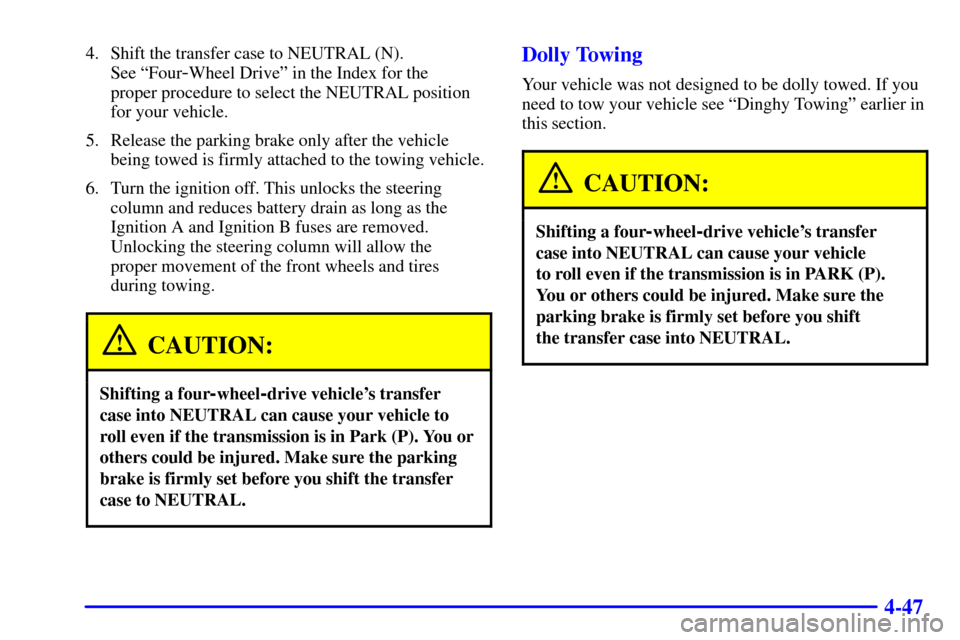
4. Shift the transfer case to NEUTRAL (N).
See ªFour
-Wheel Driveº in the Index for the
proper procedure to select the NEUTRAL position
for your vehicle.
5. Release the parking brake only after the vehicle
being towed is firmly attached to the towing vehicle.
6. Turn the ignition off. This unlocks the steering
column and reduces battery drain as long as the
Ignition A and Ignition B fuses are removed.
Unlocking the steering column will allow the
proper movement of the front wheels and tires
during towing.
CAUTION:
Shifting a four-wheel-drive vehicle's transfer
case into NEUTRAL can cause your vehicle to
roll even if the transmission is in Park (P). You or
others could be injured. Make sure the parking
brake is firmly set before you shift the transfer
case to NEUTRAL.
Dolly Towing
Your vehicle was not designed to be dolly towed. If you
need to tow your vehicle see ªDinghy Towingº earlier in
this section.
CAUTION:
Shifting a four-wheel-drive vehicle's transfer
case into NEUTRAL can cause your vehicle
to roll even if the transmission is in PARK (P).
You or others could be injured. Make sure the
parking brake is firmly set before you shift
the transfer case into NEUTRAL.
Page 296 of 432
5-4
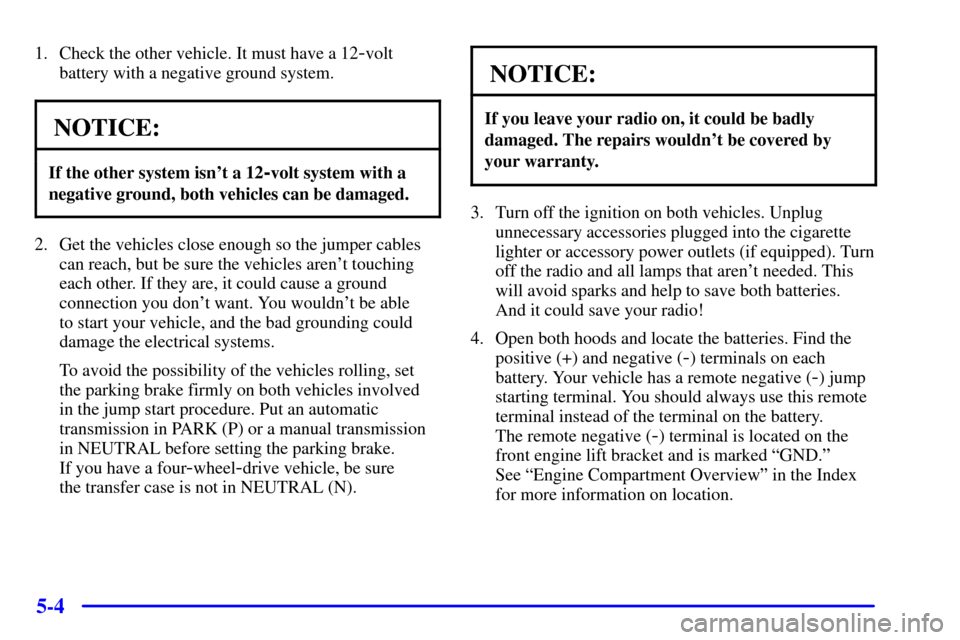
1. Check the other vehicle. It must have a 12-volt
battery with a negative ground system.
NOTICE:
If the other system isn't a 12-volt system with a
negative ground, both vehicles can be damaged.
2. Get the vehicles close enough so the jumper cables
can reach, but be sure the vehicles aren't touching
each other. If they are, it could cause a ground
connection you don't want. You wouldn't be able
to start your vehicle, and the bad grounding could
damage the electrical systems.
To avoid the possibility of the vehicles rolling, set
the parking brake firmly on both vehicles involved
in the jump start procedure. Put an automatic
transmission in PARK (P) or a manual transmission
in NEUTRAL before setting the parking brake.
If you have a four
-wheel-drive vehicle, be sure
the transfer case is not in NEUTRAL (N).
NOTICE:
If you leave your radio on, it could be badly
damaged. The repairs wouldn't be covered by
your warranty.
3. Turn off the ignition on both vehicles. Unplug
unnecessary accessories plugged into the cigarette
lighter or accessory power outlets (if equipped). Turn
off the radio and all lamps that aren't needed. This
will avoid sparks and help to save both batteries.
And it could save your radio!
4. Open both hoods and locate the batteries. Find the
positive (+) and negative (
-) terminals on each
battery. Your vehicle has a remote negative (
-) jump
starting terminal. You should always use this remote
terminal instead of the terminal on the battery.
The remote negative (
-) terminal is located on the
front engine lift bracket and is marked ªGND.º
See ªEngine Compartment Overviewº in the Index
for more information on location.
Page 341 of 432

6-15
How to Reset the CHANGE ENG OIL Light
To reset the CHANGE ENG OIL light,
do the following:
1. Turn the ignition key to RUN with the engine off.
2. Fully press and release the accelerator pedal
three times within five seconds.
If the CHANGE ENG OIL light flashes for
five seconds, the system is reset. If the light does
not flash, repeat the procedure.What to Do with Used Oil
Did you know that used engine oil contains certain
elements that may be unhealthy for your skin and could
even cause cancer? Don't let used oil stay on your skin
for very long. Clean your skin and nails with soap and
water, or a good hand cleaner. Wash or properly throw
away clothing or rags containing used engine oil. See
the manufacturer's warnings about the use and disposal
of oil products.
Used oil can be a real threat to the environment. If you
change your own oil, be sure to drain all free
-flowing
oil from the filter before disposal. Don't ever dispose of
oil by putting it in the trash, pouring it on the ground,
into sewers, or into streams or bodies of water. Instead,
recycle it by taking it to a place that collects used oil.
If you have a problem properly disposing of your used
oil, ask your dealer, a service station or a local recycling
center for help.
Page 385 of 432
6-59
Mini Fuses Usage
1 ECAS
2 Passenger's Side
High
-Beam Headlamp
3 Passenger's Side
Low
-Beam Headlamp
4 Back
-Up Trailer Lamps
5 Driver's Side
High
-Beam Headlamp
6 Driver's Side
Low
-Beam Headlamp
7 WASH
8ATC
9 Windshield Wipers
10 Powertrain Control Module B
11 Fog Lamps
12 ST/LP
13 Cigarette Lighter
14 COILS
15 RIDE
16 TBD
-- Ignition 1Mini Fuses Usage
17 Crank
18 Air Bag
19 ELEK Brake
20 Cooling Fan
21 Horn
22 Ignition E
23 ETC
24 Instrument Panel Cluster, Driver
Information Center
25 Automatic Shift Lock
Control System
26 ENG 1
27 Back
-Up
28 Powertrain Control Module 1
29 Oxygen Sensor
30 Air Conditioning
31 TBC
50 Passenger's Side Trailer TRN
51 Driver's Side Trailer TRN
52 Hazard Flashers
Page 386 of 432
6-60
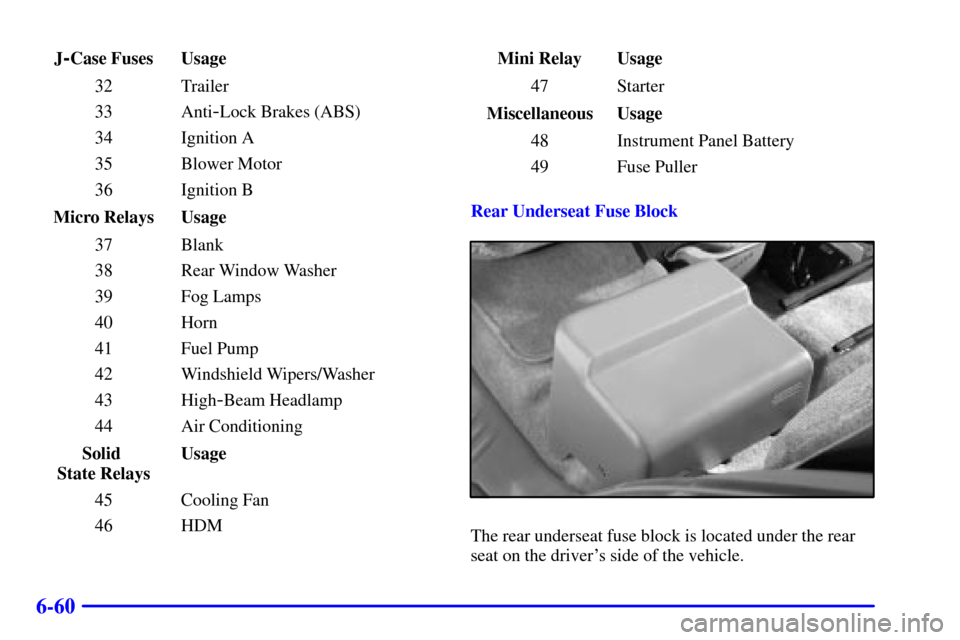
J-Case Fuses Usage
32 Trailer
33 Anti
-Lock Brakes (ABS)
34 Ignition A
35 Blower Motor
36 Ignition B
Micro Relays Usage
37 Blank
38 Rear Window Washer
39 Fog Lamps
40 Horn
41 Fuel Pump
42 Windshield Wipers/Washer
43 High
-Beam Headlamp
44 Air Conditioning
Solid
State RelaysUsage
45 Cooling Fan
46 HDMMini Relay Usage
47 Starter
Miscellaneous Usage
48 Instrument Panel Battery
49 Fuse Puller
Rear Underseat Fuse Block
The rear underseat fuse block is located under the rear
seat on the driver's side of the vehicle.
Page 388 of 432
6-62
Fuse Usage
17 Right Rear Parking Lamps
18 LOCKS
19 Blank
20 Sunroof
21 LOCK
23 Blank
24 UNLOCK
25 Blank
26 Blank
27 OH Battery/OnStar
� System
29 Rainsense Wipers
30 Parking Lamps
31 TBC 4CC
32 TBC5
33 Front Wipers
34 VEH STOP
35 BlankFuse Usage
36 HVAC B
37 Front Parking Lamps
38 Left Turn Signal
39 HVAC 1
40 TBC 4
41 Radio
42 TR PARK
43 Right Turn Signal
44 HVAC
45 Rear Fog Lamps
46 Auxiliary Power 1
47 Ignition 0
48 Four
-Wheel Drive
49 Blank
50 TBC IG
51 Brakes
52 TBC RUN
Page 408 of 432
7-19
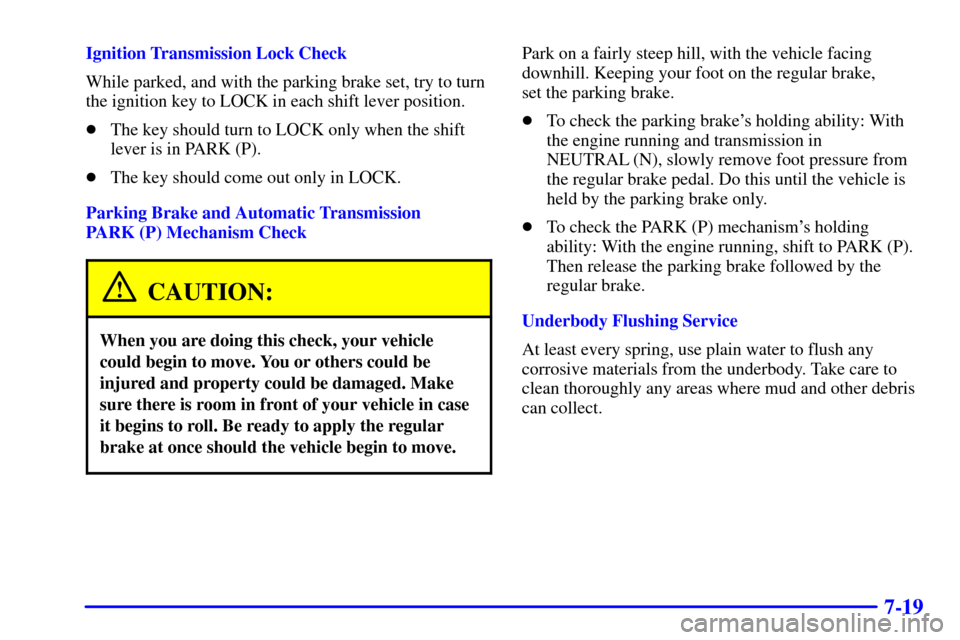
Ignition Transmission Lock Check
While parked, and with the parking brake set, try to turn
the ignition key to LOCK in each shift lever position.
�The key should turn to LOCK only when the shift
lever is in PARK (P).
�The key should come out only in LOCK.
Parking Brake and Automatic Transmission
PARK (P) Mechanism Check
CAUTION:
When you are doing this check, your vehicle
could begin to move. You or others could be
injured and property could be damaged. Make
sure there is room in front of your vehicle in case
it begins to roll. Be ready to apply the regular
brake at once should the vehicle begin to move.
Park on a fairly steep hill, with the vehicle facing
downhill. Keeping your foot on the regular brake,
set the parking brake.
�To check the parking brake's holding ability: With
the engine running and transmission in
NEUTRAL (N), slowly remove foot pressure from
the regular brake pedal. Do this until the vehicle is
held by the parking brake only.
�To check the PARK (P) mechanism's holding
ability: With the engine running, shift to PARK (P).
Then release the parking brake followed by the
regular brake.
Underbody Flushing Service
At least every spring, use plain water to flush any
corrosive materials from the underbody. Take care to
clean thoroughly any areas where mud and other debris
can collect.