Page 302 of 432
5-10 If No Steam Is Coming From Your Engine
If you get an engine overheat warning but see or hear no
steam, the problem may not be too serious. Sometimes
the engine can get a little too hot when you:
�Climb a long hill on a hot day.
�Stop after high
-speed driving.
�Idle for long periods in traffic.
�Tow a trailer. See ªDriving on Gradesº in the Index.
If you get the overheat warning with no sign of steam,
try this for a minute or so:
1. If your air conditioner is on, turn it off.
2. Turn on your heater to full hot at the highest fan
speed and open the window as necessary.
3. If you're in a traffic jam, shift to NEUTRAL (N);
otherwise, shift to the highest gear while
driving
-- DRIVE (D) or THIRD (3).If you no longer have the overheat warning,
you can drive. Just to be safe, drive slower for
about 10 minutes. If the warning doesn't come
back on, you can drive normally.
If the warning continues, pull over, stop, and park
your vehicle right away.
If there's still no sign of steam, push down the
accelerator until the engine speed is about twice as fast
as normal idle speed for at least three minutes while
you're parked. If you still have the warning, turn off
the engine and get everyone out of the vehicle until it
cools down.
You may decide not to lift the hood but to get service
help right away.
Page 309 of 432
5-17
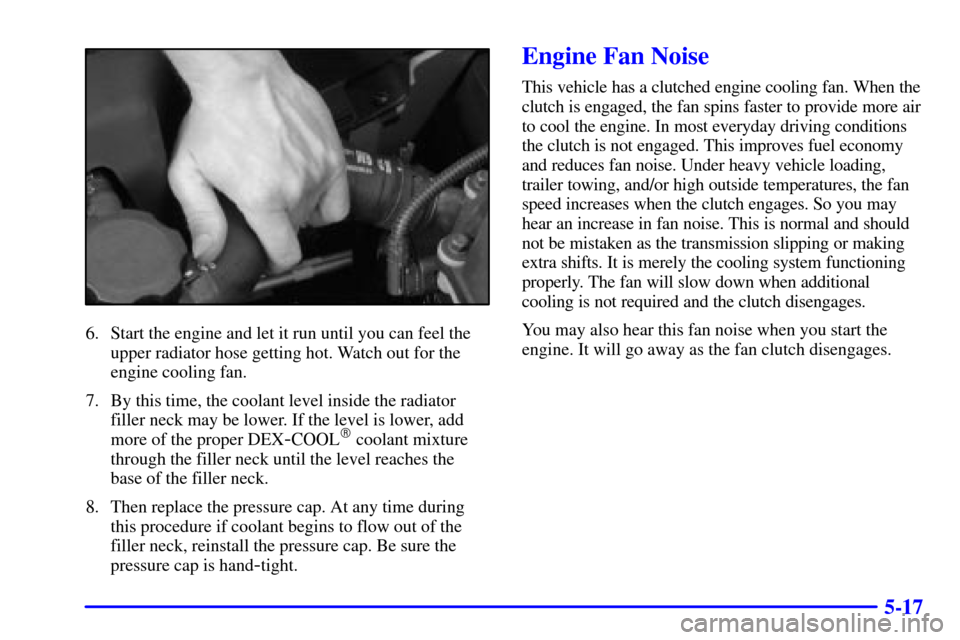
6. Start the engine and let it run until you can feel the
upper radiator hose getting hot. Watch out for the
engine cooling fan.
7. By this time, the coolant level inside the radiator
filler neck may be lower. If the level is lower, add
more of the proper DEX
-COOL� coolant mixture
through the filler neck until the level reaches the
base of the filler neck.
8. Then replace the pressure cap. At any time during
this procedure if coolant begins to flow out of the
filler neck, reinstall the pressure cap. Be sure the
pressure cap is hand
-tight.
Engine Fan Noise
This vehicle has a clutched engine cooling fan. When the
clutch is engaged, the fan spins faster to provide more air
to cool the engine. In most everyday driving conditions
the clutch is not engaged. This improves fuel economy
and reduces fan noise. Under heavy vehicle loading,
trailer towing, and/or high outside temperatures, the fan
speed increases when the clutch engages. So you may
hear an increase in fan noise. This is normal and should
not be mistaken as the transmission slipping or making
extra shifts. It is merely the cooling system functioning
properly. The fan will slow down when additional
cooling is not required and the clutch disengages.
You may also hear this fan noise when you start the
engine. It will go away as the fan clutch disengages.
Page 344 of 432
6-18
Automatic Transmission Fluid
When to Check and Change
A good time to check your automatic transmission fluid
level is when the engine oil is changed.
Change both the fluid and filter every 50,000 miles
(83 000 km) if the vehicle is mainly driven under one
or more of these conditions:
�In heavy city traffic where the outside temperature
regularly reaches 90�F (32�C) or higher.
�In hilly or mountainous terrain.
�When doing frequent trailer towing.
�Uses such as found in taxi, police or delivery service.
If you do not use your vehicle under any of
these conditions, change the fluid and filter
every 100,000 miles (166 000 km).
See ªScheduled Maintenance Servicesº in the Index.
How to Check
Because this operation can be a little difficult, you may
choose to have this done at the dealership service department.
If you do it yourself, be sure to follow all the instructions
here, or you could get a false reading on the dipstick.
NOTICE:
Too much or too little fluid can damage your
transmission. Too much can mean that some of
the fluid could come out and fall on hot engine
parts or exhaust system parts, starting a fire.
Too little fluid could cause the transmission to
overheat. Be sure to get an accurate reading if
you check your transmission fluid.
Wait at least 30 minutes before checking the
transmission fluid level if you have been driving:
�When outside temperatures are above 90�F (32�C).
�At high speed for quite a while.
�In heavy traffic
-- especially in hot weather.
�While pulling a trailer.
Page 385 of 432
6-59
Mini Fuses Usage
1 ECAS
2 Passenger's Side
High
-Beam Headlamp
3 Passenger's Side
Low
-Beam Headlamp
4 Back
-Up Trailer Lamps
5 Driver's Side
High
-Beam Headlamp
6 Driver's Side
Low
-Beam Headlamp
7 WASH
8ATC
9 Windshield Wipers
10 Powertrain Control Module B
11 Fog Lamps
12 ST/LP
13 Cigarette Lighter
14 COILS
15 RIDE
16 TBD
-- Ignition 1Mini Fuses Usage
17 Crank
18 Air Bag
19 ELEK Brake
20 Cooling Fan
21 Horn
22 Ignition E
23 ETC
24 Instrument Panel Cluster, Driver
Information Center
25 Automatic Shift Lock
Control System
26 ENG 1
27 Back
-Up
28 Powertrain Control Module 1
29 Oxygen Sensor
30 Air Conditioning
31 TBC
50 Passenger's Side Trailer TRN
51 Driver's Side Trailer TRN
52 Hazard Flashers
Page 386 of 432
6-60
J-Case Fuses Usage
32 Trailer
33 Anti
-Lock Brakes (ABS)
34 Ignition A
35 Blower Motor
36 Ignition B
Micro Relays Usage
37 Blank
38 Rear Window Washer
39 Fog Lamps
40 Horn
41 Fuel Pump
42 Windshield Wipers/Washer
43 High
-Beam Headlamp
44 Air Conditioning
Solid
State RelaysUsage
45 Cooling Fan
46 HDMMini Relay Usage
47 Starter
Miscellaneous Usage
48 Instrument Panel Battery
49 Fuse Puller
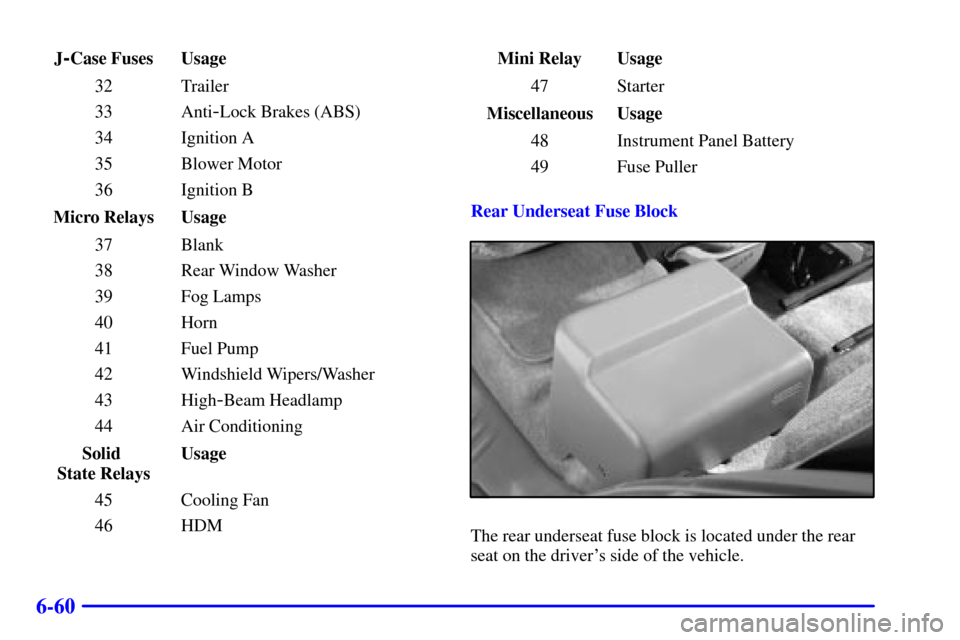
Rear Underseat Fuse Block
The rear underseat fuse block is located under the rear
seat on the driver's side of the vehicle.
Page 400 of 432
Scheduled Maintenance
7-11
50,000 Miles (83 000 km)
�Change automatic transmission fluid and filter if the vehicle is mainly driven
under one or more of these conditions:
± In heavy city traffic where the outside temperature regularly reaches
90�F (32�C) or higher.
± In hilly or mountainous terrain.
± When doing frequent trailer towing.
± Uses such as found in taxi, police or delivery service.
If you do not use your vehicle under any of these conditions, change the fluid
and filter at 100,000 miles (166 000 km).
�Automatic Transfer Case Only: Change transfer case fluid.
52,500 Miles (87 500 km)
�Check rear/front axle fluid level and add fluid as needed. Check constant
velocity joints and axle seals for leaking.
�Rotate tires. See ªTire Inspection and Rotationº in the Index for proper
rotation pattern and additional information. (See footnote +.)
ACTUAL
SERVICED BY:MILEAGE
DATE
ACTUAL
SERVICED BY:MILEAGE
DATE
Page 403 of 432
Scheduled Maintenance
7-14
100,000 Miles (166 000 km)
�Replace spark plugs.
An Emission Control Service.
�Change automatic transmission fluid and filter if the vehicle is mainly driven
under one or more of these conditions:
± In heavy city traffic where the outside temperature regularly reaches
90�F (32�C) or higher.
± In hilly or mountainous terrain.
± When doing frequent trailer towing.
± Uses such as found in taxi, police or delivery service.
�If you haven't used your vehicle under severe service conditions listed
previously and, therefore, haven't changed your automatic transmission fluid,
change both the fluid and filter.
�Automatic Transfer Case Only: Change transfer case fluid.
150,000 Miles (240 000 km)
�Drain, flush and refill cooling system (or every 60 months since last service,
whichever occurs first). See ªEngine Coolantº in the Index for what to use.
Inspect hoses. Clean radiator, condenser, pressure cap and neck.
Pressure test the cooling system and pressure cap.
An Emission Control Service.
ACTUAL
SERVICED BY:MILEAGE
DATE
ACTUAL
SERVICED BY:MILEAGE
DATE