Page 349 of 432
6-23 Front Axle
When to Check and Change Lubricant
Refer to the Maintenance Schedule to determine how
often to check the lubricant and when to change it.
See ªScheduled Maintenance Servicesº in the Index.
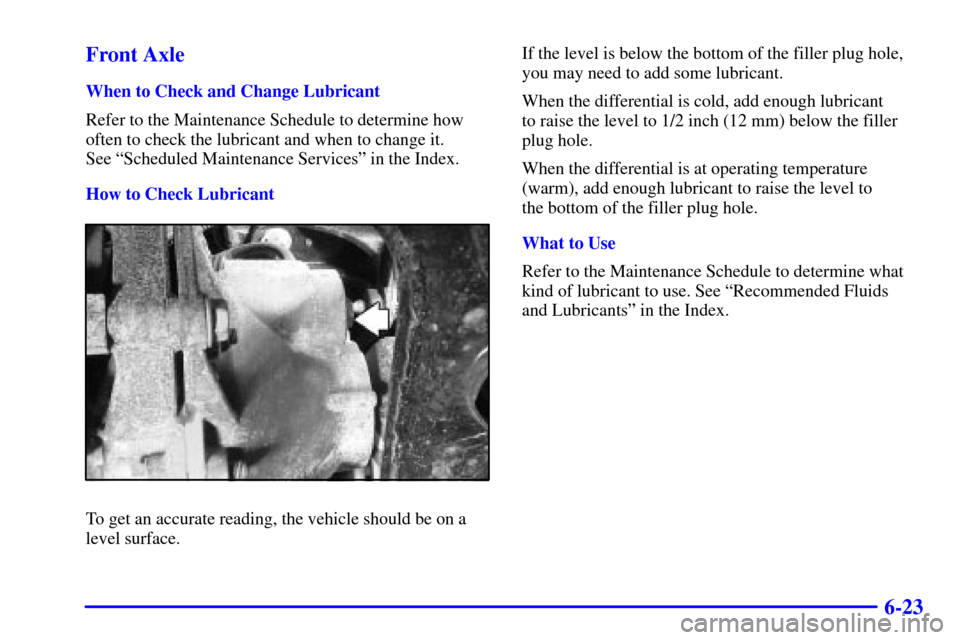
How to Check Lubricant
To get an accurate reading, the vehicle should be on a
level surface.If the level is below the bottom of the filler plug hole,
you may need to add some lubricant.
When the differential is cold, add enough lubricant
to raise the level to 1/2 inch (12 mm) below the filler
plug hole.
When the differential is at operating temperature
(warm), add enough lubricant to raise the level to
the bottom of the filler plug hole.
What to Use
Refer to the Maintenance Schedule to determine what
kind of lubricant to use. See ªRecommended Fluids
and Lubricantsº in the Index.
Page 356 of 432
6-30
Brakes
Brake Fluid
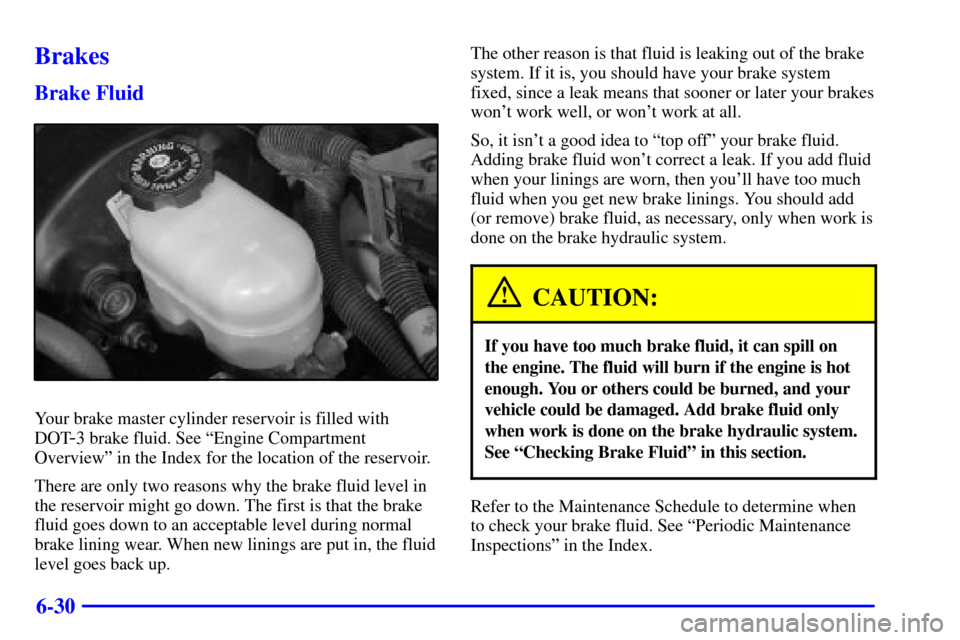
Your brake master cylinder reservoir is filled with
DOT
-3 brake fluid. See ªEngine Compartment
Overviewº in the Index for the location of the reservoir.
There are only two reasons why the brake fluid level in
the reservoir might go down. The first is that the brake
fluid goes down to an acceptable level during normal
brake lining wear. When new linings are put in, the fluid
level goes back up.The other reason is that fluid is leaking out of the brake
system. If it is, you should have your brake system
fixed, since a leak means that sooner or later your brakes
won't work well, or won't work at all.
So, it isn't a good idea to ªtop offº your brake fluid.
Adding brake fluid won't correct a leak. If you add fluid
when your linings are worn, then you'll have too much
fluid when you get new brake linings. You should add
(or remove) brake fluid, as necessary, only when work is
done on the brake hydraulic system.
CAUTION:
If you have too much brake fluid, it can spill on
the engine. The fluid will burn if the engine is hot
enough. You or others could be burned, and your
vehicle could be damaged. Add brake fluid only
when work is done on the brake hydraulic system.
See ªChecking Brake Fluidº in this section.
Refer to the Maintenance Schedule to determine when
to check your brake fluid. See ªPeriodic Maintenance
Inspectionsº in the Index.
Page 359 of 432
6-33
Some driving conditions or climates may cause a
brake squeal when the brakes are first applied or lightly
applied. This does not mean something is wrong with
your brakes.
Properly torqued wheel nuts are necessary to help
prevent brake pulsation. When tires are rotated, inspect
brake pads for wear and evenly tighten wheel nuts in
the proper sequence to GM torque specifications.
Brake linings should always be replaced as complete
axle sets.
See ªBrake System Inspectionº in Section 7 of this
manual under Part C ªPeriodic Maintenance Inspections.º
Brake Pedal Travel
See your dealer if the brake pedal does not return to
normal height, or if there is a rapid increase in pedal
travel. This could be a sign of brake trouble.
Brake Adjustment
Every time you make a brake stop, your disc brakes
adjust for wear.
Replacing Brake System Parts
The braking system on a vehicle is complex. Its
many parts have to be of top quality and work well
together if the vehicle is to have really good braking.
Your vehicle was designed and tested with top
-quality
GM brake parts. When you replace parts of your braking
system
-- for example, when your brake linings wear
down and you need new ones put in
-- be sure you get
new approved GM replacement parts. If you don't, your
brakes may no longer work properly. For example, if
someone puts in brake linings that are wrong for your
vehicle, the balance between your front and rear brakes
can change
-- for the worse. The braking performance
you've come to expect can change in many other ways
if someone puts in the wrong replacement brake parts.
Page 360 of 432
6-34
Battery
Your new vehicle comes with a maintenance free
ACDelco� battery. When it's time for a new battery,
get one that has the replacement number shown on the
original battery's label. We recommend an ACDelco
battery. See ªEngine Compartment Overviewº in the
Index for battery location.
WARNING: Battery posts, terminals and related
accessories contain lead and lead compounds, chemicals
known to the State of California to cause cancer and
reproductive harm. Wash hands after handling.
Vehicle Storage
If you're not going to drive your vehicle for 25 days
or more, remove the black, negative (
-) cable from
the battery. This will help keep your battery from
running down.
CAUTION:
Batteries have acid that can burn you and gas
that can explode. You can be badly hurt if you
aren't careful. See ªJump Startingº in the Index
for tips on working around a battery without
getting hurt.
Contact your dealer to learn how to prepare your vehicle
for longer storage periods.
Also, for your audio system, see ªTheft
-Deterrent
Featureº in the Index.
Page 362 of 432
6-36
Windshield Wiper
Blade Replacement
Windshield wiper blades should be inspected at least
twice a year for wear or cracking. See ªWiper Blade
Checkº in the Index for more information.
See ªNormal Maintenance Replacement Partsº in the
Index for the proper type of replacement blade.
NOTICE:
Use care when removing or installing a blade
assembly. Accidental bumping can cause the
arm to fall back and strike the windshield.
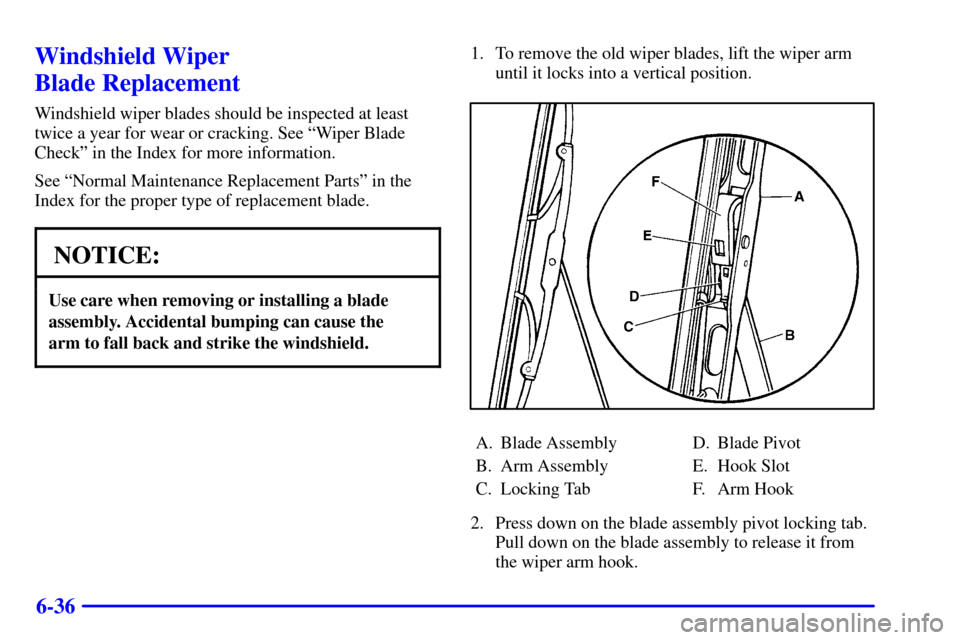
1. To remove the old wiper blades, lift the wiper arm
until it locks into a vertical position.
A. Blade Assembly
B. Arm Assembly
C. Locking TabD. Blade Pivot
E. Hook Slot
F. Arm Hook
2. Press down on the blade assembly pivot locking tab.
Pull down on the blade assembly to release it from
the wiper arm hook.
Page 366 of 432
6-40 Tire Inspection and Rotation
Tires should be rotated every 6,000 to 8,000 miles
(10 000 to 13 000 km). Any time you notice unusual
wear, rotate your tires as soon as possible and check
wheel alignment. Also check for damaged tires or
wheels. See ªWhen It's Time for New Tiresº and
ªWheel Replacementº later in this section for more
information. Make sure the spare tire is stored securely.
Push, pull, and then try to rotate or turn the tire. If it
moves, use the wheel wrench to tighten the cable. See
ªStoring a Flat or Spare Tire and Toolsº in the Index.
The purpose of regular rotation is to achieve more
uniform wear for all tires on the vehicle. The first rotation
is the most important. See ªScheduled Maintenance
Servicesº in the Index for scheduled rotation intervals.
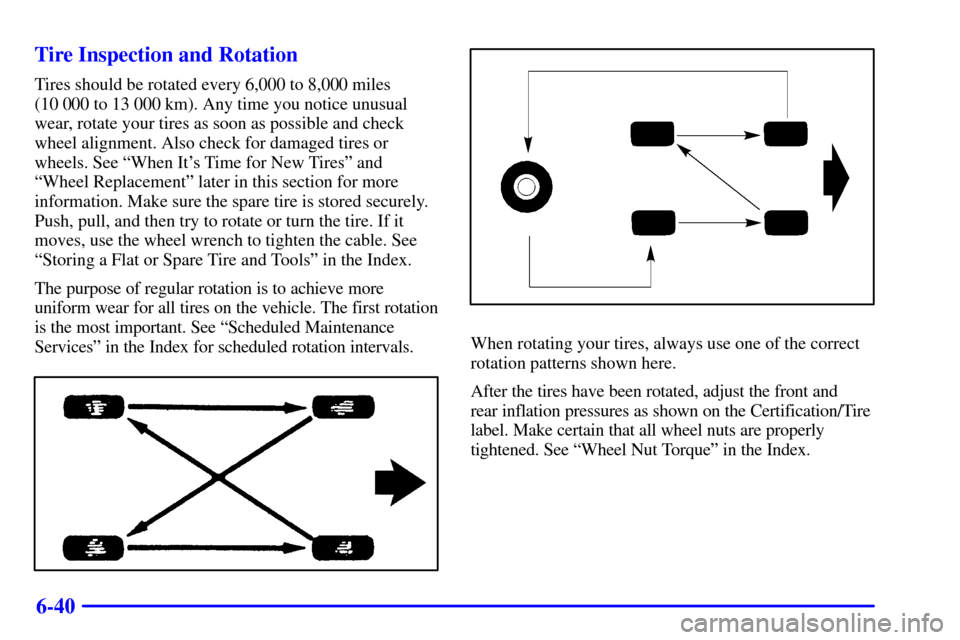
When rotating your tires, always use one of the correct
rotation patterns shown here.
After the tires have been rotated, adjust the front and
rear inflation pressures as shown on the Certification/Tire
label. Make certain that all wheel nuts are properly
tightened. See ªWheel Nut Torqueº in the Index.
Page 379 of 432
6-53
Finish Damage
Any stone chips, fractures or deep scratches in the finish
should be repaired right away. Bare metal will corrode
quickly and may develop into a major repair expense.
Minor chips and scratches can be repaired with touch
-up
materials available from your dealer or other service
outlets. Larger areas of finish damage can be corrected
in your dealer's body and paint shop.
Underbody Maintenance
Chemicals used for ice and snow removal and dust
control can collect on the underbody. If these are
not removed, accelerated corrosion (rust) can occur
on the underbody parts such as fuel lines, frame,
floor pan and exhaust system even though they have
corrosion protection.
At least every spring, flush these materials from the
underbody with plain water. Clean any areas where mud
and other debris can collect. Dirt packed in closed areas
of the frame should be loosened before being flushed.
Your dealer or an underbody car washing system can do
this for you.
Chemical Paint Spotting
Some weather and atmospheric conditions can create
a chemical fallout. Airborne pollutants can fall upon
and attack painted surfaces on your vehicle. This
damage can take two forms: blotchy, ringlet
-shaped
discolorations, and small irregular dark spots etched
into the paint surface.
Although no defect in the paint job causes this,
Chevrolet will repair, at no charge to the owner,
the surfaces of new vehicles damaged by this fallout
condition within 12 months or 12,000 miles (20 000 km)
of purchase, whichever occurs first.
Page 389 of 432
6-63
Replacement Bulbs
Lamps Number
Tail and Stoplamps 3157. . . . . . . . . . . . . . . . . . . . .
Rear Turn Signal Lamps 3157. . . . . . . . . . . . . . . . .
For any bulb not listed here contact your dealer.
Capacities and Specifications
Engine Specifications
Engine Description ªVORTECº 4200. . . . . . . . . . . .
Type L6. . . . . . . . . . . . . . . . . . . . . . . . . . . . . . . . . . . .
VIN Code S. . . . . . . . . . . . . . . . . . . . . . . . . . . . . . . . .
Firing Order 1
-5-3-6-2-4 . . . . . . . . . . . . . . . . . . . . . .
Spark Plug Gap 0.050 inches (1.25 mm). . . . . . . . . .
Wheel and Tires
Wheel Nut Torque 100 lb-ft (140 N´m) . . . . . . . . . . .
Capacities
Cooling System 13.9 quarts (13.1 L). . . . . . . . . . . . .
Crankcase 7.0 quarts (6.6 L). . . . . . . . . . . . . . . . . . . .
Transmission
(Drain and Refill) 5.0 quarts (4.7 L). . . . . . . . . . . .
Differential Fluid
Rear 4.0 pints (1.9 L). . . . . . . . . . . . . . . . . . . . . . . .
Front 2.6 pints (0.8 L). . . . . . . . . . . . . . . . . . . . . . .
Fuel Tank 18.7 U.S. gallons (75.7 L). . . . . . . . . . . . .
All capacities are approximate. When adding, be sure to
fill to the appropriate level, as recommended in this
manual. Recheck the fluid level after filling.
Normal Maintenance
Replacement Parts
Engine Oil Filter PF59*. . . . . . . . . . . . . . . . . . . . . . .
Engine Air Cleaner/Filter A2014C*. . . . . . . . . . . . . . .
Automatic Transmission
Filter Kit GM Part No. 24200796. . . . . . . . . . . . . . .
Spark Plugs 41
-965* . . . . . . . . . . . . . . . . . . . . . . . . . .
Fuel Filter GF831*. . . . . . . . . . . . . . . . . . . . . . . . . . . .
Windshield Wiper Blade 20.0 inches (50.8 cm). . . . .
Backglass Wiper Blade 14.0 inches (35.6 cm). . . . . .
*ACDelco
� part number