Page 264 of 497
4-36
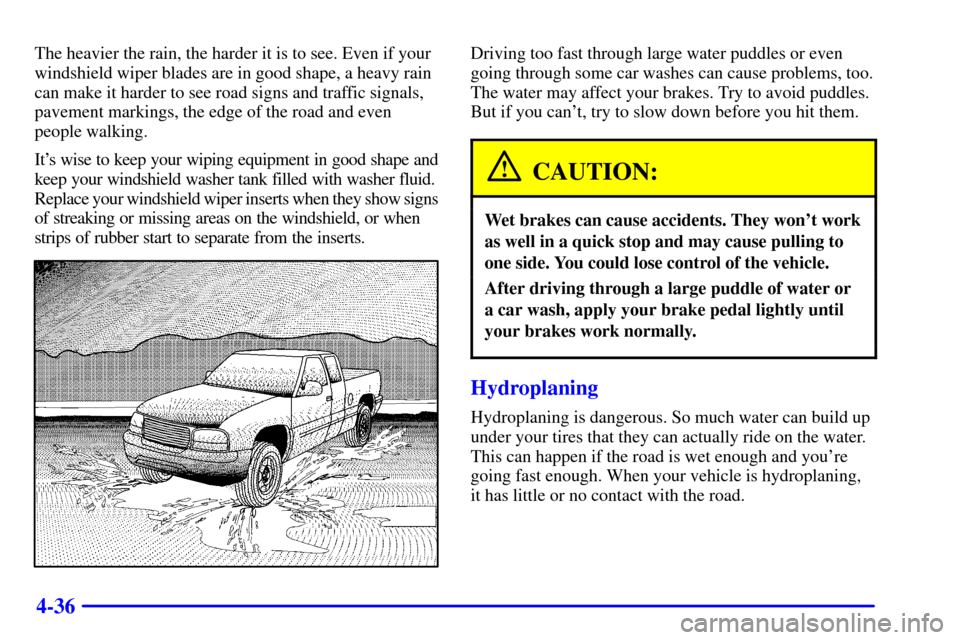
The heavier the rain, the harder it is to see. Even if your
windshield wiper blades are in good shape, a heavy rain
can make it harder to see road signs and traffic signals,
pavement markings, the edge of the road and even
people walking.
It's wise to keep your wiping equipment in good shape and
keep your windshield washer tank filled with washer fluid.
Replace your windshield wiper inserts when they show signs
of streaking or missing areas on the windshield, or when
strips of rubber start to separate from the inserts.Driving too fast through large water puddles or even
going through some car washes can cause problems, too.
The water may affect your brakes. Try to avoid puddles.
But if you can't, try to slow down before you hit them.
CAUTION:
Wet brakes can cause accidents. They won't work
as well in a quick stop and may cause pulling to
one side. You could lose control of the vehicle.
After driving through a large puddle of water or
a car wash, apply your brake pedal lightly until
your brakes work normally.
Hydroplaning
Hydroplaning is dangerous. So much water can build up
under your tires that they can actually ride on the water.
This can happen if the road is wet enough and you're
going fast enough. When your vehicle is hydroplaning,
it has little or no contact with the road.
Page 275 of 497
4-47
�Tie a red cloth to your vehicle to alert police that
you've been stopped by the snow.
�Put on extra clothing or wrap a blanket around you.
If you have no blankets or extra clothing, make body
insulators from newspapers, burlap bags, rags, floor
mats
-- anything you can wrap around yourself or
tuck under your clothing to keep warm.
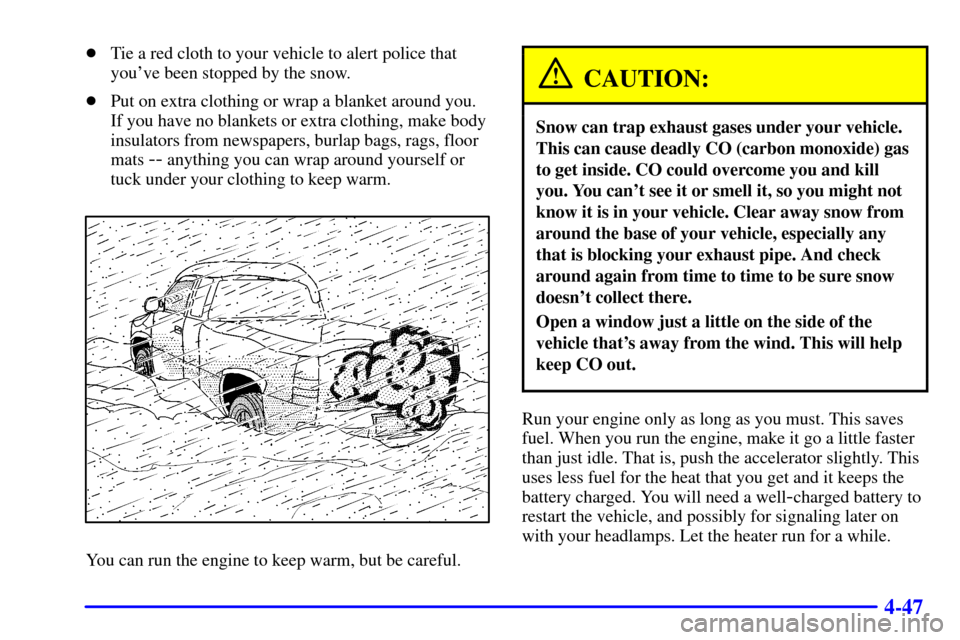
You can run the engine to keep warm, but be careful.
CAUTION:
Snow can trap exhaust gases under your vehicle.
This can cause deadly CO (carbon monoxide) gas
to get inside. CO could overcome you and kill
you. You can't see it or smell it, so you might not
know it is in your vehicle. Clear away snow from
around the base of your vehicle, especially any
that is blocking your exhaust pipe. And check
around again from time to time to be sure snow
doesn't collect there.
Open a window just a little on the side of the
vehicle that's away from the wind. This will help
keep CO out.
Run your engine only as long as you must. This saves
fuel. When you run the engine, make it go a little faster
than just idle. That is, push the accelerator slightly. This
uses less fuel for the heat that you get and it keeps the
battery charged. You will need a well
-charged battery to
restart the vehicle, and possibly for signaling later on
with your headlamps. Let the heater run for a while.
Page 293 of 497

4-65
Tow/Haul Mode (If Equipped)
Tow/haul is a feature on automatic transmission
equipped vehicles that assists when pulling a heavy
trailer or a large or heavy load. The purpose of the
tow/haul mode is to:
�Reduce the frequency and improve the predictability
of transmission shifts when pulling a heavy trailer or
a large or heavy load.
�Provide the same solid shift feel when pulling a
heavy trailer or a large or heavy load as when the
vehicle is unloaded.
�Improve control of vehicle speed while requiring less
throttle pedal activity when pulling a heavy trailer or
a large or heavy load.
Automatic transmission equipped vehicles are provided
with a button at the end of the shift lever which when
pressed enables tow/haul. When the button is pressed,
a light on the instrument panel will illuminate to indicate
that tow/haul has been selected. Tow/haul may be turned
off by pressing the button again, at which time the
indicator light on the instrument panel will turn off.
The vehicle will automatically turn off tow/haul every
time it is started.Tow/haul is designed to be most effective when the
vehicle and trailer combined weight is at least 75% of
the vehicle's Gross Combined Weight Rating (GCWR).
See ªWeight of the Trailerº later in the section.
Tow/haul is most useful under the following
driving conditions:
�When pulling a heavy trailer or a large or heavy load
through rolling terrain.
�When pulling a heavy trailer or a large or heavy load
in stop and go traffic.
�When pulling a heavy trailer or a large or heavy load
in busy parking lots where improved low speed
control of the vehicle is desired.
Operating the vehicle in tow/haul when lightly loaded or
with no trailer at all will not cause damage. However,
there is no benefit to the selection of tow/haul when the
vehicle is unloaded. Such a selection when unloaded
may result in unpleasant engine and transmission
driving characteristics and reduced fuel economy.
Tow/haul is recommended only when pulling a heavy
trailer or a large or heavy load.
Page 318 of 497
4-90 When You Are Ready to Leave After
Parking on a Hill
1. Apply your regular brakes and hold the pedal down
while you:
�start your engine,
�shift into a gear, and
�release the parking brake.
2. Let up on the brake pedal.
3. Drive slowly until the trailer is clear of the chocks.
4. Stop and have someone pick up and store the chocks.
Maintenance When Trailer Towing
Your vehicle will need service more often when you're
pulling a trailer. See the Maintenance Schedule for more
on this. Things that are especially important in trailer
operation are automatic transmission fluid (don't
overfill), engine oil, axle lubricant, belt, cooling system
and brake system. Each of these is covered in this
manual, and the Index will help you find them quickly.
If you're trailering, it's a good idea to review these
sections before you start your trip.
Check periodically to see that all hitch nuts and bolts
are tight.
Page 346 of 497

5-20
Engine Fan Noise
Your vehicle has a clutched engine cooling fan. When
the clutch is engaged, the fan spins faster to provide
more air to cool the engine. In most everyday driving
conditions, the fan is spinning slower and the clutch is
not fully engaged. This improves fuel economy and
reduces fan noise. Under heavy vehicle loading, trailer
towing and/or high outside temperatures, the fan speed
increases as the clutch more fully engages. So you may
hear an increase in fan noise. This is normal and should
not be mistaken as the transmission slipping or making
extra shifts. It is merely the cooling system functioning
properly. The fan will slow down when additional
cooling is not required and the clutch disengages.
You may also hear this fan noise when you start
the engine. It will go away as the fan clutch
partially disengages.
If a Tire Goes Flat
It's unusual for a tire to ªblow outº while you're driving,
especially if you maintain your tires properly. If air goes
out of a tire, it's much more likely to leak out slowly.
But if you should ever have a ªblowout,º here are a few
tips about what to expect and what to do:
If a front tire fails, the flat tire will create a drag that
pulls the vehicle toward that side. Take your foot off the
accelerator pedal and grip the steering wheel firmly.
Steer to maintain lane position, and then gently brake to
a stop well out of the traffic lane.
A rear blowout, particularly on a curve, acts much like a
skid and may require the same correction you'd use in a
skid. In any rear blowout, remove your foot from the
accelerator pedal. Get the vehicle under control by
steering the way you want the vehicle to go. It may be
very bumpy and noisy, but you can still steer. Gently
brake to a stop
-- well off the road if possible.
If a tire goes flat, the next part shows how to use your
jacking equipment to change a flat tire safely.
Page 448 of 497

6-83
*1 INJ B--Gasoline Engine and Diesel Engine.
*2 ECM I
--Gasoline Engine; ECMRPV--Diesel Engine.
*3 02 A
--Gasoline Engine; FUEL HT--Diesel Engine.
*4 02 B
--Gasoline Engine; ECM I--Diesel Engine.
Fuse Usage
GLOW PLUG Diesel Glow Plugs and Intake
Air Heater
CUST FEED Gasoline Accessory Power
STUD #1 Accessory Power/Trailer
Wiring Feed
ABS Anti
-Lock Brakes
IGN A Ignition Switch
AIR A.I.R. System
RAP #1 Retained Accessory Power, Power
Mirrors, Power Door Locks,
Power Seat(s)
IGN B Ignition Switch
RAP #2 Not Used
STUD #2 Accessory Power/Trailer Wiring
Brake Feed
SPARE Spare FuseFuse Usage
TRL R TRN Right Turn Signal Trailer Wiring
TRL L TRN Left Turn Signal Trailer Wiring
IGN 1 Ignition, Fuel Controls (Relay)
INJ B Ignition, Fuel Controls
STARTER Starter (Relay)
PARK LP Parking Lamps
FRT HVAC Climate Control System
STOP LP Exterior Lamps, Stoplamps
ECM I PCM
ECMRPV Fuel Controls, ECM
CHMSL Center High Mounted Stoplamp
VEH STOP Stoplamps, Cruise Control
TRL B/U Backup Lamps Trailer Wiring
INJ A Fuel Controls, Ignition
RR HVAC Not Used
VEH B/U Vehicle Backup Lamps
ENG 1 Engine Controls, Canister Purge,
Fuel System
ETC Electronic Throttle Control
IGN E A/C Compressor Relay, Rear
Window Defogger, Daytime
Running Lamps, A.I.R. System