Page 101 of 497
2-21
New Vehicle ªBreak-Inº
NOTICE:
Your vehicle doesn't need an elaborate
ªbreak
-in.º But it will perform better in the long
run if you follow these guidelines:
�Keep your speed at 55 mph (88 km/h) or
less for the first 500 miles (805 km).
�Don't drive at any one speed
-- fast or
slow
-- for the first 500 miles (805 km).
Don't make full
-throttle starts.
�Avoid making hard stops for the first
200 miles (322 km) or so. During this time
your new brake linings aren't yet broken
in. Hard stops with new linings can mean
premature wear and earlier replacement.
Follow this breaking
-in guideline every
time you get new brake linings.
�Don't tow a trailer during break
-in.
See ªTowing a Trailerº in the Index for
more information.
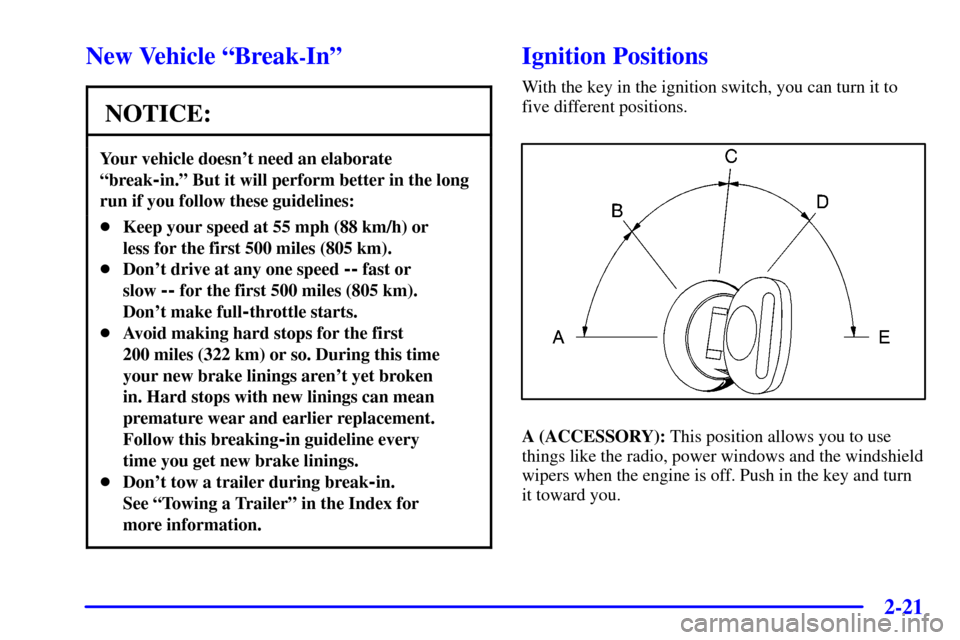
Ignition Positions
With the key in the ignition switch, you can turn it to
five different positions.
A (ACCESSORY): This position allows you to use
things like the radio, power windows and the windshield
wipers when the engine is off. Push in the key and turn
it toward you.
Page 102 of 497
2-22
B (LOCK): This position locks your ignition and
transmission. It's a theft
-deterrent feature. You will only
be able to remove your key when the ignition is turned
to LOCK.
CAUTION:
On manual transmission vehicles, turning the key
to LOCK will lock the steering column and result
in a loss of ability to steer the vehicle. This could
cause a collision. If you need to turn the engine
off while the vehicle is moving, turn the key only
to OFF. Don't press the key release button while
the vehicle is moving.
NOTICE:
If your key seems stuck in LOCK and you can't
turn it, be sure you are using the correct key; if
so, is it all the way in? Turn the key only with
your hand. Using a tool to force it could break
the key or the ignition switch. If none of this
works, then your vehicle needs service.
C (OFF): This position lets you turn off the engine.
Use OFF if you must have your vehicle in motion
while the engine is off (for example, if your vehicle is
being pushed).
D (RUN): This is the position for driving.
E (START): This position starts your engine.
Page 103 of 497
2-23
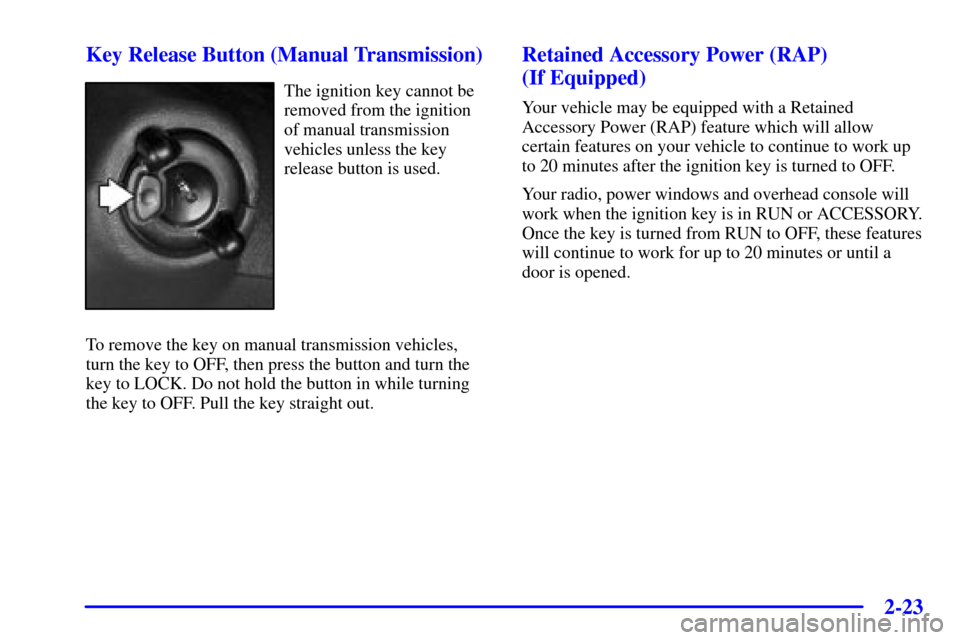
Key Release Button (Manual Transmission)
The ignition key cannot be
removed from the ignition
of manual transmission
vehicles unless the key
release button is used.
To remove the key on manual transmission vehicles,
turn the key to OFF, then press the button and turn the
key to LOCK. Do not hold the button in while turning
the key to OFF. Pull the key straight out.
Retained Accessory Power (RAP)
(If Equipped)
Your vehicle may be equipped with a Retained
Accessory Power (RAP) feature which will allow
certain features on your vehicle to continue to work up
to 20 minutes after the ignition key is turned to OFF.
Your radio, power windows and overhead console will
work when the ignition key is in RUN or ACCESSORY.
Once the key is turned from RUN to OFF, these features
will continue to work for up to 20 minutes or until a
door is opened.
Page 104 of 497
2-24
Starting Your Engine
Automatic Transmission
Move your shift lever to PARK (P) or NEUTRAL (N).
Your engine won't start in any other position
-- that's a
safety feature. To restart when you're already moving,
use NEUTRAL (N) only.
NOTICE:
Don't try to shift to PARK (P) if your vehicle is
moving. If you do, you could damage the
transmission. Shift to PARK (P) only when your
vehicle is stopped.
Manual Transmission
The gear selector should be in neutral and the parking
brake engaged. Hold the clutch pedal to the floor and
start the engine. Your vehicle won't start if the clutch
pedal is not all the way down
-- that's a safety feature.
Starting Your V8 Engine
1. With your foot off the accelerator pedal, turn the
ignition key to START. When the engine starts, let
go of the key. The idle speed will go down as your
engine gets warm.
NOTICE:
Holding your key in START for longer than
15 seconds at a time will cause your battery to
be drained much sooner. And the excessive heat
can damage your starter motor. Wait about
15 seconds between each try to help avoid
draining your battery or damaging your starter.
2. If it doesn't start within 10 seconds, push the
accelerator pedal all the way to the floor, while you
hold the ignition key in START. When the engine
starts, let go of the key and let up on the accelerator
pedal. Wait about 15 seconds between each try.
Page 105 of 497
2-25
When starting your engine in very cold weather (below
0�F or
-18�C), do this:
1. With your foot off the accelerator pedal, turn the
ignition key to START and hold it there up to
15 seconds. When the engine starts, let go of the key.
2. If your engine still won't start (or starts but then
stops), it could be flooded with too much gasoline.
Try pushing your accelerator pedal all the way to the
floor and holding it there as you hold the key in
START for about three seconds. When the engine
starts, let go of the key and accelerator. If the vehicle
starts briefly but then stops again, do the same
thing, but this time keep the pedal down for five or
six seconds. This clears the extra gasoline from
the engine.
NOTICE:
Your engine is designed to work with the
electronics in your vehicle. If you add electrical
parts or accessories, you could change the way
the engine operates. Before adding electrical
equipment, check with your dealer. If you don't,
your engine might not perform properly.
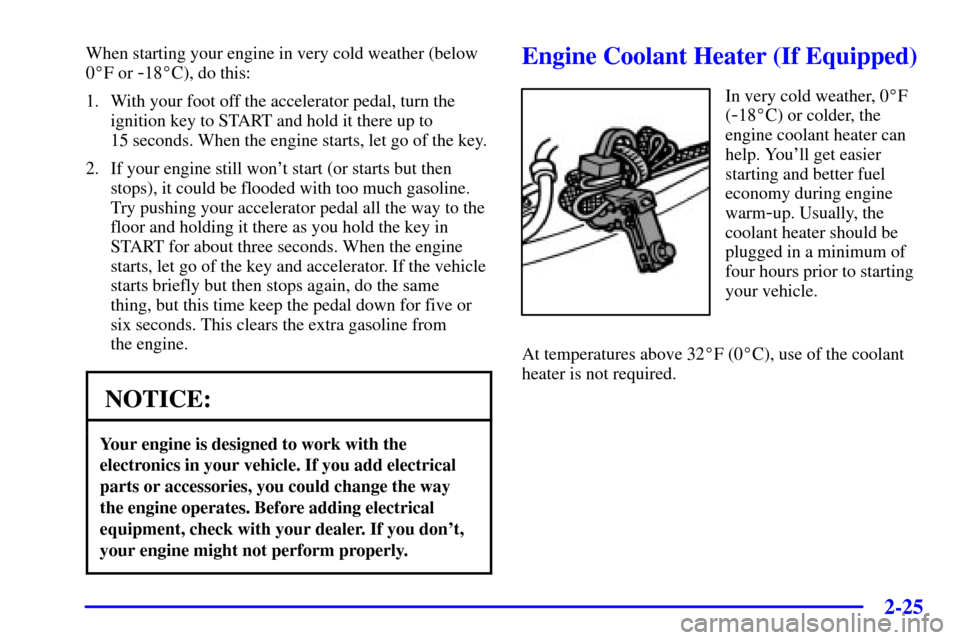
Engine Coolant Heater (If Equipped)
In very cold weather, 0�F
(
-18�C) or colder, the
engine coolant heater can
help. You'll get easier
starting and better fuel
economy during engine
warm
-up. Usually, the
coolant heater should be
plugged in a minimum of
four hours prior to starting
your vehicle.
At temperatures above 32�F (0�C), use of the coolant
heater is not required.
Page 107 of 497
2-27
Automatic Transmission OperationIf your vehicle is equipped with an automatic
transmission, it features an electronic shift position
indicator within the instrument panel cluster. This
display must be powered anytime the shift lever is
capable of being moved out of PARK (P). This means
that if your key is in OFF, rather than LOCK, there will
be a small current drain on your battery which could
discharge your battery over a period of time. If you have
to leave your key in the ignition in OFF for an extended
period, it is recommended that you remove the IGN 0
fuse from the instrument panel fuse block. See ªFuses
and Circuit Breakersº in the Index.
There are several different positions for your shift lever.
Page 119 of 497
2-39
2. Move the shift lever into PARK (P) position
like this:
�Pull the shift lever toward you.
�Move the lever up as far as it will go.
3. Be sure the transfer case is in a drive gear
-- not
in NEUTRAL (N).
4. Turn the ignition key to LOCK.
5. Remove the key and take it with you. If you can
leave your vehicle with the ignition key in your
hand, your vehicle is in PARK (P).
Page 121 of 497
2-41
Shifting Out of PARK (P)
(Automatic Transmission Only)
If your vehicle has an automatic transmission shift lock
control system, you have to fully apply your regular
brakes before you can shift from PARK (P) when the
ignition is in RUN. See ªAutomatic Transmissionº in
the Index.
If you cannot shift out of PARK (P), ease pressure on
the shift lever and push the shift lever all the way up
into PARK (P) as you maintain brake application. Then,
move the shift lever into the gear you want.
If you ever hold the brake pedal down but still can't
shift out of PARK (P), try this:
1. Turn the key to the OFF ignition position.
2. Apply and hold the brake until the end of Step 4.
3. Shift the vehicle to NEUTRAL (N).
4. Start the vehicle and then shift to the drive gear
you want.
5. Have the system fixed as soon as you can.
Parking Your Vehicle
(Manual Transmission Models Only)
CAUTION:
Shifting the transfer case to NEUTRAL can
cause your vehicle to roll even if the manual
transmission is in gear. You or someone else could
be seriously injured. Be sure to set the parking
brake before placing the transfer case in
NEUTRAL. See ªParking Brakeº in the Index.
Before you get out of your vehicle, move the shift lever
into REVERSE (R), and firmly apply the parking brake.
Once the shift lever has been placed into REVERSE (R)
with the clutch pedal pressed in, you can turn the
ignition key to OFF, remove the key and release
the clutch.
If you are parking on a hill, or if you are pulling a
trailer, see ªTowing a Trailerº in the Index.