Page 320 of 497
4-92
Heavy-Duty Trailer Wiring Package (If Equipped)
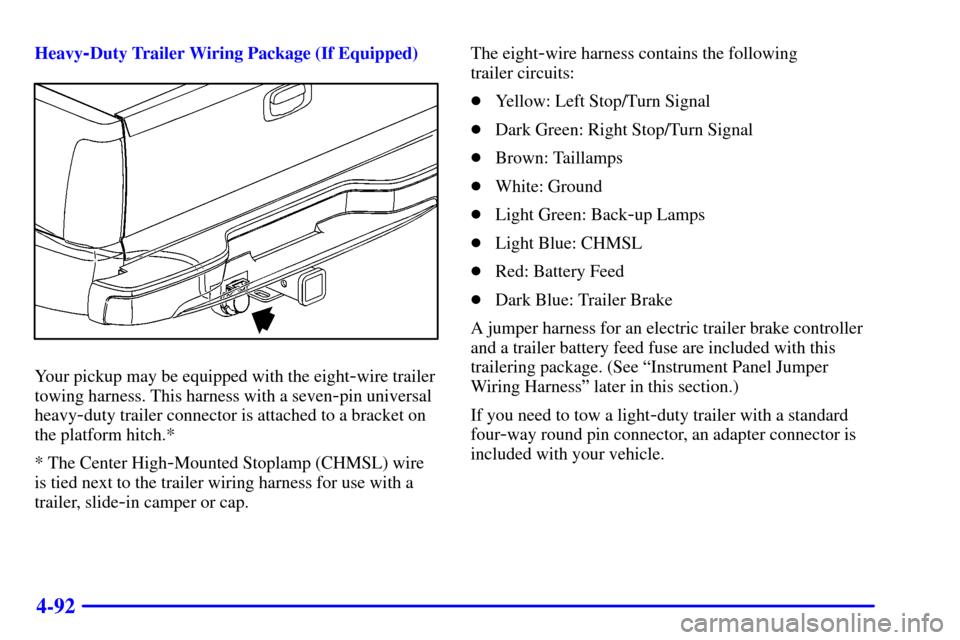
Your pickup may be equipped with the eight-wire trailer
towing harness. This harness with a seven
-pin universal
heavy
-duty trailer connector is attached to a bracket on
the platform hitch.*
* The Center High
-Mounted Stoplamp (CHMSL) wire
is tied next to the trailer wiring harness for use with a
trailer, slide
-in camper or cap.The eight
-wire harness contains the following
trailer circuits:
�Yellow: Left Stop/Turn Signal
�Dark Green: Right Stop/Turn Signal
�Brown: Taillamps
�White: Ground
�Light Green: Back
-up Lamps
�Light Blue: CHMSL
�Red: Battery Feed
�Dark Blue: Trailer Brake
A jumper harness for an electric trailer brake controller
and a trailer battery feed fuse are included with this
trailering package. (See ªInstrument Panel Jumper
Wiring Harnessº later in this section.)
If you need to tow a light
-duty trailer with a standard
four
-way round pin connector, an adapter connector is
included with your vehicle.
Page 321 of 497

4-93
Camper/Fifth-Wheel Trailer Wiring Package
(If Equipped)
The eight
-wire camper harness is located under the
front edge of the pickup box on the driver's side of the
vehicle, attached to the frame bracket. A connector will
have to be added to the wiring harness which connects
to the camper.
The eight
-wire harness contains the following
camper/trailer circuits:
�Yellow: Left Stop/Turn Signal
�Dark Green: Right Stop/Turn Signal
�Brown: Taillamps
�White: Ground
�Light Green: Back
-up Lamps
�Light Blue: Center High
-Mounted
Stoplamp (CHMSL)
�Red: Battery Feed
�Dark Blue: Trailer Brake
A jumper harness for an electric trailer brake controller
and a trailer battery feed fuse are included with this
trailering package. (See ªInstrument Panel Jumper
Wiring Harnessº later in this section.)
If your vehicle is equipped with the ªHeavy-Duty
Traileringº option, please refer to ªHeavy
-Duty Trailer
Wiring Packageº, earlier in this section.
When the camper
-wiring harness is ordered without the
heavy
-duty trailering package, an eight-wire harness
with a seven
-pin connector and separate CHMSL
connector are located at the rear of the vehicle and are
tied to the vehicle's frame.
Page 322 of 497
4-94
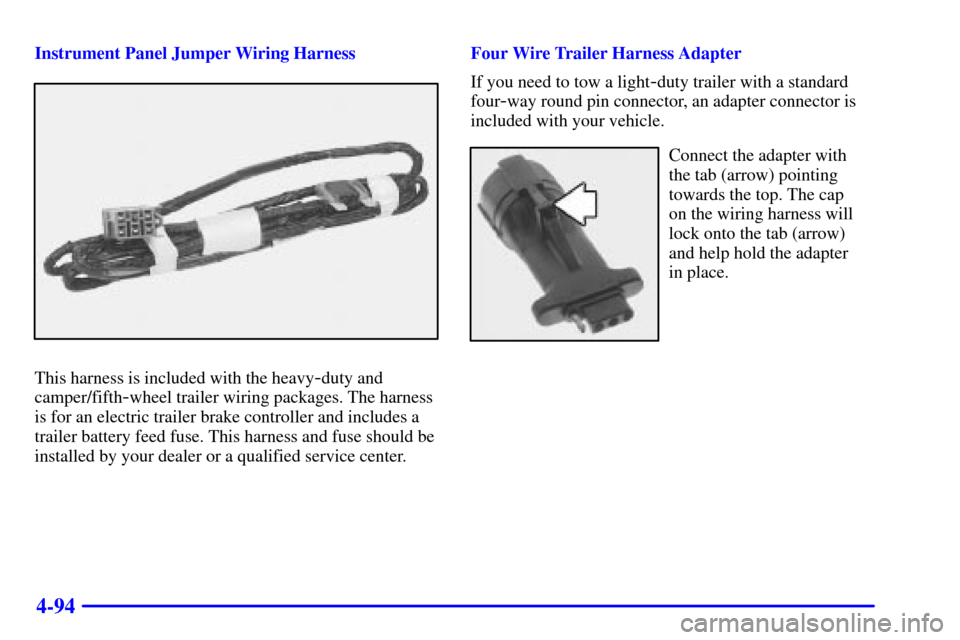
Instrument Panel Jumper Wiring Harness
This harness is included with the heavy-duty and
camper/fifth
-wheel trailer wiring packages. The harness
is for an electric trailer brake controller and includes a
trailer battery feed fuse. This harness and fuse should be
installed by your dealer or a qualified service center.Four Wire Trailer Harness Adapter
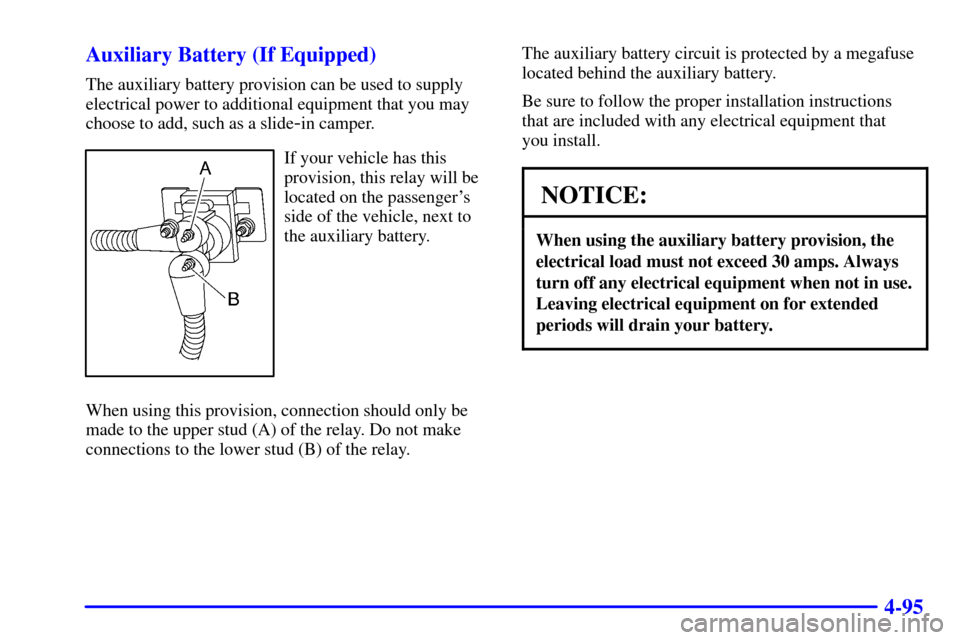
If you need to tow a light
-duty trailer with a standard
four
-way round pin connector, an adapter connector is
included with your vehicle.
Connect the adapter with
the tab (arrow) pointing
towards the top. The cap
on the wiring harness will
lock onto the tab (arrow)
and help hold the adapter
in place.
Page 323 of 497
4-95 Auxiliary Battery (If Equipped)
The auxiliary battery provision can be used to supply
electrical power to additional equipment that you may
choose to add, such as a slide
-in camper.
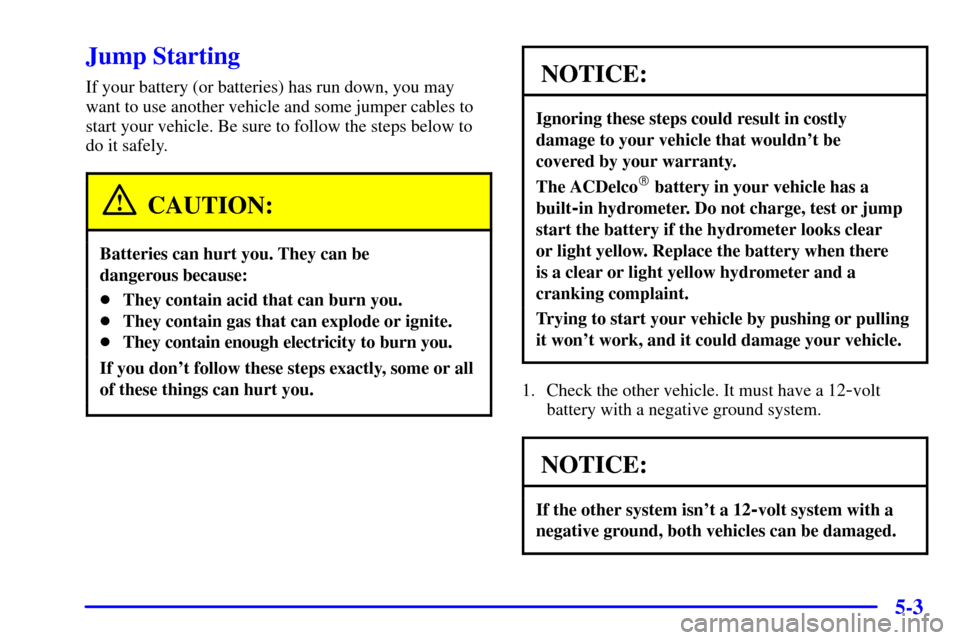
If your vehicle has this
provision, this relay will be
located on the passenger's
side of the vehicle, next to
the auxiliary battery.
When using this provision, connection should only be
made to the upper stud (A) of the relay. Do not make
connections to the lower stud (B) of the relay.The auxiliary battery circuit is protected by a megafuse
located behind the auxiliary battery.
Be sure to follow the proper installation instructions
that are included with any electrical equipment that
you install.
NOTICE:
When using the auxiliary battery provision, the
electrical load must not exceed 30 amps. Always
turn off any electrical equipment when not in use.
Leaving electrical equipment on for extended
periods will drain your battery.
Page 329 of 497
5-3
Jump Starting
If your battery (or batteries) has run down, you may
want to use another vehicle and some jumper cables to
start your vehicle. Be sure to follow the steps below to
do it safely.
CAUTION:
Batteries can hurt you. They can be
dangerous because:
�They contain acid that can burn you.
�They contain gas that can explode or ignite.
�They contain enough electricity to burn you.
If you don't follow these steps exactly, some or all
of these things can hurt you.
NOTICE:
Ignoring these steps could result in costly
damage to your vehicle that wouldn't be
covered by your warranty.
The ACDelco� battery in your vehicle has a
built
-in hydrometer. Do not charge, test or jump
start the battery if the hydrometer looks clear
or light yellow. Replace the battery when there
is a clear or light yellow hydrometer and a
cranking complaint.
Trying to start your vehicle by pushing or pulling
it won't work, and it could damage your vehicle.
1. Check the other vehicle. It must have a 12-volt
battery with a negative ground system.
NOTICE:
If the other system isn't a 12-volt system with a
negative ground, both vehicles can be damaged.
Page 330 of 497
5-4
2. If you have a vehicle with a diesel engine with two
batteries (or more), you should know before you
begin that, especially in cold weather, you may not
be able to get enough power from a single battery in
another vehicle to start your diesel engine.
If your vehicle has more than one battery, use the
battery that's closer to the starter
-- this will reduce
electrical resistance.
3. Get the vehicles close enough so the jumper cables
can reach, but be sure the vehicles aren't touching
each other. If they are, it could cause a ground
connection you don't want. You wouldn't be able to
start your vehicle, and the bad grounding could
damage the electrical systems.
To avoid the possibility of the vehicles rolling, set
the parking brake firmly on both vehicles involved
in the jump start procedure. Put an automatic
transmission in PARK (P) or a manual transmission
in NEUTRAL before setting the parking brake. If
you have a four
-wheel-drive vehicle, be sure the
transfer case is in a drive gear not in NEUTRAL.
NOTICE:
If you leave your radio on, it could be badly
damaged. The repairs wouldn't be covered by
your warranty.
4. Turn off the ignition on both vehicles. Unplug
unnecessary accessories plugged into the cigarette
lighter or accessory power outlets. Turn off the radio
and all lamps that aren't needed. This will avoid
sparks and help save both batteries. And it could
save your radio!
Page 331 of 497
5-5
5. Open the hoods and locate the positive (+) and
negative (
-) terminal locations of the other vehicle.
Your vehicle has a remote positive (+) jump starting
terminal and a remote negative (
-) jump starting
terminal. You should always use these remote
terminals instead of the terminals on the battery.
The remote positive (+) terminal is located behind a
red plastic cover near the engine accessory drive
bracket. To uncover the remote positive (+) terminal,
open the red plastic cover.
The remote negative (
-) terminal is located on the
engine drive bracket on all V8 and diesel engines.
On V8 engines it is marked ªGND.º
On V6 engines the remote negative (
-) terminal is
located on a tab attached to the engine accessory
drive bracket where it is marked ªGND.º
See ªEngine Compartment Overviewº in the Index
for more information on location.
CAUTION:
Using a match near a battery can cause battery
gas to explode. People have been hurt doing this,
and some have been blinded. Use a flashlight if
you need more light.
Be sure the batteries have enough water. You
don't need to add water to the ACDelco� battery
(or batteries) installed in every new GM vehicle.
But if a battery has filler caps, be sure the right
amount of fluid is there. If it is low, add water to
take care of that first. If you don't, explosive gas
could be present.
Battery fluid contains acid that can burn you.
Don't get it on you. If you accidentally get it in
your eyes or on your skin, flush the place with
water and get medical help immediately.
Page 332 of 497
5-6
CAUTION:
Fans or other moving engine parts can injure you
badly. Keep your hands away from moving parts
once the engine is running.
6. Check that the jumper cables don't have loose or
missing insulation. If they do, you could get a shock.
The vehicles could be damaged too.
Before you connect the cables, here are some basic
things you should know. Positive (+) will go to
positive (+) or a remote positive terminal (+) if the
vehicle has one. Negative (
-) will go to a heavy,
unpainted metal engine part or a remote negative (
-)
terminal if the vehicle has one.
Don't connect positive (+) to negative (
-) or you'll
get a short that would damage the battery and maybe
other parts too. And don't connect the negative (
-)
cable to the negative (
-) terminal on the dead battery
because this can cause sparks.
On vehicles equipped with dual batteries, make all
battery connections to the remote positive (+) and
remote negative (
-) terminals.
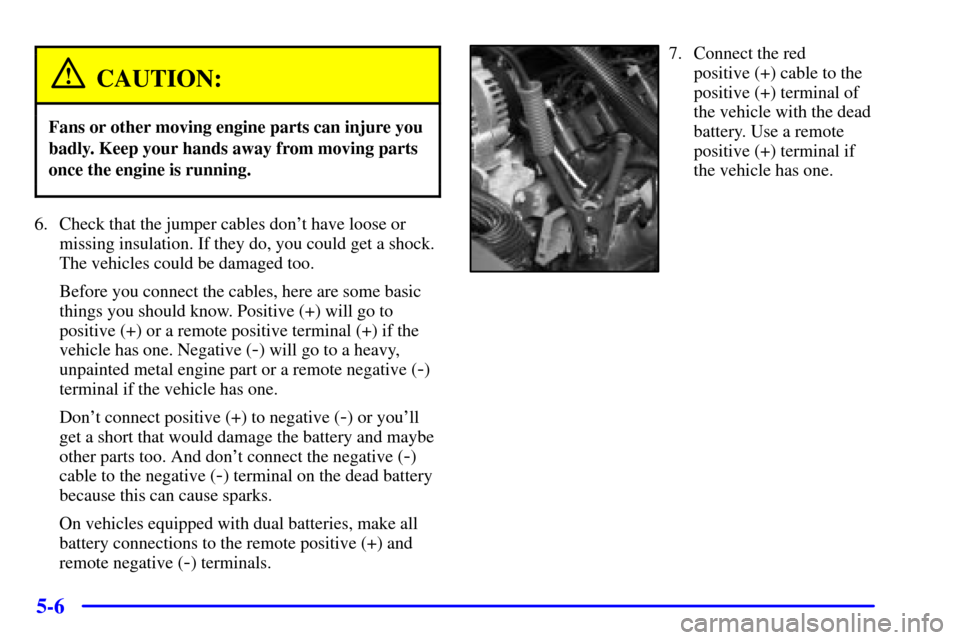
7. Connect the red
positive (+) cable to the
positive (+) terminal of
the vehicle with the dead
battery. Use a remote
positive (+) terminal if
the vehicle has one.