Page 273 of 387
5-33 Storing the Flat Tire and Tools
CAUTION:
Storing a jack, a tire or other equipment in the
passenger compartment of the vehicle could
cause injury. In a sudden stop or collision, loose
equipment could strike someone. Store all these
in the proper place.
After you've put the compact spare tire on your vehicle,
you'll need to store the flat tire in your trunk. Use the
following procedure to secure the flat tire in the trunk.
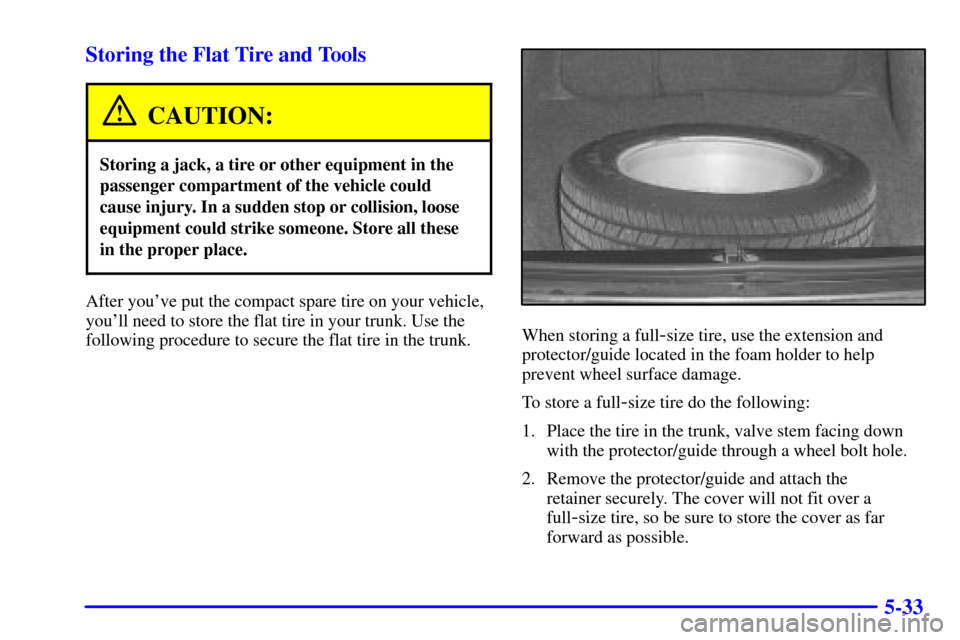
When storing a full-size tire, use the extension and
protector/guide located in the foam holder to help
prevent wheel surface damage.
To store a full
-size tire do the following:
1. Place the tire in the trunk, valve stem facing down
with the protector/guide through a wheel bolt hole.
2. Remove the protector/guide and attach the
retainer securely. The cover will not fit over a
full
-size tire, so be sure to store the cover as far
forward as possible.
Page 274 of 387
5-34 Storing the Spare Tire and Tools
CAUTION:
Storing a jack, a tire or other equipment in the
passenger compartment of the vehicle could
cause injury. In a sudden stop or collision, loose
equipment could strike someone. Store all these
in the proper place.
The compact spare tire is for temporary use only.
Replace the compact spare tire with a full
-size tire as
soon as you can. See ªCompact Spare Tireº in the Index.
To properly store the compact spare tire do
the following:
1. When you put the compact spare tire back in
the trunk, place the protector/guide back in the
foam holder.
2. Put the cover back over the compact spare tire
and tighten the center nut.
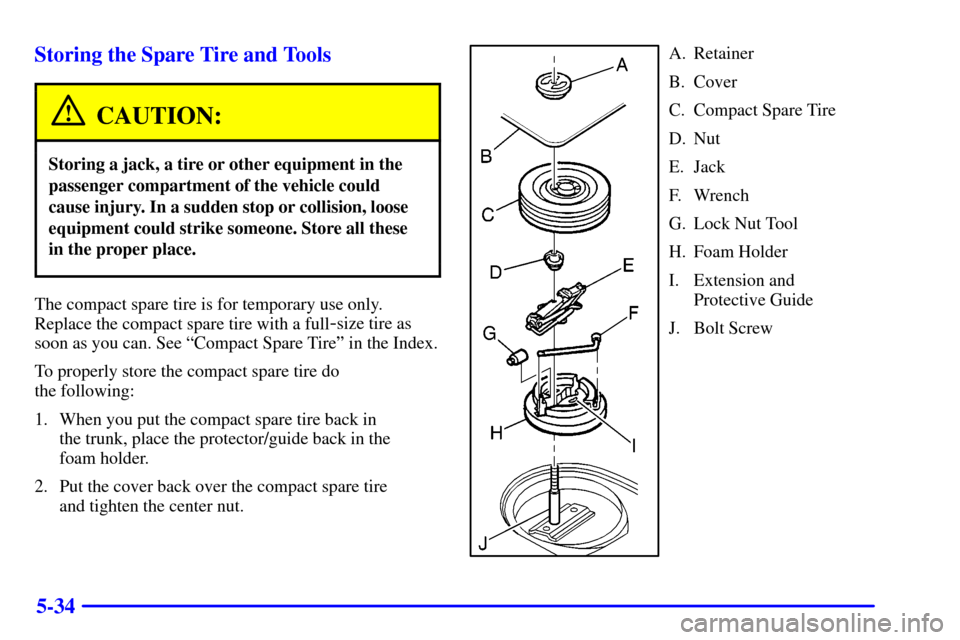
A. Retainer
B. Cover
C. Compact Spare Tire
D. Nut
E. Jack
F. Wrench
G. Lock Nut Tool
H. Foam Holder
I. Extension and
Protective Guide
J. Bolt Screw
Page 284 of 387

6-8
Filling a Portable Fuel Container
CAUTION:
Never fill a portable fuel container while it is in
your vehicle. Static electricity discharge from the
container can ignite the gasoline vapor. You can
be badly burned and your vehicle damaged if this
occurs. To help avoid injury to you and others:
�Dispense gasoline only into
approved containers.
�Do not fill a container while it is inside a
vehicle, in a vehicle's trunk, pickup bed
or on any surface other than the ground.
�Bring the fill nozzle in contact with the
inside of the fill opening before operating
the nozzle. Contact should be maintained
until the filling is complete.
�Don't smoke while pumping gasoline.
Checking Things Under the Hood
CAUTION:
An electric fan under the hood can start up and
injure you even when the engine is not running.
Keep hands, clothing and tools away from any
underhood electric fan.
CAUTION:
Things that burn can get on hot engine parts and
start a fire. These include liquids like gasoline,
oil, coolant, brake fluid, windshield washer and
other fluids, and plastic or rubber. You or others
could be burned. Be careful not to drop or spill
things that will burn onto a hot engine.
Page 315 of 387

6-39
7. Remove the electrical connector from the bulb by
raising the lock tab and pulling the connector away
from the bulb's base.
8. Install the electrical connector to the new bulb.
9. Install the new bulb by inserting the smallest tab
on the bulb base into the matching notch in the
retaining ring. Turn the bulb a quarter
-turn
clockwise until it stops.
10. Reverse Steps 1 through 5 to reinstall the
headlamp assembly.
11. Close the hood. Then, check the lamps.
Headlamp Aiming
If your vehicle is damaged in an accident, the headlamp
aim may be affected. Aim adjustment to the low beam
may be necessary if it is difficult to see lane markers
(for horizontal aim), or if oncoming drivers flash their
high beams at you (for vertical aim). If you believe your
headlamps need to be re
-aimed, we recommend that you
take your vehicle to the dealer for service. However, it is
possible for you to re
-aim your headlamps by following
the procedure in the service manual for your vehicle.
Tail/Stop/Turn Signal and Rear
Sidemarker Lamps
A. Rear
Sidemarker Lamp
B. Tail/Stop Lamp
C. Turn Signal Lamp
1. Open the trunk. If your vehicle has a convenience
net, unhook the net from the upper wing nut.
2. Remove the nut and convenience net.
3. Pull the carpet away from the rear of the vehicle.
Page 316 of 387
6-40
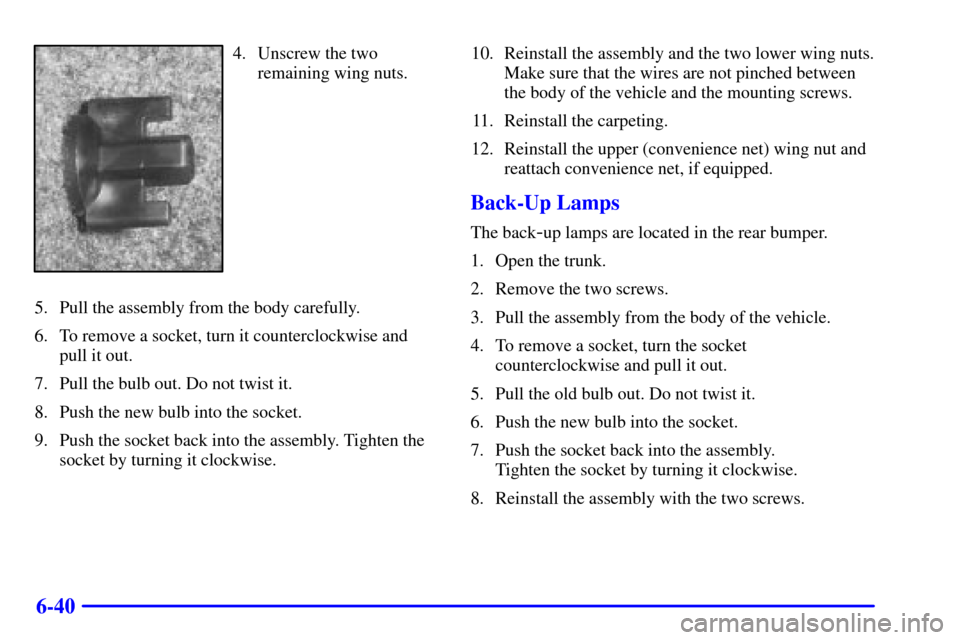
4. Unscrew the two
remaining wing nuts.
5. Pull the assembly from the body carefully.
6. To remove a socket, turn it counterclockwise and
pull it out.
7. Pull the bulb out. Do not twist it.
8. Push the new bulb into the socket.
9. Push the socket back into the assembly. Tighten the
socket by turning it clockwise.10. Reinstall the assembly and the two lower wing nuts.
Make sure that the wires are not pinched between
the body of the vehicle and the mounting screws.
11. Reinstall the carpeting.
12. Reinstall the upper (convenience net) wing nut and
reattach convenience net, if equipped.
Back-Up Lamps
The back-up lamps are located in the rear bumper.
1. Open the trunk.
2. Remove the two screws.
3. Pull the assembly from the body of the vehicle.
4. To remove a socket, turn the socket
counterclockwise and pull it out.
5. Pull the old bulb out. Do not twist it.
6. Push the new bulb into the socket.
7. Push the socket back into the assembly.
Tighten the socket by turning it clockwise.
8. Reinstall the assembly with the two screws.
Page 319 of 387
6-43 Inflation -- Tire Pressure
The Tire-Loading Information label, which is on the
inside of the trunk lid, shows the correct inflation
pressures for your tires when they're cold. ªColdº
means your vehicle has been sitting for at least three
hours or driven no more than 1 mile (1.6 km).
NOTICE:
Don't let anyone tell you that underinflation or
overinflation is all right. It's not. If your tires
don't have enough air (underinflation), you can
get the following:
�Too much flexing
�Too much heat
�Tire overloading
�Bad wear
�Bad handling
�Bad fuel economy
NOTICE: (Continued)
NOTICE: (Continued)
If your tires have too much air (overinflation),
you can get the following:
�Unusual wear
�Bad handling
�Rough ride
�Needless damage from road hazards
When to Check
Check your tires once a month or more.
Don't forget your compact spare tire. It should be at
60 psi (420 kPa).
How to Check
Use a good quality pocket
-type gage to check tire
pressure. You can't tell if your tires are properly inflated
simply by looking at them. Radial tires may look
properly inflated even when they're underinflated.
Be sure to put the valve caps back on the valve
stems. They help prevent leaks by keeping out dirt
and moisture.
Page 337 of 387
6-61
Vehicle Identification Number (VIN)
This is the legal identifier for your vehicle. It appears on
a plate in the front corner of the instrument panel, on the
driver's side. You can see it if you look through the
windshield from outside your vehicle. The VIN also
appears on the Vehicle Certification and Service Parts
labels and the certificates of title and registration.
Engine Identification
The 8th character in your VIN is the engine code.
This code will help you identify your engine,
specifications and replacement parts.
Service Parts Identification Label
You'll find this label on the inside of your trunk lid.
It's very helpful if you ever need to order parts.
On this label is:
�your VIN,
�the model designation,
�paint information and
�a list of all production options and
special equipment.
Be sure that this label is not removed from the vehicle.
Page 343 of 387
6-67
Mini Fuses Description
TRK/ROOF BRP Trunk Lamps, Headliner Lamps
HVAC BLO HVAC Blower Relay
I/P BRP Instrument Panel Footwell
Lamps, Glovebox Lamps
HTD MIR Heated Mirrors
BRK SW Brake Switch
HAZ SW Hazard Switch
REAR PRK LP Rear Parking Lamps
AUX PWR Accessory Power
Outlet (Battery)
C/LTR Cigarette Lighter
RADIO Radio, Radio Amplifier
FRT PARK LP Front Parking Lamps,
Instrumentation LightingCircuit Relay Description
PARK LP RELAY Parking Lamp Relay
BACKUP
LP RELAYBack
-up Lamps Relay
BATT RUN
DOWN
PROTECTION
RELAYBattery Run Down
Protection Relay
REAR
DEFOG RELAYRear Defogger Relay, Heated
Mirror Relay
Circuit Breaker Description
PWR
SEATS BRKRPower Seat Circuit Breaker
REAR
DEFOG BRKRRear Defogger Breaker