Page 8 of 341
1-2
Seats and Seat Controls
This section tells you about the seats -- how to
adjust them
-- and also about reclining seatbacks and
head restraints.
Manual Front Seats
CAUTION:
You can lose control of the vehicle if you try to
adjust a manual driver's seat while the vehicle is
moving. The sudden movement could startle and
confuse you, or make you push a pedal when you
don't want to. Adjust the driver's seat only when
the vehicle is not moving.
Your vehicle has the following manual front
seat control.
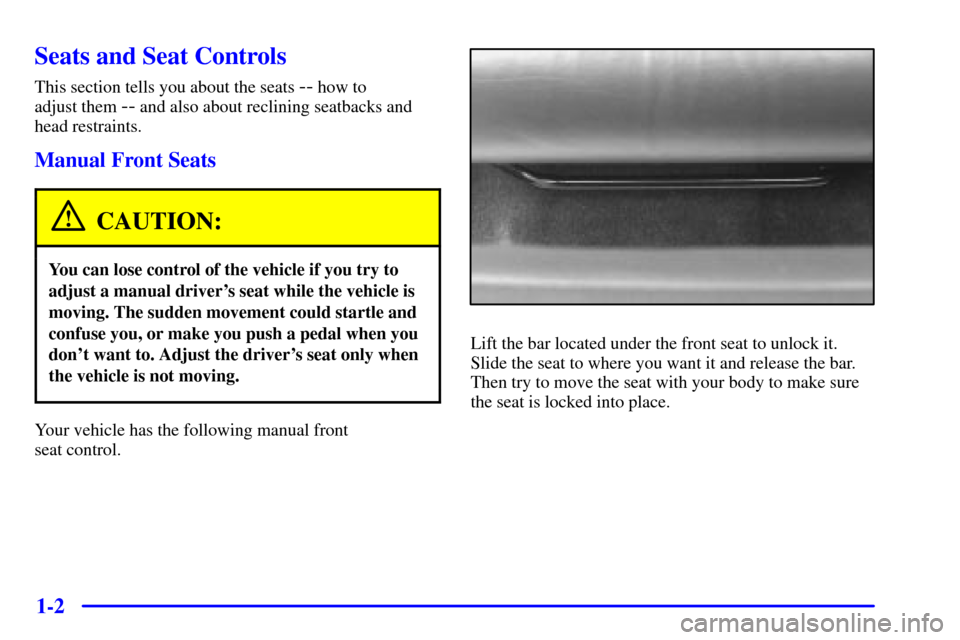
Lift the bar located under the front seat to unlock it.
Slide the seat to where you want it and release the bar.
Then try to move the seat with your body to make sure
the seat is locked into place.
Page 98 of 341
2-35
If a bulb is burned out, replace it to help avoid an
accident. If the arrows don't go on at all when you
signal a turn, check for burned
-out bulbs and then check
the fuse. See ªFuses and Circuit Breakersº in the Index.
Headlamp High/Low-Beam Changer
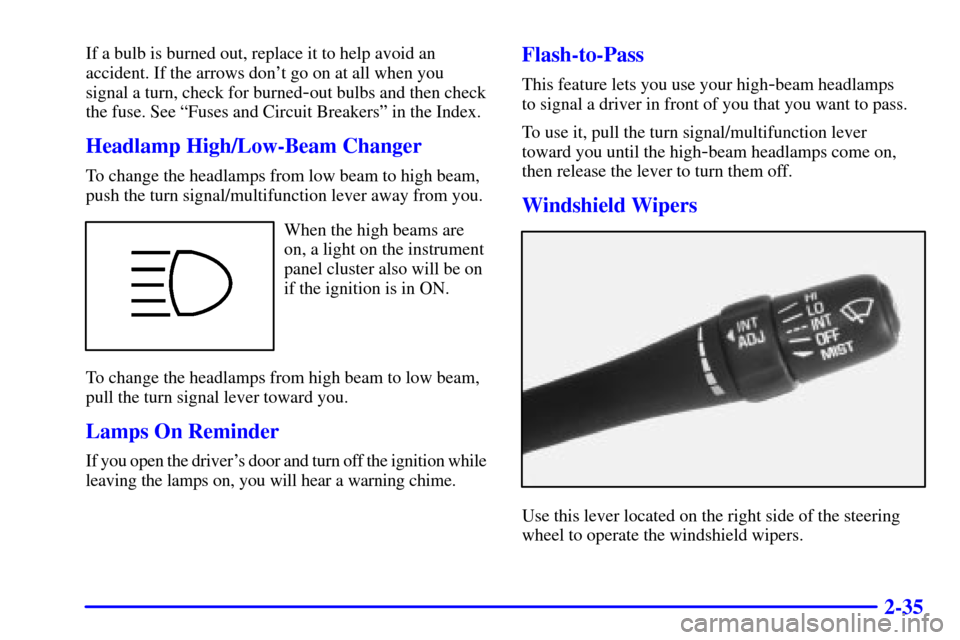
To change the headlamps from low beam to high beam,
push the turn signal/multifunction lever away from you.
When the high beams are
on, a light on the instrument
panel cluster also will be on
if the ignition is in ON.
To change the headlamps from high beam to low beam,
pull the turn signal lever toward you.
Lamps On Reminder
If you open the driver's door and turn off the ignition while
leaving the lamps on, you will hear a warning chime.
Flash-to-Pass
This feature lets you use your high-beam headlamps
to signal a driver in front of you that you want to pass.
To use it, pull the turn signal/multifunction lever
toward you until the high
-beam headlamps come on,
then release the lever to turn them off.
Windshield Wipers
Use this lever located on the right side of the steering
wheel to operate the windshield wipers.
Page 112 of 341
2-49
Accessory Power Outlet
With accessory power outlets you can plug in auxiliary
electrical equipment such as a cellular telephone or
CB radio.
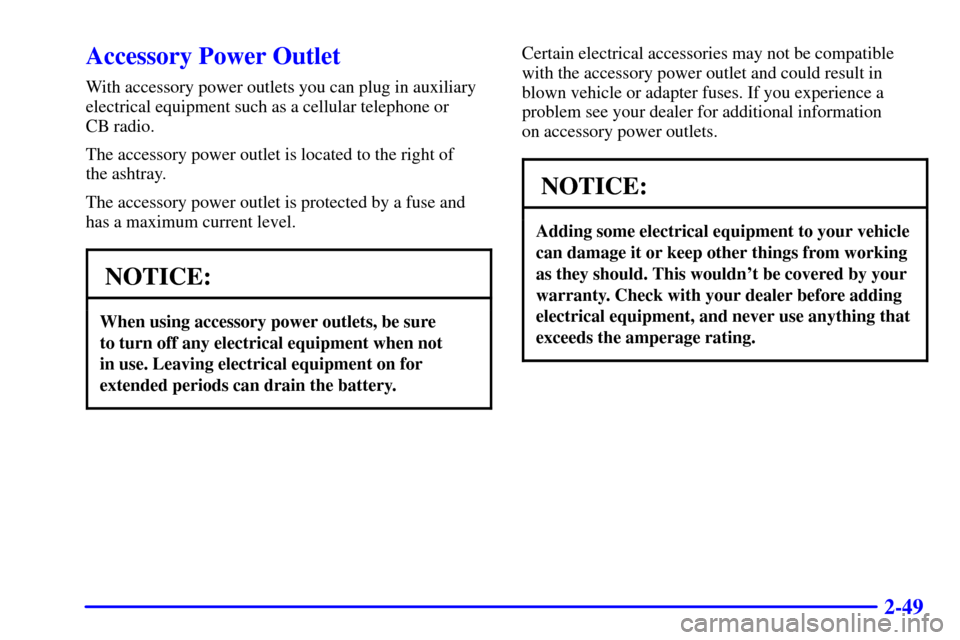
The accessory power outlet is located to the right of
the ashtray.
The accessory power outlet is protected by a fuse and
has a maximum current level.
NOTICE:
When using accessory power outlets, be sure
to turn off any electrical equipment when not
in use. Leaving electrical equipment on for
extended periods can drain the battery.
Certain electrical accessories may not be compatible
with the accessory power outlet and could result in
blown vehicle or adapter fuses. If you experience a
problem see your dealer for additional information
on accessory power outlets.
NOTICE:
Adding some electrical equipment to your vehicle
can damage it or keep other things from working
as they should. This wouldn't be covered by your
warranty. Check with your dealer before adding
electrical equipment, and never use anything that
exceeds the amperage rating.
Page 116 of 341
2-53
The main components of your instrument panel are the following:
A. Side Window Defogger Vents
B. Vent Outlets
C. Instrument Panel Brightness Thumbwheel
D. Fog Lamp Button (If Equipped)
E. Turn Signal/Multifunction Lever
F. Cruise Control Buttons (If Equipped)
G. Instrument Panel Cluster
H. Windshield Wiper/Washer Lever
I. Ignition Switch
J. Hazard Warning Flashers Button
K. Instrument Panel Fuse BlocksL. Instrument Panel Cupholder
M. Remote Trunk Release Button
N. Hood Release
O. Tilt Wheel Lever
P. Parking Brake
Q. Horn
R. Audio System
S. Cigarette Lighter
T. Ashtray
U. Accessory Power Outlet
V. Climate Control System
Page 189 of 341
4-29 Dinghy Towing
To tow your vehicle with all four wheels on the ground,
follow these steps:
1. Position the vehicle to tow and then secure it.
2. Turn the ignition switch to OFF.
3. Set the parking brake.4. To prevent your battery from draining while the
vehicle is being towed, remove the following fuses
from the driver's side instrument panel fuse block:
A) Wiper, G) Powertrain Control Module and J)
Body Function Control Module/Cluster. See
ªInstrument Panel Fuse Block
-- Driver's Sideº in
the Index for location of these fuses.
5. Turn the ignition switch to ACC.
6. Shift your transaxle to NEUTRAL (N).
7. Release the parking brake.
Remember to install the fuses once you reach your
destination. To reinstall a fuse:
1. Set the parking brake.
2. Remove the key from the ignition switch.
3. Reinstall the fuse.
Page 234 of 341
6-3
CAUTION:
You can be injured and your vehicle could be
damaged if you try to do service work on a
vehicle without knowing enough about it.
�Be sure you have sufficient knowledge,
experience, the proper replacement parts
and tools before you attempt any vehicle
maintenance task.
�Be sure to use the proper nuts, bolts and
other fasteners. ªEnglishº and ªmetricº
fasteners can be easily confused. If you use
the wrong fasteners, parts can later break
or fall off. You could be hurt.
Adding Equipment to the Outside of
Your Vehicle
Things you might add to the outside of your vehicle can
affect the airflow around it. This may cause wind noise
and affect windshield washer performance. Check with
your dealer before adding equipment to the outside of
your vehicle.
Fuel
Gasoline Octane
Use regular unleaded gasoline with a posted octane
of 87 or higher. If the octane is less than 87, you may
get a heavy knocking noise when you drive. If it is bad
enough, it can damage your engine. A little pinging
noise when you accelerate or drive uphill is considered
normal. This does not indicate a problem exists or that
a higher
-octane fuel is necessary.
Page 242 of 341
6-11 Engine Compartment Overview
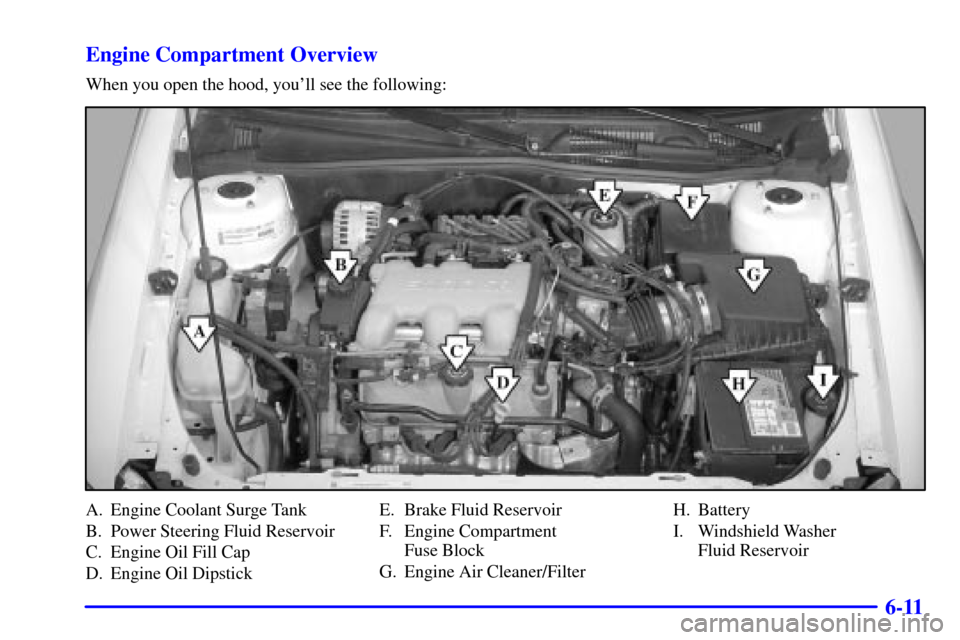
When you open the hood, you'll see the following:
A. Engine Coolant Surge Tank
B. Power Steering Fluid Reservoir
C. Engine Oil Fill Cap
D. Engine Oil DipstickE. Brake Fluid Reservoir
F. Engine Compartment
Fuse Block
G. Engine Air Cleaner/FilterH. Battery
I. Windshield Washer
Fluid Reservoir
Page 284 of 341
6-53
Electrical System
Add-On Electrical Equipment
NOTICE:
Don't add anything electrical to your vehicle
unless you check with your dealer first. Some
electrical equipment can damage your vehicle
and the damage wouldn't be covered by your
warranty. Some add
-on electrical equipment
can keep other components from working as
they should.
Your vehicle has an air bag system. Before attempting to
add anything electrical to your vehicle, see ªServicing
Your Air Bag
-Equipped Vehicleº in the Index.
Headlamp Wiring
The headlamp wiring is protected by fuses, one for each
headlamp, in the fuse block. An electrical overload will
cause the lamps to turn off. If this happens, have your
headlamp wiring checked right away.
Windshield Wipers
The windshield wiper motor is protected by an internal
circuit breaker and a fuse. If the motor overheats due to
heavy snow, etc., the wiper will stop until the motor
cools. If the overload is caused by some electrical
problem and not snow, etc., be sure to get it fixed.
Power Windows and Other Power Options
Circuit breakers in the fuse block protect the power
windows and other power accessories. When the current
load is too heavy, the circuit breaker opens and closes,
protecting the circuit until the problem is fixed or
goes away.