Page 78 of 341
2-15
Trunk
To unlock the trunk from the outside, insert the key and
turn the trunk lock cylinder. When closing the trunk,
close from the center to ensure it fully latches.
CAUTION:
It can be dangerous to drive with the trunk lid
open because carbon monoxide (CO) gas can
come into your vehicle. You can't see or smell
CO. It can cause unconsciousness and even death.
CAUTION: (Continued)
CAUTION: (Continued)
If you must drive with the trunk lid open or if
electrical wiring or other cable connections must
pass through the seal between the body and the
trunk lid:
�Make sure all other windows are shut.
�Turn the fan on your heating or cooling
system to its highest speed with the setting
on OUTSIDE AIR. That will force outside
air into your vehicle. See ªComfort
Controlsº in the Index.
�If you have air outlets on or under the
instrument panel, open them all the way.
See ªEngine Exhaustº in the Index.
Page 111 of 341
2-48
Ashtray and Cigarette Lighter
The ashtray is located at the lower part of the center
of the instrument panel. To remove the ashtray for
cleaning, pull up on the metal tab and pull the bin out.
NOTICE:
Don't put papers and other things that burn
into your ashtrays. If you do, cigarettes or
other smoking materials could set them on fire,
causing damage.
The cigarette lighter is located above the ashtray. To use
it, just push it in all the way and let go. When it's ready,
it will pop back out by itself.
NOTICE:
Don't hold a cigarette lighter in with your hand
while it is heating. If you do, it won't be able to
back away from the heating element when it's
ready. That can make it overheat, damaging the
lighter and the heating element.
Sun Visors
To block out glare, you can swing down the visors.
You can also swing them to the side.
Visor Vanity Mirror
Lift the cover to expose the vanity mirror.
Illuminated Visor Vanity Mirror
(If Equipped)
This mirror is located on the passenger's side visor.
When you lift the cover, the light will turn on.
Page 124 of 341
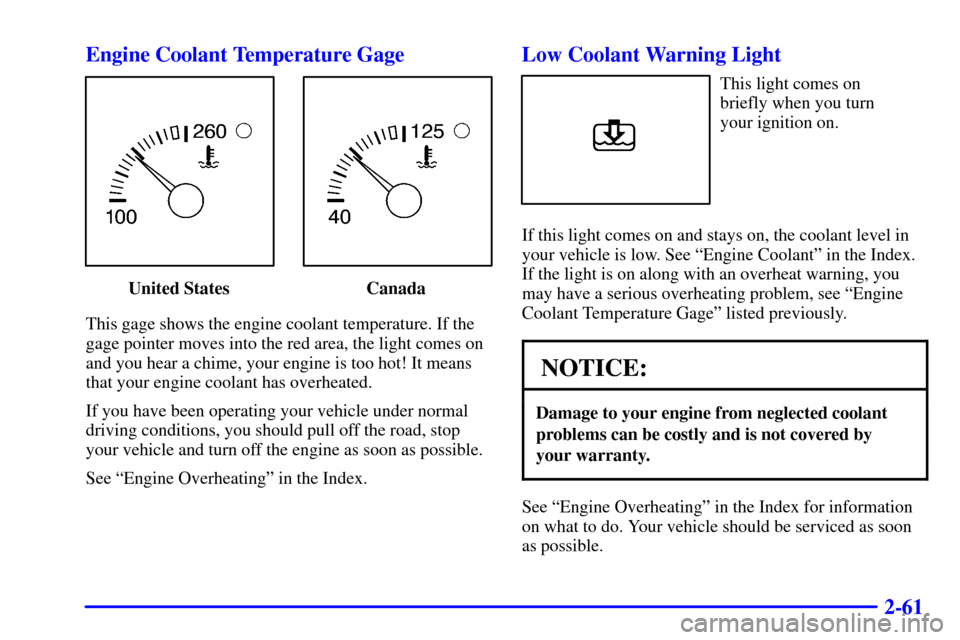
2-61 Engine Coolant Temperature Gage
United States Canada
This gage shows the engine coolant temperature. If the
gage pointer moves into the red area, the light comes on
and you hear a chime, your engine is too hot! It means
that your engine coolant has overheated.
If you have been operating your vehicle under normal
driving conditions, you should pull off the road, stop
your vehicle and turn off the engine as soon as possible.
See ªEngine Overheatingº in the Index.
Low Coolant Warning Light
This light comes on
briefly when you turn
your ignition on.
If this light comes on and stays on, the coolant level in
your vehicle is low. See ªEngine Coolantº in the Index.
If the light is on along with an overheat warning, you
may have a serious overheating problem, see ªEngine
Coolant Temperature Gageº listed previously.
NOTICE:
Damage to your engine from neglected coolant
problems can be costly and is not covered by
your warranty.
See ªEngine Overheatingº in the Index for information
on what to do. Your vehicle should be serviced as soon
as possible.
Page 132 of 341
3-
3-1
Section 3 Comfort Controls and Audio Systems
In this section, you'll find out how to operate the comfort control and audio systems offered with your vehicle. Be
sure to read about the particular systems supplied with your vehicle.
3
-2 Comfort Controls
3
-2 Climate Control System with
Air Conditioning
3
-4 Air Conditioning
3
-4 Heating
3
-5 Defogging and Defrosting Windows
3
-6 Rear Window Defogger
3
-6 Ventilation System
3
-7 Audio Systems
3
-8 Setting the Clock
3
-8AM-FM Stereo with Compact Disc Player
with Radio Data System (RDS) and Automatic
Tone Control3
-16 AM-FM Stereo with Cassette Tape and
Compact Disc Player with Radio Data
System (RDS) and Automatic Tone
Control (If Equipped)
3
-26 Theft-Deterrent Feature
3
-26 Understanding Radio Reception
3
-26 Tips About Your Audio System
3
-27 Care of Your Cassette Tape Player
3
-29 Care of Your Compact Discs
3
-29 Care of Your Compact Disc Player
3
-29 Fixed Mast Antenna
3
-29 Chime Level Adjustment
Page 133 of 341
3-2
Comfort Controls
This section tells you how to make your air system work
for you.
With this system, you can control the ventilation and
heating in your vehicle. Your vehicle also has the
flow
-through ventilation system described later in
this section.
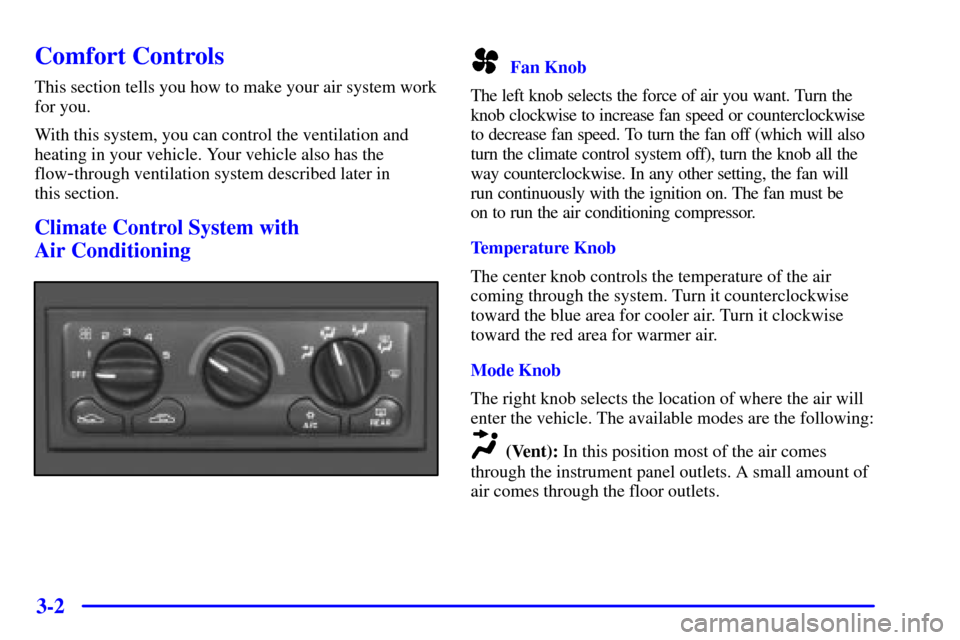
Climate Control System with
Air Conditioning
Fan Knob
The left knob selects the force of air you want. Turn the
knob clockwise to increase fan speed or counterclockwise
to decrease fan speed. To turn the fan off (which will also
turn the climate control system off), turn the knob all the
way counterclockwise. In any other setting, the fan will
run continuously with the ignition on. The fan must be
on to run the air conditioning compressor.
Temperature Knob
The center knob controls the temperature of the air
coming through the system. Turn it counterclockwise
toward the blue area for cooler air. Turn it clockwise
toward the red area for warmer air.
Mode Knob
The right knob selects the location of where the air will
enter the vehicle. The available modes are the following:
(Vent): In this position most of the air comes
through the instrument panel outlets. A small amount of
air comes through the floor outlets.
Page 135 of 341

3-4 Air Conditioning
The air conditioner and heater work best if you keep
your windows closed while using them. Your vehicle
also has the flow
-through ventilation system described
later in this section.
For normal cooling on hot days, after the vehicle has
started to cool down, use the vent mode with the
temperature knob in the blue area and the A/C button
pressed. The system will bring in outside air and cool it.
On very hot days, begin by opening the windows long
enough to let hot inside air escape. This reduces the time
it takes for your vehicle to cool down, which should
help fuel economy.
For quicker cool
-down on very hot days, use the vent
mode with the temperature knob all the way in the blue
area and the A/C button pressed. Begin with the outside
air button pressed for a few minutes, or until the vehicle
begins to feel cool. Then press the recirculation button. If
the recirculation setting is used for long periods of time,
the air in your vehicle may become too dry.
On cool, but sunny days, the sun may warm your upper
body, but your lower body may not be warm enough.
You can use bi
-level mode with the temperature knob in
the middle and the A/C button pressed. The system will
bring in outside air and direct slightly warmer air to
your lower body.
Heating
On cold days, use floor mode and outside air with the
temperature knob all the way in the red area. The system
will bring in outside air, heat it and send it to the
floor outlets.
Your vehicle has heat ducts that are directed toward
the rear seat. Keep the area under the front seats clear
of obstructions so the heated air can reach the rear
seat passengers.
If your vehicle has an engine coolant heater, you can use
it to help your system provide warm air faster when it's
cold outside (0�F (
-18�C) or lower). An engine coolant
heater warms the coolant in your engine and heating
system that is used to provide heat. See ªEngine Coolant
Heaterº in the Index.
Page 137 of 341
3-6 Rear Window Defogger
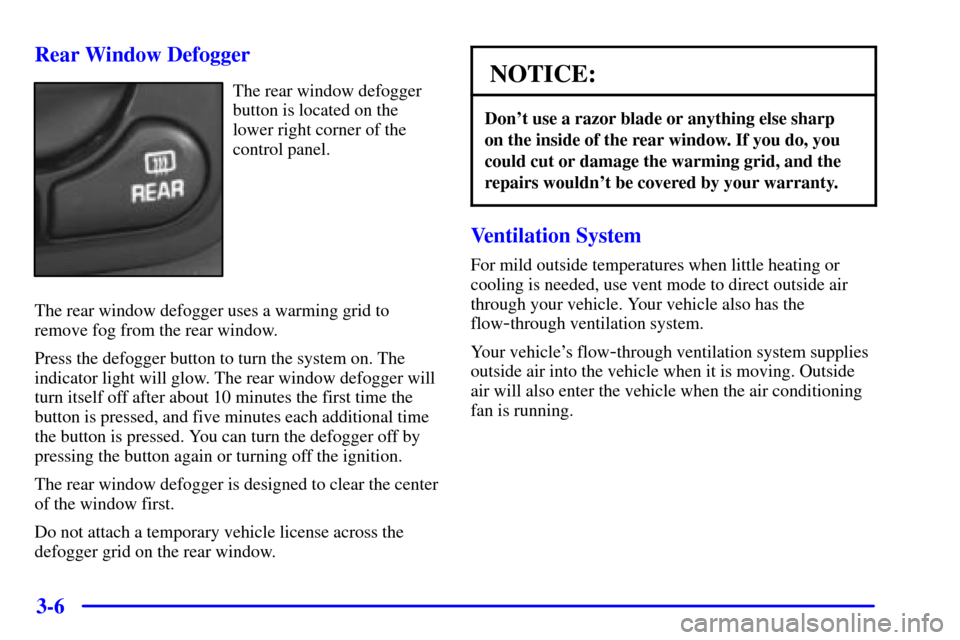
The rear window defogger
button is located on the
lower right corner of the
control panel.
The rear window defogger uses a warming grid to
remove fog from the rear window.
Press the defogger button to turn the system on. The
indicator light will glow. The rear window defogger will
turn itself off after about 10 minutes the first time the
button is pressed, and five minutes each additional time
the button is pressed. You can turn the defogger off by
pressing the button again or turning off the ignition.
The rear window defogger is designed to clear the center
of the window first.
Do not attach a temporary vehicle license across the
defogger grid on the rear window.NOTICE:
Don't use a razor blade or anything else sharp
on the inside of the rear window. If you do, you
could cut or damage the warming grid, and the
repairs wouldn't be covered by your warranty.
Ventilation System
For mild outside temperatures when little heating or
cooling is needed, use vent mode to direct outside air
through your vehicle. Your vehicle also has the
flow
-through ventilation system.
Your vehicle's flow
-through ventilation system supplies
outside air into the vehicle when it is moving. Outside
air will also enter the vehicle when the air conditioning
fan is running.
Page 200 of 341
4-40 Driving On Grades
NOTICE:
Do not tow on steep continuous grades exceeding
6 miles (9.6 km). Extended, higher than normal
engine and transaxle temperatures may result
and damage your vehicle. Frequent stops are
very important to allow the engine and transaxle
to cool.
Reduce speed and shift to a lower gear before you start
down a long or steep downgrade. If you don't shift
down, you might have to use your brakes so much that
they would get hot and no longer work well.
On a long uphill grade, shift down and reduce your
speed to around 45 mph (70 km/h) to reduce the
possibility of engine and transaxle overheating.
Pay attention to the engine coolant gage. If the indicator
is in the red area, turn off the air conditioning to reduce
engine load. See ªEngine Overheatingº in the Index.
Parking on Hills
CAUTION:
You really should not park your vehicle, with a
trailer attached, on a hill. If something goes
wrong, your rig could start to move. People can
be injured, and both your vehicle and the trailer
can be damaged.
But if you ever have to park your rig on a hill, here's
how to do it:
1. Apply your regular brakes, but don't shift into
PARK (P) yet.
2. Have someone place chocks under the trailer wheels.
3. When the wheel chocks are in place, release the
regular brakes until the chocks absorb the load.
4. Reapply the regular brakes. Then apply your parking
brake and shift into PARK (P).
5. Release the regular brakes.