Page 62 of 397
1-56
Older Children
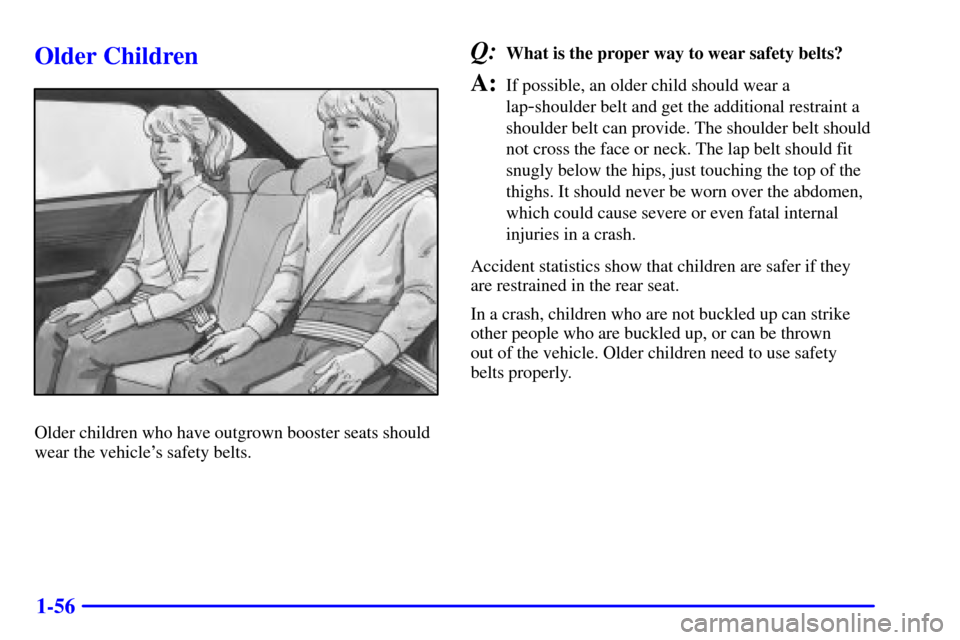
Older children who have outgrown booster seats should
wear the vehicle's safety belts.
Q:What is the proper way to wear safety belts?
A:If possible, an older child should wear a
lap
-shoulder belt and get the additional restraint a
shoulder belt can provide. The shoulder belt should
not cross the face or neck. The lap belt should fit
snugly below the hips, just touching the top of the
thighs. It should never be worn over the abdomen,
which could cause severe or even fatal internal
injuries in a crash.
Accident statistics show that children are safer if they
are restrained in the rear seat.
In a crash, children who are not buckled up can strike
other people who are buckled up, or can be thrown
out of the vehicle. Older children need to use safety
belts properly.
Page 63 of 397
1-57
CAUTION:
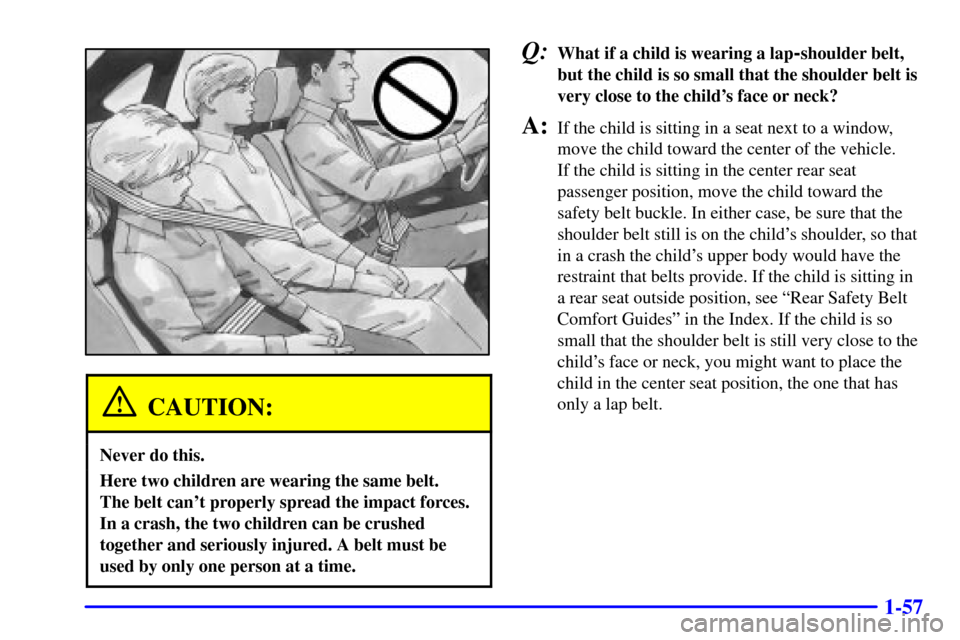
Never do this.
Here two children are wearing the same belt.
The belt can't properly spread the impact forces.
In a crash, the two children can be crushed
together and seriously injured. A belt must be
used by only one person at a time.
Q:What if a child is wearing a lap-shoulder belt,
but the child is so small that the shoulder belt is
very close to the child's face or neck?
A:If the child is sitting in a seat next to a window,
move the child toward the center of the vehicle.
If the child is sitting in the center rear seat
passenger position, move the child toward the
safety belt buckle. In either case, be sure that the
shoulder belt still is on the child's shoulder, so that
in a crash the child's upper body would have the
restraint that belts provide. If the child is sitting in
a rear seat outside position, see ªRear Safety Belt
Comfort Guidesº in the Index. If the child is so
small that the shoulder belt is still very close to the
child's face or neck, you might want to place the
child in the center seat position, the one that has
only a lap belt.
Page 64 of 397
1-58
CAUTION:
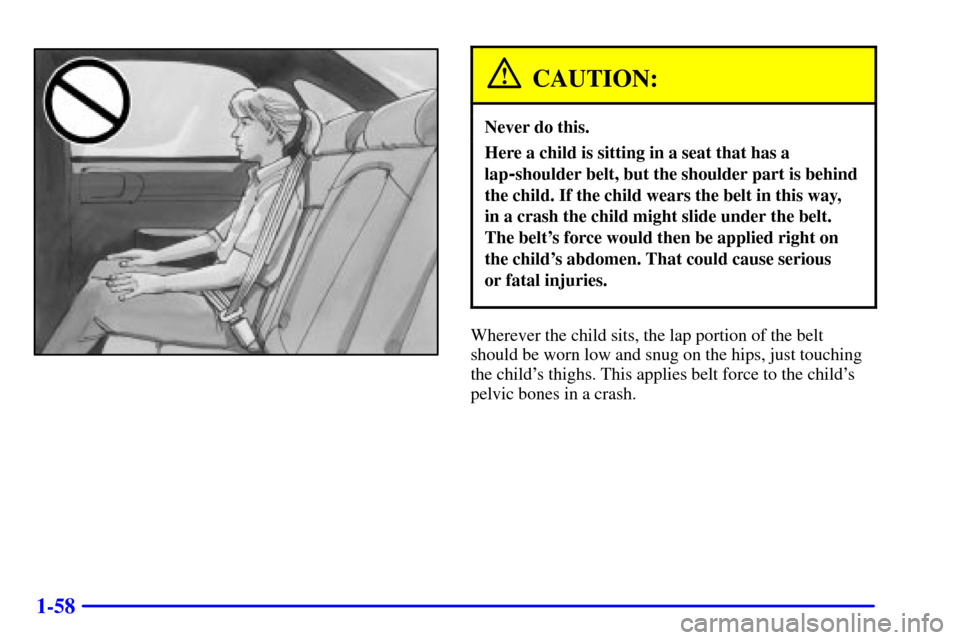
Never do this.
Here a child is sitting in a seat that has a
lap
-shoulder belt, but the shoulder part is behind
the child. If the child wears the belt in this way,
in a crash the child might slide under the belt.
The belt's force would then be applied right on
the child's abdomen. That could cause serious
or fatal injuries.
Wherever the child sits, the lap portion of the belt
should be worn low and snug on the hips, just touching
the child's thighs. This applies belt force to the child's
pelvic bones in a crash.
Page 65 of 397
1-59
Safety Belt Extender
If the vehicle's safety belt will fasten around you,
you should use it.
But if a safety belt isn't long enough to fasten, your
dealer will order you an extender. It's free. When you go
in to order it, take the heaviest coat you will wear, so the
extender will be long enough for you. The extender will
be just for you, and just for the seat in your vehicle that
you choose. Don't let someone else use it, and use it
only for the seat it is made to fit. To wear it, just attach
it to the regular safety belt.
Checking Your Restraint Systems
Now and then, make sure the safety belt reminder light
and all your belts, buckles, latch plates, retractors and
anchorages are working properly. Look for any other
loose or damaged safety belt system parts. If you see
anything that might keep a safety belt system from
doing its job, have it repaired.
Torn or frayed safety belts may not protect you in a
crash. They can rip apart under impact forces. If a belt
is torn or frayed, get a new one right away.
Also look for any opened or broken air bag covers, and
have them repaired or replaced. (The air bag system
does not need regular maintenance.)
Page 66 of 397
1-60
Replacing Restraint System Parts
After a Crash
CAUTION:
A crash can damage the restraint systems in
your vehicle. A damaged restraint system may
not properly protect the person using it, resulting
in serious injury or even death in a crash. To help
make sure your restraint systems are working
properly after a crash, have them inspected
and any necessary replacements made as soon
as possible.
If you've had a crash, do you need new belts or LATCH
system parts?
After a very minor collision, nothing may be necessary.
But if the belts were stretched, as they would be if worn
during a more severe crash, then you need new parts.
If the LATCH system was being used during a more
severe crash, you may need new LATCH system parts.
If belts are cut or damaged, replace them. Collision
damage also may mean you will need to have LATCH
system, safety belt or seat parts repaired or replaced.
New parts and repairs may be necessary even if the
belt or LATCH system wasn't being used at the time
of the collision.
If an air bag inflates, you'll need to replace air bag
system parts. See the part on the air bag system
earlier in this section.
Page 72 of 397

2-6
Door Locks
CAUTION:
Unlocked doors can be dangerous.
�Passengers -- especially children -- can
easily open the doors and fall out of a
moving vehicle. When a door is locked,
the handle won't open it. You increase the
chance of being thrown out of the vehicle in
a crash if the doors aren't locked. So, wear
safety belts properly and lock the doors
whenever you drive.
�Young children who get into unlocked
vehicles may be unable to get out. A child
can be overcome by extreme heat and can
suffer permanent injuries or even death
from heat stroke. Always lock your vehicle
whenever you leave it.
�Outsiders can easily enter through an
unlocked door when you slow down or stop
your vehicle. Locking your doors can help
prevent this from happening.
There are several ways to lock and unlock your vehicle.
From the outside, use your key or remote keyless entry
transmitter (if equipped). From the inside, use the
manual or power door locks.
To unlock either front door from the outside with the
key, insert the key and turn it toward the front of the
vehicle. To lock either front door from the outside with
your key, insert the key and turn it toward the rear of
the vehicle.
To lock the door from the inside, push the manual
lock lever forward. To unlock the door, pull the
lever rearward.
Page 150 of 397
2-84
Gages can indicate when there may be or is a problem
with one of your vehicle's functions. Often gages and
warning lights work together to let you know when
there's a problem with your vehicle.
When one of the warning lights comes on and stays on
when you are driving, or when one of the gages shows
there may be a problem, check the section that tells you
what to do about it. Please follow this manual's advice.
Waiting to do repairs can be costly
-- and even
dangerous. So please get to know your warning lights
and gages. They're a big help.
Your vehicle may also have a Driver Information Center
(DIC) that works along with the warning lights and
gages. See ªDriver Information Center (DIC)º in
the Index.
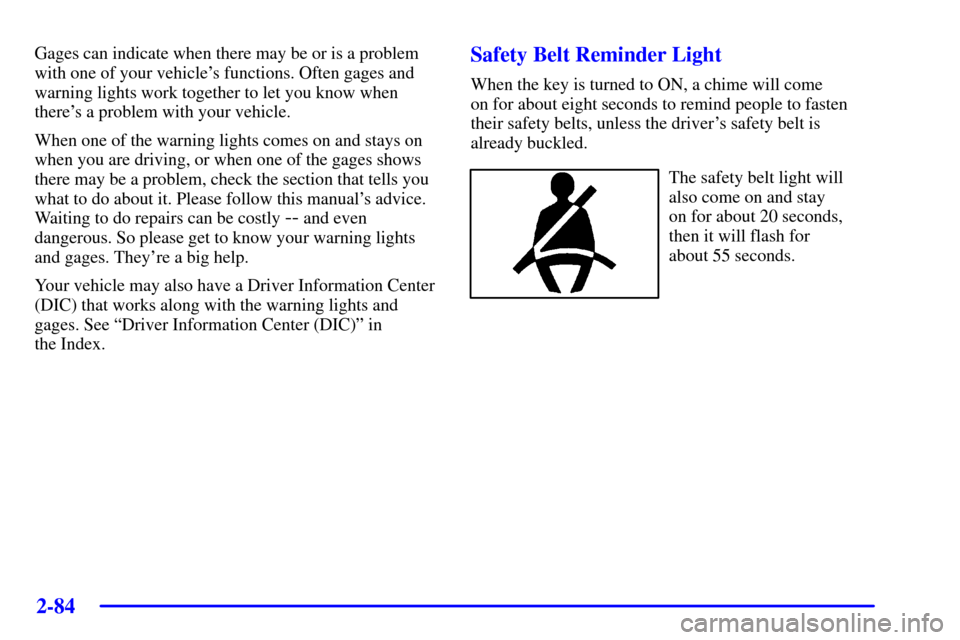
Safety Belt Reminder Light
When the key is turned to ON, a chime will come
on for about eight seconds to remind people to fasten
their safety belts, unless the driver's safety belt is
already buckled.
The safety belt light will
also come on and stay
on for about 20 seconds,
then it will flash for
about 55 seconds.
Page 161 of 397
2-95
Traction Active (If Equipped)
United States Canada
This message will appear when the traction control
system is limiting wheel spin.
The message will stay on a few seconds after the
traction system stops limiting wheel spin.Battery Life Indicator
When the vehicle is started
this message will be
displayed for three seconds.
If the message is displayed when the engine is running,
you may have a problem with your charging system. If
there is a problem with the charging system, four chimes
will sound when the message comes on. The battery
display will also stay on while the key is in ON until the
engine is started.
If the message stays on after starting the engine it
could indicate a problem with the generator drive belt,
or some other charging system problem. Have it
checked right away. Driving with this message on could
drain your battery.
If you must drive a short distance with this message
displayed, it helps to turn off all your accessories.