Page 329 of 397
6-40
Windshield Wiper
Blade Replacement
Windshield wiper blades should be inspected at least
twice a year for wear or cracking. See ªWindshield
Wipers, Blade Checkº in the Index for
more information.
Replacement blades come in different types and are
removed in different ways. For proper type and length,
see ªNormal Maintenance Replacement Partsº in the
Index. Here's how to remove the wiper blades:
1. Turn on the wipers to the low wipe setting.
2. Turn off the ignition while the wipers are at the
outer positions of the wiper pattern. The blades are
more accessible for removal/replacement while in
this position.
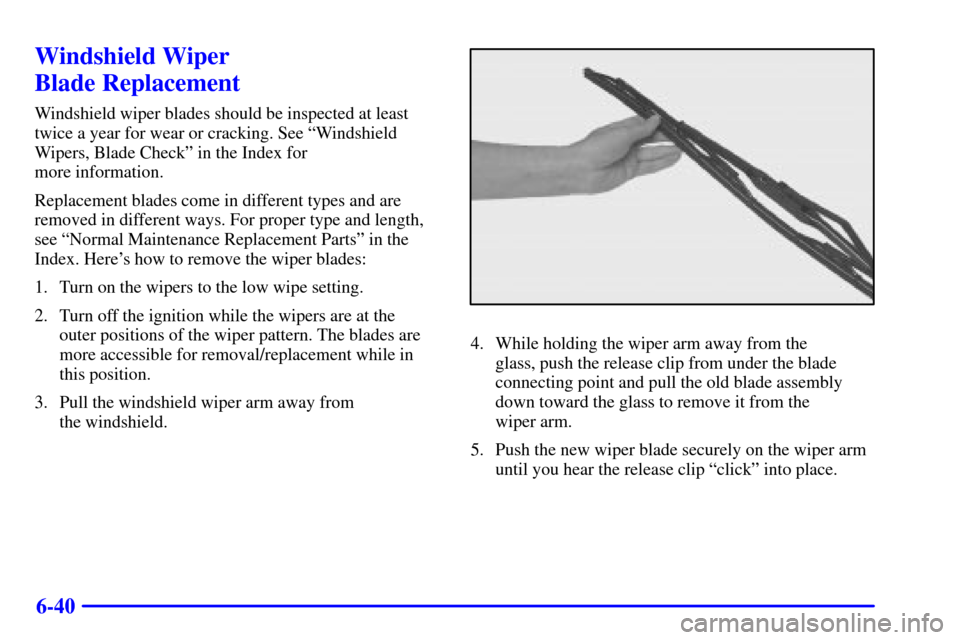
3. Pull the windshield wiper arm away from
the windshield.
4. While holding the wiper arm away from the
glass, push the release clip from under the blade
connecting point and pull the old blade assembly
down toward the glass to remove it from the
wiper arm.
5. Push the new wiper blade securely on the wiper arm
until you hear the release clip ªclickº into place.
Page 332 of 397

6-43 Tire Inflation Monitor System
(If Equipped)
The tire inflation monitor system can alert you to a large
change in the pressure of one tire. The system ªlearnsº
the pressure at each tire throughout the operating speed
range of your vehicle. The system normally takes
between 45 and 90 minutes of driving to learn the tire
pressures. This time may be longer depending on your
individual driving habits. Learning need not be
accumulated during a single trip. Once learned, the
system will remember the tire pressures until the
system is recalibrated.
After the system has learned tire pressures with properly
inflated tires, the LOW TIRE PRESSURE message
will come on if the pressure in one tire becomes 12 psi
(83 kPa) lower than the other three tires. The tire
inflation monitor system won't alert you if the
pressure in more than one tire is low, if the system
is not properly calibrated, or if the vehicle is moving
faster than 70 mph (110 km/h).
The tire inflation monitor system detects differences
in tire rotation speeds that are caused by changes in
tire pressure. The system can alert you about a low
tire
-- but it doesn't replace normal tire maintenance.
See ªTiresº in the Index.When the LOW TIRE PRESSURE message comes on,
you should stop as soon as you can and check all your
tires for damage. (If a tire is flat, see ªIf a Tire Goes
Flatº in the Index.) Also check the tire pressure in all
four tires as soon as you can. See ªInflation
- Tire
Pressureº in the Index.
The LOW TIRE PRESSURE message will also be
displayed (while the ignition is on) until you reset
(calibrate) the system.
Don't reset the tire inflation monitor system without
first correcting the cause of the problem and checking
and adjusting the pressure in all four tires. If you reset
the system when the tire pressures are incorrect, the
system will not work properly and may not alert you
when a tire is low.
Any time you adjust a tire's pressure, rotate your tires,
or have one or more tires repaired or replaced, you'll
need to reset (calibrate) the tire inflation monitor
system. You'll also need to reset the system whenever
you buy new tires and whenever the vehicle's battery
has been disconnected.
Page 333 of 397

6-44
To reset (calibrate) the system: The tire inflation
monitor system can be reset two ways. With the
ignition position at ON, pull the interior lamps
control to the ON and OFF settings three times.
It can also be reset through the radio using the
following steps:
1. Turn the ignition to ACC or ON and turn the
radio off.
2. Press and hold the TUNE DISP button on the radio for
at least five seconds until SETTINGS is displayed.
3. Press the SEEK PTYPE up or down arrow to scroll
through the main menu.
4. Scroll until TIRE MON appears on the display.
5. Press the 1 PREV or 2 NEXT button to enter the
submenu. RESET will be displayed.
6. Press the TUNE DISP button to reset. A chime will
be heard to verify the new setting and DONE will be
displayed for one second.
7. Once the monitor has been reset, scroll until EXIT
appears on the display.
8. Press the DISP button to exit programming. A chime
will be heard to verify exit.
The system completes the calibration process
during driving.The system normally takes 15 to 20 minutes of driving
in each of three speed ranges to ªlearnº tire pressures.
The speed ranges are 15 to 40 mph (25 to 65 km/h),
40 to 65 mph (65 to 105 km/h) and above 65 mph
(105 km/h). When learning is complete, the system
will alert you after two to eight minutes if a tire is 12 psi
(83 kPa) different from the other three tires. Detection
thresholds may be higher and detection times may be
longer on rough roads, curves and at high speeds. The
system is not capable of detection at speeds greater than
70 mph (110 km/h).
Tire Inspection and Rotation
Tires should be rotated every 6,000 to 8,000 miles
(10 000 to 13 000 km). Any time you notice unusual
wear, rotate your tires as soon as possible and check
wheel alignment. Also check for damaged tires or
wheels. See ªWhen It's Time for New Tiresº and
ªWheel Replacementº later in this section for
more information.
The purpose of regular rotation is to achieve more
uniform wear for all tires on the vehicle. The first
rotation is the most important. See ªScheduled
Maintenance Servicesº in the Index for scheduled
rotation intervals.
Page 347 of 397

6-58
Finish Damage
Any stone chips, fractures or deep scratches in the finish
should be repaired right away. Bare metal will corrode
quickly and may develop into a major repair expense.
Minor chips and scratches can be repaired with touch
-up
materials available from your dealer or other service
outlets. Larger areas of finish damage can be corrected
in your dealer's body and paint shop.
Underbody Maintenance
Chemicals used for ice and snow removal and dust
control can collect on the underbody. If these are
not removed, accelerated corrosion (rust) can occur
on the underbody parts such as fuel lines, frame,
floor pan and exhaust system even though they have
corrosion protection.
At least every spring, flush these materials from the
underbody with plain water. Clean any areas where mud
and other debris can collect. Dirt packed in closed areas
of the frame should be loosened before being flushed.
Your dealer or an underbody car washing system can do
this for you.
Chemical Paint Spotting
Some weather and atmospheric conditions can create a
chemical fallout. Airborne pollutants can fall upon and
attack painted surfaces on your vehicle. This damage
can take two forms: blotchy, ringlet
-shaped
discolorations, and small irregular dark spots etched into
the paint surface.
Although no defect in the paint job causes this,
Chevrolet will repair, at no charge to the owner, the
surfaces of new vehicles damaged by this fallout
condition within 12 months or 12,000 miles (20 000 km)
of purchase, whichever occurs first.
Page 359 of 397
6-70
Normal Maintenance
Replacement Parts
Engine Air Cleaner/Filter
All Engines A1614C*. . . . . . . . . . . . . . . . . . . . . . . .
Passenger Compartment Air Filter
All Engines GM Part No. 10406026. . . . . . . . . . . . .
Engine Oil Filter
All Engines PF47*. . . . . . . . . . . . . . . . . . . . . . . . . . Spark Plugs
3400 (Code E) V6 41
-940* . . . . . . . . . . . . . . . . . . .
Gap: 0.060 inches (1.52 mm)
3800 (Code K) V6 41
-921* . . . . . . . . . . . . . . . . . . .
Gap: 0.060 inches (1.52 mm)
Windshield Wiper Blades
Length 22.0 inches (56.0 cm). . . . . . . . . . . . . . . . . .
Type Shepherd's Hook. . . . . . . . . . . . . . . . . . . . . . . .
*AC Delco
� part number.
Page 360 of 397
7-
7-1
Section 7 Maintenance Schedule
This section covers the maintenance required for your vehicle. Your vehicle needs these services to retain its safety,
dependability and emission control performance.
7
-2 Introduction
7
-4 Part A: Scheduled Maintenance Services
7
-5 Scheduled Maintenance
7
-16 Part B: Owner Checks and Services7
-20 Part C: Periodic Maintenance Inspections
7
-22 Part D: Recommended Fluids and Lubricants
7
-23 Part E: Maintenance Record
Page 361 of 397

7-2
Have you purchased the GM Protection Plan? The Plan
supplements your new vehicle warranties. See your
Warranty and Owner Assistance booklet or your dealer
for details.
Introduction
Your Vehicle and the Environment
Proper vehicle maintenance not only helps to keep your
vehicle in good working condition, but also helps the
environment. All recommended maintenance procedures
are important. Improper vehicle maintenance can even
affect the quality of the air we breathe. Improper fluid
levels or the wrong tire inflation can increase the level
of emissions from your vehicle. To help protect our
environment, and to keep your vehicle in good
condition, please maintain your vehicle properly.
Maintenance Requirements
Maintenance intervals, checks, inspections and
recommended fluids and lubricants as prescribed in
this manual are necessary to keep your vehicle in good
working condition. Any damage caused by failure to
follow recommended maintenance may not be covered
by warranty.
Page 362 of 397
7-3 How This Section is Organized
This maintenance schedule is divided into five parts:
ªPart A: Scheduled Maintenance Servicesº explains
what to have done and how often. Some of these
services can be complex, so unless you are technically
qualified and have the necessary equipment, you should
let your dealer's service department or another qualified
service center do these jobs.
CAUTION:
Performing maintenance work on a vehicle can
be dangerous. In trying to do some jobs, you can
be seriously injured. Do your own maintenance
work only if you have the required know
-how
and the proper tools and equipment for the job.
If you have any doubt, have a qualified
technician do the work.
If you want to get the service information,
see ªService and Owner Publicationsº in the Index.ªPart B: Owner Checks and Servicesº tells you
what should be checked and when. It also explains
what you can easily do to help keep your vehicle in
good condition.
ªPart C: Periodic Maintenance Inspectionsº explains
important inspections that your dealer's service
department or another qualified service center
should perform.
ªPart D: Recommended Fluids and Lubricantsº lists
some recommended products necessary to help keep
your vehicle properly maintained. These products, or
their equivalents, should be used whether you do the
work yourself or have it done.
ªPart E: Maintenance Recordº is a place for you
to record and keep track of the maintenance performed
on your vehicle. Keep your maintenance receipts.
They may be needed to qualify your vehicle for
warranty repairs.