4-17
Loss of Control
Let's review what driving experts say about what happens
when the three control systems (brakes, steering and
acceleration) don't have enough friction where the tires
meet the road to do what the driver has asked.
In any emergency, don't give up. Keep trying to steer and
constantly seek an escape route or area of less danger.
Skidding
In a skid, a driver can lose control of the vehicle.
Defensive drivers avoid most skids by taking
reasonable care suited to existing conditions, and
by not ªoverdrivingº those conditions. But skids
are always possible.
The three types of skids correspond to your vehicle's
three control systems. In the braking skid, your wheels
aren't rolling. In the steering or cornering skid, too
much speed or steering in a curve causes tires to slip
and lose cornering force. And in the acceleration skid,
too much throttle causes the driving wheels to spin.
A cornering skid is best handled by easing your foot
off the accelerator pedal.
Remember: Any traction control system helps avoid
only the acceleration skid.If your TCS system is off, then an acceleration
skid is also best handled by easing your foot off
the accelerator pedal.
If your vehicle starts to slide, ease your foot off the
accelerator pedal and quickly steer the way you want
the vehicle to go. If you start steering quickly enough,
your vehicle may straighten out. Always be ready for a
second skid if it occurs.
Of course, traction is reduced when water, snow, ice,
gravel or other material is on the road. For safety,
you'll want to slow down and adjust your driving to
these conditions. It is important to slow down on
slippery surfaces because stopping distance will be
longer and vehicle control more limited.
While driving on a surface with reduced traction, try
your best to avoid sudden steering, acceleration or
braking (including engine braking by shifting to a
lower gear). Any sudden changes could cause the tires
to slide. You may not realize the surface is slippery
until your vehicle is skidding. Learn to recognize
warning clues
-- such as enough water, ice or packed
snow on the road to make a ªmirrored surfaceº
-- and
slow down when you have any doubt.
Remember: Any anti
-lock brake system (ABS) helps
avoid only the braking skid.
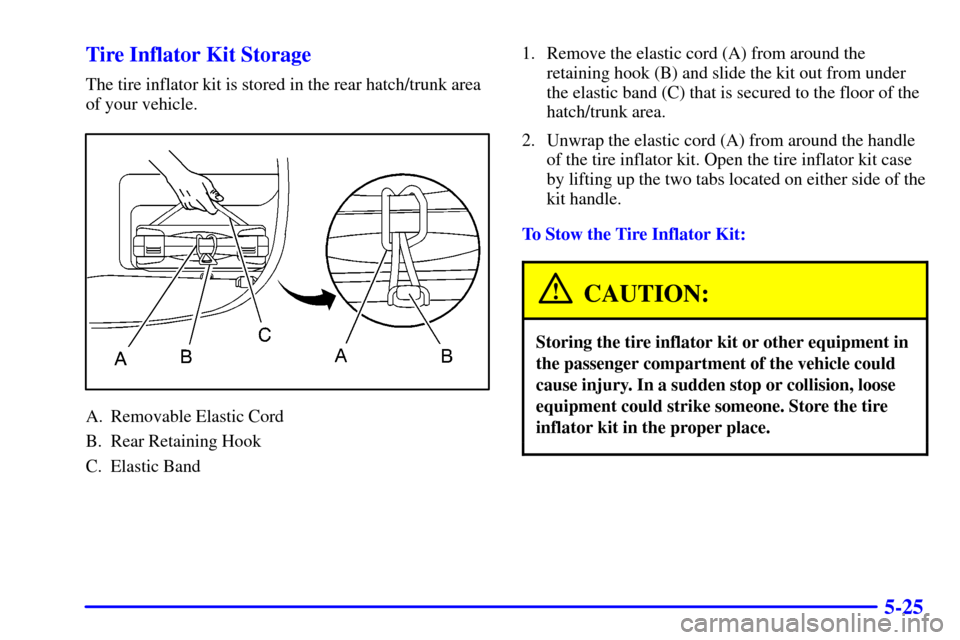
5-25 Tire Inflator Kit Storage
The tire inflator kit is stored in the rear hatch/trunk area
of your vehicle.
A. Removable Elastic Cord
B. Rear Retaining Hook
C. Elastic Band1. Remove the elastic cord (A) from around the
retaining hook (B) and slide the kit out from under
the elastic band (C) that is secured to the floor of the
hatch/trunk area.
2. Unwrap the elastic cord (A) from around the handle
of the tire inflator kit. Open the tire inflator kit case
by lifting up the two tabs located on either side of the
kit handle.
To Stow the Tire Inflator Kit:
CAUTION:
Storing the tire inflator kit or other equipment in
the passenger compartment of the vehicle could
cause injury. In a sudden stop or collision, loose
equipment could strike someone. Store the tire
inflator kit in the proper place.