Page 101 of 360

2-40 Turn and Lane-Change Signals
The turn signal has two upward (for right) and two
downward (for left) positions. These positions allow you
to signal a turn or a lane change.
To signal a turn, move the lever all the way up
or down. When the turn is finished, the lever will
return automatically.
An arrow on the instrument
panel cluster will flash in
the direction of the turn or
lane change.
To signal a lane change, just raise or lower the lever
until the arrow starts to flash. Hold it there until you
complete your lane change. The lever will return by
itself when you release it.
As you signal a turn or a lane change, if the arrows flash
rapidly, a signal bulb may be burned out and other
drivers won't see your turn signal.If a bulb is burned out, replace it to help avoid an
accident. If the arrows don't go on at all when you
signal a turn, check the fuse (see ªFuses and Circuit
Breakersº in the Index) and for burned
-out bulbs.
Headlamp High/Low-Beam Changer
To change the headlamps from low beam to high or high
beam to low, pull the turn signal lever all the way
toward you. Then release it.
When the high beams
are on, this light on the
instrument panel cluster
will also be on.
Flash-to-Pass
This feature lets you use your high-beam headlamps to
signal a driver in front of you that you want to pass.
To use it, pull the turn signal/multifunction lever toward
you until the high
-beam headlamps come on, then
release the lever to turn them off.
Page 132 of 360

2-71 Oil Pressure Light
If you have a low engine oil
pressure problem, this light
will stay on after you start
your engine, or come on
when you are driving. This
indicates that your engine is
not receiving enough oil.
The engine could be low on oil, or could have some
other oil problem. Have it fixed immediately.
The oil light could also come on in three other situations:
�When the ignition is on but the engine is not running,
the light will come on as a test to show you it is
working, but the light will go out when you turn the
ignition to START. If it doesn't come on with the
ignition on, you may have a problem with the fuse or
bulb. Have it fixed right away.
�If you're idling at a stop sign, the light may blink on
and then off.
�If you make a hard stop, the light may come on for a
moment. This is normal.CAUTION:
Don't keep driving if the oil pressure is low.
If you do, your engine can become so hot that it
catches fire. You or others could be burned.
Check your oil as soon as possible and have your
vehicle serviced.
NOTICE:
Damage to your engine from neglected oil
problems can be costly and is not covered by
your warranty.
Page 205 of 360
4-40 Making Turns
NOTICE:
Making very sharp turns while trailering
could cause the trailer to come in contact with
the vehicle. Your vehicle could be damaged.
Avoid making very sharp turns while trailering.
When you're turning with a trailer, make wider turns than
normal. Do this so your trailer won't strike soft shoulders,
curbs, road signs, trees or other objects. Avoid jerky or
sudden maneuvers. Signal well in advance.
Turn Signals When Towing a Trailer
When you tow a trailer, your vehicle may need a
different turn signal flasher and/or extra wiring. Check
with your dealer. The arrows on your instrument panel
will flash whenever you signal a turn or lane change.
Properly hooked up, the trailer lamps will also flash,
telling other drivers you're about to turn, change lanes
or stop.
When towing a trailer, the arrows on your instrument
panel will flash for turns even if the bulbs on the trailer
are burned out. Thus, you may think drivers behind you
are seeing your signal when they are not. It's important
to check occasionally to be sure the trailer bulbs are
still working.
Page 240 of 360

6-
6-1
Section 6 Service and Appearance Care
Here you will find information about the care of your vehicle. This section begins with service and fuel information,
and then it shows how to check important fluid and lubricant levels. There is also technical information about your
vehicle, and a part devoted to its appearance care.
6
-2 Service
6
-3 Fuel
6
-5 Fuels in Foreign Countries
6
-6 Filling Your Tank
6
-8 Filling a Portable Fuel Container
6
-9 Checking Things Under the Hood
6
-14 Engine Oil
6
-21 Engine Air Cleaner/Filter
6
-23 Automatic Transaxle Fluid
6
-24 Manual Transaxle Fluid
6
-24 Hydraulic Clutch
6
-25 Engine Coolant
6
-28 Surge Tank Pressure Cap
6
-29 Power Steering Fluid6
-29 Windshield Washer Fluid
6
-31 Brakes
6
-35 Battery
6
-36 Bulb Replacement
6
-43 Tires
6
-51 Appearance Care
6
-52 Cleaning the Inside of Your Vehicle
6
-54 Care of Safety Belts
6
-55 Cleaning the Outside of Your Vehicle
6
-60 Vehicle Identification Number (VIN)
6
-61 Electrical System
6
-66 Replacement Bulbs
6
-66 Capacities and Specifications
6
-67 Normal Maintenance Replacement Parts
Page 275 of 360
6-36
Bulb Replacement
For the type of bulb to use, see ªReplacement Bulbsº in
the Index.
For any bulb changing procedure not listed in this
section, contact your dealer.
Halogen Bulbs
CAUTION:
Halogen bulbs have pressurized gas inside and
can burst if you drop or scratch the bulb. You or
others could be injured. Be sure to read and
follow the instructions on the bulb package.
Headlamps
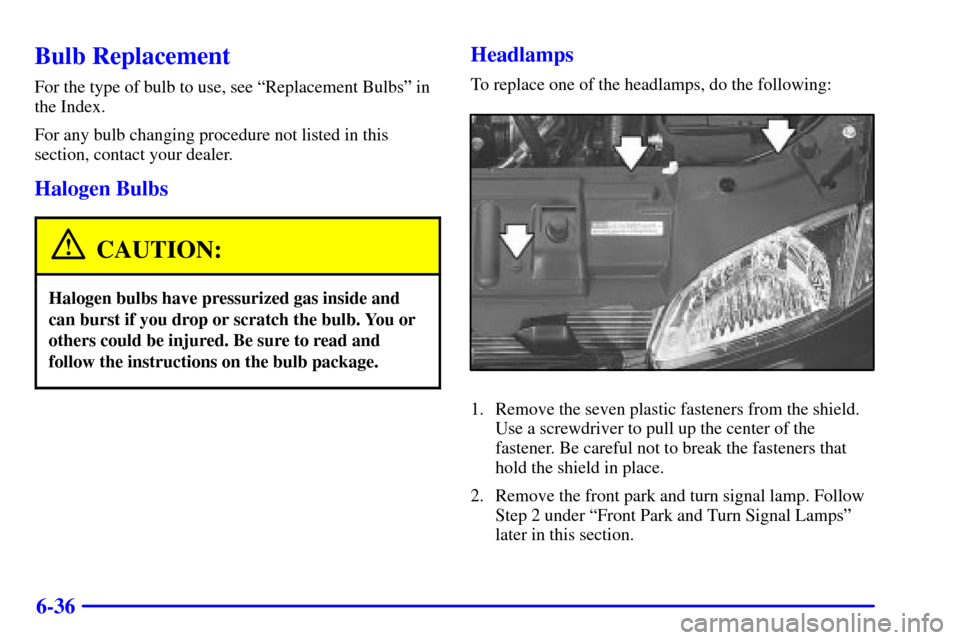
To replace one of the headlamps, do the following:
1. Remove the seven plastic fasteners from the shield.
Use a screwdriver to pull up the center of the
fastener. Be careful not to break the fasteners that
hold the shield in place.
2. Remove the front park and turn signal lamp. Follow
Step 2 under ªFront Park and Turn Signal Lampsº
later in this section.
Page 276 of 360
6-37
3. Remove the two bolts from the headlamp assembly.
Pull the headlamp assembly up and toward the front
of the vehicle to access the bulb assembly.
4. Remove the black collar by turning it counterclockwise.5. Disconnect the bulb base from the socket by lifting
the plastic locking tab.
Page 277 of 360
6-38
6. Remove the bulb by pulling the bulb straight out.
7. Snap a new bulb into the socket.
8. Reinstall the bulb assembly by reversing
Steps 1 through 5, making sure the lower leg
of the headlamp bracket is properly seated into
the wedge
-shaped retainer.
Front Park and Turn Signal Lamps
1. Follow Step 1 under ªHeadlamps.º
2. Place the tip of a screwdriver through the rectangle
hole in the headlamp bracket. Apply pressure to the
snap feature (toward the outboard side of the
vehicle). Guide the lamp forward.
Page 278 of 360
6-39
3. When the lamp is removed twist the socket to
remove from the lamp. (The bulb is connected to
the wire harness).
4. Replace the bulb and reinstall the socket.5. Align the outboard pin to the outboard tab in the
bracket. Align the (two) inboard pins with the hole in
the headlamp bracket.