Page 77 of 360

2-16
Theft
Vehicle theft is big business, especially in some cities.
Although your vehicle has a number of theft
-deterrent
features, we know that nothing we put on it can make
it impossible to steal. However, there are ways you
can help.
Key in the Ignition
If you leave your vehicle with the keys inside, it's an
easy target for joy riders or professional thieves
-- so
don't do it.
When you park your vehicle and open the driver's door,
you'll hear a chime reminding you to remove your key
from the ignition and take it with you. Always do this.
Your steering wheel will be locked, and so will your
ignition. If you take the key with you, and you have an
automatic transaxle, it will be locked. And remember to
lock the doors.
Parking at Night
Park in a lighted spot, close all windows and lock your
vehicle. Remember to keep your valuables out of sight.
Put them in a storage area, or take them with you.
Parking Lots
Even if you park in a lot where someone will be
watching your vehicle, it's still best to lock it up and
take your keys. But what if you have to leave your key?
�If possible, park in a busy, well
-lit area.
�Put your valuables in a storage area, like your trunk
or glove box.
�Be sure to close and lock the storage area.
�Close all windows.
�Move the trunk release lockout switch to OFF.
�Lock all the doors except the driver's.
�If your vehicle has a remote keyless entry system,
take the transmitter with you.
Page 78 of 360
2-17
Content Theft Security System
(If Equipped)
Arming the System
With the ignition off, pressing the transmitter LOCK
button will arm the system immediately after all doors
and trunk are closed. If the transmitter LOCK button is
pressed again within five seconds, the horn will chirp to
confirm that the system had been armed.
Once the system is armed, the THEFT SYSTEM light
on your instrument panel will flash and remain flashing.
This confirms the system is armed and monitoring the
doors and trunk. If the light is on solid, the system is
not properly activated due to either a door or the trunk
being ajar.
If you don't want to arm the system, lock the car
with the lock levers on the doors or with the door
lock switch.
Disarming the System
If the system is armed, pressing the UNLOCK button
on the transmitter will disarm the system. The THEFT
SYSTEM light will stop flashing.
If the system is armed, turning the key to START will
also disarm the system.
If the system is armed and the trunk is opened using the
trunk release button on the transmitter, the system will
temporarily disarm itself and rearm when the trunk has
been closed. This allows the customer to exit the
vehicle, lock the doors using the transmitter, and open
the trunk using the transmitter without having to disarm
and subsequently rearm the system.
How the System Alarm is Activated
If the system is armed, opening any door or trunk,
or using a wrong key to start the vehicle will cause a
pre
-alarm chirp for 10 seconds and then a full alarm
of horn and headlights for two minutes.
If an alarm event has finished and all doors and
trunk are closed, the content theft security system
will re
-arm itself.
Page 79 of 360
2-18 How to Turn Off the System Alarm
If the system alarm is active, it can be deactivated by:
�Pressing the transmitter LOCK or panic button to
turn
-off alarm. The system will also rearm if all
doors and trunk are later closed, or
�pressing the transmitter UNLOCK or trunk button to
turn off the alarm and disarm system, or
�putting the key in the ignition and turning it to
START to turn off the alarm and disarm the system.
How to Detect a Tamper Condition
If you hear three horn chirps when you press the
UNLOCK, LOCK or trunk buttons on your transmitter,
that means the content theft security system alarm was
triggered while you were away.
Your dealer can change the settings to disable the
headlamp flash and horn chirp features. Your dealer can
also change the settings to allow the horn to chirp twice
on the first press of the UNLOCK button. See your
dealer for more information.
Passlock�
Your vehicle is equipped with the Passlock
theft
-deterrent system.
Passlock is a passive theft
-deterrent system. Passlock
enables fuel if the ignition lock cylinder is turned with a
valid key. If a correct key is not used or the ignition lock
cylinder is tampered with, fuel is disabled.
During normal operation, the THEFT SYSTEM light
will go off approximately five seconds after the key
is turned to the RUN ignition position following an
engine start.
If the engine stalls and the THEFT SYSTEM light
flashes, wait until the light stops flashing before trying
to restart the engine. Remember to release the key from
START as soon as the engine starts.
If the engine is running and the THEFT SYSTEM light
comes on, you will be able to restart the engine if you
turn the engine off. However, your Passlock system is
not working properly and must be serviced by your
dealer. Your vehicle is not protected by Passlock at this
time. You may also want to check the fuses (See ªFuses
and Circuit Breakersº in the Index). See your dealer for
service. Also, see ªRoadside Assistanceº in the Index
for more information.
Page 82 of 360
2-21
D (RUN): This is the position to which the switch
returns, after you start your engine and release the
switch. The switch stays in RUN when the engine is
running. But even when the engine is not running, you
can use RUN to operate your electrical accessories, and
to display some instrument panel warning lights.
E (START): This position starts the engine. When the
engine starts, release the key. The ignition switch will
return to RUN for normal driving.
Even if the engine is not running, the positions
ACCESSORY and RUN allow you to operate electrical
accessories, such as the radio.Key Release Button (Manual Transaxle)
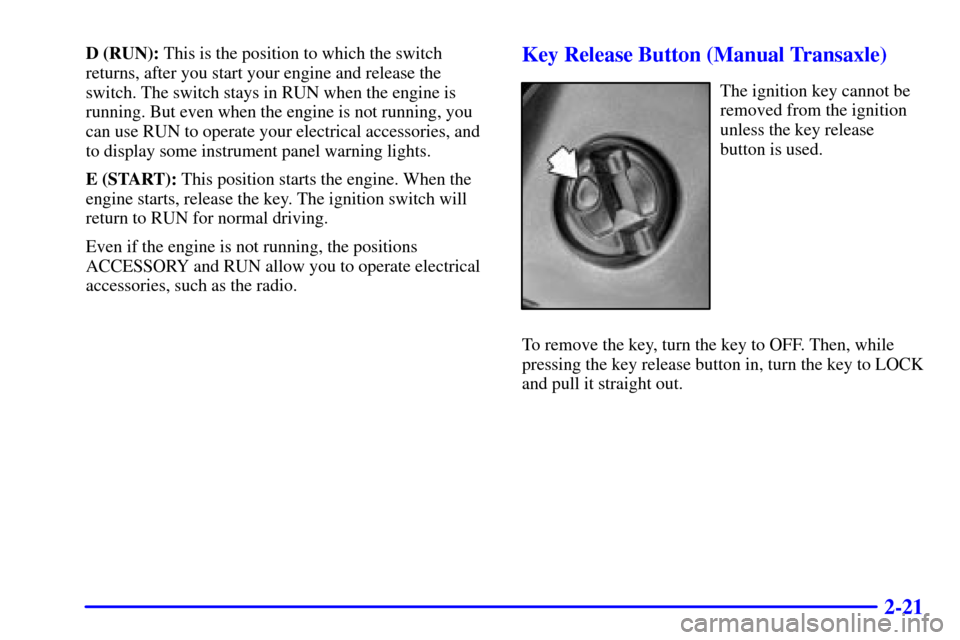
The ignition key cannot be
removed from the ignition
unless the key release
button is used.
To remove the key, turn the key to OFF. Then, while
pressing the key release button in, turn the key to LOCK
and pull it straight out.
Page 93 of 360
2-32 Shift Speeds
CAUTION:
If you skip a gear when you downshift, you could
lose control of your vehicle. You could injure
yourself or others. Don't shift down more than
one gear at a time when you downshift.
Up-Shift Light (Manual Transaxle)
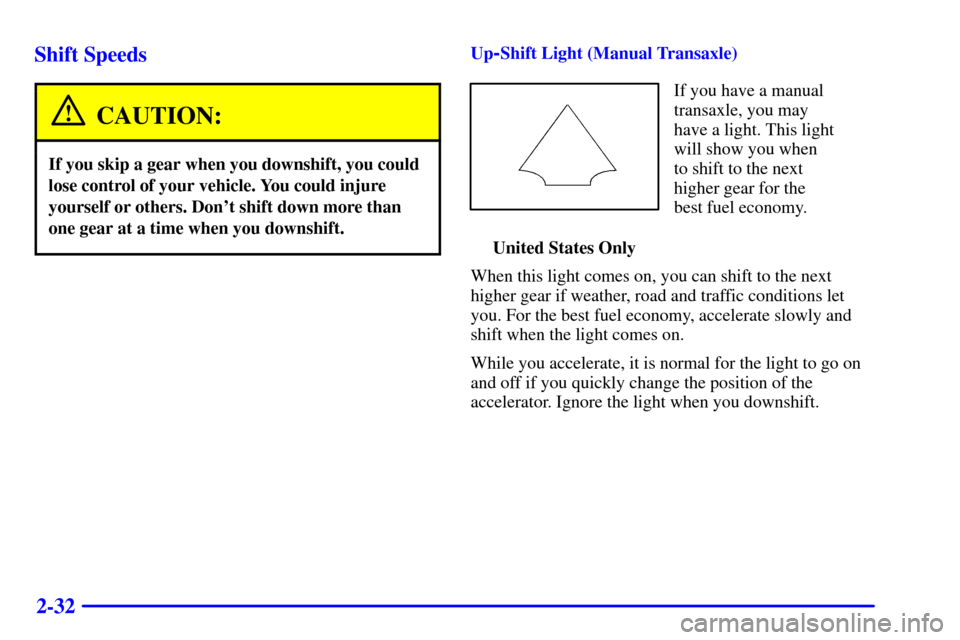
If you have a manual
transaxle, you may
have a light. This light
will show you when
to shift to the next
higher gear for the
best fuel economy.
United States Only
When this light comes on, you can shift to the next
higher gear if weather, road and traffic conditions let
you. For the best fuel economy, accelerate slowly and
shift when the light comes on.
While you accelerate, it is normal for the light to go on
and off if you quickly change the position of the
accelerator. Ignore the light when you downshift.
Page 94 of 360
2-33
Parking Brake
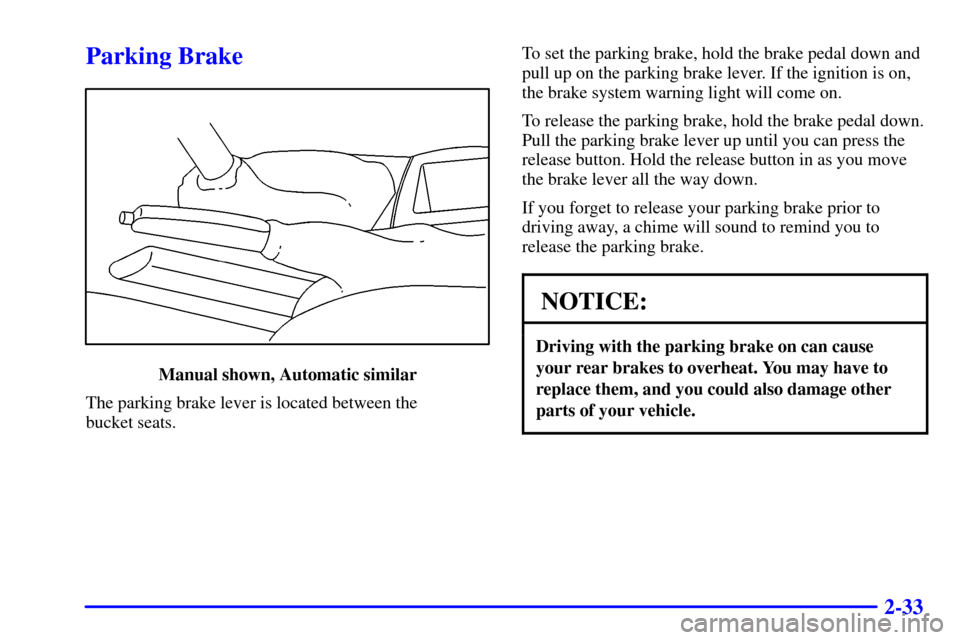
Manual shown, Automatic similar
The parking brake lever is located between the
bucket seats.To set the parking brake, hold the brake pedal down and
pull up on the parking brake lever. If the ignition is on,
the brake system warning light will come on.
To release the parking brake, hold the brake pedal down.
Pull the parking brake lever up until you can press the
release button. Hold the release button in as you move
the brake lever all the way down.
If you forget to release your parking brake prior to
driving away, a chime will sound to remind you to
release the parking brake.
NOTICE:
Driving with the parking brake on can cause
your rear brakes to overheat. You may have to
replace them, and you could also damage other
parts of your vehicle.
Page 101 of 360

2-40 Turn and Lane-Change Signals
The turn signal has two upward (for right) and two
downward (for left) positions. These positions allow you
to signal a turn or a lane change.
To signal a turn, move the lever all the way up
or down. When the turn is finished, the lever will
return automatically.
An arrow on the instrument
panel cluster will flash in
the direction of the turn or
lane change.
To signal a lane change, just raise or lower the lever
until the arrow starts to flash. Hold it there until you
complete your lane change. The lever will return by
itself when you release it.
As you signal a turn or a lane change, if the arrows flash
rapidly, a signal bulb may be burned out and other
drivers won't see your turn signal.If a bulb is burned out, replace it to help avoid an
accident. If the arrows don't go on at all when you
signal a turn, check the fuse (see ªFuses and Circuit
Breakersº in the Index) and for burned
-out bulbs.
Headlamp High/Low-Beam Changer
To change the headlamps from low beam to high or high
beam to low, pull the turn signal lever all the way
toward you. Then release it.
When the high beams
are on, this light on the
instrument panel cluster
will also be on.
Flash-to-Pass
This feature lets you use your high-beam headlamps to
signal a driver in front of you that you want to pass.
To use it, pull the turn signal/multifunction lever toward
you until the high
-beam headlamps come on, then
release the lever to turn them off.
Page 106 of 360
2-45
Using Cruise Control on Hills
How well your cruise control will work on hills depends
upon your speed, load and the steepness of the hills.
When going up a steep hill, you may have to step on the
accelerator pedal to maintain your speed. When going
downhill, you may have to brake or shift to a lower gear
to keep your speed down. Of course, applying the brake
or clutch pedal takes you out of cruise control. Many
drivers find this to be too much trouble and don't use
cruise control on steep hills.
Ending Cruise Control
There are several ways to turn off the cruise control:
�Step lightly on the brake pedal, or push the clutch
pedal, if you have a manual transaxle, or
�move the cruise switch to OFF.
Erasing Cruise Speed Memory
When you turn off the cruise control or the ignition,
your cruise control set speed memory is erased.Exterior Lamps
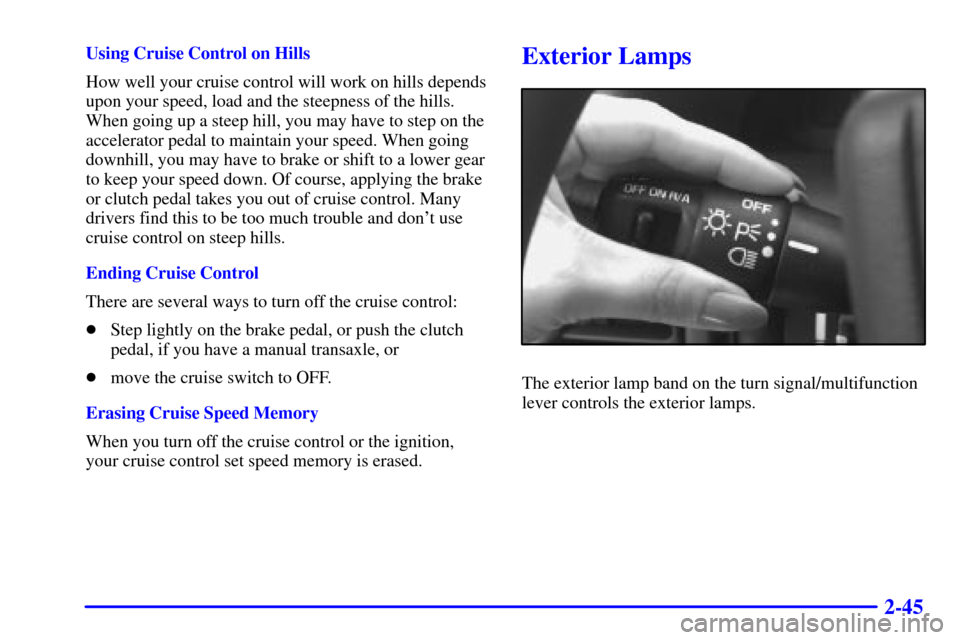
The exterior lamp band on the turn signal/multifunction
lever controls the exterior lamps.