Page 246 of 356
5-36
If You're Stuck: In Sand, Mud,
Ice or Snow
In order to free your vehicle when it is stuck, you will
need to spin the wheels, but you don't want to spin
your wheels too fast. The method known as ªrockingº
can help you get out when you're stuck, but you must
use caution.
CAUTION:
If you let your tires spin at high speed, they can
explode, and you or others could be injured.
And, the transmission or other parts of the
vehicle can overheat. That could cause an engine
compartment fire or other damage. When you're
stuck, spin the wheels as little as possible. Don't
spin the wheels above 35 mph (55 km/h) as shown
on the speedometer.
NOTICE:
Spinning your wheels can destroy parts of your
vehicle as well as the tires. If you spin the wheels
too fast while shifting your transmission back
and forth, you can destroy your transmission.
For information about using tire chains on your vehicle,
see ªTire Chainsº in the Index.
Rocking Your Vehicle To Get It Out
First, turn your steering wheel left and right. That will
clear the area around your front wheels. If your vehicle
has ASR, you should turn the system off. See ªASR
Systemº in the Index. Then shift back and forth between
REVERSE (R) and a forward gear (or with a manual
transmission, between FIRST (1) or SECOND (2) and
REVERSE (R)), spinning the wheels as little as possible.
Release the accelerator pedal while you shift, and press
lightly on the accelerator pedal when the transmission is
in gear. By slowly spinning your wheels in the forward
and reverse directions, you will cause a rocking motion
that may free your vehicle. If that doesn't get you out
after a few tries, you may need to be towed out. If you
do need to be towed out, see ªTowing Your Vehicleº
in the Index.
Page 247 of 356

6-
6-1
Section 6 Service and Appearance Care
Here you will find information about the care of your vehicle. This section begins with service and fuel information,
and then it shows how to check important fluid and lubricant levels. There is also technical information about your
vehicle, and a part devoted to its appearance care.
6
-2 Service
6
-3 Fuel
6
-5 Fuels in Foreign Countries
6
-6 Filling Your Tank
6
-8 Filling a Portable Fuel Container
6
-8 Checking Things Under the Hood
6
-10 Engine Compartment Overview
6
-12 Engine Oil
6
-18 Engine Air Cleaner/Filter
6
-21 Automatic Transmission Fluid
6
-24 Manual Transmission Fluid
6
-25 Hydraulic Clutch
6
-26 Rear Axle
6
-27 Engine Coolant
6
-30 Power Steering Fluid
6
-32 Windshield Washer Fluid
6
-33 Brakes
6
-38 Battery
6
-39 Bulb Replacement6
-44 Tires
6
-53 Appearance Care
6
-54 Cleaning the Inside of Your Vehicle
6
-56 Care of Safety Belts
6
-56 Cleaning Glass Surfaces
6
-57 Cleaning a Removeable Roof Panel
6
-58 Cleaning the Outside of Your Vehicle
6
-59 Cleaning Your Convertible Top
6
-60 Cleaning Aluminum or Chrome-Plated
Wheels (If Equipped)
6
-61 Underbody Maintenance
6
-62 GM Vehicle Care/Appearance Materials
6
-63 Vehicle Identification Number (VIN)
6
-63 Service Parts Identification Label
6
-64 Electrical System
6
-70 Replacement Bulbs
6
-71 Capacities and Specifications
6
-72 Normal Maintenance Replacement Parts
Page 256 of 356
6-10 Engine Compartment Overview
When you open the hood of the 3800 V6 engine, you'll see:
A. Engine Coolant Reservoir
B. Battery
C. Radiator Pressure Cap
D. Engine Oil Fill CapE. Automatic Transmission Fluid
Dipstick (If Equipped)
F. Windshield Washer Fluid Reservoir
G. Engine Cooling Fans
H. Engine Air Cleaner/FilterI. Power Steering Fluid Reservoir
J. Engine Oil Dipstick
K. Brake Fluid Reservoir
L. Clutch Master Cylinder
Reservoir (If Equipped)
Page 257 of 356
6-11
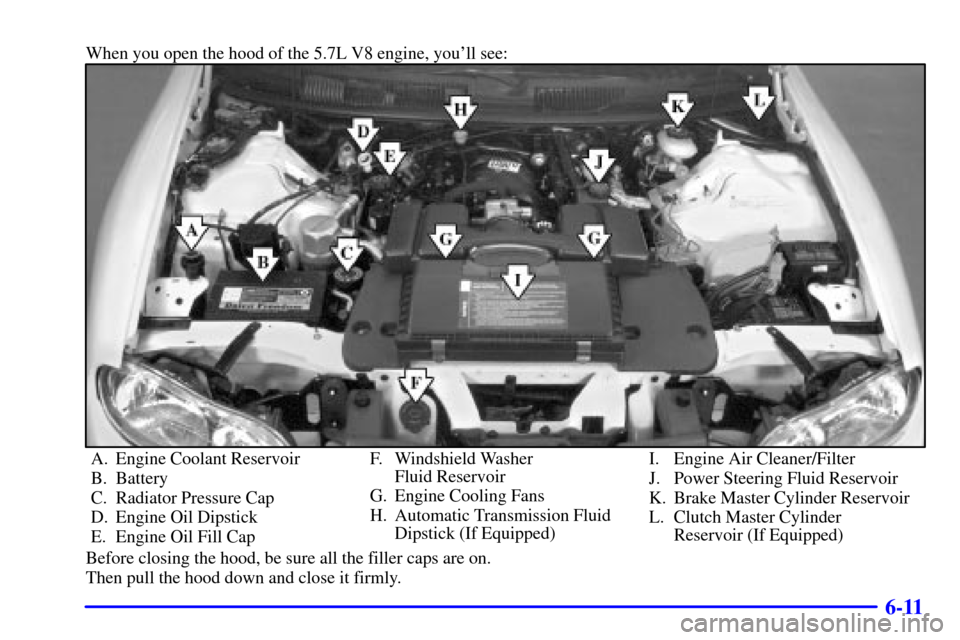
When you open the hood of the 5.7L V8 engine, you'll see:
A. Engine Coolant Reservoir
B. Battery
C. Radiator Pressure Cap
D. Engine Oil Dipstick
E. Engine Oil Fill CapF. Windshield Washer
Fluid Reservoir
G. Engine Cooling Fans
H. Automatic Transmission Fluid
Dipstick (If Equipped)I. Engine Air Cleaner/Filter
J. Power Steering Fluid Reservoir
K. Brake Master Cylinder Reservoir
L. Clutch Master Cylinder
Reservoir (If Equipped)
Before closing the hood, be sure all the filler caps are on.
Then pull the hood down and close it firmly.
Page 276 of 356
6-30
Radiator Pressure Cap
The radiator pressure cap is located toward the front of
the engine compartment near the battery. See ªEngine
Compartment Overviewº in the Index for more
information on location.
NOTICE:
Your radiator cap is an 18 psi (124 kPa)
pressure
-type cap and must be tightly installed to
prevent coolant loss and possible engine damage
from overheating. Be sure the arrows on the cap
line up with the overflow tube on the radiator
filler neck. See ªEngine Compartment Overviewº
in the Index for more information on location.
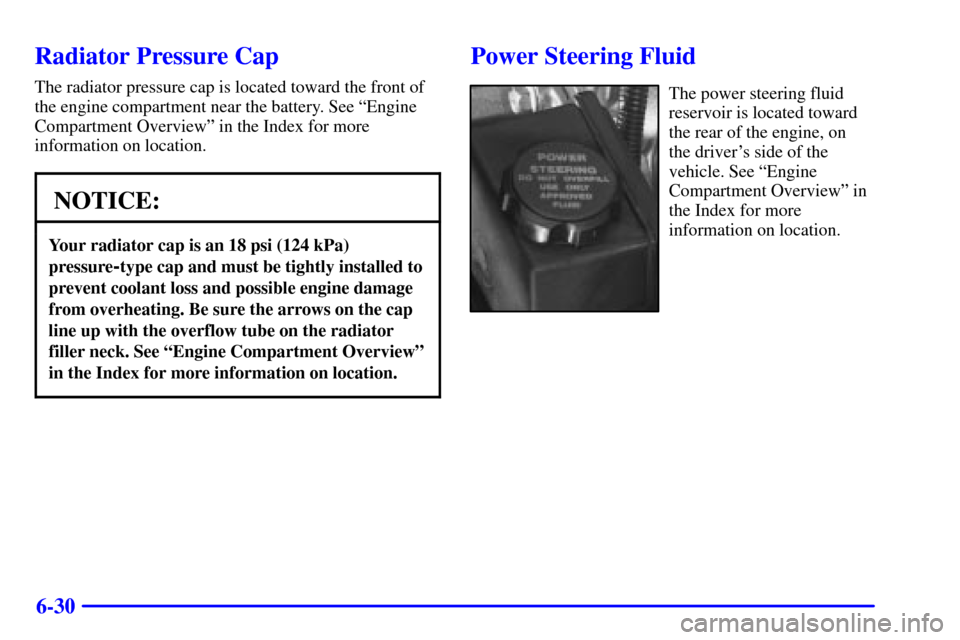
Power Steering Fluid
The power steering fluid
reservoir is located toward
the rear of the engine, on
the driver's side of the
vehicle. See ªEngine
Compartment Overviewº in
the Index for more
information on location.
Page 277 of 356

6-31 When to Check Power Steering Fluid
It is not necessary to regularly check power steering
fluid unless you suspect there is a leak in the system or
you hear an unusual noise. A fluid loss in this system
could indicate a problem. Have the system inspected and
repaired. See ªEngine Compartment Overviewº in the
Index for reservoir location.
How to Check Power Steering Fluid
Turn the key off, let the engine compartment cool down,
wipe the cap and the top of the reservoir clean, then
unscrew the cap and wipe the dipstick with a clean rag.
Replace the cap and completely tighten it. Then remove
the cap again and look at the fluid level on the dipstick.
�When the engine compartment is hot, the level
should be at the H (hot) mark.
�When the engine compartment is cool, the level
should be at the C (cold) mark.
If necessary, add only enough fluid to bring the level up
to the mark.
What to Use
To determine what kind of fluid to use, see
ªRecommended Fluids and Lubricantsº in the Index.
Always use the proper fluid. Failure to use the proper
fluid can cause leaks and damage hoses and seals.
Page 312 of 356
6-66
Main Fuse BlockFuse Usage
STOP/HAZARD Hazard Flashers, Brake
Switch Assembly
TURN B/U Traction Control/Second
-Gear
Start Switch, Back
-Up Lamp
Switch, Turn Flasher, Daytime
Running Lamps (DRL) Module
STG
WHL CNTRLSteering Wheel Controls
RADIO ACCY Delco Monsoon Radio Amplifier,
Remote CD Player (Trunk)
TAIL LPS Daytime Running Lamps (DRL)
Module, Headlamp Switch
HVAC HVAC Selector Switch, Rear
Defogger Switch/Timer
PWR ACCY Parking Lamp Relay, Hatch
Release Relay, Power Mirror
Switch, Radio, Shock Sensor,
Instrument Cluster
Page 313 of 356
6-67
Fuse Usage
COURTESY Body Control Module (BCM)
GAUGES Body Control Module (BCM),
Brake
-Transmission Shift
Interlock (BTSI), Instrument
Cluster, Daytime Running
Lamps (DRL) Module
AIR BAG Air Bag System
CIG/ACCY Cigarette Lighter, Data Link
Connector (DLC)
DEFOG/SEATS Rear Defogger Switch/Timer,
Power Seats
IGN Aftermarket Use Only
STG
WHL CNTRLSteering Wheel
Controls Illumination
WIPER/WASH Wiper Motor Assembly,
Wiper/Washer SwitchFuse Usage
BATT Aftermarket Use Only
WINDOWS Power Windows Switch (RH, LH),
Express-Down Module,
Convertible Top Switch
IP DIMMER Door Illumination Lamp
(LH, RH), Headlamp Switch, Fog
Lamp Switch, Instrument Cluster,
HVAC Control Assembly, PRNDL
Illumination Lamp, Ashtray Lamp,
Radio, Rear Window Defogger
Switch/Timer, Traction Control
(ASR)/Second
-Gear Start Switch,
Convertible Top Switch
ACCY Aftermarket Use Only
RADIO Body Control Module (BCM),
Radio, Amplifier, Steering
Wheel Controls
-Radio