Page 257 of 356
6-11
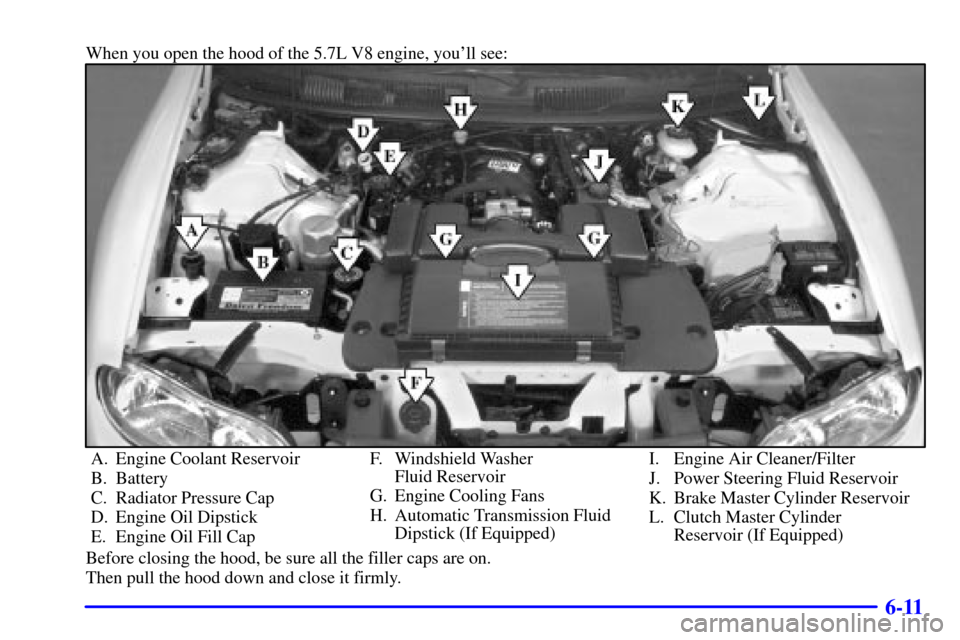
When you open the hood of the 5.7L V8 engine, you'll see:
A. Engine Coolant Reservoir
B. Battery
C. Radiator Pressure Cap
D. Engine Oil Dipstick
E. Engine Oil Fill CapF. Windshield Washer
Fluid Reservoir
G. Engine Cooling Fans
H. Automatic Transmission Fluid
Dipstick (If Equipped)I. Engine Air Cleaner/Filter
J. Power Steering Fluid Reservoir
K. Brake Master Cylinder Reservoir
L. Clutch Master Cylinder
Reservoir (If Equipped)
Before closing the hood, be sure all the filler caps are on.
Then pull the hood down and close it firmly.
Page 273 of 356
6-27 What to Use
Standard Differential
Use SAE 75W
-90 Synthetic Gear Lubricant
(GM Part No. 12378261) or equivalent meeting
GM Specification 9986115.
Limited
-Slip Differential
To add lubricant when the level is low, use SAE 75W
-90
Synthetic Gear Lubricant (GM Part No. 12378261) or
equivalent meeting GM Specification 9986115. To
completely refill after draining, add 4 ounces (118 ml)
of Limited
-Slip Differential Lubricant Additive (GM
Part No. 1052358) or equivalent. Then fill to the bottom
of the filler plug hole with the Synthetic Gear Lubricant.
Engine Coolant
The cooling system in your vehicle is filled with
DEX
-COOL� engine coolant. This coolant is designed
to remain in your vehicle for 5 years or 150,000 miles
(240 000 km), whichever occurs first, if you add only
DEX
-COOL� extended life coolant.
The following explains your cooling system and how to
add coolant when it is low. If you have a problem with
engine overheating or if you need to add coolant to your
radiator, see ªEngine Overheatingº in the Index.A 50/50 mixture of clean, drinkable water and
DEX
-COOL� coolant will:
�Give freezing protection down to
-34�F (-37�C).
�Give boiling protection up to 265�F (129�C).
�Protect against rust and corrosion.
�Help keep the proper engine temperature.
�Let the warning lights and gages work as
they should.
NOTICE:
When adding coolant, it is important that you use
only DEX
-COOL� (silicate-free) coolant.
If coolant other than DEX-COOL is added to the
system, premature engine, heater core or
radiator corrosion may result. In addition, the
engine coolant will require change sooner
-- at
30,000 miles (50 000 km) or 24 months,
whichever occurs first. Damage caused by the
use of coolant other than DEX
-COOL� is not
covered by your new vehicle warranty.
Page 274 of 356

6-28 What to Use
Use a mixture of one-half clean, drinkable water and
one
-half DEX-COOL� coolant which won't damage
aluminum parts. If you use this coolant mixture, you
don't need to add anything else.
CAUTION:
Adding only plain water to your cooling system
can be dangerous. Plain water, or some other
liquid such as alcohol, can boil before the proper
coolant mixture will. Your vehicle's coolant
warning system is set for the proper coolant
mixture. With plain water or the wrong mixture,
your engine could get too hot but you wouldn't
get the overheat warning. Your engine could
catch fire and you or others could be burned.
Use a 50/50 mixture of clean, drinkable water
and DEX
-COOL� coolant.
NOTICE:
If you use an improper coolant mixture, your
engine could overheat and be badly damaged.
The repair cost wouldn't be covered by your
warranty. Too much water in the mixture can
freeze and crack the engine, radiator, heater core
and other parts.
If you have to add coolant more than four times a year,
have your dealer check your cooling system.
NOTICE:
If you use the proper coolant, you don't have to
add extra inhibitors or additives which claim to
improve the system. These can be harmful.
Page 275 of 356

6-29 Checking Coolant
See ªEngine Compartment Overviewº in the Index for
information on location.
The vehicle must be on a level surface. When your engine
is cold, check the dipstick on the cap of the coolant
recovery tank. The coolant level should be at COLD, or a
little higher. When your engine is warm, the level on the
dipstick should be up to HOT, or a little higher.
Adding Coolant to the Recovery Tank
If you need more coolant, add the proper DEX
-COOL�
coolant mixture at the coolant recovery tank, but only
when your engine is cool. If the tank is very low or
empty, also add coolant to the radiator. See ªEngine
Overheatingº in the Index for information.
CAUTION:
Turning the radiator pressure cap when the
engine and radiator are hot can allow steam
and scalding liquids to blow out and burn you
badly. Never turn the pressure cap
-- even a
little
-- when the engine and radiator are hot.
Add coolant mixture at the recovery tank, but be careful
not to spill it.
CAUTION:
You can be burned if you spill coolant on hot
engine parts. Coolant contains ethylene glycol,
and it will burn if the engine parts are hot
enough. Don't spill coolant on a hot engine.
Occasionally check the coolant level in the radiator. For
information on how to add coolant to the radiator, see
ªCooling Systemº in the Index.
Page 297 of 356

6-51 Wheel Alignment and Tire Balance
The wheels on your vehicle were aligned and balanced
carefully at the factory to give you the longest tire life
and best overall performance.
Scheduled wheel alignment and wheel balancing are not
needed. However, if you notice unusual tire wear or
your vehicle pulling one way or the other, the alignment
may need to be reset. If you notice your vehicle
vibrating when driving on a smooth road, your wheels
may need to be rebalanced.
Wheel Replacement
Replace any wheel that is bent, cracked, or badly rusted
or corroded. If wheel nuts keep coming loose, the wheel,
wheel bolts and wheel nuts should be replaced. If the
wheel leaks air, replace it (except some aluminum
wheels, which can sometimes be repaired). See your
dealer if any of these conditions exist.
Your dealer will know the kind of wheel you need.
Each new wheel should have the same load
-carrying
capacity, diameter, width, offset and be mounted the
same way as the one it replaces.
If you need to replace any of your wheels, wheel bolts
or wheel nuts, replace them only with new GM original
equipment parts. This way, you will be sure to have the
right wheel, wheel bolts and wheel nuts for your vehicle.
CAUTION:
Using the wrong replacement wheels, wheel bolts
or wheel nuts on your vehicle can be dangerous.
It could affect the braking and handling of your
vehicle, make your tires lose air and make you
lose control. You could have a collision in which
you or others could be injured. Always use
the correct wheel, wheel bolts and wheel nuts
for replacement.
NOTICE:
The wrong wheel can also cause problems with
bearing life, brake cooling, speedometer or
odometer calibration, headlamp aim, bumper
height, vehicle ground clearance and tire or tire
chain clearance to the body and chassis.
See ªChanging a Flat Tireº in the Index for
more information.
Page 314 of 356
6-68
Underhood Fuse Center
Fuse and Relay Center 1
Fuse Usage
ABS BAT SOL Anti
-Lock Brake System
TCS BAT Traction Control System (ASR)
and ETC
COOL FAN Cooling Fan Control
PCM BAT Powertrain Control
Module (PCM)Fuse Usage
FUEL PUMP Fuel Pump
AIR PUMP Air Pump Relay and Bleed Valve
LH HDLP DR Left Headlamp Door and Module
RH HDLP DR Right Headlamp Door and Module
HORN Horn Relay
ABS BAT
-1 Anti-Lock Brake System Module
H/L DR HORN Horn and Headlamp Doors
ABS BAT
-2 Anti-Lock Brake and Traction
Control System (ASR)
COOL FAN Cooling Fan Relays
Relay Description
FOG LAMP Fog Lamps
HORN Horn
FAN #3 Cooling Fans
FAN #2 Cooling Fans
FAN #1 Cooling Fans
Page 315 of 356
6-69
Fuse and Relay Center 2
Fuse Usage
INJ
-2 Fuel Injectors (Not Used for V6)
(LH Injectors for V8 and
Ignition Module)
INJ
-1 Fuel Injectors (All for V6)
(RH Injectors for V8 and
Ignition Module)Fuse Usage
ENG SEN Mass Air Flow, Heated Oxygen
Sensor, Skip Shift Solenoid (V8
Only), Reverse Lockout Solenoid,
Brake Switch
STRTR Powertrain Control Module
(PCM) and Clutch Pedal Switch
ABS IGN Anti
-Lock Brake System Module
PCM IGN Powertrain Control
Module (PCM)
ETC Electronic Throttle
Control (V6 Only)
ENG CTRL Ignition Module (V6 Only),
Automatic Transmission and
Charcoal Canister Purge Solenoid
A/C CRUISE Air Conditioning Compressor
Relay, Cruise Control Switches
and Module
ENG CTRL Engine Controls, Fuel Pump,
Powertrain Control Module
(PCM), A.I.R. and Cooling Fans
Page 317 of 356

6-71
Capacities and Specifications
The following approximate capacities are given in
English and metric conversions. Please refer to
ªRecommended Fluids and Lubricantsº in the Index
for more information.
Automatic Transmission
Drain and Refill Overhaul 5.0 quarts (4.7 L). . . . . .
3800 V6 8.8 quarts (8.3 L). . . . . . . . . . . . . . . . . . . .
5.7L V8 10.8 quarts (10.2 L). . . . . . . . . . . . . . . . . .
Manual Transmission
Five
-Speed 3.4 quarts (3.2 L). . . . . . . . . . . . . . . . .
Six
-Speed 4.0 quarts (3.8 L). . . . . . . . . . . . . . . . . . Cooling System
3800 V6
With Manual Transmission 11.6 quarts (11.0 L). . . .
With Automatic Transmission 11.4 quarts (10.8 L). .
5.7L V8
With Manual Transmission 11.9 quarts (11.3 L). . . .
With Automatic Transmission 11.8 quarts (11.2 L).
Engine Oil with Filter
3800 V6 4.5 quarts (4.2 L). . . . . . . . . . . . . . . . . . . .
5.7L V8 5.5 quarts (5.2 L). . . . . . . . . . . . . . . . . . . .
Fuel Tank16.8 U.S. gallons (63 L) . . . . . . . . . . . . . .
Wheel Nut Torque100 lb-ft (140 N´m) . . . . . . . . . .
All capacities are approximate. When adding, be sure to
fill to the approximate level, as recommended in this
manual. Recheck fluid level after filling.
Engine Specifications
Type
VIN Engine Code K 3800 V6. . . . . . . . . . . . . . . . . . .
VIN Engine Code G 5.7L V8. . . . . . . . . . . . . . . . . . . .