Page 99 of 331
2-56 Engine Coolant Temperature Gage
This gage shows the engine
coolant temperature.
It also provides an indicator of how hard your vehicle is
working. During a majority of the operation, the gage
will read 210�F (100�C) or less. If you are pulling a
load or going up hills, it is normal for the temperature to
fluctuate and approach the 260�F (125�C) mark. If the
gage reaches the 260�F (125�C) mark, it indicates that
the cooling system is working beyond its capacity.
See ªEngine Overheatingº in the Index.
Malfunction Indicator Lamp (Service
Engine Soon Light in the United States
or Check Engine Light in Canada)
(Gasoline Engine)
United States Canada
Your vehicle is equipped with a computer which
monitors operation of the fuel, ignition and emission
control systems.
Page 103 of 331
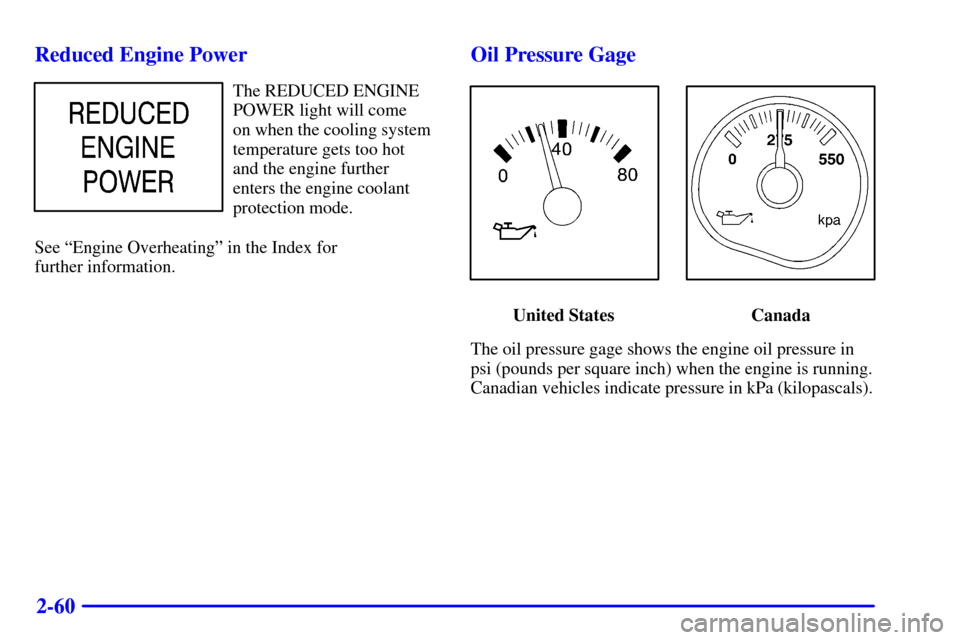
2-60 Reduced Engine Power
The REDUCED ENGINE
POWER light will come
on when the cooling system
temperature gets too hot
and the engine further
enters the engine coolant
protection mode.
See ªEngine Overheatingº in the Index for
further information.
Oil Pressure Gage
United States Canada
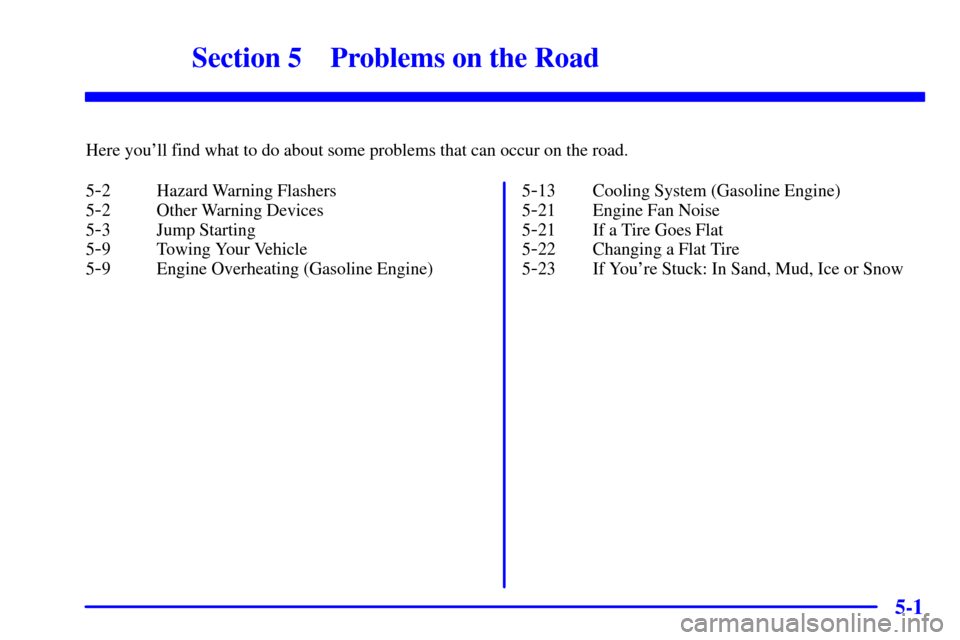
The oil pressure gage shows the engine oil pressure in
psi (pounds per square inch) when the engine is running.
Canadian vehicles indicate pressure in kPa (kilopascals).
Page 168 of 331
4-36 Driving On Grades
Reduce speed and shift to a lower gear before you start
down a long or steep downgrade. If you don't shift
down, you might have to use your brakes so much
that they would get hot and no longer work well.
If you have an automatic transmission, you can tow in
AUTOMATIC OVERDRIVE (�). You may want to
shift the transmission to THIRD (3) or, if necessary, a
lower gear selection if the transmission shifts too often
(e.g., under heavy loads and/or hilly conditions).
If you have a manual transmission and you are towing a
trailer, it's better not to use FIFTH (5) gear. Just drive
in FOURTH (4) gear (or, as you need to, a lower gear).
When towing at high altitude on steep uphill grades,
consider the following: Engine coolant will boil at a
lower temperature than at normal altitudes. If you
turn your engine off immediately after towing at high
altitude on steep uphill grades, your vehicle may show
signs similar to engine overheating. To avoid this,
let the engine run while parked (preferably on level
ground) with the automatic transmission in PARK (P)
(or the manual transmission out of gear and the
parking brake applied) for a few minutes before
turning the engine off. If you do get the overheat
warning, see ªEngine Overheatingº in the Index.
Parking on Hills
CAUTION:
You really should not park your vehicle, with
a trailer attached, on a hill. If something goes
wrong, your rig could start to move. People can
be injured, and both your vehicle and the trailer
can be damaged.
But if you ever have to park your rig on a hill, here's how
to do it:
1. Apply your regular brakes, but don't shift into
PARK (P) yet for an automatic transmission,
or into gear for a manual transmission.
2. Have someone place chocks under the trailer wheels.
3. When the wheel chocks are in place, release the
regular brakes until the chocks absorb the load.
4. Reapply the regular brakes. Then apply your
parking brake and shift into PARK (P) for an
automatic transmission, or REVERSE (R) for a
manual transmission.
5. Release the regular brakes.
Page 173 of 331
5-
5-1
Section 5 Problems on the Road
Here you'll find what to do about some problems that can occur on the road.
5
-2 Hazard Warning Flashers
5
-2 Other Warning Devices
5
-3 Jump Starting
5
-9 Towing Your Vehicle
5
-9 Engine Overheating (Gasoline Engine)5
-13 Cooling System (Gasoline Engine)
5
-21 Engine Fan Noise
5
-21 If a Tire Goes Flat
5
-22 Changing a Flat Tire
5
-23 If You're Stuck: In Sand, Mud, Ice or Snow
Page 181 of 331
5-9
To disconnect the jumper cables from both vehicles,
do the following:
1. Disconnect the black negative (
-) cable from the
vehicle that has the dead battery.
2. Disconnect the black negative (
-) cable from the
vehicle with the good battery.
3. Disconnect the red positive (+) cable from the
vehicle with the good battery.
4. Disconnect the red positive (+) cable from the
other vehicle.
Towing Your Vehicle
Consult your dealer or a professional towing service
if you need to have your disabled vehicle towed.
See ªRoadside Assistanceº in the Index.
Engine Overheating
(Gasoline Engine)
You will find a coolant temperature gage on your
vehicle's instrument panel. See ªEngine Coolant
Temperature Gageº in the Index.
If your vehicle has a diesel engine, see ªEngine
Overheatingº in the Diesel Engine Supplement.
Page 219 of 331
6-24
Engine Coolant
The cooling system in your vehicle is filled with
DEX
-COOL� engine coolant. This coolant is designed
to remain in your vehicle for 5 years or 150,000 miles
(240 000 km), whichever occurs first, if you add only
DEX
-COOL� extended life coolant.
The following explains your cooling system and how to
add coolant when it is low. If you have a problem with
engine overheating, see ªEngine Overheatingº in
the Index.
A 50/50 mixture of clean, drinkable water and
DEX
-COOL� coolant will:
�Give freezing protection down to
-34�F (-37�C).
�Give boiling protection up to 265�F (129�C).
�Protect against rust and corrosion.
�Help keep the proper engine temperature.
�Let the warning gages work as they should.
NOTICE:
When adding coolant, it is important that you
use only DEX
-COOL� (silicate-free) coolant.
If coolant other than DEX-COOL is added to
the system, premature engine, heater core or
radiator corrosion may result. In addition, the
engine coolant will require change sooner
-- at
30,000 miles (50 000 km) or 24 months,
whichever occurs first. Damage caused by the
use of coolant other than DEX
-COOL� is not
covered by your new vehicle warranty.
Page 222 of 331
6-27
Add coolant mixture at the recovery tank, but be careful
not to spill it.
CAUTION:
You can be burned if you spill coolant on hot
engine parts. Coolant contains ethylene glycol,
and it will burn if the engine parts are hot
enough. Don't spill coolant on a hot engine.
Occasionally check the coolant level in the radiator.
For information on how to add coolant to the radiator,
see ªCooling Systemº in the Index.
Radiator Pressure Cap
(Gasoline Engine)
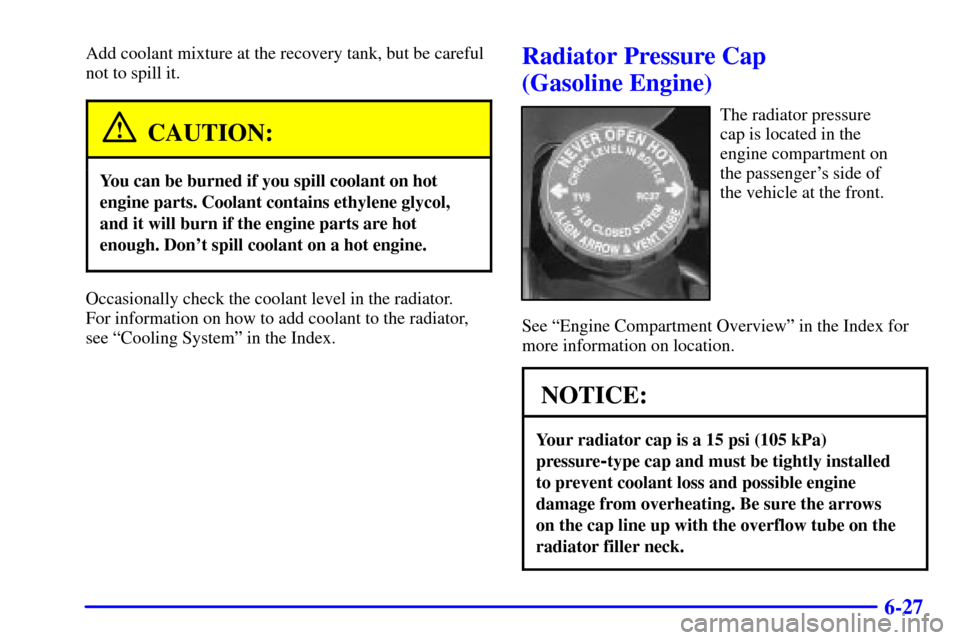
The radiator pressure
cap is located in the
engine compartment on
the passenger's side of
the vehicle at the front.
See ªEngine Compartment Overviewº in the Index for
more information on location.
NOTICE:
Your radiator cap is a 15 psi (105 kPa)
pressure
-type cap and must be tightly installed
to prevent coolant loss and possible engine
damage from overheating. Be sure the arrows
on the cap line up with the overflow tube on the
radiator filler neck.
Page 235 of 331
6-40
Tires
Your new vehicle comes with high-quality tires made by
a leading tire manufacturer. If you ever have questions
about your tire warranty and where to obtain service,
see your GM Warranty booklet for details.
CAUTION:
Poorly maintained and improperly used tires
are dangerous.
�Overloading your tires can cause overheating
as a result of too much friction. You could
have an air
-out and a serious accident.
See ªLoading Your Vehicleº in the Index.
CAUTION: (Continued)
CAUTION: (Continued)
�Underinflated tires pose the same danger
as overloaded tires. The resulting accident
could cause serious injury. Check all tires
frequently to maintain the recommended
pressure. Tire pressure should be checked
when your tires are cold.
�Overinflated tires are more likely to be
cut, punctured or broken by a sudden
impact
-- such as when you hit a pothole.
Keep tires at the recommended pressure.
�Worn, old tires can cause accidents. If your
tread is badly worn, or if your tires have
been damaged, replace them.