Page 309 of 488
5-
5-1
Section 5 Problems on the Road
Here you'll find what to do about some problems that can occur on the road.
5
-2 Hazard Warning Flashers
5
-2 Other Warning Devices
5
-3 Jump Starting
5
-8 Towing Your Vehicle
5
-8 Engine Overheating5
-10 Cooling System
5
-18 Engine Fan Noise
5
-18 If a Tire Goes Flat
5
-19 Changing a Flat Tire
5
-34 Spare Tire
5
-35 If You're Stuck: In Sand, Mud, Ice or Snow
Page 316 of 488
5-8
To disconnect the jumper cables from both vehicles,
do the following:
1. Disconnect the black negative (
-) cable from the
vehicle that had the dead battery.
2. Disconnect the black negative (
-) cable from the
vehicle with the good battery.
3. Disconnect the red positive (+) cable from the
vehicle with the good battery.
4. Disconnect the red positive (+) cable from the
other vehicle.
Towing Your Vehicle
Consult your dealer or a professional towing service if
you need to have your disabled vehicle towed. See
ªRoadside Assistanceº in the Index. If you want to tow
your vehicle behind another vehicle for recreational
purposes (such as behind a motorhome), see
ªRecreational Vehicle Towingº in the Index.
Engine Overheating
You will find a coolant temperature gage on your
vehicle's instrument panel. See ªGagesº in the Index.
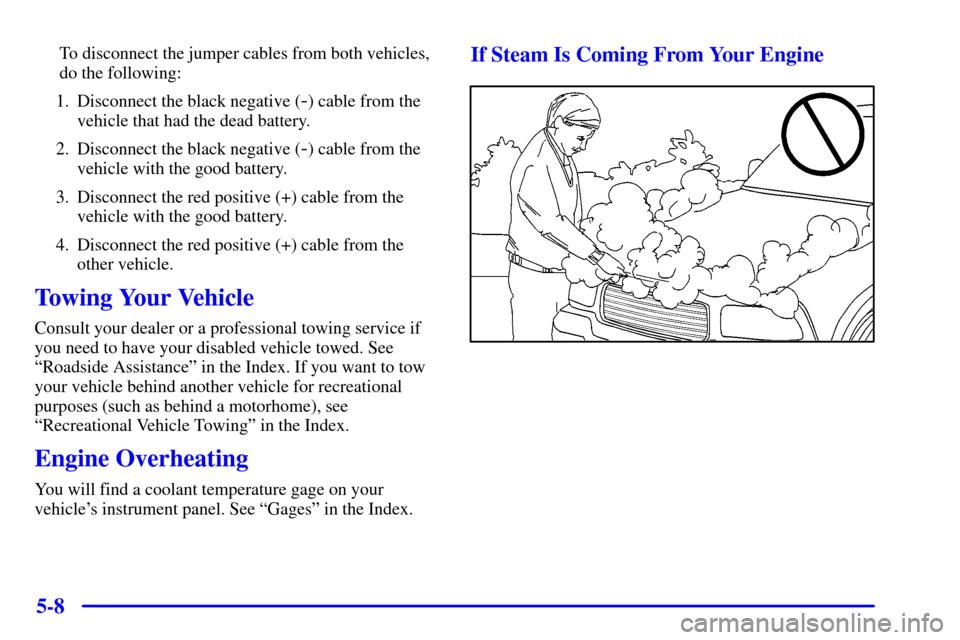
If Steam Is Coming From Your Engine
Page 326 of 488

5-18
Engine Fan Noise
This vehicle has a clutched engine cooling fan. When
the clutch is engaged, the fan spins faster to provide
more air to cool the engine. In most everyday driving
conditions, the clutch is not engaged. This improves
fuel economy and reduces fan noise. Under heavy
vehicle loading, trailer towing and/or high outside
temperatures, the fan speed increases when the clutch
engages. So you may hear an increase in fan noise.
This is normal and should not be mistaken as the
transmission slipping or making extra shifts. It is merely
the cooling system functioning properly. The fan will
slow down when additional cooling is not required and
the clutch disengages.
You may also hear this fan noise when you start the
engine. It will go away as the fan clutch disengages.
If a Tire Goes Flat
It's unusual for a tire to ªblow outº while you're driving,
especially if you maintain your tires properly. If air goes
out of a tire, it's much more likely to leak out slowly.
But if you should ever have a ªblowout,º here are a few
tips about what to expect and what to do:
If a front tire fails, the flat tire will create a drag that
pulls the vehicle toward that side. Take your foot off the
accelerator pedal and grip the steering wheel firmly.
Steer to maintain lane position, and then gently brake to
a stop well out of the traffic lane.
A rear blowout, particularly on a curve, acts much like a
skid and may require the same correction you'd use in a
skid. In any rear blowout, remove your foot from the
accelerator pedal. Get the vehicle under control by
steering the way you want the vehicle to go. It may be
very bumpy and noisy, but you can still steer. Gently
brake to a stop
-- well off the road if possible.
If a tire goes flat, the next part shows how to use your
jacking equipment to change a flat tire safely.
Page 328 of 488

5-20 Removing the Spare Tire and Tools
The jacking equipment you'll need is stored along the
driver's side inner rear quarter panel. In some cases, you
may have to remove the spare tire in order to reach the
jack. Your vehicle is also equipped with work gloves
and a plastic ground mat to assist in the changing of a
flat tire.
The following instructions explain how to remove the
spare tire, depending on where it is mounted on your
vehicle. See ªSpare Tireº or ªCompact Spare Tireº later
in this section for more information about the spare.
1. To remove your jack
cover, pull up on the
latch(es) on the cover.
Remove the wheel
blocks, jack and
wheel wrench.
NOTICE:
Never remove or restow a tire from/to a stowage
position under the vehicle while the vehicle is
supported by a jack. Always tighten the tire
fully against the underside of the vehicle
when restowing.
2. To remove the
underbody
-mounted
spare, insert the chisel
end of the wheel
wrench, on an angle,
into the hoist shaft hole
in the rear bumper. Be
sure the chisel end of the
wheel wrench connects
into the hoist shaft.
Page 344 of 488
5-36 Rocking Your Vehicle To Get It Out
First, turn your steering wheel left and right. That will
clear the area around your front wheels. If you have a
four
-wheel-drive vehicle, shift into 4HI. Then shift back
and forth between REVERSE (R) and a forward gear
(or with a manual transmission, between FIRST (1) or
SECOND (2) and REVERSE (R)), spinning the wheels
as little as possible. Release the accelerator pedal while
you shift, and press lightly on the accelerator pedal
when the transmission is in gear. By slowly spinning
your wheels in the forward and reverse directions, you
will cause a rocking motion that may free your vehicle.
If that doesn't get you out after a few tries, you may
need to be towed out. Or, you can use your recovery
hooks if your vehicle has them. If you do need to be
towed out, see ªTowing Your Vehicleº in the Index.
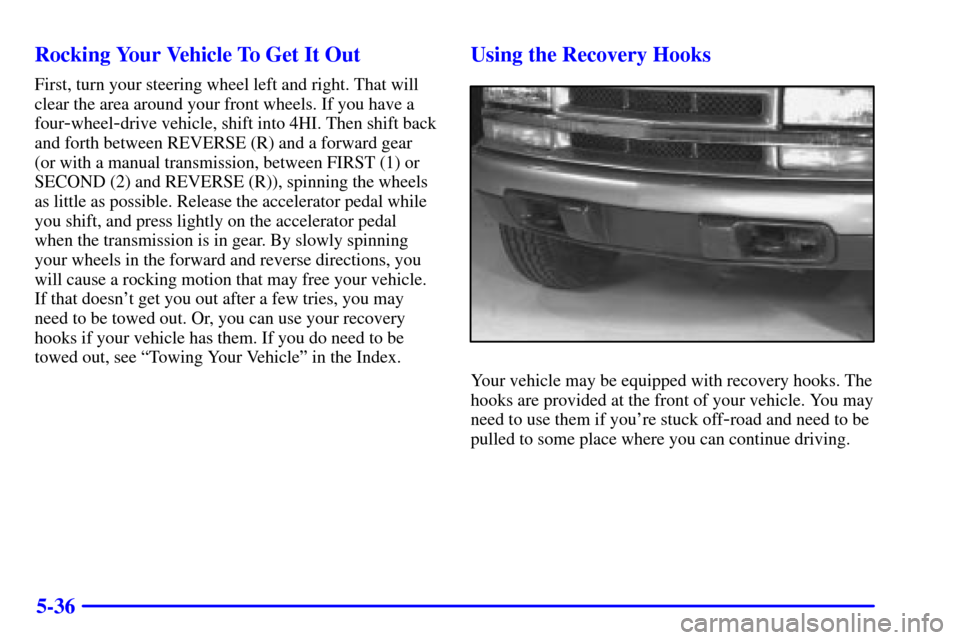
Using the Recovery Hooks
Your vehicle may be equipped with recovery hooks. The
hooks are provided at the front of your vehicle. You may
need to use them if you're stuck off
-road and need to be
pulled to some place where you can continue driving.
Page 362 of 488

6-17
Automatic Transmission Fluid
When to Check and Change
A good time to check your automatic transmission fluid
level is when the engine oil is changed.
Change both the fluid and filter every 15,000 miles
(25 000 km) if the vehicle is mainly driven under one or
more of these conditions:
�In heavy city traffic where the outside temperature
regularly reaches 90�F (32�C) or higher.
�In hilly or mountainous terrain.
�When doing frequent trailer towing.
�Uses such as found in taxi, police or delivery service.
If you do not use your vehicle under any of these
conditions, change the fluid and filter every
50,000 miles (83 000 km).
See ªScheduled Maintenance Servicesº in
How to Check
Because this operation can be a little difficult, you may
choose to have this done at the dealership service
department.
If you do it yourself, be sure to follow all the
instructions here, or you could get a false reading
on the dipstick.
NOTICE:
Too much or too little fluid can damage your
transmission. Too much can mean that some of
the fluid could come out and fall on hot engine
parts or exhaust system parts, starting a fire. Too
little fluid could cause the transmission to
overheat. Be sure to get an accurate reading if
you check your transmission fluid.
Page 424 of 488
Scheduled Maintenance
7-6
Short Trip/City Intervals
Every 60,000 Miles (100 000 km): Engine Accessory
Drive Belt Inspection.
Every 100,000 Miles (166 000 km): Spark Plug Wire
Inspection. Spark Plug Replacement. Positive
Crankcase Ventilation (PCV) Valve Inspection.
Every 150,000 Miles (240 000 km): Cooling System
Service (or every 60 months, whichever occurs first).
These intervals only summarize maintenance services.
Be sure to follow the complete scheduled maintenance
on the following pages.
Long Trip/Highway Definition
Follow this scheduled maintenance only if none of the
conditions from the Short Trip/City Scheduled
Maintenance are true. Do not use this schedule if the
vehicle is used for trailer towing, driven in a dusty area
or used off paved roads. Use the Short Trip/City
schedule for these conditions.
Driving a vehicle with a fully warmed engine under
highway conditions will cause engine oil to break
down slower.
Page 426 of 488
Short Trip/City Scheduled Maintenance
7-8
The services shown in this schedule up to 100,000 miles
(166 000 km) should be repeated after 100,000 miles
(166 000 km) at the same intervals for the life of
this vehicle. The services shown at 150,000 miles
(240 000 km) should be repeated at the same interval
after 150,000 miles (240 000 km) for the life of
this vehicle.
See ªOwner Checks and Servicesº and ªPeriodic
Maintenance Inspectionsº following.
Footnotes
� The U.S. Environmental Protection Agency or the
California Air Resources Board has determined that the
failure to perform this maintenance item will not nullify
the emission warranty or limit recall liability prior to
the completion of the vehicle's useful life. We, however,
urge that all recommended maintenance services be
performed at the indicated intervals and the
maintenance be recorded.# Lubricate the front suspension, ball joints, steering
linkage, parking brake cable guides, propshaft splines,
universal joints and brake pedal springs.
+ A good time to check your brakes is during tire
rotation. See ªBrake System Inspectionº under
ªPeriodic Maintenance Inspectionsº in Part C of
this schedule.
** Drive axle service. See ªRecommended Fluids and
Lubricantsº in the Index for proper lubricant to use:
�Check fluid level and add fluid as needed. If driving
in dusty areas or when towing a trailer, drain fluid
and refill every 15,000 miles (25 000 km).
�If your vehicle has a locking differential, drain fluid
and refill at first engine oil change.
�More frequent lubrication may be required for
heavy
-duty or off-road use.