Page 82 of 488
2-16
Emergency Release for Opening Endgate
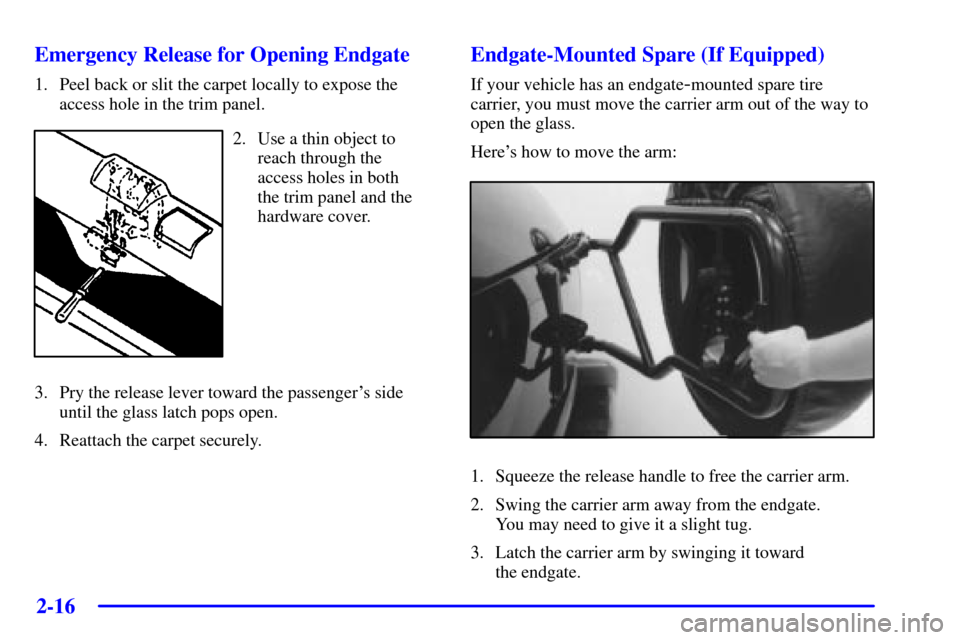
1. Peel back or slit the carpet locally to expose the
access hole in the trim panel.
2. Use a thin object to
reach through the
access holes in both
the trim panel and the
hardware cover.
3. Pry the release lever toward the passenger's side
until the glass latch pops open.
4. Reattach the carpet securely.
Endgate-Mounted Spare (If Equipped)
If your vehicle has an endgate-mounted spare tire
carrier, you must move the carrier arm out of the way to
open the glass.
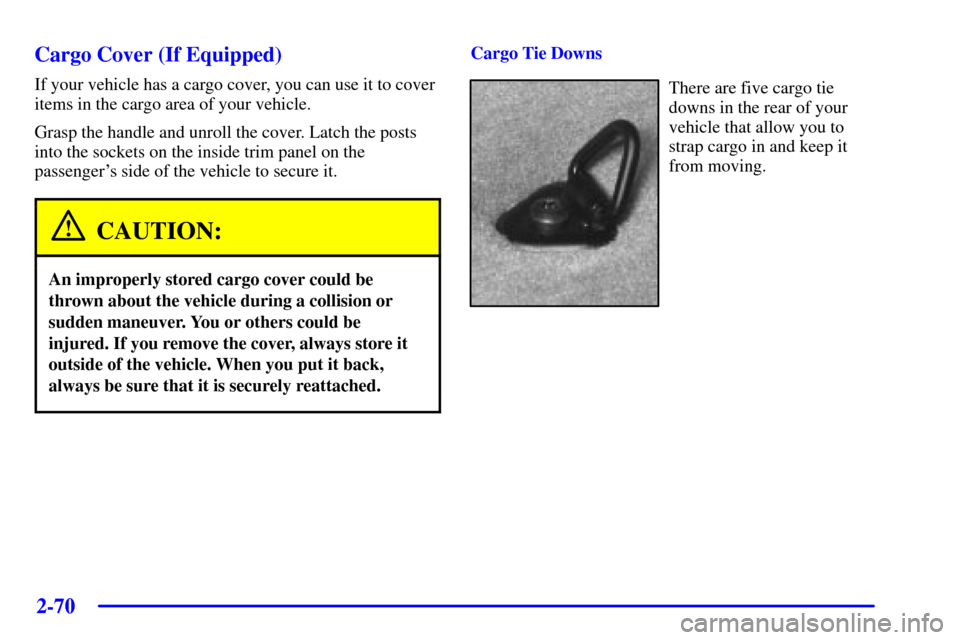
Here's how to move the arm:
1. Squeeze the release handle to free the carrier arm.
2. Swing the carrier arm away from the endgate.
You may need to give it a slight tug.
3. Latch the carrier arm by swinging it toward
the endgate.
Page 84 of 488

2-18
Content Theft-Deterrent
(If Equipped)
Your vehicle may be equipped with a Content
Theft
-Deterrent alarm system.
With this system, the
SECURITY light will
flash as you open the door
(if your ignition is off).
This light reminds you to activate the theft
-deterrent
system. Here's how to do it:
1. Open the door.
2. Lock the door with the power door lock switch or the
remote keyless entry transmitter. The SECURITY
light should come on and stay on.
3. Close all doors. The SECURITY light should go off
after approximately 30 seconds. The alarm is not
armed until the SECURITY light goes off.If a door is opened without the key or the remote keyless
entry transmitter, the alarm will go off. Your vehicle's
headlamps will flash and the horn will sound for
110 seconds, then will turn off to save the battery power.
Remember, the theft
-deterrent system won't activate if
you lock the doors with a key or use the manual door
lock. It activates only if you use a power door lock
switch with the door open, or with the remote keyless
entry transmitter. You should also remember that you
can start your vehicle with the correct ignition key if the
alarm has been set off.
Here's how to avoid setting off the alarm by accident:
�If you don't want to activate the theft
-deterrent
system, the vehicle should be locked with the door
key after the doors are closed.
�Always unlock a door with a key, or use the remote
keyless entry transmitter. Unlocking a door any other
way will set off the alarm.
If you set off the alarm by accident, unlock any door
with the key. You can also turn off the alarm by pressing
UNLOCK on the remote keyless entry transmitter.
The alarm won't stop if you try to unlock a door any
other way.
Page 85 of 488

2-19
Testing the Alarm
The alarm can be tested by following these steps:
1. From inside the vehicle, lower the driver's window
and open the driver's door.
2. Activate the system by locking the doors with the
power door lock switch while the door is open, or
with the remote keyless entry transmitter.
3. Get out of the vehicle, close the door and wait for the
SECURITY light to go out.
4. Then reach in through the window, unlock the door
with the manual door lock and open the door. This
should set off the alarm.
If the alarm does not sound when it should but the
vehicle's headlamps flash, check to see if the horn
works. The horn fuse may be blown. To replace the fuse,
see ªFuses and Circuit Breakersº in the Index.
If the alarm does not sound or the vehicle's headlamps
do not flash, the vehicle should be serviced by an
authorized service center.
Passlock�
Your vehicle is equipped with the Passlock
theft
-deterrent system.
Passlock is a passive theft
-deterrent system. Passlock
enables fuel if the ignition lock cylinder is turned with a
valid key. If a correct key is not used or the ignition lock
cylinder is tampered with, fuel is disabled.
During normal operation, the SECURITY light will
go off approximately five seconds after the key is turned
to RUN.
If the engine stalls and the SECURITY light flashes,
wait about 10 minutes until the light stops flashing
before trying to restart the engine. Remember to release
the key from START as soon as the engine starts.
If the engine does not start after three tries, the vehicle
needs service.
If the engine is running and the SECURITY message
comes on, you will be able to restart the engine if you turn
the engine off. However, your Passlock system is not
working properly and must be serviced by your dealer.
Your vehicle is not protected by Passlock at this time. You
may also want to check the fuse (see ªFuses and Circuit
Breakersº in the Index). See your dealer for service.
In an emergency, call the GM Roadside Assistance
Center. See ªRoadside Assistanceº in the Index.
Page 136 of 488
2-70
Cargo Cover (If Equipped)
If your vehicle has a cargo cover, you can use it to cover
items in the cargo area of your vehicle.
Grasp the handle and unroll the cover. Latch the posts
into the sockets on the inside trim panel on the
passenger's side of the vehicle to secure it.
CAUTION:
An improperly stored cargo cover could be
thrown about the vehicle during a collision or
sudden maneuver. You or others could be
injured. If you remove the cover, always store it
outside of the vehicle. When you put it back,
always be sure that it is securely reattached.
Cargo Tie Downs
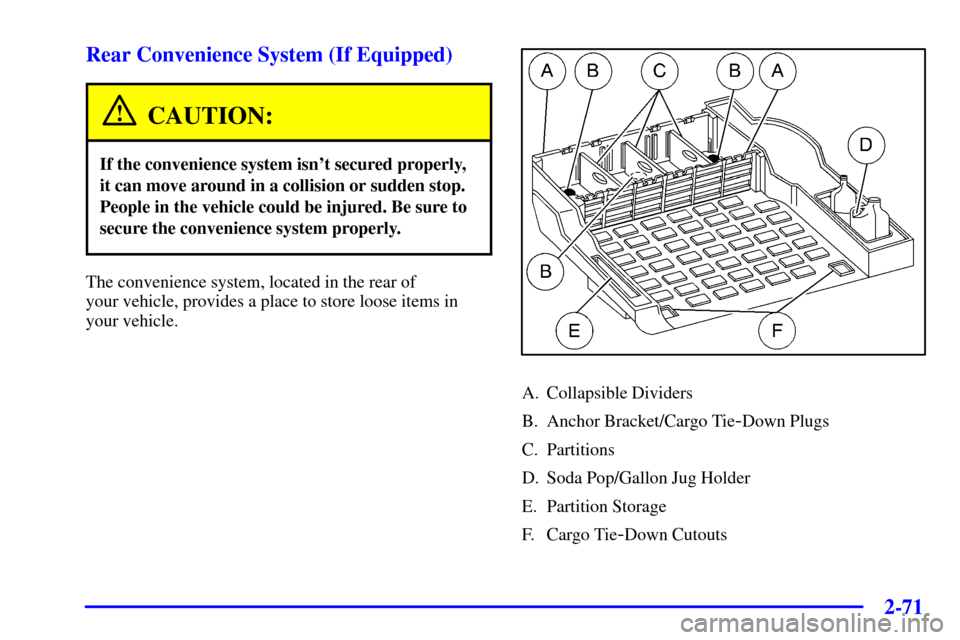
There are five cargo tie
downs in the rear of your
vehicle that allow you to
strap cargo in and keep it
from moving.
Page 137 of 488
2-71
Rear Convenience System (If Equipped)
CAUTION:
If the convenience system isn't secured properly,
it can move around in a collision or sudden stop.
People in the vehicle could be injured. Be sure to
secure the convenience system properly.
The convenience system, located in the rear of
your vehicle, provides a place to store loose items in
your vehicle.
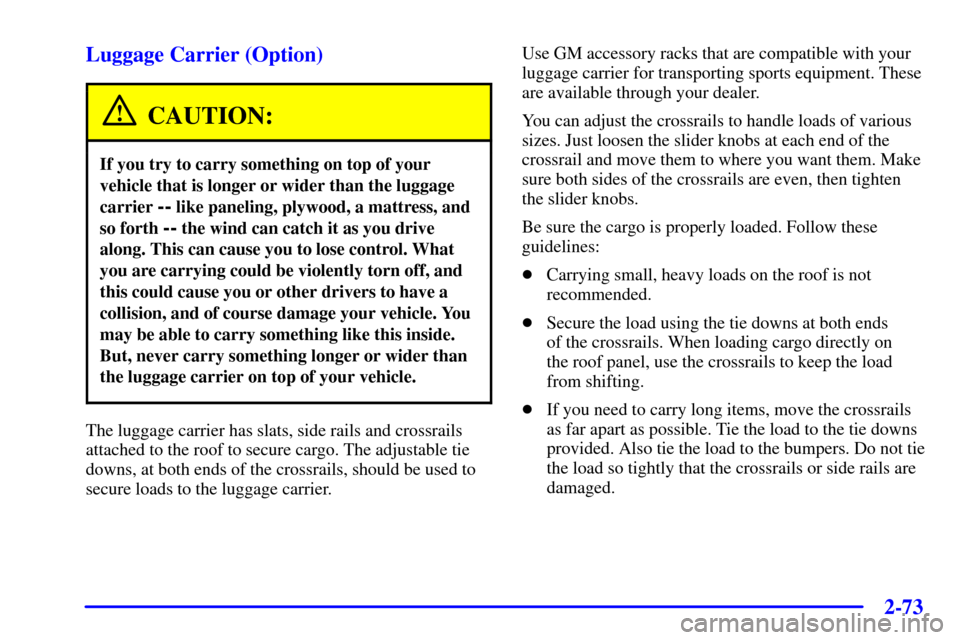
A. Collapsible Dividers
B. Anchor Bracket/Cargo Tie
-Down Plugs
C. Partitions
D. Soda Pop/Gallon Jug Holder
E. Partition Storage
F. Cargo Tie
-Down Cutouts
Page 139 of 488
2-73
Luggage Carrier (Option)
CAUTION:
If you try to carry something on top of your
vehicle that is longer or wider than the luggage
carrier
-- like paneling, plywood, a mattress, and
so forth
-- the wind can catch it as you drive
along. This can cause you to lose control. What
you are carrying could be violently torn off, and
this could cause you or other drivers to have a
collision, and of course damage your vehicle. You
may be able to carry something like this inside.
But, never carry something longer or wider than
the luggage carrier on top of your vehicle.
The luggage carrier has slats, side rails and crossrails
attached to the roof to secure cargo. The adjustable tie
downs, at both ends of the crossrails, should be used to
secure loads to the luggage carrier.Use GM accessory racks that are compatible with your
luggage carrier for transporting sports equipment. These
are available through your dealer.
You can adjust the crossrails to handle loads of various
sizes. Just loosen the slider knobs at each end of the
crossrail and move them to where you want them. Make
sure both sides of the crossrails are even, then tighten
the slider knobs.
Be sure the cargo is properly loaded. Follow these
guidelines:
�Carrying small, heavy loads on the roof is not
recommended.
�Secure the load using the tie downs at both ends
of the crossrails. When loading cargo directly on
the roof panel, use the crossrails to keep the load
from shifting.
�If you need to carry long items, move the crossrails
as far apart as possible. Tie the load to the tie downs
provided. Also tie the load to the bumpers. Do not tie
the load so tightly that the crossrails or side rails are
damaged.
Page 140 of 488
2-74
NOTICE:
Loading cargo that weighs more than 200 lbs.
(91 kg) on the luggage carrier may damage your
vehicle. When you carry large things, never let
them hang over the rear or the sides of your
vehicle. When loading cargo on the roof panel, be
sure it rests on the slats and does not scratch or
damage the vehicle.
Put the cargo against the side rails and fasten it
securely to the luggage carrier. Put the main
weight as far forward as you can and move the
rear crossrail forward as far as possible to keep
the load from shifting.
Don't exceed the maximum vehicle capacity when
loading your vehicle. For more information on vehicle
capacity and loading, see ªLoading Your Vehicleº in
the Index.
To prevent damage or loss of cargo as you're driving,
check now and then to make sure the luggage carrier and
cargo are still securely fastened.
Ashtrays and Cigarette Lighter
Pull the front ashtray door down to open it.
NOTICE:
Don't put papers and other things that burn into
your ashtray. If you do, cigarettes or other
smoking materials could set them on fire,
causing damage.
To remove the front ashtray, pull the bin upward.
To use the lighter, press it in all the way, and let go.
When it's ready, it will pop back out by itself.
NOTICE:
Don't hold a cigarette lighter in with your hand
while it is heating. If you do, it won't be able to
back away from the heating element when it's
ready. That can make it overload, damaging the
lighter and the heating element.
Page 163 of 488

2-97
Security Light
This light will come on
briefly when you turn the
key toward START. The
light will stay on until the
engine starts.
If the light flashes, the Passlock
� system has entered a
tamper mode. If the vehicle fails to start, see ªPasslockº
in the Index.
If the light comes on continuously while driving and
stays on, there may be a problem with the Passlock
system. Your vehicle will not be protected by Passlock,
and you should see your dealer.
Also, see ªContent Theft
-Deterrentº in the Index for
additional information regarding the SECURITY light.
Service Four-Wheel-Drive Warning Light
(If Equipped)
This light should come on
briefly when you turn on the
ignition, as a check to show
you it is working.
The SERVICE 4WD light comes on to indicate that
there may be a problem with the drive system and
service is required. Malfunctions can be indicated by the
system before any problem is apparent, which may
prevent serious damage to the vehicle. This system is
also designed to assist your service technician in
correctly diagnosing a malfunction.