Page 346 of 488

6-
6-1
Section 6 Service and Appearance Care
Here you will find information about the care of your vehicle. This section begins with service and fuel information,
and then it shows how to check important fluid and lubricant levels. There is also technical information about your
vehicle, and a part devoted to its appearance care.
6
-2 Service
6
-3 Fuel
6
-5 Fuels in Foreign Countries
6
-6 Filling Your Tank
6
-8 Filling a Portable Fuel Container
6
-8 Checking Things Under the Hood
6
-11 Engine Oil
6
-16 Engine Air Cleaner/Filter
6
-17 Automatic Transmission Fluid
6
-20 Manual Transmission Fluid
6
-21 Hydraulic Clutch
6
-22 Rear Axle
6
-23 Four-Wheel Drive (If Equipped)
6
-25 Engine Coolant
6
-29 Radiator Pressure Cap
6
-29 Power Steering Fluid
6
-30 Windshield Washer Fluid6
-32 Brakes
6
-36 Battery
6
-37 Bulb Replacement
6
-42 Windshield Wiper Blade Replacement
6
-45 Tires
6
-55 Appearance Care
6
-55 Cleaning the Inside of Your Vehicle
6
-58 Care of Safety Belts
6
-59 Cleaning the Outside of Your Vehicle
6
-63 GM Vehicle Care/Appearance Materials
6
-64 Vehicle Identification Number (VIN)
6
-64 Service Parts Identification Label
6
-65 Electrical System
6
-71 Replacement Bulbs
6
-71 Capacities and Specifications
6
-73 Normal Maintenance Replacement Parts
Page 355 of 488
6-10 Engine Compartment Overview
When you open the hood, you will see the following:
A. Battery
B. Coolant Recovery Tank
C. Engine Oil Dipstick
D. Engine Oil FillE. Automatic Transmission Dipstick
(If Equipped)
F. Power Steering Reservoir
G. Brake Master Cylinder ReservoirH. Engine Air Cleaner/Filter
I. Clutch Master Cylinder Reservoir
J. Engine Compartment Fuse Block
K. Windshield Washer Fluid Reservoir
Page 374 of 488
6-29
Radiator Pressure Cap
NOTICE:
Your radiator cap is a 15 psi (105 kPa)
pressure
-type cap and must be tightly installed to
prevent coolant loss and possible engine damage
from overheating. Be sure the arrows on the cap
line up with the overflow tube on the radiator
filler neck.
Power Steering Fluid
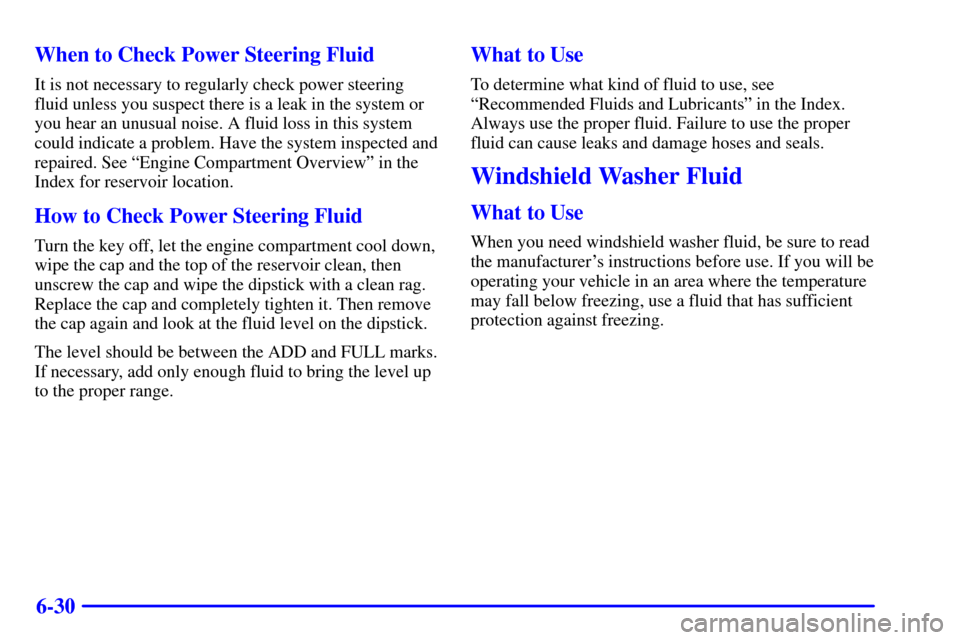
The power steering reservoir is located near the front
of the engine compartment on the driver's side of
the vehicle.
Page 375 of 488
6-30 When to Check Power Steering Fluid
It is not necessary to regularly check power steering
fluid unless you suspect there is a leak in the system or
you hear an unusual noise. A fluid loss in this system
could indicate a problem. Have the system inspected and
repaired. See ªEngine Compartment Overviewº in the
Index for reservoir location.
How to Check Power Steering Fluid
Turn the key off, let the engine compartment cool down,
wipe the cap and the top of the reservoir clean, then
unscrew the cap and wipe the dipstick with a clean rag.
Replace the cap and completely tighten it. Then remove
the cap again and look at the fluid level on the dipstick.
The level should be between the ADD and FULL marks.
If necessary, add only enough fluid to bring the level up
to the proper range.
What to Use
To determine what kind of fluid to use, see
ªRecommended Fluids and Lubricantsº in the Index.
Always use the proper fluid. Failure to use the proper
fluid can cause leaks and damage hoses and seals.
Windshield Washer Fluid
What to Use
When you need windshield washer fluid, be sure to read
the manufacturer's instructions before use. If you will be
operating your vehicle in an area where the temperature
may fall below freezing, use a fluid that has sufficient
protection against freezing.
Page 412 of 488
6-67
Fuse/Circuit
BreakerUsage
A Not Used
B Not Used
1 Not Used
2 Cigarette Lighter, Data
Link ConnectorFuse/Circuit
BreakerUsage
3 Cruise Control Module and
Switch, Body Control Module,
Heated Seats
4 Gages, Body Control Module,
Instrument Panel Cluster
5 Parking Lamps, Power Window
Switch, Body Control Module,
Ashtray Lamp
6 Steering Wheel Radio Controls
7 Headlamps Switch, Body Control
Module, Headlamp Relay
8 Courtesy Lamps, Battery
Run-Down Protection
9 HVAC Control Head (Manual)
10 Turn Signal
11 Cluster, Engine Control Module
12 Interior Lights
13 Auxiliary Power
Page 413 of 488
6-68
Fuse/Circuit
BreakerUsage
14 Power Locks Motor
15 4WD Switch, Engine Controls
(VCM, PCM, Transmission)
16 Supplemental Inflatable Restraint
17 Front Wiper
18 Steering Wheel Radio Controls
19 Radio, Battery
20 Amplifier
21 HVAC (Manual), HVAC I
(Automatic), HVAC
Sensors (Automatic)
22 Anti
-Lock Brakes
23 Rear Wiper
24 Radio, Ignition
Engine Compartment Fuse Block
The engine compartment fuse block is located under the
hood on the driver's side of the vehicle. See ªEngine
Compartment Overviewº in the Index for more
information on location. Before using this fuse block
picture and chart, check to see that it matches the fuse
block in your vehicle. If the fuse block pictured here is
different than your vehicle's, use the fuse block picture
and chart located later in this section.
Remove the cover by turning the fastener
counterclockwise. To reinstall the fuse panel cover, push
in and turn the fastener clockwise.
Page 468 of 488
7-50
Part C: Periodic Maintenance
Inspections
Listed in this part are inspections and services which
should be performed at least twice a year (for instance,
each spring and fall). You should let your dealer's
service department or other qualified service center
do these jobs. Make sure any necessary repairs are
completed at once.
Proper procedures to perform these services may be
found in a service manual. See ªService and Owner
Publicationsº in the Index.
Steering, Suspension and Front Drive Axle
Boot and Seal Inspection
Inspect the front and rear suspension and steering
system for damaged, loose or missing parts, signs of
wear or lack of lubrication. Inspect the power steering
lines and hoses for proper hook
-up, binding, leaks,
cracks, chafing, etc. Clean and then inspect the drive
axle boot seals for damage, tears or leakage. Replace
seals if necessary.
Exhaust System Inspection
Inspect the complete exhaust system. Inspect the body
near the exhaust system. Look for broken, damaged,
missing or out
-of-position parts as well as open seams,
holes, loose connections or other conditions which could
cause a heat build
-up in the floor pan or could let
exhaust fumes into the vehicle. See ªEngine Exhaustº in
the Index.
Fuel System Inspection
Inspect the complete fuel system for damage or leaks.
Engine Cooling System Inspection
Inspect the hoses and have them replaced if they are
cracked, swollen or deteriorated. Inspect all pipes,
fittings and clamps; replace as needed. Clean the outside
of the radiator and air conditioning condenser. To help
ensure proper operation, a pressure test of the cooling
system and pressure cap is recommended at least once
a year.
Page 470 of 488

7-52
Part D: Recommended Fluids and
Lubricants
Fluids and lubricants identified below by name,
part number or specification may be obtained from
your dealer.
USAGE
FLUID/LUBRICANT
Engine OilEngine oil with the American
Petroleum Institute Certified for
Gasoline Engines starburst symbol
of the proper viscosity. To
determine the preferred viscosity
for your vehicle's engine, see
ªEngine Oilº in the Index.
Engine Coolant50/50 mixture of clean, drinkable
water and use only GM
Goodwrench
� DEX-COOL� or
Havoline� DEX-COOL�
Coolant. See ªEngine Coolantº in
the Index.
USAGEFLUID/LUBRICANT
Hydraulic
Brake SystemDelco Supreme 11� Brake Fluid
(GM Part No. 12377967 or
equivalent DOT
-3 brake fluid).
Windshield
Washer SolventGM Optikleen� Washer
Solvent (GM Part No. 1051515)
or equivalent.
Hydraulic
Clutch SystemHydraulic Clutch Fluid
(GM Part No. 12345347 or
equivalent DOT
-3 brake fluid).
Parking Brake
Cable GuidesChassis Lubricant (GM Part
No. 12377985 or equivalent) or
lubricant meeting requirements
of NLGI # 2, Category LB
or GC
-LB.
Power
Steering SystemGM Power Steering Fluid
(GM Part No. 1052884
- 1 pint,
1050017
- 1 quart, or equivalent).