2002 CHEVROLET AVEO ABS
[x] Cancel search: ABSPage 1598 of 5127
Avoid needless heavy braking. Some people drive
in spurts−heavy acceleration followed by heavy
braking — rather than keeping pace with traffic. This is
a mistake. Your brakes may not have time to cool
between hard stops. Your brakes will wear out much
faster if you do a lot of heavy braking. If you keep pace
with the traffic and allow realistic following distances,
you will eliminate a lot of unnecessary braking.
That means better braking and longer brake life.
If your engine ever stops while you are driving, brake
normally but do not pump your brakes. If you do,
the pedal may get harder to push down. If your engine
stops, you will still have some power brake assist.
But you will use it when you brake. Once the power
assist is used up, it may take longer to stop and
the brake pedal will be harder to push.Anti-lock Brake System (ABS)
Your vehicle may have anti-lock brakes. ABS is an
advanced electronic braking system that will help
prevent a braking skid.
If your vehicle has anti-lock
brakes, this warning light
on the instrument panel will
come on briefly when
you start your vehicle.
4-7
Page 1599 of 5127
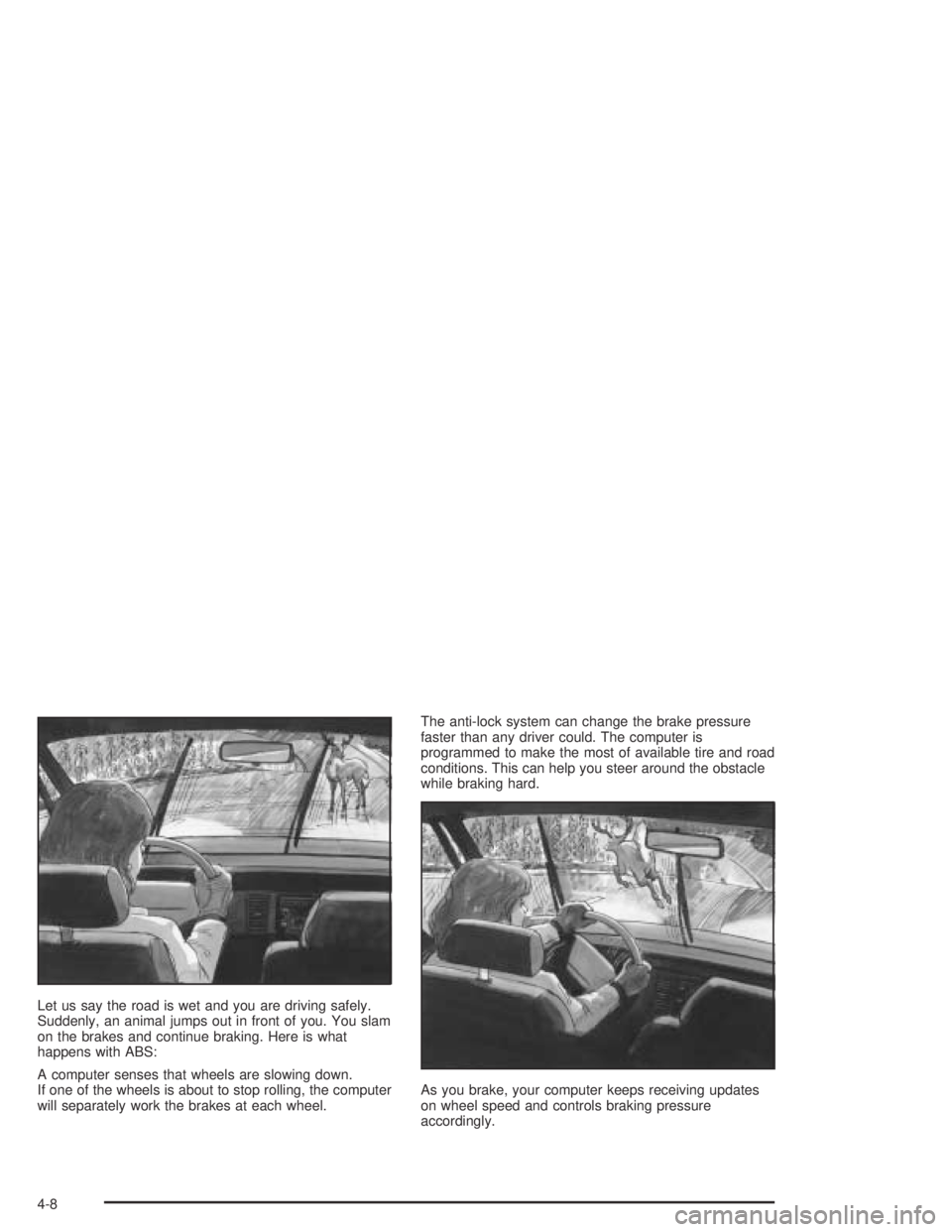
Let us say the road is wet and you are driving safely.
Suddenly, an animal jumps out in front of you. You slam
on the brakes and continue braking. Here is what
happens with ABS:
A computer senses that wheels are slowing down.
If one of the wheels is about to stop rolling, the computer
will separately work the brakes at each wheel.The anti-lock system can change the brake pressure
faster than any driver could. The computer is
programmed to make the most of available tire and road
conditions. This can help you steer around the obstacle
while braking hard.
As you brake, your computer keeps receiving updates
on wheel speed and controls braking pressure
accordingly.
4-8
Page 1716 of 5127
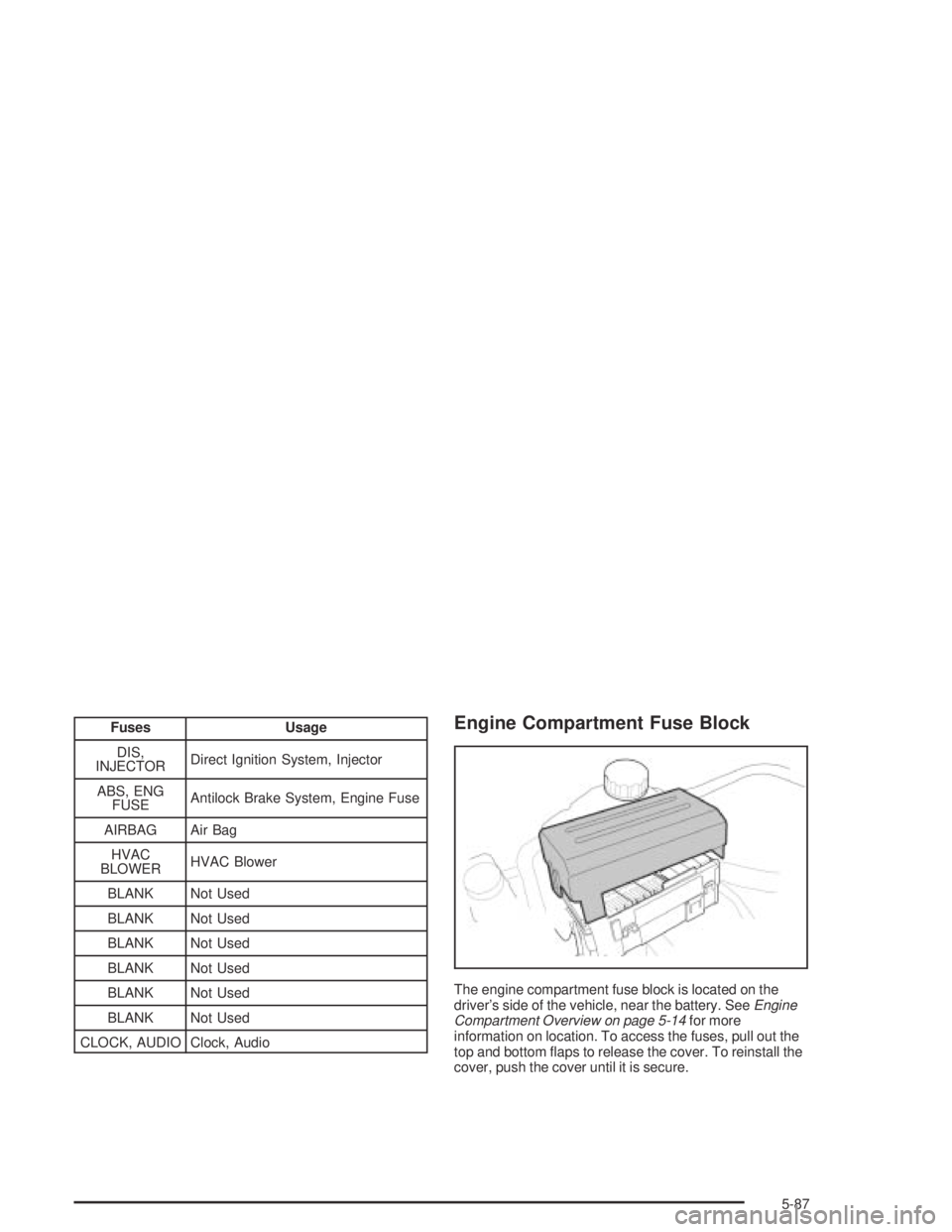
Fuses Usage
DIS,
INJECTORDirect Ignition System, Injector
ABS, ENG
FUSEAntilock Brake System, Engine Fuse
AIRBAG Air Bag
HVAC
BLOWERHVAC Blower
BLANK Not Used
BLANK Not Used
BLANK Not Used
BLANK Not Used
BLANK Not Used
BLANK Not Used
CLOCK, AUDIO Clock, AudioEngine Compartment Fuse Block
The engine compartment fuse block is located on the
driver’s side of the vehicle, near the battery. SeeEngine
Compartment Overview on page 5-14for more
information on location. To access the fuses, pull out the
top and bottom flaps to release the cover. To reinstall the
cover, push the cover until it is secure.
5-87
Page 1718 of 5127
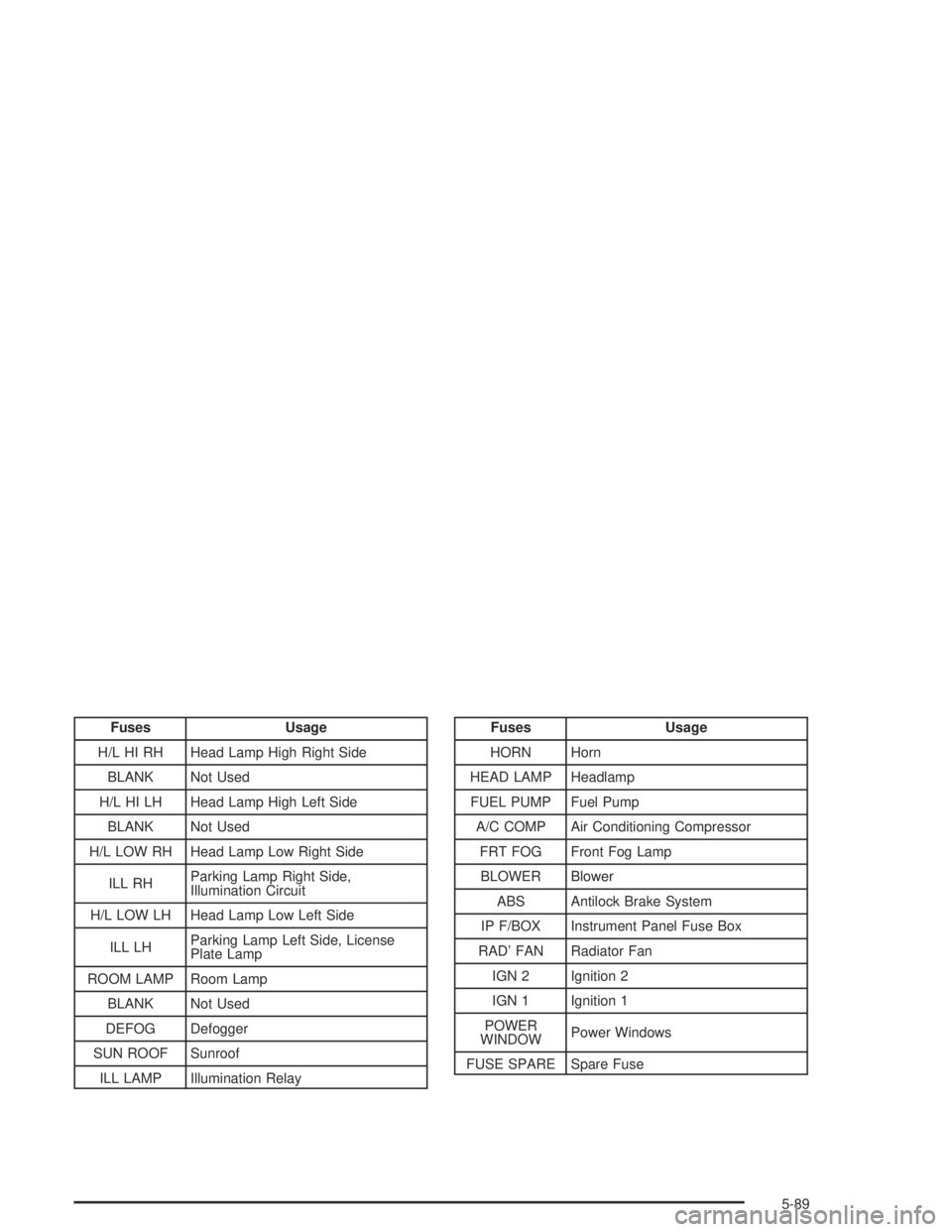
Fuses Usage
H/L HI RH Head Lamp High Right Side
BLANK Not Used
H/L HI LH Head Lamp High Left Side
BLANK Not Used
H/L LOW RH Head Lamp Low Right Side
ILL RHParking Lamp Right Side,
Illumination Circuit
H/L LOW LH Head Lamp Low Left Side
ILL LHParking Lamp Left Side, License
Plate Lamp
ROOM LAMP Room Lamp
BLANK Not Used
DEFOG Defogger
SUN ROOF Sunroof
ILL LAMP Illumination RelayFuses Usage
HORN Horn
HEAD LAMP Headlamp
FUEL PUMP Fuel Pump
A/C COMP Air Conditioning Compressor
FRT FOG Front Fog Lamp
BLOWER Blower
ABS Antilock Brake System
IP F/BOX Instrument Panel Fuse Box
RAD’ FAN Radiator Fan
IGN 2 Ignition 2
IGN 1 Ignition 1
POWER
WINDOWPower Windows
FUSE SPARE Spare Fuse
5-89
Page 1764 of 5127
A
Accessory Power Outlets.................................3-11
Adding Washer Fluid.......................................5-35
Additional Program Information........................... 7-9
Additives, Fuel................................................. 5-6
Add-On Electrical Equipment............................5-84
Adjusting the Speakers (Balance/Fade)......3-35, 3-37
Air Bag
Readiness Light..........................................3-26
Air Bag Systems.............................................1-50
How Does an Air Bag Restrain?....................1-56
Servicing Your Air Bag-Equipped Vehicle.........1-58
What Makes an Air Bag Inflate?....................1-55
What Will You See After an
Air Bag Inflates?......................................1-56
When Should an Air Bag Inflate?...................1-55
Where Are the Air Bags?..............................1-53
Air Cleaner/Filter, Engine.................................5-20
Airbag Sensing and Diagnostic Module (SDM)......... 7-9
AM ...............................................................3-43
AM-FM Radio.................................................3-34
Antenna, Backglass.........................................3-44
Anti-lock Brake System (ABS)............................ 4-7
Anti-Lock Brake, System Warning Light..............3-27Appearance Care............................................5-76
Care of Safety Belts....................................5-79
Chemical Paint Spotting...............................5-82
Cleaning the Inside of Your Vehicle................5-76
Cleaning the Outside of Your Vehicle..............5-79
Finish Damage............................................5-81
Sheet Metal Damage...................................5-81
Underbody Maintenance...............................5-82
Vehicle Care/Appearance Materials................5-82
Weatherstrips..............................................5-79
Arming the System.........................................2-15
Ashtrays........................................................3-12
Audio System(s).............................................3-34
AM-FM Radio.............................................3-34
Backglass Antenna......................................3-44
Care of Your CD Player...............................3-44
Care of Your CDs........................................3-44
Radio with CD............................................3-36
Theft-Deterrent Feature................................3-43
Understanding Radio Reception.....................3-43
Automatic Transaxle........................................2-20
Fluid..........................................................5-21
Operation...................................................2-22
Automatic Transaxle Inspection.........................6-20
Automatic Transaxle Shift Lock Control
System Check.............................................6-22
1
Page 1964 of 5127
Your Driving, the Road, and Your Vehicle..........4-2
Defensive Driving...........................................4-2
Drunken Driving.............................................4-3
Control of a Vehicle........................................4-6
Braking.........................................................4-6
Anti-Lock Brake System (ABS).........................4-7
Braking in Emergencies...................................4-8
Steering........................................................4-9
Off-Road Recovery.......................................4-11
Passing.......................................................4-11
Loss of Control.............................................4-13
Driving at Night............................................4-14
Driving in Rain and on Wet Roads..................4-15
City Driving..................................................4-17Freeway Driving...........................................4-18
Before Leaving on a Long Trip.......................4-19
Highway Hypnosis........................................4-20
Hill and Mountain Roads................................4-20
Winter Driving..............................................4-22
If Your Vehicle is Stuck in Sand, Mud,
Ice, or Snow.............................................4-26
Rocking Your Vehicle to Get It Out.................4-26
Loading Your Vehicle....................................4-27
Towing..........................................................4-34
Towing Your Vehicle.....................................4-34
Recreational Vehicle Towing...........................4-34
Towing a Trailer...........................................4-35
Section 4 Driving Your Vehicle
4-1
Page 1970 of 5127
If your engine ever stops while you are driving, brake
normally but do not pump your brakes. If you do,
the pedal may get harder to push down. If your engine
stops, you will still have some power brake assist.
But you will use it when you brake. Once the power
assist is used up, it may take longer to stop and
the brake pedal will be harder to push.
Adding non-GM accessories can affect your vehicle’s
performance. SeeAccessories and Modifications
on page 5-3.
Anti-Lock Brake System (ABS)
Your vehicle may have the Anti-Lock Brake System
(ABS), an advanced electronic braking system that will
help prevent a braking skid.
If your vehicle has ABS,
this warning light on the
instrument panel will come
on briefly when you
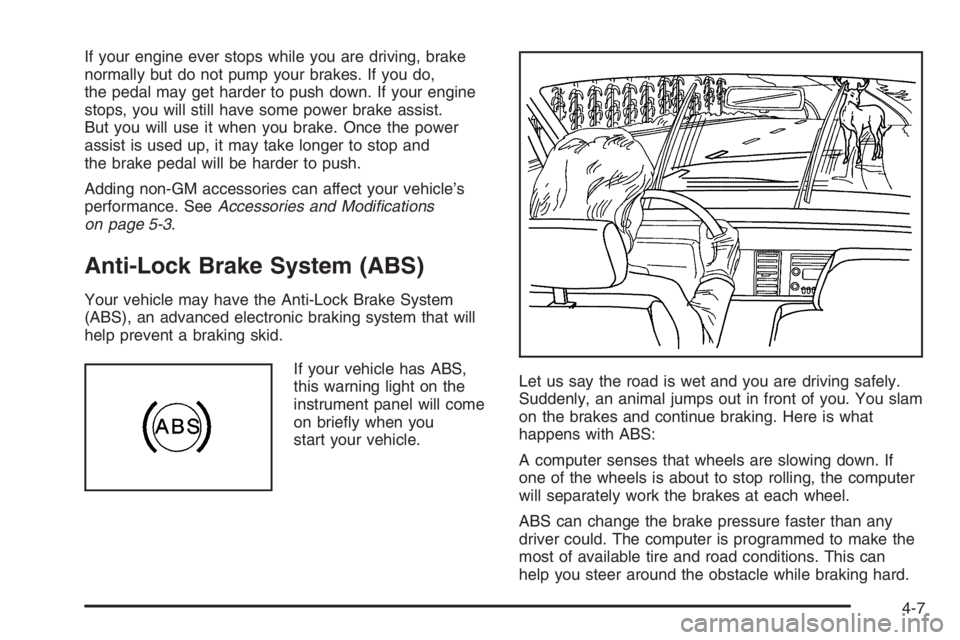
start your vehicle.Let us say the road is wet and you are driving safely.
Suddenly, an animal jumps out in front of you. You slam
on the brakes and continue braking. Here is what
happens with ABS:
A computer senses that wheels are slowing down. If
one of the wheels is about to stop rolling, the computer
will separately work the brakes at each wheel.
ABS can change the brake pressure faster than any
driver could. The computer is programmed to make the
most of available tire and road conditions. This can
help you steer around the obstacle while braking hard.
4-7
Page 1971 of 5127
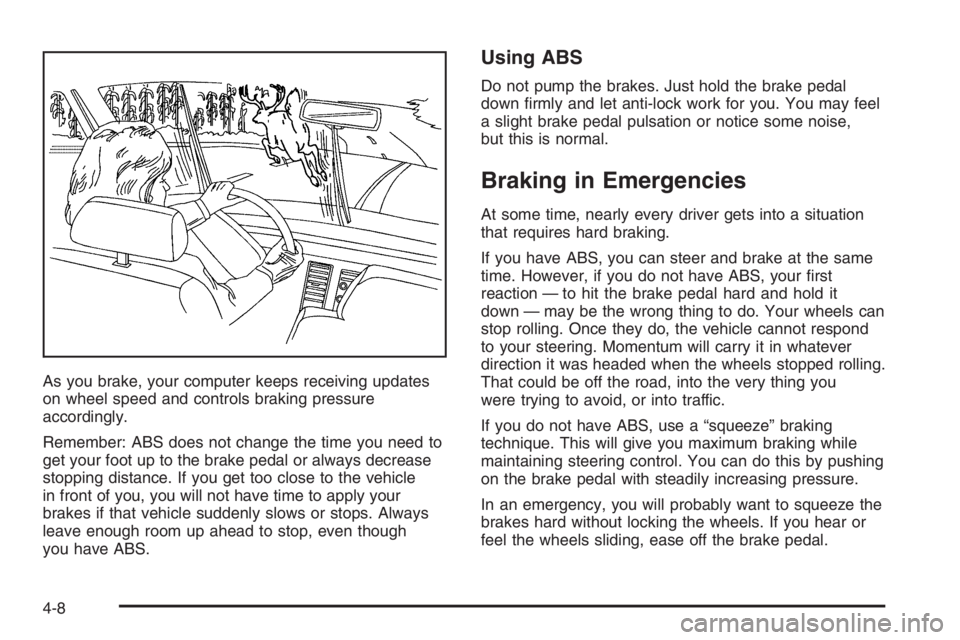
As you brake, your computer keeps receiving updates
on wheel speed and controls braking pressure
accordingly.
Remember: ABS does not change the time you need to
get your foot up to the brake pedal or always decrease
stopping distance. If you get too close to the vehicle
in front of you, you will not have time to apply your
brakes if that vehicle suddenly slows or stops. Always
leave enough room up ahead to stop, even though
you have ABS.
Using ABS
Do not pump the brakes. Just hold the brake pedal
down firmly and let anti-lock work for you. You may feel
a slight brake pedal pulsation or notice some noise,
but this is normal.
Braking in Emergencies
At some time, nearly every driver gets into a situation
that requires hard braking.
If you have ABS, you can steer and brake at the same
time. However, if you do not have ABS, your first
reaction — to hit the brake pedal hard and hold it
down — may be the wrong thing to do. Your wheels can
stop rolling. Once they do, the vehicle cannot respond
to your steering. Momentum will carry it in whatever
direction it was headed when the wheels stopped rolling.
That could be off the road, into the very thing you
were trying to avoid, or into traffic.
If you do not have ABS, use a “squeeze” braking
technique. This will give you maximum braking while
maintaining steering control. You can do this by pushing
on the brake pedal with steadily increasing pressure.
In an emergency, you will probably want to squeeze the
brakes hard without locking the wheels. If you hear or
feel the wheels sliding, ease off the brake pedal.
4-8