Page 82 of 399
2-25
3. If your engine still won't start (or starts but then
stops), it could be flooded with too much gasoline.
Try pushing your accelerator pedal all the way to
the floor and holding it there as you hold the key in
START for about three seconds. If the vehicle starts
briefly but then stops again, do the same thing.
NOTICE:
Your engine is designed to work with the
electronics in your vehicle. If you add electrical
parts or accessories, you could change the way
the engine operates. Before adding electrical
equipment, check with your dealer. If you don't,
your engine might not perform properly.
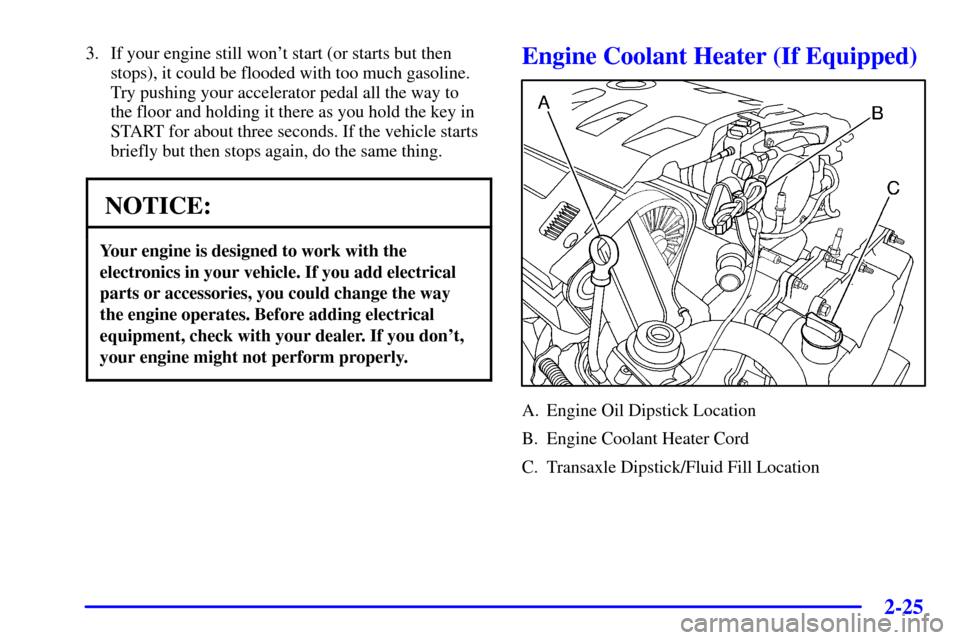
Engine Coolant Heater (If Equipped)
A. Engine Oil Dipstick Location
B. Engine Coolant Heater Cord
C. Transaxle Dipstick/Fluid Fill Location
Page 83 of 399
2-26
In very cold weather, 0�F (-18�C) or colder,
the engine coolant heater can help. You'll get easier
starting and better fuel economy during engine
warm
-up. Usually, the coolant heater should be
plugged in a minimum of four hours prior to starting
your vehicle. At temperatures above 32�F (0�C),
use of the coolant heater is not required.
To Use the Engine Coolant Heater
1. Turn off the engine.
2. Open the hood and unwrap the electrical cord.
The electrical cord is located on the driver's side of
the engine, behind the transaxle dipstick/fluid fill
location (C) and next to the engine.
3. Plug it into a normal, grounded 110
-volt AC outlet.
CAUTION:
Plugging the cord into an ungrounded outlet
could cause an electrical shock. Also, the wrong
kind of extension cord could overheat and cause
a fire. You could be seriously injured. Plug the
cord into a properly grounded three
-prong
11 0
-volt AC outlet. If the cord won't reach, use a
heavy
-duty three-prong extension cord rated for
at least 15 amps.
4. Before starting the engine, be sure to unplug
and store the cord as it was before to keep it away
from moving engine parts. If you don't, it could
be damaged.
How long should you keep the coolant heater plugged in?
The answer depends on the outside temperature, the
kind of oil you have, and some other things. Instead of
trying to list everything here, we ask that you contact
your dealer in the area where you'll be parking your
vehicle. The dealer can give you the best advice for that
particular area.
Page 149 of 399

2-92
CHANGE BRAKE PADS - 125: This message is used
to notify you that the brake pads may have worn down.
A sensor is connected to the brake pads and is triggered
when they wear to a certain point. Have the front and
rear brakes serviced by your dealer as soon as possible.
CHANGE ENGINE OIL
- 82: This means that
the life of the engine oil has expired and it should be
changed within 200 miles. See ªEngine Oilº and ªFilter
Recommendationsº in the Index. After an oil change,
the Oil Life Indicator must be reset. See ªOil Life
Indicator, How to Resetº in the Index.
CHANGE TRANS FLUID
- 47: This message will
appear when it is time to replace the transaxle fluid.
See ªMaintenance Scheduleº in the Index for the
proper fluid and change intervals.
CHECK BRAKE FLUID
- 37: This message will
display if the ignition is in ON to inform the driver
that the brake fluid level is low. Have the brake
system serviced by a technician as soon as possible.
See ªBrake System Warning Lightº in the Index.
CHECK COOLANT LEVEL
- 2: This message
will appear when there is a low level of engine coolant.
Have the cooling system serviced by a technician as
soon as possible.CHECK FUEL GAGE
- 50: This message will appear
when the fuel supply is less than 5 gallons (18.9 L) and
the display is turned off. A single chime will also sound
when this message is displayed.
CHECK GAS CAP
- 61: This message will appear
if the gas cap has not been fully tightened. You should
recheck your gas cap to ensure that it's on properly.
CHECK OIL LEVEL
- 36: For correct operation of
the low oil sensing system, your vehicle should be on
a level surface. A false CHECK OIL LEVEL message
may appear if the vehicle is parked on grades. The oil
level sensing system does not check for actual oil level
if the engine has been off for a short period of time,
and the oil level is never sensed while the engine is
running. If the CHECK OIL LEVEL message appears,
and your vehicle has been parked on level ground with
the engine off for at least 30 minutes, the oil level
should be checked by observing the oil dipstick.
Prior to checking the oil level, be sure the engine has
been off for a few minutes and your vehicle is on a
level surface. Then check the dipstick and add oil
if necessary. See ªEngine Oilº in the Index.
Page 292 of 399
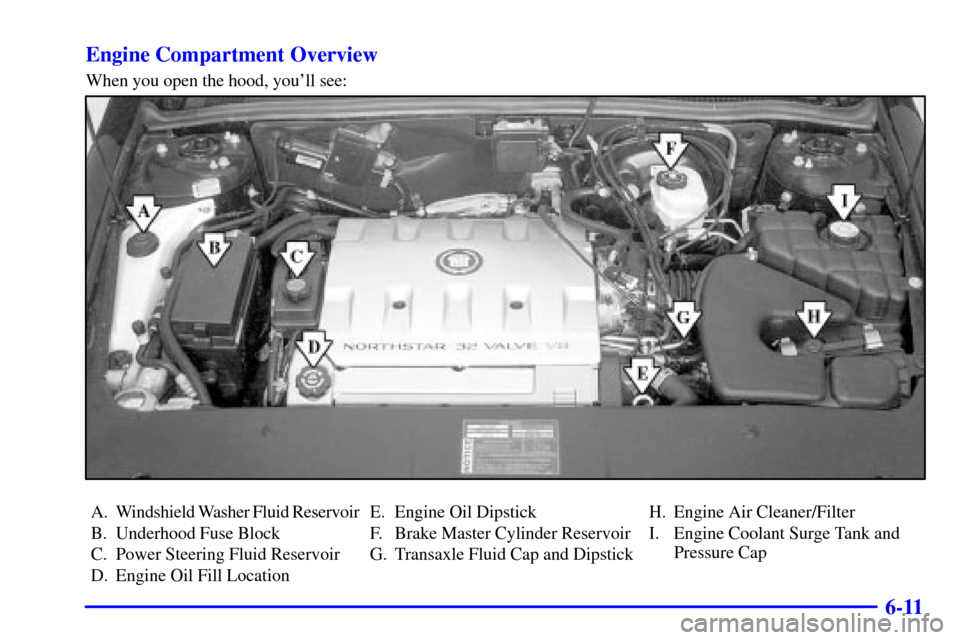
6-11 Engine Compartment Overview
When you open the hood, you'll see:
A. Windshield Washer Fluid Reservoir
B. Underhood Fuse Block
C. Power Steering Fluid Reservoir
D. Engine Oil Fill LocationE. Engine Oil Dipstick
F. Brake Master Cylinder Reservoir
G. Transaxle Fluid Cap and DipstickH. Engine Air Cleaner/Filter
I. Engine Coolant Surge Tank and
Pressure Cap
Page 293 of 399
6-12
Before closing the hood, be sure all filler caps are on
properly. Then pull the hood down and close it firmly.
Underhood Lamp
Turn the parking lamps on to operate the underhood
lamp. The underhood lamp will come on when the hood
is opened.
Engine Oil
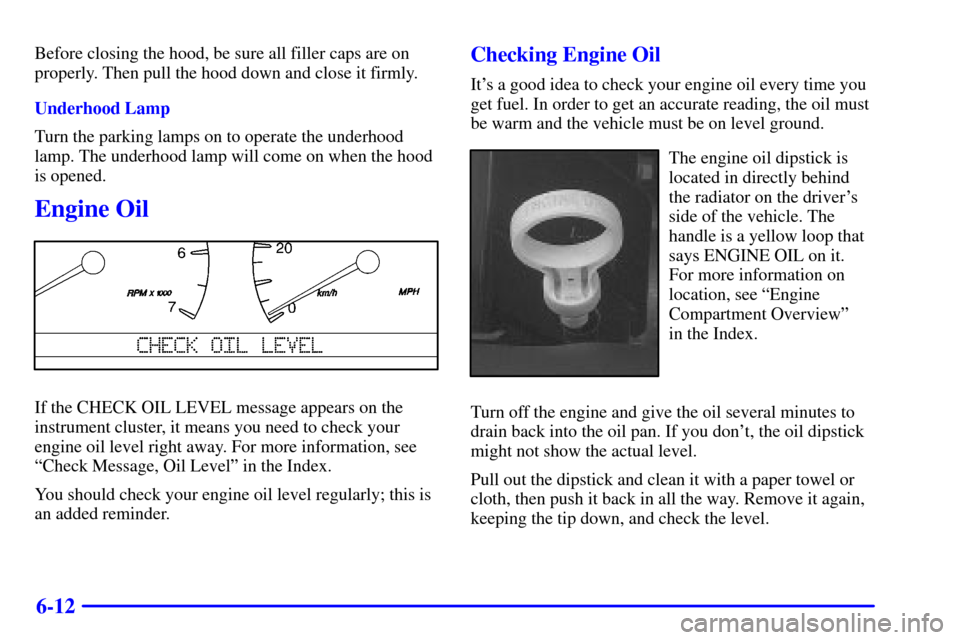
If the CHECK OIL LEVEL message appears on the
instrument cluster, it means you need to check your
engine oil level right away. For more information, see
ªCheck Message, Oil Levelº in the Index.
You should check your engine oil level regularly; this is
an added reminder.
Checking Engine Oil
It's a good idea to check your engine oil every time you
get fuel. In order to get an accurate reading, the oil must
be warm and the vehicle must be on level ground.
The engine oil dipstick is
located in directly behind
the radiator on the driver's
side of the vehicle. The
handle is a yellow loop that
says ENGINE OIL on it.
For more information on
location, see ªEngine
Compartment Overviewº
in the Index.
Turn off the engine and give the oil several minutes to
drain back into the oil pan. If you don't, the oil dipstick
might not show the actual level.
Pull out the dipstick and clean it with a paper towel or
cloth, then push it back in all the way. Remove it again,
keeping the tip down, and check the level.
Page 294 of 399
6-13
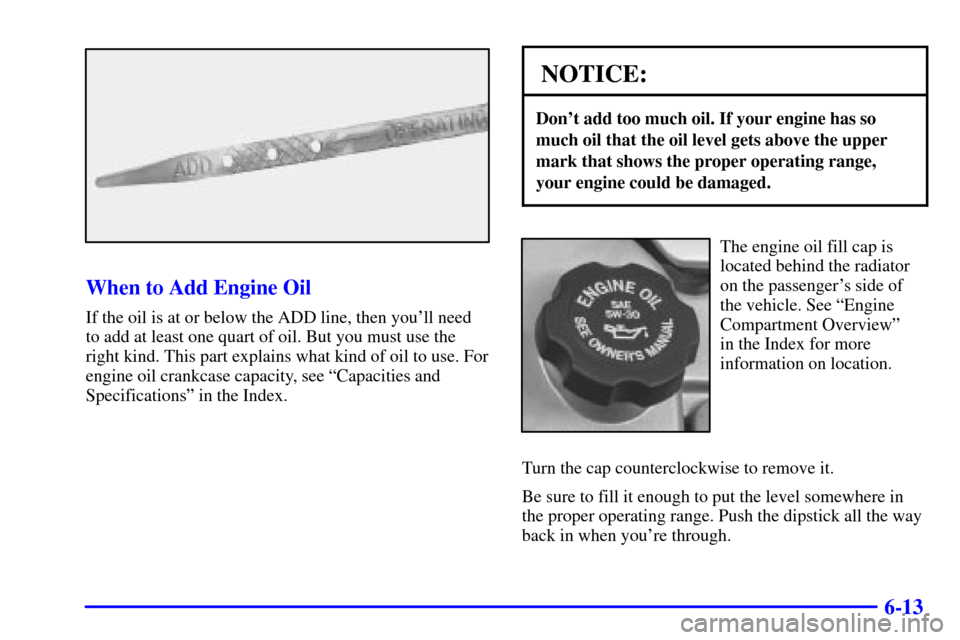
When to Add Engine Oil
If the oil is at or below the ADD line, then you'll need
to add at least one quart of oil. But you must use the
right kind. This part explains what kind of oil to use. For
engine oil crankcase capacity, see ªCapacities and
Specificationsº in the Index.
NOTICE:
Don't add too much oil. If your engine has so
much oil that the oil level gets above the upper
mark that shows the proper operating range,
your engine could be damaged.
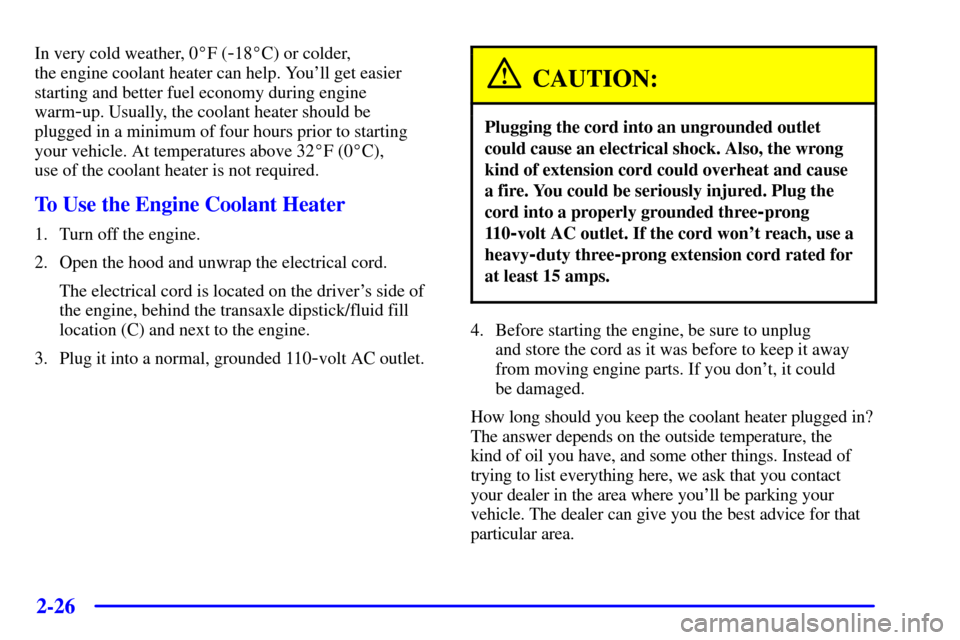
The engine oil fill cap is
located behind the radiator
on the passenger's side of
the vehicle. See ªEngine
Compartment Overviewº
in the Index for more
information on location.
Turn the cap counterclockwise to remove it.
Be sure to fill it enough to put the level somewhere in
the proper operating range. Push the dipstick all the way
back in when you're through.
Page 301 of 399
6-20
Automatic Transaxle Fluid
When to Check and Change
A good time to check your automatic transaxle fluid
level is when the engine oil is changed.
Change both the fluid and filter every 50,000 miles
(83 000 km) if the vehicle is mainly driven under one or
more of these conditions:
�In heavy city traffic where the outside temperature
regularly reaches 90�F (32�C) or higher.
�In hilly or mountainous terrain.
�When doing frequent trailer towing.
�Uses such as found in taxi, police or delivery service.
If you do not use your vehicle under any of these
conditions, the fluid and filter do not require change
until the message CHANGE TRANS FLUID appears on
the Driver Information Center.
See ªScheduled Maintenance Servicesº in the Index.
How to Check
Because this operation can be a little difficult, you
may choose to have this done at the dealership
service department.
If you do it yourself, be sure to follow all the instructions
here, or you could get a false reading on the dipstick.
NOTICE:
Too much or too little fluid can damage your
transaxle. Too much can mean that some of the
fluid could come out and fall on hot engine parts
or exhaust system parts, starting a fire. Too little
fluid could cause the transaxle to overheat. Be
sure to get an accurate reading if you check your
transaxle fluid.