Page 252 of 417

4-49
Your warranty does not cover parts or components that
fail because of overloading.
The label will help you decide how much cargo and
installed equipment your truck can carry.
Using heavier suspension components to get added
durability might not change your weight ratings. Ask
your dealer to help you load your vehicle the right way.
If you put things inside your vehicle
-- like suitcases,
tools, packages, or anything else
-- they go as fast as
the vehicle goes. If you have to stop or turn quickly, or
if there is a crash, they'll keep going.
CAUTION:
Things you put inside your vehicle can strike
and injure people in a sudden stop or turn, or in
a crash.
�Put things in the cargo area of your vehicle.
Try to spread the weight evenly.
�Never stack heavier things, like suitcases,
inside the vehicle so that some of them are
above the tops of the seats.
�Don't leave an unsecured child restraint in
your vehicle.
�When you carry something inside the
vehicle, secure it whenever you can.
�Don't leave a seat folded down unless you
need to.
There's also important loading information for off-road
driving in this manual. See ªLoading Your Vehicle for
Off
-Road Drivingº in the Index.
Page 259 of 417
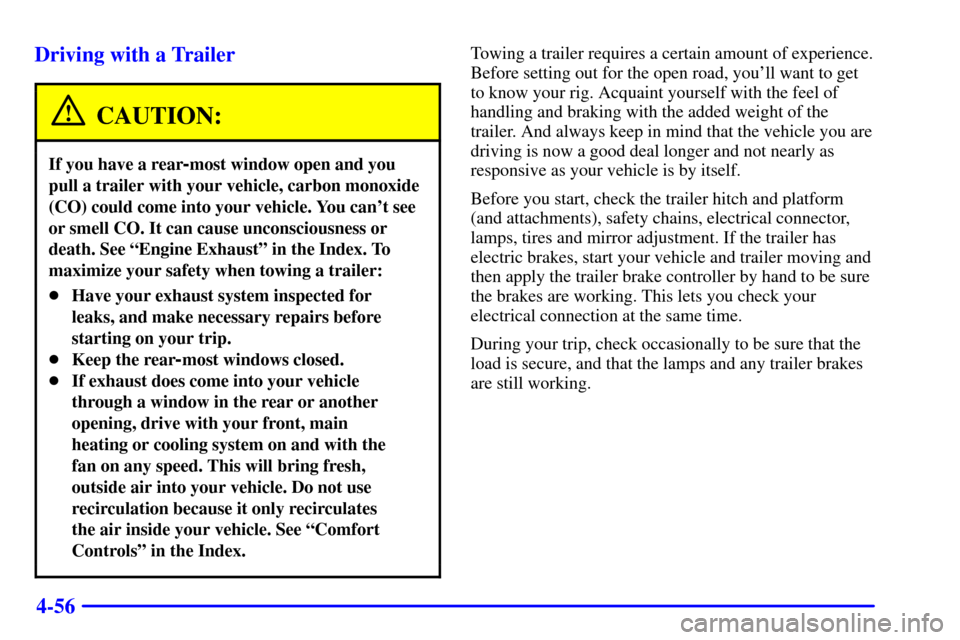
4-56 Driving with a Trailer
CAUTION:
If you have a rear-most window open and you
pull a trailer with your vehicle, carbon monoxide
(CO) could come into your vehicle. You can't see
or smell CO. It can cause unconsciousness or
death. See ªEngine Exhaustº in the Index. To
maximize your safety when towing a trailer:
�Have your exhaust system inspected for
leaks, and make necessary repairs before
starting on your trip.
�Keep the rear
-most windows closed.
�If exhaust does come into your vehicle
through a window in the rear or another
opening, drive with your front, main
heating or cooling system on and with the
fan on any speed. This will bring fresh,
outside air into your vehicle. Do not use
recirculation because it only recirculates
the air inside your vehicle. See ªComfort
Controlsº in the Index.
Towing a trailer requires a certain amount of experience.
Before setting out for the open road, you'll want to get
to know your rig. Acquaint yourself with the feel of
handling and braking with the added weight of the
trailer. And always keep in mind that the vehicle you are
driving is now a good deal longer and not nearly as
responsive as your vehicle is by itself.
Before you start, check the trailer hitch and platform
(and attachments), safety chains, electrical connector,
lamps, tires and mirror adjustment. If the trailer has
electric brakes, start your vehicle and trailer moving and
then apply the trailer brake controller by hand to be sure
the brakes are working. This lets you check your
electrical connection at the same time.
During your trip, check occasionally to be sure that the
load is secure, and that the lamps and any trailer brakes
are still working.
Page 291 of 417
5-27
Front Position
3. Make sure the jack
head is positioned
so that the rear axle
is resting securely
between the grooves
that are on the jack
head. Turn the wheel
wrench clockwise to
raise the vehicle.
Rear Position
Raise the vehicle far enough off the ground so there is
enough room for the spare tire to fit back underneath the
rear of the vehicle.
Page 296 of 417
5-32
Store the tire under the rear of the vehicle in the spare
tire carrier. To store the tire do the following:
1. Put the tire on the ground at the rear of the vehicle
with the valve stem pointed upward.
2. Tilt the retainer downward and through the wheel
opening. Make sure the retainer is fully seated across
the underside of the wheel.
3. Attach the wheel wrench and extensions together.
Insert the hoist end through the hole in the rear
bumper and into the hoist shaft.
4. Raise the tire part way upward. Make sure the
retainer is seated in the wheel opening.
5. Raise the tire fully against the underside of the
vehicle. Continue turning the wheel wrench until the
tire is secure and the cable is tight. The spare tire
hoist cannot be overtightened.
6. Make sure the tire is stored securely. Push, pull, and
then try to rotate or turn the tire. If the tire moves,
use the wheel wrench to tighten the cable.
Replace the jack, tools and spare tire lock.
Page 298 of 417
5-34
Rear Access Panel
A. Speaker
B. Bottle Jack
C. Wing NutD. Retaining Hook
E. Wheel Blocks
F. Cover Panel1. Put the tool kit, with the jack tools and gloves,
in the tool bag and place in the retaining clip under
the driver's side second seat.
2. Tighten down with the wing nut.
3. Then, assemble wheel blocks and bottle jack
together with the wing nut and retaining hook.
4. Position behind the jack storage cover in the left
rear side panel just below the speaker and tighten,
adjusting clockwise until the jack is secured tight in
the mounting bracket.
Page 352 of 417

6-51 Tire Inspection and Rotation
Tires should be rotated every 6,000 to 8,000 miles
(10 000 to 13 000 km). Any time you notice unusual
wear, rotate your tires as soon as possible and check
wheel alignment. Also check for damaged tires or
wheels. See ªWhen It's Time for New Tiresº and
ªWheel Replacementº later in this section for more
information. Make sure the spare tire is stored securely.
Push, pull, and then try to rotate or turn the tire. If it
moves, use the wheel wrench to tighten the cable. See
ªStoring a Flat or Spare Tire and Toolsº in the Index.
The purpose of regular rotation is to achieve more
uniform wear for all tires on the vehicle. The first
rotation is the most important. See ªScheduled
Maintenance Servicesº in the Index for scheduled
rotation intervals.
When rotating your tires, always use the correct rotation
pattern shown here. Don't include the spare tire in your
tire rotation.
After the tires have been rotated, adjust the front
and rear inflation pressures as shown on the
Certification/Tire label. Make certain that all wheel nuts
are properly tightened. See ªWheel Nut Torqueº in
the Index.
Page 396 of 417

7-18
Also look for any opened or broken air bag coverings,
and have them repaired or replaced. (The air bag system
does not need regular maintenance.)
Wiper Blade Check
Inspect wiper blades for wear or cracking. Replace blade
inserts that appear worn or damaged or that streak or
miss areas of the windshield. Also see ªWiper Blades,
Cleaningº in the Index.
Spare Tire Check
At least twice a year, after the monthly inflation check
of the spare tire determines that the spare is inflated
to the correct tire inflation pressure, make sure that the
spare tire is stored securely. Push, pull, and then try
to rotate or turn the tire. If it moves, use the wheel
wrench/ratchet to tighten the cable. See ªStoring the
Spare Tire and Toolsº in the Index.
Engine Air Cleaner Filter Restriction Indicator Check
Your vehicle has an indicator located on the air cleaner
in the engine compartment that lets you know when the
air cleaner filter is dirty and needs to be changed. Check
indicator at least twice a year or when your engine oil is
changed, whichever occurs first. See ªAir Cleanerº in
the Index for more information. Inspect your air cleaner
filter restriction indicator more often if the vehicle is
used in dusty areas or under off road conditions.Weatherstrip Lubrication
Silicone grease on weatherstrips will make them last
longer, seal better, and not stick or squeak. Apply
silicone grease with a clean cloth. During very cold,
damp weather more frequent application may be
required. See ªRecommended Fluids and Lubricantsº
in the Index.
Automatic Transmission Check
Check the transmission fluid level; add if needed.
See ªAutomatic Transmission Fluidº in the Index.
A fluid loss may indicate a problem. Check the system
and repair if needed.
At Least Once a Year
Key Lock Cylinders Service
Lubricate the key lock cylinders with the lubricant
specified in Part D.
Body Lubrication Service
Lubricate all hood latch assembly, secondary latch,
pivots, spring anchor, release pawl, rear compartment
hinges, outer liftgate handle pivot points, liftgate
handle pivot points, latch bolt, fuel door hinge, and
folding seat hardware. Part D tells you what to use.
More frequent lubrication may be required when
exposed to a corrosive environment.


