Page 83 of 417
2-4
Keys
CAUTION:
Leaving children in a vehicle with the ignition
key is dangerous for many reasons. A child or
others could be badly injured or even killed.
They could operate the power windows or
other controls or even make the vehicle move.
Don't leave the keys in a vehicle with children.
Page 91 of 417

2-12
Liftgate/Liftglass
CAUTION:
It can be dangerous to drive with the liftgate or
liftglass open because carbon monoxide (CO) gas
can come into your vehicle. You can't see or smell
CO. It can cause unconsciousness and even death.
If you must drive with the liftgate or liftglass
open or if electrical wiring or other cable
connections must pass through the seal between
the body and the liftgate or liftglass:
�Make sure all other windows are shut.
�Turn the fan on your heating or cooling
system to its highest speed with the setting
on VENT or OUTSIDE AIR. That will
force outside air into your vehicle.
See ªComfort Controlsº in the Index.
�If you have air outlets on or under the
instrument panel, open them all the way.
See ªEngine Exhaustº in the Index.
To open a mechanical lock system from the outside,
insert the key into the lock and turn it counterclockwise
to unlock the liftgate and liftglass.
The liftglass can be opened using the pushbutton on the
liftgate after the doors have been unlocked. This can be
done by using either the power door locks or the remote
keyless entry system.
To open the entire liftgate, lift the handle located in the
center of the door.
To lock a power lock system from the outside, insert the
key into the lock button and turn it clockwise. All doors
will lock. You may also use the keyless entry system or
the power door locks to lock the liftgate and liftglass.
Page 92 of 417

2-13
Theft
Vehicle theft is big business, especially in some cities.
Although your vehicle has a number of theft
-deterrent
features, we know that nothing we put on it can make
it impossible to steal. However, there are ways you
can help.
Key in the Ignition
If you leave your vehicle with the keys inside, it's an
easy target for joy riders or professional thieves
-- so
don't do it.
When you park your vehicle and open the driver's door,
you'll hear a chime reminding you to remove your key
from the ignition and take it with you. Always do this.
Your ignition and transmission will be locked. Also
remember to lock the doors.
If the key is in the ignition, with any door open, and you
try to lock your doors with the power door locks, the
driver's door will not stay locked. This will help to keep
you from locking your keys in the vehicle.
Parking at Night
Park in a lighted spot, close all windows and lock your
vehicle. Remember to keep your valuables out of sight.
Put them in a storage area, or take them with you.
Parking Lots
Even if you park in a lot where someone will be
watching your vehicle, it's still best to lock it up and
take your keys. But what if you have to leave your
ignition key? What if you have to leave something
valuable in your vehicle?
�Put your valuables in a storage area, like your
glove box.
�Valuables can be locked in the center floor console.
�Take the remote keyless entry system transmitter
with you.
�Lock all the doors except the driver's.
Page 94 of 417

2-15 Testing the Alarm
The alarm can be tested by following these steps:
1. From inside the vehicle, lower the driver's window
and open the driver's door.
2. Activate the system by locking the doors with the
power door lock switch while the door is open, or
with the remote keyless entry transmitter.
3. Get out of the vehicle, close the door and wait for the
SECURITY message to go out.
4. Then reach in through the window, unlock the
door with the manual door lock and open the door.
This should set off the alarm.
If the alarm does not sound when it should but the
vehicle's headlamps flash, check to see if the horn
works. The horn fuse may be blown. To replace the
fuse, see ªFuses and Circuit Breakersº in the Index.
If the alarm does not sound or the vehicle's headlamps
do not flash, the vehicle should be serviced by an
authorized service center.
Passlock�
Your vehicle is equipped with the Passlock
theft
-deterrent system.
Passlock is a passive theft
-deterrent system. Passlock
enables fuel if the ignition lock cylinder is turned with a
valid key. If a correct key is not used or the ignition lock
cylinder is tampered with, fuel is disabled.
If the engine stalls and the SECURITY message flashes,
wait until the light stops flashing before trying to restart
the engine. Remember to release the key from START
as soon as the engine starts.
If the engine is running and the SECURITY message
comes on, you will be able to restart the engine if you
turn the engine off. However, your Passlock system is
not working properly and must be serviced by your
dealer. Your vehicle is not protected by Passlock at this
time. You may also want to check the fuse (see ªFuses
and Circuit Breakersº in the Index). See your dealer
for service.
In an emergency, call the Cadillac Roadside Service
Center. See ªRoadside Serviceº in the Index.
Page 95 of 417

2-16
New Vehicle ªBreak-Inº
NOTICE:
Your vehicle doesn't need an elaborate
ªbreak
-in.º But it will perform better in the
long run if you follow these guidelines:
�Keep your speed at 55 mph (88 km/h) or
less for the first 500 miles (805 km).
�Don't drive at any one speed
-- fast or
slow
-- for the first 500 miles (805 km).
Don't make full
-throttle starts.
�Avoid making hard stops for the first
200 miles (322 km) or so. During this time
your new brake linings aren't yet broken
in. Hard stops with new linings can mean
premature wear and earlier replacement.
Follow this breaking
-in guideline every
time you get new brake linings.
�Don't tow a trailer during break
-in.
See ªTowing a Trailerº in the Index for
more information.
Ignition Positions
You can use your key to turn the ignition switch to
five different positions.
(A) ACCESSORY: This position lets you use things
like the radio, power windows and the windshield wipers
when the engine is off. Push in the key and turn it
toward you.
(B) LOCK: This position locks your ignition and
transmission. It's a theft
-deterrent feature. You will only
be able to remove your key when the ignition is turned
to LOCK.
Page 96 of 417

2-17
NOTICE:
If your key seems stuck in LOCK and you can't
turn it, be sure you are using the correct key; if
so, is it all the way in? Turn the key only with
your hand. Using a tool to force it could break
the key or the ignition switch. If none of this
works, then your vehicle needs service.
(C) OFF:This lets you turn off the engine. Use OFF if
you must have your vehicle in motion while the engine
is off (for example, if your vehicle is being pushed).
(D) RUN: This is the position for driving.
(E) START: This position starts your engine.
Retained Accessory Power (RAP)
The Retained Accessory Power (RAP) feature will allow
certain features on your vehicle to continue to work up
to 20 minutes after the ignition key is turned to OFF,
or a door is opened.
Your radio, power windows, sunroof (if equipped) and
OnStar System (if equipped) will also work when the
ignition key is in RUN or ACCESSORY.
Starting Your Engine
Move your shift lever to PARK (P) or NEUTRAL (N).
Your engine won't start in any other position
-- that's a
safety feature. To restart when you're already moving,
use NEUTRAL (N) only.
NOTICE:
Don't try to shift to PARK (P) if your vehicle
is moving. If you do, you could damage the
transmission. Shift to PARK (P) only when
your vehicle is stopped.
1. With your foot off the accelerator pedal, turn the
ignition key to START. When the engine starts, let
go of the key. The idle speed will go down as your
engine gets warm.
Page 107 of 417
2-28
Parking Over Things That Burn
CAUTION:
Things that can burn could touch hot exhaust
parts under your vehicle and ignite. Don't park
over papers, leaves, dry grass or other things that
can burn.
Engine Exhaust
CAUTION:
Engine exhaust can kill. It contains the gas
carbon monoxide (CO), which you can't see or
smell. It can cause unconsciousness and death.
You might have exhaust coming in if:
�Your exhaust system sounds strange
or different.
�Your vehicle gets rusty underneath.
�Your vehicle was damaged in a collision.
�Your vehicle was damaged when driving over
high points on the road or over road debris.
�Repairs weren't done correctly.
�Your vehicle or exhaust system had been
modified improperly.
If you ever suspect exhaust is coming into
your vehicle:
�Drive it only with all the windows down to
blow out any CO; and
�Have your vehicle fixed immediately.
Page 112 of 417
2-33 Windshield Washer
There is a paddle marked with the windshield washer
symbol at the top of the multifunction lever. To spray
washer fluid on the windshield, push the paddle.
The wipers will clear the window and then either stop
or return to your preset speed.
CAUTION:
In freezing weather, don't use your washer until
the windshield is warmed. Otherwise the washer
fluid can form ice on the windshield, blocking
your vision.
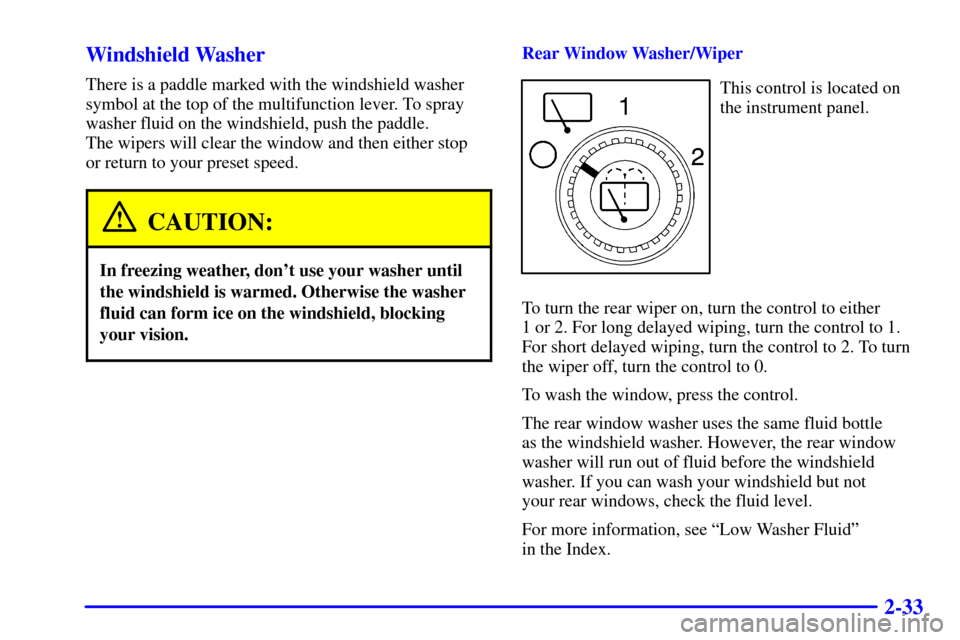
Rear Window Washer/Wiper
This control is located on
the instrument panel.
To turn the rear wiper on, turn the control to either
1 or 2. For long delayed wiping, turn the control to 1.
For short delayed wiping, turn the control to 2. To turn
the wiper off, turn the control to 0.
To wash the window, press the control.
The rear window washer uses the same fluid bottle
as the windshield washer. However, the rear window
washer will run out of fluid before the windshield
washer. If you can wash your windshield but not
your rear windows, check the fluid level.
For more information, see ªLow Washer Fluidº
in the Index.

