Page 18 of 368
1-12
How to Wear Safety Belts Properly
Adults
This part is only for people of adult size.
Be aware that there are special things to know
about safety belts and children. And there are
different rules for smaller children and babies. If a
child will be riding in your vehicle, see the part of this
manual called ªChildren.º Follow those rules for
everyone's protection.
First, you'll want to know which restraint systems your
vehicle has.
We'll start with the driver position.
Driver Position
This part describes the driver's restraint system.
Lap-Shoulder Belt
The driver has a lap-shoulder belt. Here's how to wear
it properly.
1. Close and lock the door.
2. Adjust the seat so you can sit up straight. To see
how, see ªSeatsº in the Index.
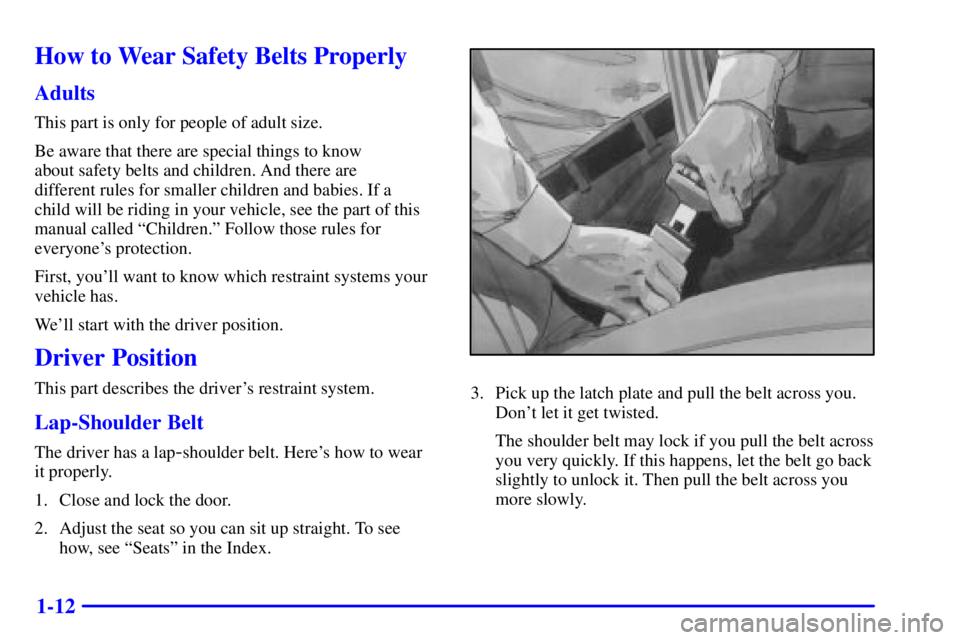
3. Pick up the latch plate and pull the belt across you.
Don't let it get twisted.
The shoulder belt may lock if you pull the belt across
you very quickly. If this happens, let the belt go back
slightly to unlock it. Then pull the belt across you
more slowly.
Page 26 of 368
1-20
The best way to protect the fetus is to protect the
mother. When a safety belt is worn properly, it's more
likely that the fetus won't be hurt in a crash. For
pregnant women, as for anyone, the key to making
safety belts effective is wearing them properly.
Right Front Passenger Position
To learn how to wear the right front passenger's
safety belt properly, see ªDriver Positionº earlier in
this section.
The right front passenger's safety belt works the same
way as the driver's safety belt
-- except for one thing.
If you ever pull the shoulder portion of the belt out all
the way, you will engage the child restraint locking
feature. If this happens, just let the belt go back all
the way and start again.
Air Bag Systems
This part explains the frontal and side impact air
bag systems.
Your vehicle has air bags
-- a frontal air bag for the
driver and another frontal air bag for the right front
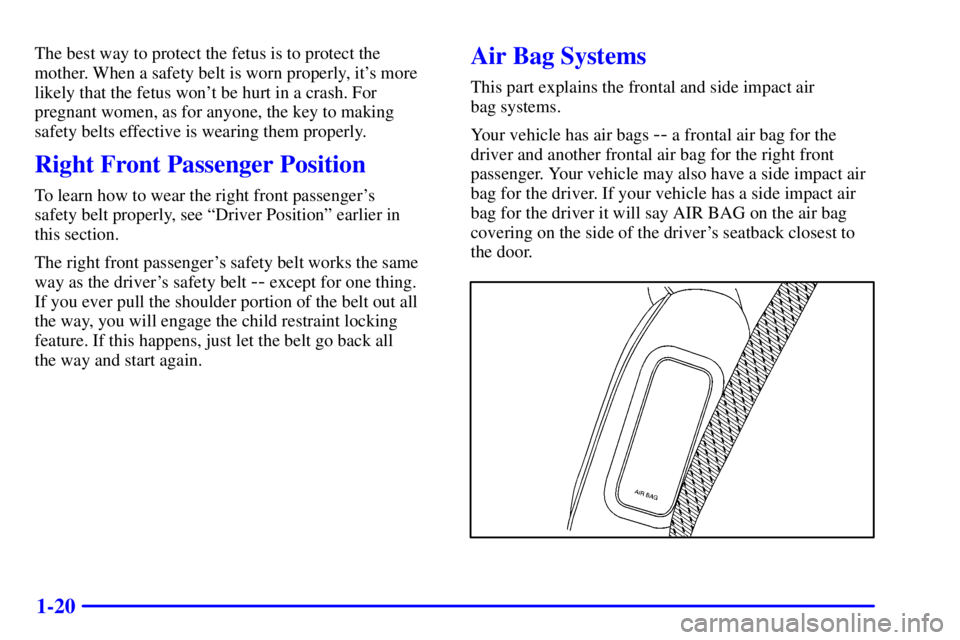
passenger. Your vehicle may also have a side impact air
bag for the driver. If your vehicle has a side impact air
bag for the driver it will say AIR BAG on the air bag
covering on the side of the driver's seatback closest to
the door.
Page 55 of 368
1-49
4. Pull the rest of the shoulder belt all the way out of
the retractor to set the lock.5. To tighten the belt, feed the shoulder belt back into the
retractor while you push down on the child restraint.
If you're using a forward
-facing child restraint, you
may find it helpful to use your knee to push down on
the child restraint as you tighten the belt.
6. Push and pull the child restraint in different
directions to be sure it is secure.
To remove the child restraint, just unbuckle the vehicle's
safety belt and let it go back all the way. The safety belt
will move freely again and be ready to work for an adult
or larger child passenger.
Page 60 of 368
1-54
5. Pull the rest of the shoulder belt all the way out of
the retractor to set the lock.6. To tighten the belt, feed the shoulder belt back into the
retractor while you push down on the child restraint.
You may find it helpful to use your knee to push down
on the child restraint as you tighten the belt.
7. Push and pull the child restraint in different
directions to be sure it is secure.
To remove the child restraint, just unbuckle the vehicle's
safety belt and let it go back all the way. The safety belt
will move freely again and be ready to work for an adult
or larger child passenger.
Page 70 of 368
2-6
Door Locks
CAUTION:
Unlocked doors can be dangerous.
�Passengers -- especially children -- can
easily open the doors and fall out of a
moving vehicle. When a door is locked,
the handle won't open it. You increase the
chance of being thrown out of the vehicle
in a crash if the doors aren't locked.
So, wear safety belts properly and lock
the doors whenever you drive.
�Young children who get into unlocked
vehicles may be unable to get out. A child
can be overcome by extreme heat and can
suffer permanent injuries or even death
from heat stroke. Always lock your vehicle
whenever you leave it.
�Outsiders can easily enter through an
unlocked door when you slow down or stop
your vehicle. Locking your doors can help
prevent this from happening.
There are several ways to lock and unlock your vehicle.
From the outside, use your door key or remote keyless
entry transmitter.
From the inside, to manually lock the door, push the
lever forward. To unlock, push the lever rearward.
Page 73 of 368
2-9 Rear-Door Child Security Locks
Your vehicle is equipped with rear-door child security
locks that help prevent passengers from opening the rear
doors of your vehicle from the inside. To use one of
these locks:
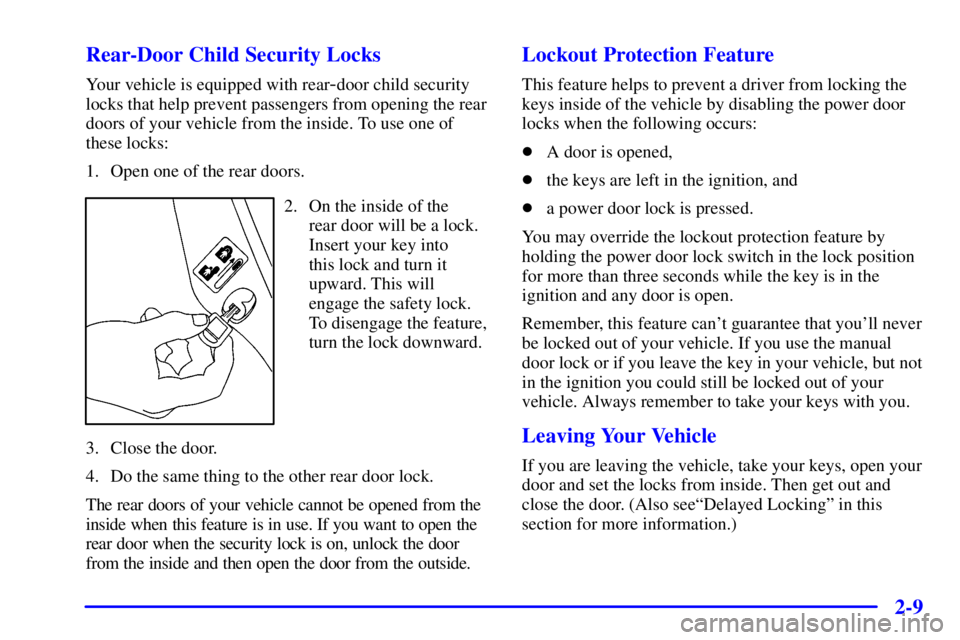
1. Open one of the rear doors.
2. On the inside of the
rear door will be a lock.
Insert your key into
this lock and turn it
upward. This will
engage the safety lock.
To disengage the feature,
turn the lock downward.
3. Close the door.
4. Do the same thing to the other rear door lock.
The rear doors of your vehicle cannot be opened from the
inside when this feature is in use. If you want to open the
rear door when the security lock is on, unlock the door
from the inside and then open the door from the outside.
Lockout Protection Feature
This feature helps to prevent a driver from locking the
keys inside of the vehicle by disabling the power door
locks when the following occurs:
�A door is opened,
�the keys are left in the ignition, and
�a power door lock is pressed.
You may override the lockout protection feature by
holding the power door lock switch in the lock position
for more than three seconds while the key is in the
ignition and any door is open.
Remember, this feature can't guarantee that you'll never
be locked out of your vehicle. If you use the manual
door lock or if you leave the key in your vehicle, but not
in the ignition you could still be locked out of your
vehicle. Always remember to take your keys with you.
Leaving Your Vehicle
If you are leaving the vehicle, take your keys, open your
door and set the locks from inside. Then get out and
close the door. (Also seeªDelayed Lockingº in this
section for more information.)


