Page 225 of 368
5-8
NOTICE:
Damage to your vehicle may result from
electrical shorting if jumper cables are removed
incorrectly. To prevent electrical shorting, take
care that the cables don't touch each other or any
other metal. The repairs wouldn't be covered by
your warranty.
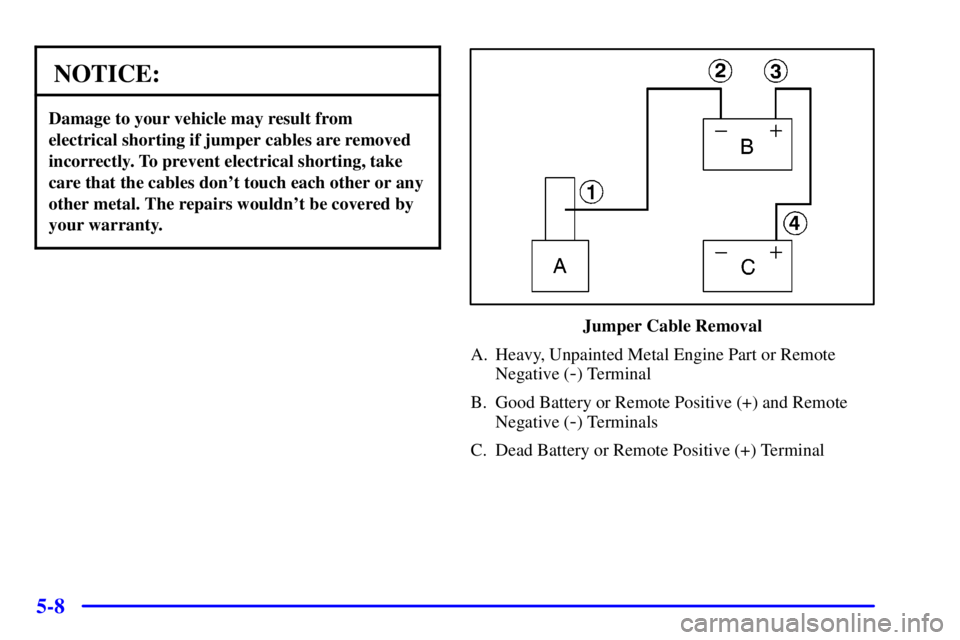
Jumper Cable Removal
A. Heavy, Unpainted Metal Engine Part or Remote
Negative (
-) Terminal
B. Good Battery or Remote Positive (+) and Remote
Negative (
-) Terminals
C. Dead Battery or Remote Positive (+) Terminal
Page 226 of 368

5-9
To disconnect the jumper cables from both vehicles do
the following:
1. Disconnect the black negative (
-) cable from the
vehicle that had the dead battery.
2. Disconnect the black negative (
-) cable from the
vehicle with the good battery.
3. Disconnect the red positive (+) cable from the
vehicle with the good battery.
4. Disconnect the red positive (+) cable from the
other vehicle.
5. Return the remote positive (+) terminal cover to its
original position.
Towing Your Vehicle
Consult your dealer or a professional towing service
if you need to have your disabled vehicle towed.
See ªRoadside Assistanceº in the Index. If you want
to tow your vehicle behind another vehicle for
recreational purposes (such as behind a motorhome),
see ªRecreational Vehicle Towingº in the Index.
Engine Overheating
You will find a coolant temperature gage and a hot
engine warning light on your instrument panel. See
ªEngine Coolant Temperature Gageº and ªEngine
Coolant Temperature Warning Lightº in the Index.
You also have a LOW COOLANT warning light on
your instrument panel cluster. See ªLow Coolant
Warning Lightº in the Index.
Page 255 of 368

6-
6-1
Section 6 Service and Appearance Care
Here you will find information about the care of your vehicle. This section begins with service and fuel information,
and then it shows how to check important fluid and lubricant levels. There is also technical information about your
vehicle, and a part devoted to its appearance care.
6
-2 Service
6
-3 Fuel
6
-5 Fuels in Foreign Countries
6
-6 Filling Your Tank
6
-8 Filling a Portable Fuel Container
6
-8 Checking Things Under the Hood
6
-12 Engine Oil
6
-18 Engine Air Cleaner/Filter
6
-19 Passenger Compartment Air Filter
6
-20 Supercharger Oil
6
-21 Automatic Transaxle Fluid
6
-25 Engine Coolant
6
-29 Power Steering Fluid
6
-30 Windshield Washer Fluid
6
-31 Brakes
6
-35 Battery
6
-36 Bulb Replacement
6
-43 Windshield Wiper Blade Replacement6
-44 Tires
6
-55 Appearance Care
6
-55 Cleaning the Inside of Your Vehicle
6
-58 Cleaning Glass Surfaces
6
-59 Cleaning the Outside of the Windshield and
Wiper Blades
6
-59 Cleaning the Outside of Your Vehicle
6
-61 Cleaning Aluminum or Chrome-Plated
Wheels (If Equipped)
6
-61 Cleaning Tires
6
-63 GM Vehicle Care/Appearance Materials
6
-64 Vehicle Identification Number (VIN)
6
-65 Electrical System
6
-71 Replacement Bulbs
6
-72 Capacities and Specifications
6
-72 Air Conditioning Refrigerant Capacity
6
-72 Normal Maintenance Replacement Parts
Page 264 of 368
6-10 Engine Compartment Overview
When you open the hood on the 3800 V6 engine, you'll see:
A. Windshield Washer
Fluid Reservoir
B. Battery
C. Remote Positive (+)
Battery Terminal
D. Underhood Fuse BlockE. Radiator Pressure Cap
F. Engine Coolant Recovery Tank
G. Power Steering Fluid Reservoir
(Below Generator)
H. Engine Oil DipstickI. Engine Oil Fill Cap
J. Automatic Transaxle
Fluid Dipstick
K. Brake Fluid Reservoir
L. Engine Air Cleaner/Filter
Page 265 of 368
6-11
When you open the hood on the 3800 V6 Supercharged engine, you'll see:
A. Windshield Washer
Fluid Reservoir
B. Battery
C. Remote Positive (+)
Battery Terminal
D. Underhood Electrical CenterE. Radiator Pressure Cap
F. Engine Coolant Recovery Tank
G. Power Steering Fluid Reservoir
(Below Generator)
H. Engine Oil DipstickI. Engine Oil Fill Cap
J. Automatic Transaxle
Fluid Dipstick
K. Brake Fluid Reservoir
L. Engine Air Cleaner/Filter
Page 289 of 368
6-35
Battery
Your new vehicle comes with a maintenance free
ACDelco� battery. When it's time for a new battery,
get one that has the replacement number shown on the
original battery's label. We recommend an ACDelco
battery. See ªEngine Compartment Overviewº in the
Index for battery location.
WARNING: Battery posts, terminals and related
accessories contain lead and lead compounds, chemicals
known to the State of California to cause cancer and
reproductive harm. Wash hands after handling.
If your battery has a very low charge or is dead, you
may not be able to remove the ignition key from the
ignition switch or shift out of PARK (P). Refer to
ªShifting Out of PARK(P)º in the Index.
Vehicle Storage
If you're not going to drive your vehicle for 25 days
or more, remove the black, negative (
-) cable from
the battery. This will help keep your battery from
running down.
CAUTION:
Batteries have acid that can burn you and gas
that can explode. You can be badly hurt if you
aren't careful. See ªJump Startingº in the Index
for tips on working around a battery without
getting hurt.
Contact your dealer to learn how to prepare your vehicle
for longer storage periods.
Also, for your audio system, see ªTheft
-Deterrent
Featureº in the Index.
Page 300 of 368

6-46 Tire Inflation Monitor System
The tire inflation monitor system can alert you to a large
change in the pressure of one tire. The system ªlearnsº
the pressure at each tire throughout the operating speed
range of your vehicle. The system normally takes
between 45 and 90 minutes of driving to learn the
tire pressures. This time may be longer depending
on your individual driving habits. Learning need not
be accumulated during a single trip. Once learned, the
system will remember the tire pressures until the system
is recalibrated.
After the system has learned tire pressures with properly
inflated tires, the LOW TIRE light will come on if the
pressure in one tire becomes 12 psi (83 kPa) lower than
the other three tires. The tire inflation monitor system
won't alert you if the pressure in more than one tire is
low, if the system is not properly calibrated, or if the
vehicle is moving faster than 70 mph (110 km/h).
The tire inflation monitor system detects differences
in tire rotation speeds that are caused by changes in
tire pressure. The system can alert you about a low
tire
-- but it doesn't replace normal tire maintenance.
See ªTiresº in the Index.When the LOW TIRE light comes on, you should stop
as soon as you can and check all your tires for damage.
(If a tire is flat, see ªIf a Tire Goes Flatº in the Index.)
Also check the tire pressure in all four tires as soon as
you can. See ªInflation
- Tire Pressureº in the Index.
The LOW TIRE light will also be displayed (while the
ignition is on) until you reset (calibrate) the system.
Don't reset the tire inflation monitor system without
first correcting the cause of the problem and checking
and adjusting the pressure in all four tires. If you reset
the system when the tire pressures are incorrect, the
system will not work properly and may not alert you
when a tire is low.
Any time you adjust a tire's pressure, rotate your
tires, or have one or more tires repaired or replaced,
you'll need to reset (calibrate) the tire inflation monitor
system. You'll also need to reset the system whenever
you buy new tires and whenever the vehicle's battery
has been disconnected.