Page 217 of 368

4-42 When You Are Ready to Leave After
Parking on a Hill
1. Apply your regular brakes and hold the pedal down
while you:
�start your engine,
�shift into a gear, and
�release the parking brake.
2. Let up on the brake pedal.
3. Drive slowly until the trailer is clear of the chocks.
4. Stop and have someone pick up and store the chocks.
Maintenance When Trailer Towing
Your vehicle will need service more often when you're
pulling a trailer. See the Maintenance Schedule for more
on this. Things that are especially important in trailer
operation are automatic transaxle fluid (don't overfill),
engine oil, drive belt, cooling system and brake system.
Each of these is covered in this manual, and the Index
will help you find them quickly. If you're trailering, it's
a good idea to review this information before you start
your trip.
Check periodically to see that all hitch nuts and bolts
are tight.
Engine Cooling When Trailer Towing
Your cooling system may temporarily overheat during
severe operating conditions. See ªEngine Overheatingº
in the Index.
Page 227 of 368
5-10 Overheated Engine Protection
Operating Mode
This emergency operating mode allows your vehicle to
be driven to a safe place in an emergency situation.
If an overheated engine condition exists, an overheat
protection mode which alternates firing groups of
cylinders helps prevent engine damage. In this mode,
you will notice a significant loss in power and engine
performance. The low coolant light may come on
and the temperature gage will indicate an overheat
condition exists. Driving extended miles (km) and/or
towing a trailer in the overheat protection mode
should be avoided.
NOTICE:
After driving in the overheated engine protection
operating mode, to avoid engine damage, allow
the engine to cool before attempting any repair.
The engine oil will be severely degraded. Repair
the cause of coolant loss, change the oil and reset
the oil life system. See ªEngine Oilº in the Index.
If Steam Is Coming From Your Engine
Page 229 of 368
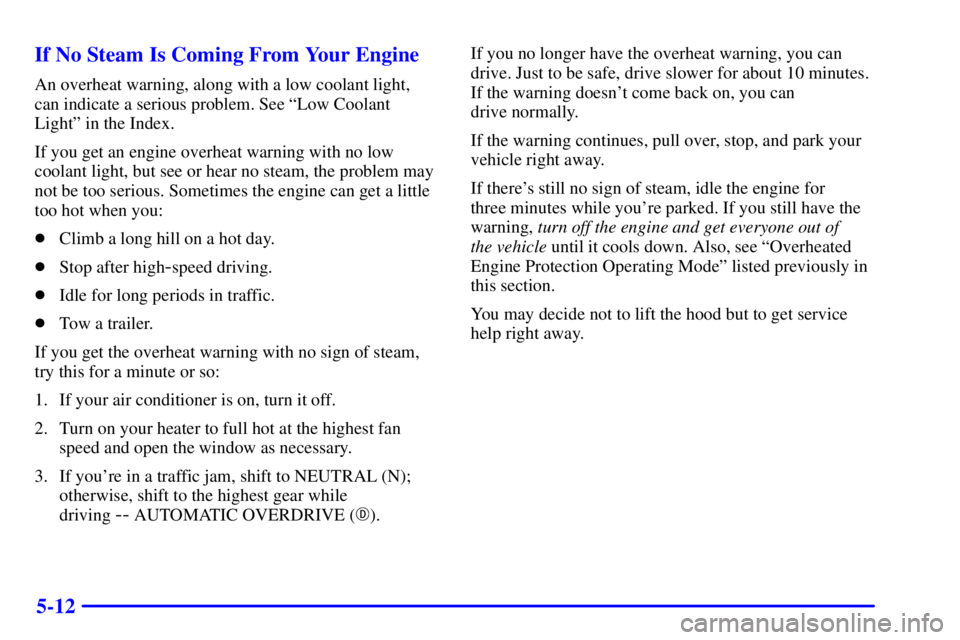
5-12 If No Steam Is Coming From Your Engine
An overheat warning, along with a low coolant light,
can indicate a serious problem. See ªLow Coolant
Lightº in the Index.
If you get an engine overheat warning with no low
coolant light, but see or hear no steam, the problem may
not be too serious. Sometimes the engine can get a little
too hot when you:
�Climb a long hill on a hot day.
�Stop after high
-speed driving.
�Idle for long periods in traffic.
�Tow a trailer.
If you get the overheat warning with no sign of steam,
try this for a minute or so:
1. If your air conditioner is on, turn it off.
2. Turn on your heater to full hot at the highest fan
speed and open the window as necessary.
3. If you're in a traffic jam, shift to NEUTRAL (N);
otherwise, shift to the highest gear while
driving
-- AUTOMATIC OVERDRIVE (�).If you no longer have the overheat warning, you can
drive. Just to be safe, drive slower for about 10 minutes.
If the warning doesn't come back on, you can
drive normally.
If the warning continues, pull over, stop, and park your
vehicle right away.
If there's still no sign of steam, idle the engine for
three minutes while you're parked. If you still have the
warning, turn off the engine and get everyone out of
the vehicle until it cools down. Also, see ªOverheated
Engine Protection Operating Modeº listed previously in
this section.
You may decide not to lift the hood but to get service
help right away.
Page 275 of 368

6-21 How to Check and Add Oil
Park the vehicle on a level surface. Check oil only when
the engine is cold. Allow the engine to cool two to three
hours after running.
CAUTION:
If you remove the supercharger oil fill plug while
the engine is hot, pressure may cause hot oil to
blow out of the oil fill hole. You may be burned.
Do not remove the plug until the engine cools.
1. Clean the area around the oil fill plug before
removing it.
2. Remove the oil fill plug using a 3/16 inch
Allen wrench.
3. The oil level is correct when it just reaches the
bottom of the threads of the inspection hole.
4. Replace the oil plug with the O
-ring in place.
Tighten to 88 lb
-in (10 N´m).
Automatic Transaxle Fluid
When to Check and Change
A good time to check your automatic transaxle fluid
level is when the engine oil is changed.
Change both the fluid and filter every 50,000 miles
(83 000 km) if the vehicle is mainly driven under one
or more of these conditions:
�In heavy city traffic where the outside temperature
regularly reaches 90�F (32�C) or higher.
�In hilly or mountainous terrain.
�When doing frequent trailer towing.
�Uses such as found in taxi, police or delivery service.
If you do not use your vehicle under any of
these conditions, change the fluid and filter at
100,000 miles (166 000 km).
See ªScheduled Maintenance Servicesº in the Index.
Page 276 of 368

6-22 How to Check
Because this operation can be a little difficult, you may
choose to have this done at the dealership service department.
If you do it yourself, be sure to follow all the instructions
here, or you could get a false reading on the dipstick.
NOTICE:
Too much or too little fluid can damage your
transaxle. Too much can mean that some of the
fluid could come out and fall on hot engine parts
or exhaust system parts, starting a fire. Too little
fluid could cause the transaxle to overheat. Be
sure to get an accurate reading if you check your
transaxle fluid.
Wait at least 30 minutes before checking the transaxle
fluid level if you have been driving:
�When outside temperatures are above 90�F (32�C).
�At high speed for quite a while.
�In heavy traffic
-- especially in hot weather.
�While pulling a trailer.To get the right reading, the fluid should be at normal
operating temperature, which is 180�F to 200�F
(82�C to 93�C).
Get the vehicle warmed up by driving about 15 miles
(24 km) when outside temperatures are above 50�F
(10�C). If it's colder than 50�F (10�C), you may have
to drive longer.
Checking the Fluid Level
Prepare your vehicle as follows:
�Park your vehicle on a level place. Keep the
engine running.
�With the parking brake applied, place the shift lever
in PARK (P).
�With your foot on the brake pedal, move the shift
lever through each gear range, pausing for about
three seconds in each range. Then, position the
shift lever in PARK (P).
�Let the engine run at idle for three to five minutes.
Page 337 of 368
Scheduled Maintenance
7-11
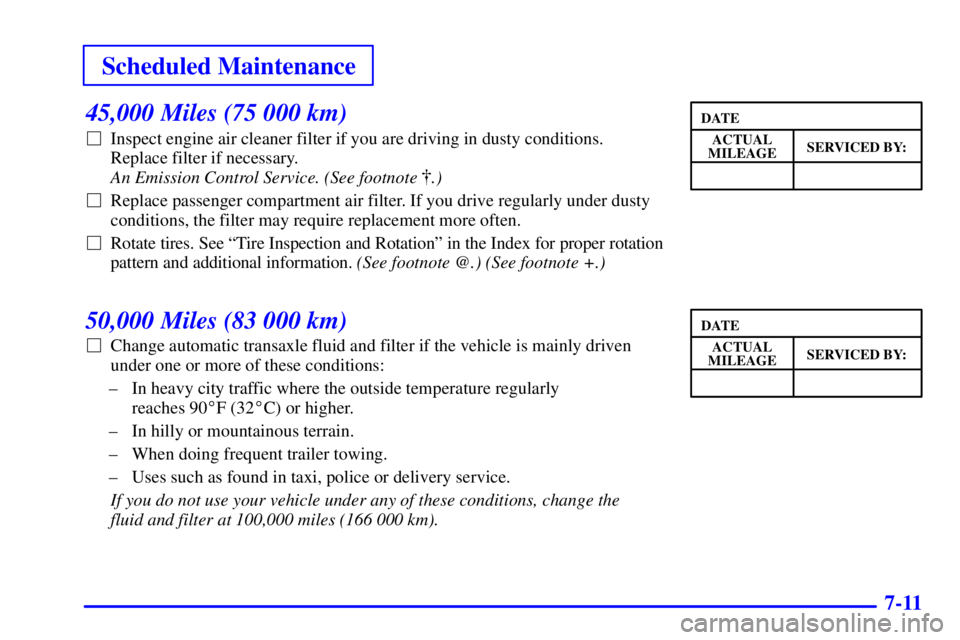
45,000 Miles (75 000 km)
�Inspect engine air cleaner filter if you are driving in dusty conditions.
Replace filter if necessary.
An Emission Control Service. (See footnote �.)
�Replace passenger compartment air filter. If you drive regularly under dusty
conditions, the filter may require replacement more often.
�Rotate tires. See ªTire Inspection and Rotationº in the Index for proper rotation
pattern and additional information. (See footnote @.) (See footnote +.)
50,000 Miles (83 000 km)
�Change automatic transaxle fluid and filter if the vehicle is mainly driven
under one or more of these conditions:
± In heavy city traffic where the outside temperature regularly
reaches 90�F (32�C) or higher.
± In hilly or mountainous terrain.
± When doing frequent trailer towing.
± Uses such as found in taxi, police or delivery service.
If you do not use your vehicle under any of these conditions, change the
fluid and filter at 100,000 miles (166 000 km).
ACTUAL
SERVICED BY:MILEAGE
DATE
ACTUAL
SERVICED BY:MILEAGE
DATE
Page 341 of 368

Scheduled Maintenance
7-15
100,000 Miles (166 000 km)
�Inspect spark plug wires.
An Emission Control Service.
�Replace spark plugs.
An Emission Control Service.
�Change automatic transaxle fluid and filter if the vehicle is mainly driven
under one or more of these conditions:
± In heavy city traffic where the outside temperature regularly
reaches 90�F (32�C) or higher.
± In hilly or mountainous terrain.
± When doing frequent trailer towing.
± Uses such as found in taxi, police or delivery service.
�If you haven't used your vehicle under severe service conditions listed
previously and, therefore, haven't changed your automatic transaxle fluid,
change both the fluid and filter.
150,000 Miles (240 000 km)
�Drain, flush and refill cooling system (or every 60 months since last service,
whichever occurs first). See ªEngine Coolantº in the Index for what to use.
Inspect hoses. Clean radiator, condenser, pressure cap and neck.
Pressure test the cooling system and pressure cap.
An Emission Control Service.
ACTUAL
SERVICED BY:MILEAGE
DATE
ACTUAL
SERVICED BY:MILEAGE
DATE
Page:
< prev 1-8 9-16 17-24
