Page 205 of 368
4-30 If You're Caught in a Blizzard
If you are stopped by heavy snow, you could be in a
serious situation. You should probably stay with your
vehicle unless you know for sure that you are near help
and you can hike through the snow. Here are some
things to do to summon help and keep yourself and your
passengers safe:
�Turn on your hazard flashers.�Tie a red cloth to your vehicle to alert police that
you've been stopped by the snow.
�Put on extra clothing or wrap a blanket around you.
If you have no blankets or extra clothing, make body
insulators from newspapers, burlap bags, rags, floor
mats
-- anything you can wrap around yourself or
tuck under your clothing to keep warm.
You can run the engine to keep warm, but be careful.
Page 216 of 368

4-41 Turn Signals When Towing a Trailer
When you tow a trailer, your vehicle may need a
different turn signal flasher and/or extra wiring. Check
with your dealer. The arrows on your instrument panel
will flash whenever you signal a turn or lane change.
Properly hooked up, the trailer lamps will also flash,
telling other drivers you're about to turn, change lanes
or stop.
When towing a trailer, the arrows on your instrument
panel will flash for turns even if the bulbs on the trailer
are burned out. Thus, you may think drivers behind you
are seeing your signal when they are not. It's important
to check occasionally to be sure the trailer bulbs are
still working.
Driving On Grades
Reduce speed and shift to a lower gear before you start
down a long or steep downgrade. If you don't shift
down, you might have to use your brakes so much that
they would get hot and no longer work well.
On a long uphill grade, shift down and reduce your
speed to around 45 mph (70 km/h) to reduce the
possibility of engine and transaxle overheating.
If you are towing a trailer, you may want to drive in
THIRD (3) instead of AUTOMATIC OVERDRIVE (�)
(or, as you need to, a lower gear).
Parking on Hills
CAUTION:
You really should not park your vehicle, with a
trailer attached, on a hill. If something goes
wrong, your rig could start to move. People can
be injured, and both your vehicle and the trailer
can be damaged.
But if you ever have to park your rig on a hill, here's
how to do it:
1. Apply your regular brakes, but don't shift into
PARK (P) yet.
2. Have someone place chocks under the
trailer's wheels.
3. When the wheel chocks are in place, release the
regular brakes until the chocks absorb the load.
4. Reapply the regular brakes. Then apply your parking
brake, and shift to PARK (P).
5. Release the regular brakes.
Page 218 of 368
5-
5-1
Section 5 Problems on the Road
Here you'll find what to do about some problems that can occur on the road.
5
-2 Hazard Warning Flashers
5
-2 Other Warning Devices
5
-3 Jump Starting
5
-9 Towing Your Vehicle
5
-9 Engine Overheating5
-13 Cooling System
5
-22 If a Tire Goes Flat
5
-22 Changing a Flat Tire
5
-33 Compact Spare Tire
5
-34 If You're Stuck: In Sand, Mud, Ice or Snow
Page 219 of 368
5-2
Hazard Warning Flashers
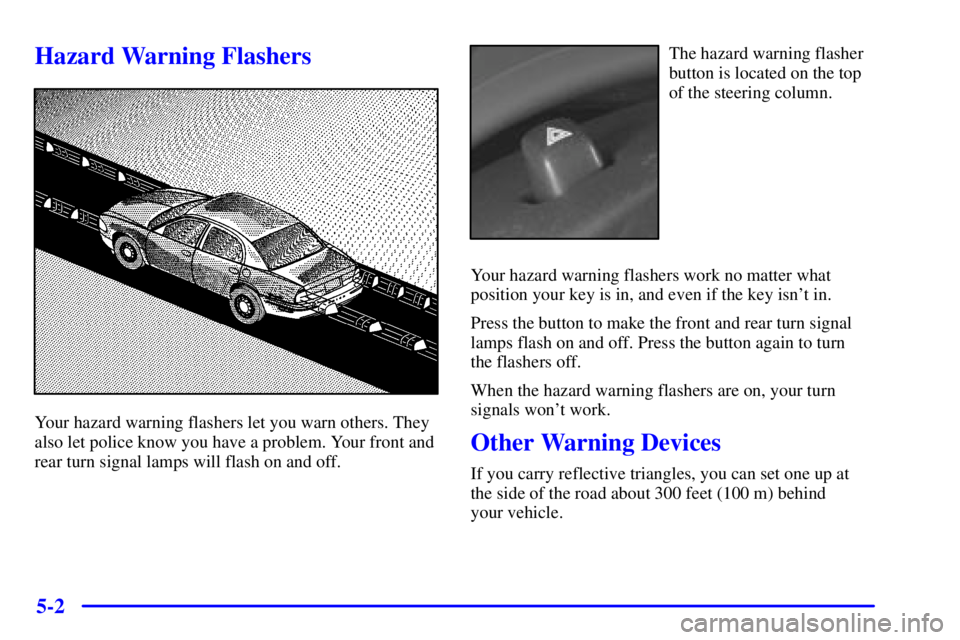
Your hazard warning flashers let you warn others. They
also let police know you have a problem. Your front and
rear turn signal lamps will flash on and off.
The hazard warning flasher
button is located on the top
of the steering column.
Your hazard warning flashers work no matter what
position your key is in, and even if the key isn't in.
Press the button to make the front and rear turn signal
lamps flash on and off. Press the button again to turn
the flashers off.
When the hazard warning flashers are on, your turn
signals won't work.
Other Warning Devices
If you carry reflective triangles, you can set one up at
the side of the road about 300 feet (100 m) behind
your vehicle.
Page 239 of 368
5-22
If a Tire Goes Flat
It's unusual for a tire to ªblow outº while you're driving,
especially if you maintain your tires properly. If air goes
out of a tire, it's much more likely to leak out slowly.
But if you should ever have a ªblowout,º here are a few
tips about what to expect and what to do:
If a front tire fails, the flat tire will create a drag that
pulls the vehicle toward that side. Take your foot off the
accelerator pedal and grip the steering wheel firmly.
Steer to maintain lane position, and then gently brake to
a stop well out of the traffic lane.
A rear blowout, particularly on a curve, acts much like a
skid and may require the same correction you'd use in a
skid. In any rear blowout, remove your foot from the
accelerator pedal. Get the vehicle under control by
steering the way you want the vehicle to go. It may be
very bumpy and noisy, but you can still steer. Gently
brake to a stop
-- well off the road if possible.
If a tire goes flat, the next part shows how to use your
jacking equipment to change a flat tire safely.
Changing a Flat Tire
If a tire goes flat, avoid further tire and wheel damage
by driving slowly to a level place. Turn on your hazard
warning flashers.
CAUTION:
Changing a tire can cause an injury. The vehicle
can slip off the jack and roll over you or other
people. You and they could be badly injured.
Find a level place to change your tire. To help
prevent the vehicle from moving:
1. Set the parking brake firmly.
2. Put the shift lever in PARK (P).
3. Turn off the engine.
To be even more certain the vehicle won't move,
you can put blocks at the front and rear of the
tire farthest away from the one being changed.
That would be the tire on the other side of the
vehicle, at the opposite end.
Page 322 of 368
6-68
Fuse Usage
STOP LAMPS Stoplamps
ONSTAR OnStar
�
FRT PARK LPS Parking Lamps
POWER DROP Auxiliary Power Connection
(Power Drop): Hot in ACC
and Run
CRANK SIGNAL,
BCM, CLUSTERCrank Signal, Body Control
Module, Cluster, Powertrain
Control Module
HVAC Ignition Signal, Heating
Ventilation Air Conditioning
Control Head
BTSI PARK LOCK Shifter Lock Solenoid
AIR BAG Air Bag
BCM PWR Body Control Module
HAZARD Hazard FlashersFuse Usage
LH HEATED SEAT Driver's Heated Seat
Blank Not Used
BCM ACC Ignition Signal: Hot in ACC
and Run, Body Control Module
Blank Not Used
LOW BLOWER Low Blower
ABS Anti
-Lock Brakes
TURN SIGNALS,
CORN LPSTurn Signals, Cornering Lamps
RADIO, HVAC,
RFA, CLUSTERRadio, Heating Ventilation Air
Conditioning Head, Remote
Keyless Entry, Cluster
HIGH BLOWER High Blower
RH HEATED SEAT Passenger's Heated Seat
STRG WHL CONT Audio Steering Wheel Controls
WIPER Wipers
Page 323 of 368
6-69
Underhood Fuse Block
Some fuses and relays are located in the underhood
fuse block on the passenger's side of the vehicle in
the engine compartment. See ªEngine Compartment
Overviewº in the Index for more information
on location.Maxi Fuse Usage
1 Anti
-Lock Brake System
2 Starter Solenoid
3 Power Seats, Rear Defog, Heated Seats
4 High Blower, Hazard Flasher,
Stoplamps, Power Mirror, Door Locks
5 Ignition Switch, BTSI, Stoplamps,
ABS, Turn Signals, Cluster, Air Bag,
DRL Module
6 Cooling Fan
7 Retained Accessory Power, Keyless
Entry, Data Link, Heating Ventilation
Air Conditioning Head, Cluster, Radio,
Auxiliary Power (Power Drop),
Cigarette Lighter
8 Ignition Switch, Wipers, Radio,
Steering Wheel Controls, Body
Control Module, Auxiliary Power
(Power Drop), Power Windows,
Sunroof, Heating Ventilation Air
Conditioning Controls, Daytime
Running Lamps, Rear Defog Relay