Page 85 of 368

2-21
Disabling the Trunk Release Sensor
A. Sensor Lens
B. Disable SwitchBecause the sensor detects motion, there are times when
you may want to turn off the trunk sensor so that the
motion of your vehicle or items in the trunk won't cause
the trunk to open, such as the following:
�When your vehicle is transported on a car ferry,
�when your vehicle is towed, or
�when you will be loading items through the opening
in the split folding rear seat (if equipped).
Next to the sensor lens, there is a disable switch you can
use to turn off the trunk release sensor. To turn off the
sensor, turn the ignition to ON and press the switch next
to the lens for two seconds. The horn will chirp once
when the sensor is turned off. When the sensor is off,
the light in the switch will flash. The DOOR/TRUNK
light will flash for one minute each time the ignition is
turned on as a reminder that the sensor is turned off.
See ªDoor/Trunk Lightº in the Index.
To turn the sensor on again, press the switch again
or open the trunk. When the trunk is opened, the
sensor is automatically turned back on. If the sensor
is turned back on with the disable switch, the horn will
chirp twice.
Page 86 of 368

2-22
Servicing the Trunk Release Sensor
The sensor lens should be inspected periodically. If the
lens is dirty, wipe it gently with a clean, soft cotton cloth.
If there is an electrical problem with the sensor, the
SERVICE VEHICLE SOON light will appear in the
instrument panel cluster. There are other possible
reasons for this light to appear. Be sure to see your
dealer as soon as possible. See ªService Vehicle Soon
Lightº in the Index for more information.
Theft
Vehicle theft is big business, especially in some cities.
Although your vehicle has a number of theft
-deterrent
features, we know that nothing we put on it can make it
impossible to steal. However, there are ways you can help.
Key in the Ignition
If you leave your vehicle with the keys inside, it's an
easy target for joy riders or professional thieves
-- so
don't do it.
When you park your vehicle and open the driver's door,
you'll hear a chime reminding you to remove your key
from the ignition and take it with you. Always do this.
Your steering wheel will be locked, and so will your
ignition and transaxle. And remember to lock the doors.
Parking at Night
Park in a lighted spot, close all windows and lock your
vehicle. Remember to keep your valuables out of sight.
Put them in a storage area, or take them with you.
Parking Lots
Even if you park in a lot where someone will be
watching your vehicle, it's still best to lock it up and
take your keys. But what if you have to leave your
ignition key?
�If possible, park in a busy, well
-lit area.
�Put your valuables in a storage area, like your trunk
or glove box.
�Be sure to close and lock the storage area.
�Close all windows.
�Lock the glove box.
�Lock all the doors except the driver's.
�Then take the door key and remote keyless entry
transmitter with you.
Page 115 of 368

2-51
You may enable or disable the perimeter lighting feature
when the driver performs the following sequence with
the engine not running and the doors closed:
1. Turn the ignition to RUN.
2. Close all the doors.
3. Apply your brakes.
4. Press and hold the power door lock switch. While
holding the door lock switch press and release the
panic button on the remote keyless entry transmitter.
This will initialize the customization mode. While in the
customization mode, the feature will sound the number
of chimes corresponding to the current mode. In Mode
1, one chime means the feature is disabled. In Mode 2,
two chimes signal that the perimeter lighting feature is
enabled. Each additional press will advance the mode by
one, starting from the current mode. During this
procedure, the feature will sound the number of chimes
corresponding to the mode. When the lock switch is
released, the vehicle will remain in the last mode.
Disconnecting the vehicle's battery for up to a year will
not change the programmed operation for this feature.Rearview Mirror Reading Lamps
The reading lamps are located on the underside of the
rearview mirror.
Use the button next to each lamp to turn them on
and off.
Dome Lamp (If Equipped)
The dome lamp will come on when you open a door.
Battery Rundown Protection
Your vehicle has a feature to help prevent you from
draining the battery in case you accidentally leave
the interior courtesy lamps, reading/map lamps, visor
vanity lamps, trunk lamp, underhood lamp or glove box
lamps on. If you leave any of these lamps on, they will
automatically turn off after 20 minutes, if the ignition is
in OFF. The lamps won't come back on again until you
do one of the following:
�Turn the ignition on,
�turn the exterior lamps control off, then on, or
�open a door.
If your vehicle has less than 15 miles (25 km) on the
odometer, the battery saver will turn off the lamps after
only three minutes.
Page 121 of 368

2-57 Convenience Net (If Equipped)
Your vehicle may have a convenience net. You'll see it
on the back wall of the trunk.
Put small loads, like grocery bags, behind the net. It can
help keep them from falling over during sharp turns or
quick starts and stops.
The net isn't for larger, heavier loads. Store those in the
trunk as far forward as you can.
You can unhook the net so that it will lie flat when
you're not using it.
Ashtrays and Cigarette Lighter
The center front ashtray is located just below the
instrument panel's comfort controls at the front of the
console, behind the front compartment storage door.
To remove the ashtray, open the storage door. Then open
the small black door, lift up on the ashtray and pull it out.
The rear ashtray is located within a small door at the
rear of the console. Push on the right side of the door.
The ashtray will then pivot to the right for usage. You
can only access the ashtray by pushing on the door's
right side.To remove the ashtray, push down on the snuffer located
in the middle of the ashtray and lift it out.
NOTICE:
Don't put papers and other things that burn
into your ashtrays. If you do, cigarettes or
other smoking materials could set them on fire,
causing damage.
To use the lighter, just push it in all the way and let go.
When it's ready, it will pop back out by itself.
NOTICE:
Don't hold a cigarette lighter in with your hand
while it is heating. If you do, it won't be able to
back away from the heating element when it's
ready. That can make it overheat, damaging the
lighter and the heating element.
Page 145 of 368
2-81 Door/Trunk Ajar Warning Light
The DOOR/TRUNK light
will come on if your trunk
or any door is not
completely closed.
Fuel Gage
United States CanadaYour fuel gage tells you about how much fuel you have
left when the ignition is on. When the indicator nears
empty, you still have a little fuel left, but you should
get more soon.
Here are four things that some owners ask about. All
these things are normal and do not indicate that anything
is wrong with the fuel gage:
�At the gas station, the pump shuts off before the gage
reads full.
�It takes more (or less) fuel to fill up than the gage
reads. For example, the gage reads half full, but it
took more (or less) than half of the tank's capacity
to fill it.
�The gage pointer may move while cornering, braking
or speeding up.
�The gage may not indicate empty when the ignition
is turned off.
Page 202 of 368
4-27
CAUTION:
Coasting downhill in NEUTRAL (N) or with the
ignition off is dangerous. Your brakes will have to
do all the work of slowing down. They could get so
hot that they wouldn't work well. You would then
have poor braking or even none going down a hill.
You could crash. Always have your engine running
and your vehicle in gear when you go downhill.
�Know how to go uphill. You may want to shift down
to a lower gear. The lower gears help cool your engine
and transaxle, and you can climb the hill better.
�Stay in your own lane when driving on two
-lane
roads in hills or mountains. Don't swing wide or cut
across the center of the road. Drive at speeds that let
you stay in your own lane.
�As you go over the top of a hill, be alert. There could be
something in your lane, like a stalled car or an accident.
�You may see highway signs on mountains that warn of
special problems. Examples are long grades, passing or
no
-passing zones, a falling rocks area or winding
roads. Be alert to these and take appropriate action.
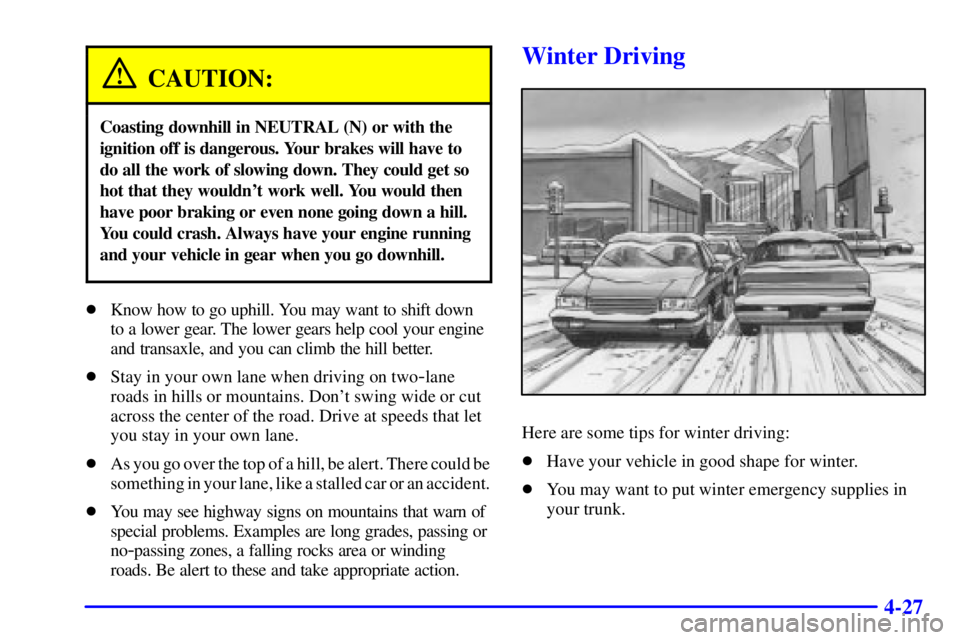
Winter Driving
Here are some tips for winter driving:
�Have your vehicle in good shape for winter.
�You may want to put winter emergency supplies in
your trunk.
Page 208 of 368
4-33 Dolly Towing
To dolly tow your vehicle do the following:
1. Put the front or rear wheels on a dolly.
2. Put the vehicle in PARK (P).
3. Set the parking brake and then remove the key from
the ignition.
4. Clamp the steering wheel in a straight
-ahead position
with a clamping device designed for towing.
5. Release the parking brake.
Loading Your Vehicle
Two labels on your vehicle show how much weight it
may properly carry. The Tire
-Loading Information label
is inside the trunk lid. The label tells you the proper size,
speed rating and recommended inflation pressures for
the tires on your vehicle. It also gives you important
information about the number of people that can be in
your vehicle and the total weight you can carry. This
weight is called the vehicle capacity weight and includes
the weight of all occupants, cargo and all
nonfactory
-installed options.
Page 209 of 368
4-34
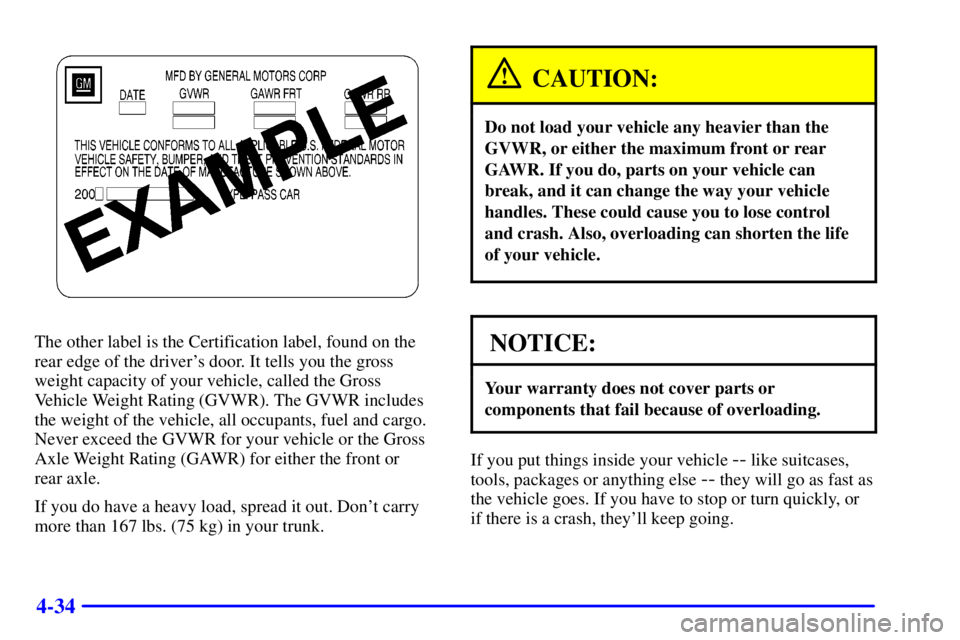
The other label is the Certification label, found on the
rear edge of the driver's door. It tells you the gross
weight capacity of your vehicle, called the Gross
Vehicle Weight Rating (GVWR). The GVWR includes
the weight of the vehicle, all occupants, fuel and cargo.
Never exceed the GVWR for your vehicle or the Gross
Axle Weight Rating (GAWR) for either the front or
rear axle.
If you do have a heavy load, spread it out. Don't carry
more than 167 lbs. (75 kg) in your trunk.
CAUTION:
Do not load your vehicle any heavier than the
GVWR, or either the maximum front or rear
GAWR. If you do, parts on your vehicle can
break, and it can change the way your vehicle
handles. These could cause you to lose control
and crash. Also, overloading can shorten the life
of your vehicle.
NOTICE:
Your warranty does not cover parts or
components that fail because of overloading.
If you put things inside your vehicle -- like suitcases,
tools, packages or anything else
-- they will go as fast as
the vehicle goes. If you have to stop or turn quickly, or
if there is a crash, they'll keep going.