Page 153 of 395

2-90
Oil Life System: Press the GAGE INFO button until
OIL LIFE INDEX appears in the display. The OIL LIFE
INDEX NORMAL display will show an estimate of the
oil's remaining useful life. When the oil life index is less
than 10%, the display will show OIL LIFE INDEX
CHANGE OIL. When you have the oil changed, you
will have to reset the GM Oil Life System�. To reset
the Oil Life System, see ªEngine Oil Life Systemº or
ªEngine Oil, When to Changeº in the Index.
DIC Warnings and Messages
Other messages or warnings may appear in the DIC
display. For Canadian drivers, in addition to the DIC
message your DIC will display EXP with a number after
it which reflects the following messages:
EXP (Export ID) Warning Message. . . . . . . . . . . .
23 DOOR AJAR. . . . . . . . . . . . . . . . . . . . . . . . . . . . .
24 TRUNK AJAR. . . . . . . . . . . . . . . . . . . . . . . . . . . .
25 WINDSHIELD WASHER FLUID LOW. . . . . . . .
36 ENGINE OIL LOW
- CHECK LEVEL . . . . . . . . .
54 SERVICE STABILITY SYSTEM. . . . . . . . . . . . .
55 STABILITY SYSTEM ACTIVE. . . . . . . . . . . . . .
82 CHANGE ENGINE OIL SOON. . . . . . . . . . . . . .
91 TRACTION CONTROL SYSTEM ACTIVE. . . .
140 TIRE PRESSURE LOW. . . . . . . . . . . . . . . . . . . The EXP codes are used to make translation from
English to other languages easier.
Pressing any of the DIC control buttons will remove the
messages or warnings from the DIC display.
SERVICE STABILITY SYSTEM
- 54: If you ever
see the SERVICE STABILITY SYSTEM message, it
means there may be a problem with your stability
enhancement system. If you see this message, try to
reset the system (stop; turn off the engine; then start the
engine again). If the SERVICE STABILITY SYSTEM
message still comes on, it means there is a problem. You
should see your dealer for service. Reduce your speed
and drive accordingly.
STABILITY SYSTEM ACTIVE
- 55: You may see
the STABILITY SYSTEM ACTIVE message on the
Driver Information Center. It means that an advanced,
computer
-controlled system has come on to help your
vehicle continue to go in the direction in which you're
steering. This stability enhancement system activates
when the computer senses that your vehicle is just
starting to spin, as it might if you hit a patch of ice or
other slippery spot on the road. When the system is on,
you may hear a noise or feel a vibration in the brake
pedal. This is normal.
Page 217 of 395
4-25
If you drive regularly in steep country, or if you're
planning to visit there, here are some tips that can make
your trips safer and more enjoyable.
�Keep your vehicle in good shape. Check all fluid
levels and also the brakes, tires, cooling system
and transaxle. These parts can work hard on
mountain roads.
�Know how to go down hills. The most important
thing to know is this: let your engine do some of the
slowing down. Shift to a lower gear when you go
down a steep or long hill.
CAUTION:
If you don't shift down, your brakes could get
so hot that they wouldn't work well. You would
then have poor braking or even none going
down a hill. You could crash. Shift down to let
your engine assist your brakes on a steep
downhill slope.
CAUTION:
Coasting downhill in NEUTRAL (N) or with the
ignition off is dangerous. Your brakes will have to
do all the work of slowing down. They could get
so hot that they wouldn't work well. You would
then have poor braking or even none going
down a hill. You could crash. Always have your
engine running and your vehicle in gear when
you go downhill.
�Know how to go uphill. Drive in the highest
gear possible.
�Stay in your own lane when driving on two
-lane
roads in hills or mountains. Don't swing wide or cut
across the center of the road. Drive at speeds that let
you stay in your own lane.
�As you go over the top of a hill, be alert. There could be
something in your lane, like a stalled car or an accident.
�You may see highway signs on mountains that warn of
special problems. Examples are long grades, passing or
no
-passing zones, a falling rocks area or winding
roads. Be alert to these and take appropriate action.
Page 233 of 395

4-41 When You Are Ready to Leave After
Parking on a Hill
1. Apply your regular brakes and hold the pedal down
while you:
�start your engine,
�shift into a gear, and
�release the parking brake.
2. Let up on the brake pedal.
3. Drive slowly until the trailer is clear of the chocks.
4. Stop and have someone pick up and store the chocks.
Maintenance When Trailer Towing
Your vehicle will need service more often when you're
pulling a trailer. See the Maintenance Schedule for more
on this. Things that are especially important in trailer
operation are automatic transaxle fluid (don't overfill),
engine oil, drive belt, cooling system and brake system.
Each of these is covered in this manual, and the Index
will help you find them quickly. If you're trailering, it's
a good idea to review this information before you start
your trip.
Check periodically to see that all hitch nuts and bolts
are tight.
Engine Cooling When Trailer Towing
Your cooling system may temporarily overheat during
severe operating conditions. See ªEngine Overheatingº
in the Index.
Page 265 of 395

6-
6-1
Section 6 Service and Appearance Care
Here you will find information about the care of your vehicle. This section begins with service and fuel information,
and then it shows how to check important fluid and lubricant levels. There is also technical information about your
vehicle, and a part devoted to its appearance care.
6
-2 Service
6
-3 Fuel
6
-5 Fuels in Foreign Countries
6
-6 Filling Your Tank
6
-8 Filling a Portable Fuel Container
6
-9 Checking Things Under the Hood
6
-12 Engine Oil
6
-17 Engine Air Cleaner/Filter
6
-20 Passenger Compartment Air Filter
6
-20 Supercharger Oil
6
-21 Automatic Transaxle Fluid
6
-25 Engine Coolant
6
-28 Radiator Pressure Cap
6
-28 Power Steering Fluid
6
-29 Windshield Washer Fluid
6
-31 Brakes
6
-34 Battery6
-35 Bulb Replacement
6
-46 Windshield Wiper Blade Replacement
6
-48 Tires
6
-57 Appearance Care
6
-58 Cleaning the Inside of Your Vehicle
6
-62 Cleaning the Outside of Your Vehicle
6
-64 Underbody Maintenance
6
-64 Chemical Paint Spotting
6
-65 GM Vehicle Care/Appearance Materials
6
-66 Vehicle Identification Number (VIN)
6
-66 Service Parts Identification Label
6
-67 Electrical System
6
-73 Removing the Rear Seat Cushion
6
-76 Replacement Bulbs
6
-76 Capacities and Specifications
6
-77 Normal Maintenance Replacement Parts
Page 273 of 395
6-9
Checking Things Under the Hood
CAUTION:
An electric fan under the hood can start up and
injure you even when the engine is not running.
Keep hands, clothing and tools away from any
underhood electric fan.
CAUTION:
Things that burn can get on hot engine parts and
start a fire. These include liquids like gasoline,
oil, coolant, brake fluid, windshield washer and
other fluids, and plastic or rubber. You or others
could be burned. Be careful not to drop or spill
things that will burn onto a hot engine.
Hood Release
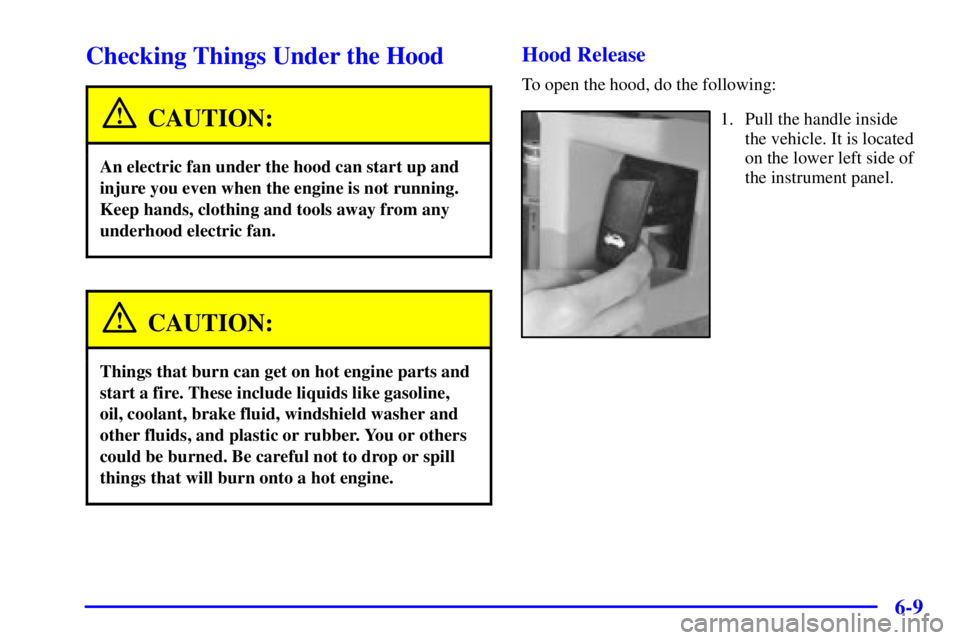
To open the hood, do the following:
1. Pull the handle inside
the vehicle. It is located
on the lower left side of
the instrument panel.
Page 275 of 395
6-11 Engine Compartment Overview
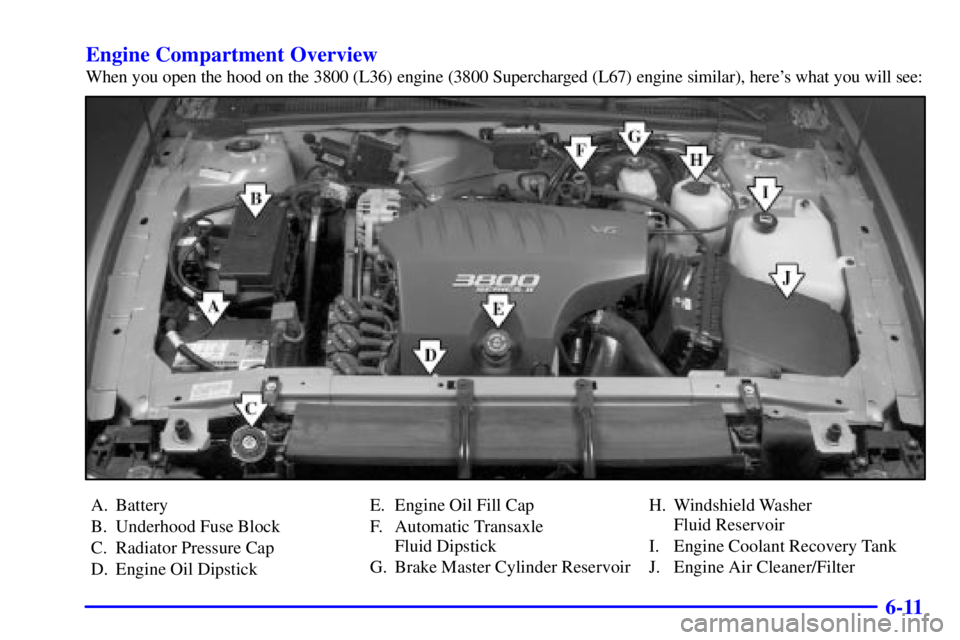
When you open the hood on the 3800 (L36) engine (3800 Supercharged (L67) engine similar), here's what you will see:
A. Battery
B. Underhood Fuse Block
C. Radiator Pressure Cap
D. Engine Oil DipstickE. Engine Oil Fill Cap
F. Automatic Transaxle
Fluid Dipstick
G. Brake Master Cylinder ReservoirH. Windshield Washer
Fluid Reservoir
I. Engine Coolant Recovery Tank
J. Engine Air Cleaner/Filter
Page 286 of 395
6-22 How to Check
Because this operation can be a little difficult, you may
choose to have this done at the dealership service department.
If you do it yourself, be sure to follow all the instructions
here, or you could get a false reading on the dipstick.
NOTICE:
Too much or too little fluid can damage your
transaxle. Too much can mean that some of the
fluid could come out and fall on hot engine parts
or exhaust system parts, starting a fire. Too little
fluid could cause the transaxle to overheat. Be
sure to get an accurate reading if you check your
transaxle fluid.
Wait at least 30 minutes before checking the transaxle
fluid level if you have been driving:
�When outside temperatures are above 90�F (32�C).
�At high speed for quite a while.
�In heavy traffic
-- especially in hot weather.
�While pulling a trailer.To get the right reading, the fluid should be at normal
operating temperature, which is 180�F to 200�F
(82�C to 93�C).
Get the vehicle warmed up by driving about 15 miles
(24 km) when outside temperatures are above 50�F
(10�C). If it's colder than 50�F (10�C), you may
have to drive longer.
Checking the Fluid Level
Prepare your vehicle as follows:
�Park your vehicle on a level place. Keep the
engine running.
�With the parking brake applied, place the shift lever
in PARK (P).
�With your foot on the brake pedal, move the shift
lever through each gear range, pausing for about
three seconds in each range. Then, position the shift
lever in PARK (P).
�Let the engine run at idle for three to five minutes.
Page 287 of 395
6-23
Then, without shutting off the engine, follow these steps:
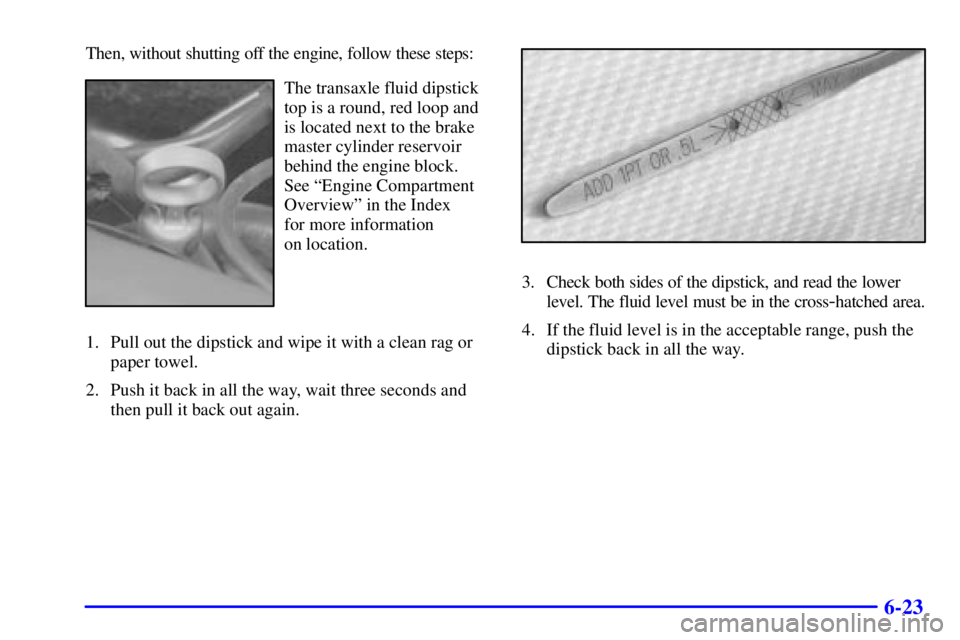
The transaxle fluid dipstick
top is a round, red loop and
is located next to the brake
master cylinder reservoir
behind the engine block.
See ªEngine Compartment
Overviewº in the Index
for more information
on location.
1. Pull out the dipstick and wipe it with a clean rag or
paper towel.
2. Push it back in all the way, wait three seconds and
then pull it back out again.
3. Check both sides of the dipstick, and read the lower
level. The fluid level must be in the cross
-hatched area.
4. If the fluid level is in the acceptable range, push the
dipstick back in all the way.